Astronomy in China: The Pekin Observatory, 1888

observatory6.jpg

Observatoire de Peking (c. 1790).

Work this week has necessitated going through more 19th-century journals. For a while now I’ve had some downloaded copies of Scientific News, a kind of London equivalent of Scientific American, but I hadn’t noticed this particular article until I had to look through it again. The uncredited piece describes the ancient astronomical instruments at the observatory in the heart of Beijing, China (or “Pekin” as they have it here). Armillary spheres always catch my attention, and the Beijing ones are splendid examples supported by ornamental dragons. The text is informative but also mildly condescending as most discussion of China or Japan at this time tended to be. The piece includes some nice engraved illustrations of the instruments (scroll down), all of which can still be seen today surrounded by a city which the Chinese of 1888 would no longer recognise.

*   *   *

ASTRONOMY IN CHINA: THE PEKIN OBSERVATORY

VICE-ADMIRAL MOUCHEZ has just received from Pekin, for the Astronomical Museum which he has founded in connection with the Observatory of Paris, a series of photographs representing the Pekin Observatory and the instruments there erected. By the courtesy of our contemporary La Nature we are enabled to place these curious views before our readers, and thus give them an exact idea of the present state of astronomy in the nation which has cultivated it with the greatest zeal, for the longest time, and among whom it has received the most remarkable developments.

Astronomical functions have not ceased to be held in honour in China, and the Observatory of the Celestial Empire is at present under the direction of an uncle of the Emperor, who ranks as the fifth prince of the blood, and bears the title of Chancellor.

The number of persons attached to this establishment is more considerable than that at Paris. It amounts, including students, to 196. The chief functionaries after the Chancellor are a Chinese director and a Tartar director, having the right to wear a button of a precious stone, and to bear on the chest the image of a sea-raven. Then follow two sub-directors, one Chinese and one Tartar, and two assistants entrusted with calculations. These latter, prior to the expulsion of the Jesuits, were always foreigners. Two other functionaries require to be noted. The first is the keeper of the buildings, and the second the custodian of the water-clocks, as chronometers have not been as yet introduced into the observatory, any more than have telescopes.

Continue reading “Astronomy in China: The Pekin Observatory, 1888”

Shorpy arcades

arcade1.jpg

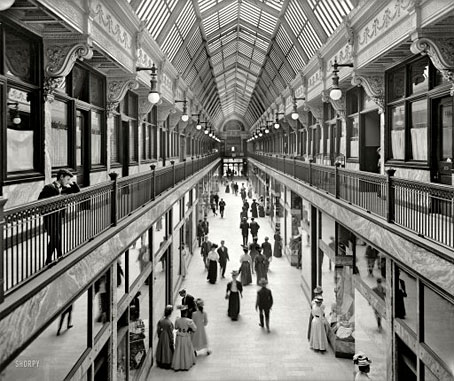
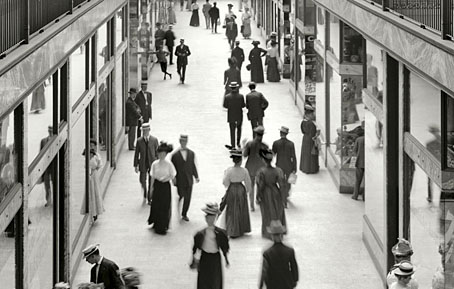
The Arcade, Cincinnati (1905).

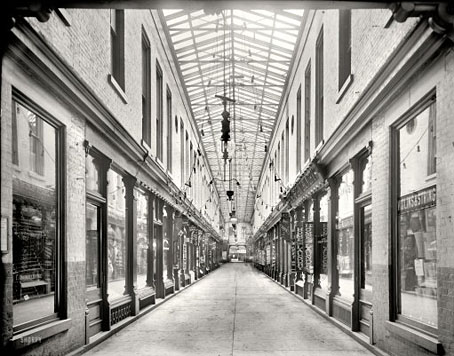
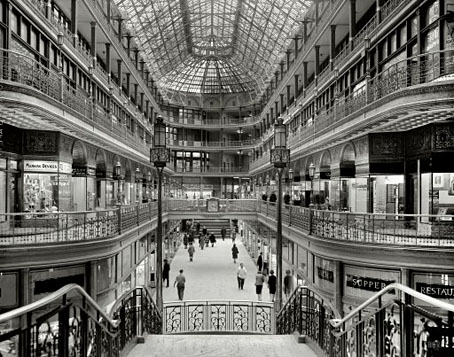
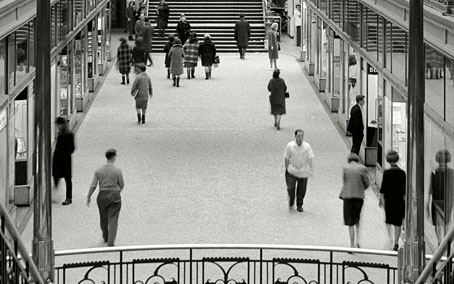
Some arcade views from the Shorpy Historical Photo Archive, home of many wonderful high-res pictures. The Colonial Arcade below has appeared here before since some of Shorpy’s prints can also be found at the Library of Congress. This page has details about Cleveland’s arcades while the photos themselves show the changing fashions. It’s surprising to find the people in the 1966 photo appearing almost as blurred as their ancestors.

arcade2.jpg

Colonial Arcade, Cleveland (1908).

arcade3.jpg

arcade4.jpg

Euclid Avenue Arcade, Cleveland (1966).

arcade5.jpg

Previously on { feuilleton }
Austrian arcades
Cours et passages à Paris
Arcades panoramas
Arcades
Passage des Panoramas
Passages 2
Passages

Balloons in the Grand Palais

balloons1.jpg

Autochrome by Léon Gimpel.

The Grand Palais exhibition hall in Paris is one of the few sites remaining from the Exposition Universelle of 1900 (see yesterday’s post), and is still in use today as a venue for art exhibits, fashion shows and the like. The huge and graceful canopy ceiling makes it a far better venue for art events than the Turbine Hall in Tate Modern, London, which suffers from being narrow, lightless and bisected by a concrete walkway.

palaisposter.jpg

Nine years after the Exposition the first Paris Air Show was held at the Grand Palais giving us these photos of the place filled with a variety of balloons and a blimp. I’m wondering now whether you could fit an entire Zeppelin inside the nave (probably not), although even if it fit there’d be no way to get it inside without demolishing a wall.

The current Grand Palais site has a section devoted to the history of the building which includes this surprising photo from 1937 showing the Beaux Arts structure covered in a Deco-style disguise.

balloons2.jpg

balloons3.jpg

balloons4.jpg

balloons5.jpg

Previously on { feuilleton }
Paris III: Le Grande Répertoire–Machines de Spectacle

Exposition Universelle photochroms

exposition05.jpg

Grand entrance.

Every time I think I’ve said enough on this subject something else turns up. I’ve linked before to the Brooklyn Museum’s tinted photographs of the Paris Exposition Universelle of 1900 but these photochom prints at the Library of Congress are so sharp, detailed and subtly hued they make all other views seem crude in comparison. If you’ve seen earlier views of the exposition buildings then everything here is very familiar, albeit more lifelike than anything you’ll find elsewhere. In addition to the greater veracity, the Library of Congress also makes many of its pictures available as high-quality files. These prints and the few minutes of film footage is the closest you’ll get to this event without a time machine.

exposition01.jpg

Champs de Mars.

exposition02.jpg

Le Chateau d’eau and plaza.

exposition03.jpg

The Palais Lumineux.

Continue reading “Exposition Universelle photochroms”

Borobudur panoramas

borobudur1.jpg

Photo by Ursula & David Molenda.

Panoramas of Borobudur, the Buddhist monument in Magelang, Central Java, which lay undisturbed and overgrown for centuries until restoration began following the British occupation of the island in the 19th century. The bell-like structures are stupas, many of which contain statues of the Buddha in different symbolic postures. The entire monument is a complex three-dimensional map of the Buddhist cosmology: pilgrims ascend from the lowest level reading the bas-reliefs and visiting each Buddha in turn. Wikipedia has a detailed account of both the history of the monument and its meaning as a piece of religious architecture.

borobudur2.jpg

Photo by Ursula & David Molenda.

borobudur3.jpg

Photo by Lanang Lintang.

borobudur4.jpg

Photo by Lanang Lintang.

Elsewhere on { feuilleton }
The panoramas archive