Weekend links 57

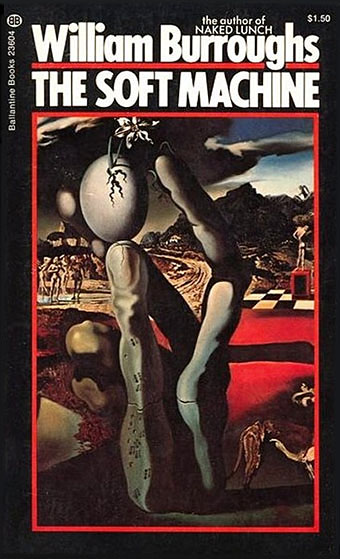
softmachine.jpg

A 1973 Ballantine edition of William Burroughs’ novel with a cover illustration from Metamorphosis of Narcissus (1937) by Salvador Dalí. Via the Burroughs Book Covers archive.

The Sel Publishing House, Turkey, published a new translation of The Soft Machine by William Burroughs in January, an edition which is now under investigation by the Istanbul Prosecutor’s Office following a report by the (deep breath) Prime Ministry’s Council for Protecting Minors from Explicit Publications. The Council lodged a number of complaints, among them assertions of “lacking unity in its subject matter,” “incompliance with narrative unity,” “using slang and colloquial terms” and “the application of a fragmented narrative style.” Details here. Does Turkey still want to join the EU? Because this kind of persistently illiberal bullshit (see the earlier treatment of Orhan Pamuk) isn’t helping their case at all.

• Related to the above: Evan J Peterson reads Allen Ginsberg’s Howl in the toilet of a Seattle gay bar; Ginsberg himself reads Kaddish and other works here.

• More illiberal bullshit: LGBT activists arrested during royal wedding; Queer Resistance released a statement about the arrests. MPs, activists and trade unionists condemn new attacks on the right to protest.

The Dorian Gray That Wilde Would Want Us To Read. Harvard University Press publishes an uncensored and annotated edition of Wilde’s novel. Kudos for using Caravaggio’s Narcissus on the cover.

One weekend in late 1967, they all decamped to a hotel suite in California’s Ojai Valley for a brainstorming session. Amid clouds of pot smoke, they talked all weekend with the tape recorder running. [Jack] Nicholson then took the tapes and turned the conversations into a screenplay; according to Rafelson, he structured it while on LSD.

Revisiting The Monkees’ psychedelic movie, Head.

kraftwerkicons.jpg

Kraftwerk icons for Windows and Mac OS X by Dave Brasgalla.

Robert Louis Stevenson gets his revenge on sneaky literary agent – 120 years later. And Michael Moorcock imagines tales of unseen Mervyn Peake pictures.

Painting doesn’t look so good on the web. It looks better in life. Sculpture looks better in life. What you end up with is just a reproduction. Whereas with film or with sound or with poetry, you get the deep primary experience not the secondary experience. The web delivers those primary experiences very well.

Ubuweb’s Kenneth Goldsmith interviewed.

• Arkhonia’s Another Dispatch in a World of Multiple Veils is now a free download.

• The story of This Is The Sea: An interview with Mike Scott of The Waterboys.

Fairlight: The Rolls Royce of synthesizers.

Haeckel Clock, a free app for the iPad.

What is totalitarian art?

Porpoise Song (1968) by The Monkees | Hope For Happiness (1969) by The Soft Machine | I’m A Believer (1974) by Robert Wyatt.
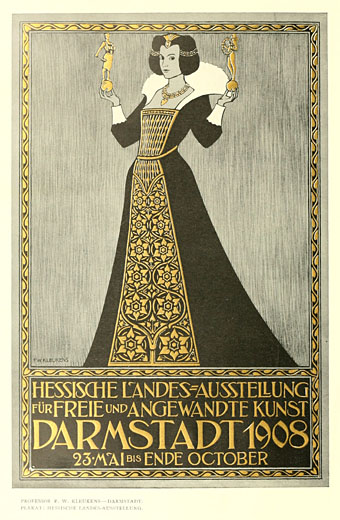
Deutsche Kunst und Dekoration #21

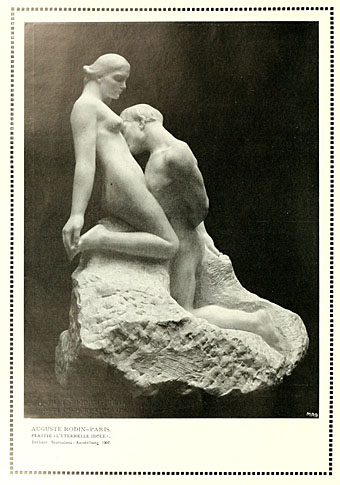
dkd21-01.jpg

The Eternal Idol by Auguste Rodin.

Continuing the delve into back numbers of Deutsche Kunst und Dekoration, the German periodical of art and decoration. Volume 21 covers the period from October 1907 to March 1908, and the highlight of this issue is a feature on the black-and-white art of Julius Klinger, an artist whose drawings appeared regularly in Jugend.

If you’ve been following this series it’s worth noting that volume 3 which is missing from the collection at the Internet Archive can be found at the University of Heidelberg. I would have featured it here but it turns out to be surprisingly dull compared to the other early editions. As before, anyone wishing to see these samples in greater detail is advised to download the entire number at the Internet Archive. There’ll be more DK&D next week.

dkd21-02.jpg

dkd21-03.jpg

Continue reading “Deutsche Kunst und Dekoration #21”

No future in England’s dreaming

charles1.jpg

A German print showing the 1649 execution of Charles I outside the Banqueting House, Whitehall, London.

…the so-called “English Civil War” of 1649–60 was more truthfully “The English Revolution”, as the Marxist author Christopher Hill has long maintained, being the direct precursor to both the French and Russian Revolutions. That the English killed their king well over one hundred years before the French Revolutionaries did the same is a fact often overlooked because our Commonwealth failed after only twelve years and the English monarchy returned in 1660. The regicide of Charles I having taken place so much earlier than other European regicides, however, scared future English parliaments into passing just enough reforms to appease subsequent generations, thus averting any real justification for total revolution.

Dorian Cope

Just think about the Queen for a moment. That is what is holding the whole of England back…the subservience on the part of a great majority of the English people to this bitch…I say there’s no hope for them until we have five thousand people out in Trafalgar Square screaming “Bugger the Queen”.

William Burroughs

The institution of royalty in any form is an insult to the human race.

Mark Twain

And if you need an explanation of the title of this post, go thou here.

Ver Sacrum, 1898

vs-1898-01.jpg

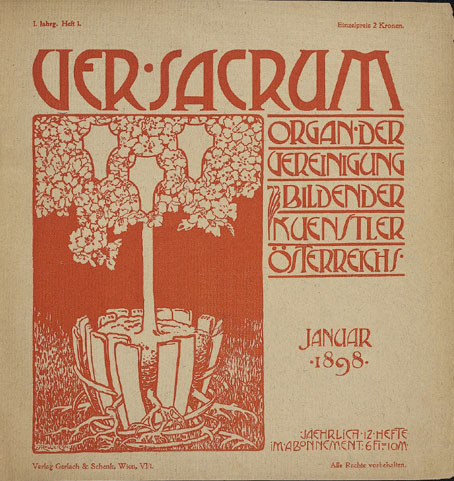
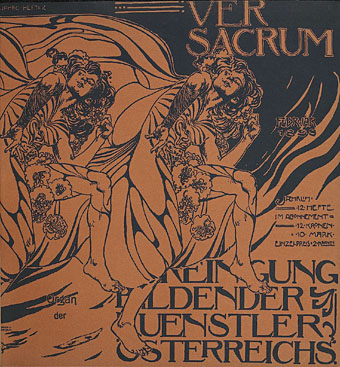
There are art magazines, and then there’s Ver Sacrum. I’m tempted to say there are magazines, and then there’s Ver Sacrum but that’s going a little far. Suffice to say that among the many fine art magazines of the period 1890 to 1910, a number of which have been featured here already, Ver Sacrum stands apart for its design and the consistent quality of its contents. Having seen back numbers of Jugend and Pan made available at the University of Heidelberg I’d been hoping the archivists there would eventually turn their attention to the art journal of the Viennese Secession, and they finally have, with the first bound number digitised here.

vs-1898-01.jpg

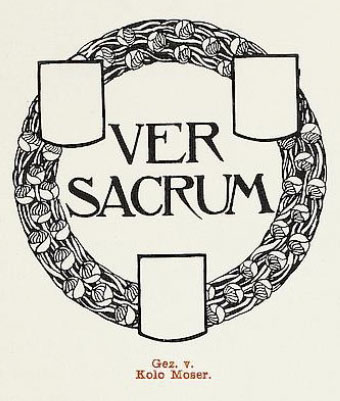
The volume for 1898 collects the first year of the journal cum manifesto of the Union of Austrian Artists, as the Secession group called themselves. That union is represented by the triple shield symbol which recurs in different forms across all the media produced by the group, the shields representing painting, sculpture and architecture. (On the cover of the first issue, the shields are shown growing from a tree whose roots have burst the confines of their container.) Ver Sacrum was a team effort with design contributions by Koloman Moser, Alfred Roller, Josef Hoffmann and Gustav Klimt, and what really sets it apart for me is its striking square format and the wide margins which provided a very flexible template for presenting a variety of graphic content. Other magazines of the period such as Pan shared some of the content but their presentation didn’t greatly differ from the more staid magazines of the era. Ver Sacrum was a break with the style of 19th century journals, and its graphic design points the way to much of the magazine and book design which would follow. It’s also a superb showcase for the Austrian development of the Art Nouveau style, and the overlap between Art Nouveau and the final flourishes of the Symbolist movement.

vs-1898-01.jpg

There’s far too much in this first volume to easily select, all I can do is advise that anyone interested has a browse through the entire book. As with Deutsche Kunst und Dekoration some of the art is the typically conservative fare of the period but the presentation makes up for that, and there’s enough of interest elsewhere to prevent things from getting dull. Here’s hoping the other volumes are made available very soon.

Update: Paul in the comments draws my attention to additional scans of Ver Sacrum at the Österreichische Nationalbibliothek. Heidelberg does a better job of making the issues browsable but it’s still great to have more than one source for this material.

Continue reading “Ver Sacrum, 1898”

Ira Cohen, 1935–2011

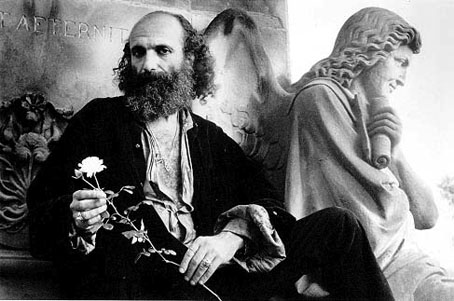
cohen.jpg

Ira Cohen (1979) by Gerard Malanga.

Another of the psychedelic magi departed our mundane sphere this week, and for the moment his passing seems to have been unacknowledged by those cultural wardens who you’d think would know better. Ira Cohen was a poet with a gift for phrases which demand to be appended to Mati Klarwein paintings (one such phrase, The Surgeon Of The Nightsky Restores Dead Things By The Power Of Sound, was used by Jon Hassell for an album title); he was also a photographer whose use of a chamber covered in sheets of reflective Mylar turned photo-portraiture into a psychotropic art:

I never wanted to be a photographer like the commercial photographers. For me, it was more about the involvement of the mirror, and scrying, reflection, crystal-ball-gazing, trying to get to some other place. It was all about reflection, in the deepest sense of the word. (More.)

Cohen’s 1968 film, The Invasion of Thunderbolt Pagoda, used his Mylar Chamber as a locus to create one of the key works of psychedelic cinema. More of that work can be seen here while his 1994 album of readings and music, The Majoon Traveler, is available via iTunes.

The Invasion of Thunderbolt Pagoda, six postcards from Aspen no. 9 (1971).

Previously on { feuilleton }
Dreamweapon: The Art and Life of Angus MacLise, 1938–1979
William Burroughs by Ira Cohen, 1967
The Invasion of Thunderbolt Pagoda