Ry Cooder & The Moula Banda Rhythm Aces: Let’s Have A Ball

rycooder.jpg

Someone told me once they didn’t like Ry Cooder, a sentiment I’d place in the same category as saying you don’t like, say, chocolate: as an attitude it’s within the bounds of possibility but it requires a considerable effort of sympathetic imagination to appreciate. Let’s Have A Ball is a 90-minute Ry Cooder concert film by the great documentary filmmaker Les Blank, better known for Burden of Dreams (1982), his chronicle of the trials of Werner Herzog and company during the making of Fitzcarraldo. Burden of Dreams is that rare thing among “making of” films, a documentary that’s as fascinating as the film whose production it depicts.

Let’s Have A Ball catches Ry Cooder and his band playing at the Catalyst in Santa Cruz, California, on March 25th, 1987 during their Get Rhythm tour. I’d seen this when it was broadcast on Channel 4 in 1988 but don’t have it on tape so thanks go to the Metafilter people for drawing attention to the entire concert at YouTube. The film was screened in Europe and elsewhere but not in the US, and for now remains unavailable in any official capacity for unspecified reasons; Les Blank’s site says Cooder doesn’t want it released. This is surprising since it’s a fantastic concert film, the sound quality and performances are easily as good as anything on his live albums. In addition to great renditions of Cooder’s back catalogue you get to see several of his regular collaborators in action, not least Van Dyke Parks playing some typically idiosyncratic piano. The high spot is a 16-minute version of Down In Hollywood where everyone, singers included, gets to show off their solo prowess.

The band:
Ry Cooder: guitar, vocals
Jim Keltner: drums
Van Dyke Parks: keyboards
Jorge Calderon: bass
Flaco Jiménez: accordion
Miguel Cruiz: percussion
Steve Douglas: sax
George Bohannon: trombone
Singers: Bobby King, tenor; Terry Evans, baritone; Arnold McCuller, tenor; Willie Green Jr, bass

The songs:
Let’s Have A Ball
Jesus On The Mainline
How Can A Poor Man Stand Such Times And Live?
Jesus Hits Like The Atom Bomb
Down In Mississippi
Maria Elena
Just A Little Bit
The Very Thing That Makes You Rich (Makes Me Poor)
Crazy About An Automobile
Chain Gang
Down In Hollywood
Good Night Irene

Previously on { feuilleton }
My Name Is Buddy by Ry Cooder

Gekko Hayashi revisited

hayashi02.jpg

It remains a fact that the most popular posts here are the sex-related ones. The post about Clayton Cubitt’s Hysterical Literature project continues to rack up views despite having been written about at greater length on far more popular sites; this weekend Facebook users were flocking to see the phallic plaster casts (why now?).

One of the perennial favourites from the gay artists archive is the post I made two years ago about the homoerotic art of Gekko Hayashi, the pseudonymous alter ego of Goji Ishihara (1923–1997). This has managed to become an almost universal point of reference despite all my knowledge about the artist being gleaned from other websites. The popularity would appear to be due to a generally high level of visibility in Google rankings combined with a tendency to write about recherché subjects which don’t receive high-profile attention elsewhere. Talking to Anne Billson yesterday about Ishihara’s monster art had me searching around for more of the Hayashi material. There’s still little to be seen outside some Japanese reprints. Given the language barrier when searching the Japanese book world it’s difficult to say whether any of these are still in print.

hayashi05.jpg

After turning up a few more examples of Hayashi’s work I’m increasingly struck by the strangeness of some of his art as well as the rare disjunction of seeing a commercial illustration style serving semi-pornographic ends. The latter effect is like seeing the libido of an artist such as Look and Learn painter Ron Embleton suddenly laid bare. A similar disjunction can be found in Oliver Frey’s work where a polished illustration and comic strip technique is applied to raw sexual scenarios. (I should note that Ron Embleton’s libido was on display in his comic strips for Penthouse magazine while—going in the opposite direction—Oliver Frey worked for a while at Look and Learn.)

hayashi07.jpg

You can find a polished style elsewhere but few artists get quite as weird with their erotic fantasies as the picture below showing a pair of penis-headed males embracing, and the one of a boy in what may be a bath full of blood being menaced (?) by an ambulatory midget phallus. Weirdness is familiar in the fetish world—everyone’s fetish is inherently weird to those who don’t share it—but always within strict limits, and besides, these aren’t fetishes. What’s odd about the pictures (especially the first) is the way they overburden the eros with a peculiarity you’d think would defeat the purpose of the painting. Hayashi/Ishihara worked as a comic artist as well as an illustrator so perhaps they’re part of a larger narrative; they may also be illustrating a text piece like some of the other pictures. For the moment they appear caught between the gay work and the monster illustration from the 1970s. This isn’t a complaint, it makes the art all the more intriguing and worth searching for.

hayashi09.jpg

Continue reading “Gekko Hayashi revisited”

Weekend links 138

durette.jpg

Heartsick (2011) by Kelly Durette.

• Now that Scott Walker’s Bish Bosch album is out and causing the usual consternation, the spotlight-shy singer/composer has been doing a surprising amount of promotional interviews. Simon Hattenstone talked to him for the Guardian at the end of last month; this week it was John Doran’s turn at The Quietus. One quote from the latter piece stood out in the light of this week’s posts: “…the music we’re making is meant to be an aural version of the HR Giger drawings for Alien. It always sounds to me like those look.”

Satanica is a limited-edition publication curated by Gio Black Peter & Christopher Stoddard “for anyone who rejects societal norms, for those dedicated to a life of pleasure, excess and self-reflection”.

• Sci-Fi-O-Rama has put five years’ worth of blog pictures onto Pinterest. I don’t really need to do that, there’s already a diverse crowd of Pinterest users compiling their own selection of things posted here.

As Susan Sontag once observed, pornography is practical. It was designed as a marital aid, and its vocabulary should follow natural biological rhythms and stick with hot-button words in order to produce a predictable climax. It is not about sex but is sex. Whereas the great sex writers (Harold Brodkey, DH Lawrence, Robert Gluck, David Plante, the Australian Frank Moorhouse) have a quirky, phenomenological, realistic approach to sex. They are doing what the Russian formalists said was the secret of all good fiction – making the familiar strange, writing from the Martian’s point of view.

Edmund White on writing about sex in fiction

• When pirate DVDs of films by Cocteau, Bresson and Pasolini are on sale in a Mexican market, life in the 21st century increasingly resembles a William Gibson novel. Joanne McNeil investigates.

• Copies of City Fun, Manchester’s premier music fanzine/alt culture mag (founded 1978), can now be read online at the Manchester District Music Archive.

• Linked everywhere during the past few days, the astonishing map of bomb hits on London during the Blitz (October 1940 to June 1941).

• At 50 Watts: 30 Vintage Magazine Covers from Japan and Alfred Kubin’s illustrations for Lesabéndio: An Asteroid Novel (1913) by Paul Scheerbart.

• Earlier this year for Frieze Magazine Geeta Dayal talked to musical collaborators of the great German producer Conny Plank.

Invisible Ink by Christopher Fowler, “the extraordinary stories of over one hundred forgotten authors”.

Cynthia Carr talks about Fire in the Belly, her biography of American artist David Wojnarowicz.

• “Blasphemy, Filth, And Nonsense” More Aleister Crowley ephemera at Front Free Endpaper.

• At Strange Flowers: Surrealist art by Jindrich Heisler (1914–1953).

Vladimir Nabokov wrote to Alfred Hitchcock in 1964.

• Scott Walker’s four tracks from the Nite Flights album (1978): Shutout | Fat Mama Kick | Nite Flights | The Electrician.

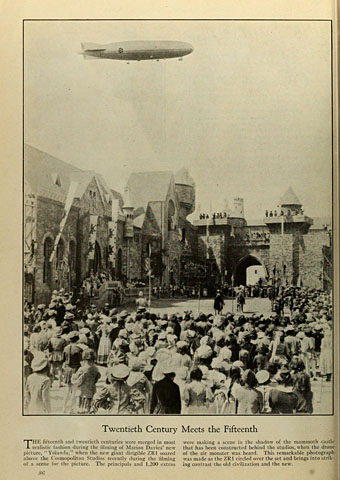
Twentieth Century Meets the Fifteenth

dirigible.jpg

Something spotted whilst browsing issues of Photoplay magazine at the Internet Archive, a photo showing the US dirigible ZR1 drifting over the Cosmopolitan Studios in 1923 during the filming of Yolanda. I don’t doubt that the ZR1 really did fly over Hollywood although it looks here to be at an odd perspective (it’s also being completely ignored by the crowd of extras). This makes me think the magazine may have comped two separate photos for convenience, as famously occurred with the cover photo of Pink Floyd’s Animals album.

kibardin.jpg

Searching around for details about the ZR1 turned up this 1931 poster by Georgii Kibardin exhorting Soviet citizens to build a fleet of airships in Lenin’s name. The Hindenberg disaster six years later put an end to this kind of enthusiasm.

Previously on { feuilleton }
Zeppelinology
Vickers Airship Catalogue
The Air Ship
Dirigibles
The Airship Destroyer
Zeppelin vs. Pterodactyls

Giger’s Tarot

giger13.jpg

This week’s posts reminded me that I have a copy of the HR Giger Tarot set published by Taschen under their Evergreen imprint in 2000. The set is Taschen’s reworking of Giger & Akron’s Baphomet Tarot der Unterwelt set from 1994, and I recall this being one of the last things Taschen created with Giger after spending the previous decade producing a run of books, diaries and posters featuring his paintings. Inside a box you find a set of 22 oversize Tarot trumps presenting some of Giger’s works against metallic silver surrounds. There’s also a poster-size sheet for card readings printed with his pentagram design plus a 224-page paperback book by Swiss Tarot scholar Akron, aka CF Frey, which interprets the paintings as they relate to the Major Arcana. (The Baphomet set had a hardback book and the pentagram design printed on the back of each card.)

giger12.jpg

The design on the back of the cards, printed in black on metallic silver.

If you’re familiar with Tarot symbolism you don’t have to use these cards to find the correspondences intriguing. The trump ordering is an odd mix of the Crowley scheme with the more traditional designations. Two of the trumps have also been given new names: The Hanged Man is now The Hanged Woman while Crowley’s Art (formerly Temperance) has become Alchemy, an association which works since the card in the Crowley deck depicts the Androgyne of alchemical symbolism. I can imagine some Tarot collectors finding these cards far too dark and nasty, but when so many Tarot designs today are various degrees of garish or twee there’s plenty of room for a Giger or two to harsh the New Age mellow.

The card set has been out of print for years but Abebooks still carries copies at reasonable prices. A few examples of the cards follow.

giger14.jpg

Continue reading “Giger’s Tarot”