Kusama’s Self-Obliteration, a film by Jud Yalkut

kusama1.jpg

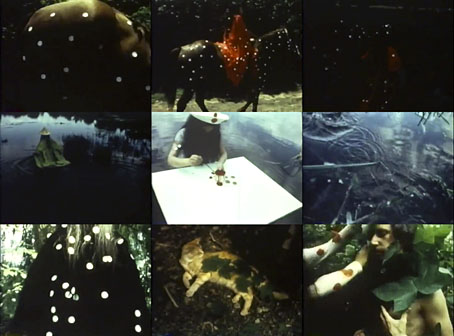
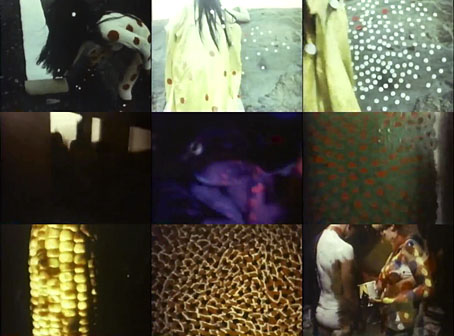
Yayoi Kusama’s art has often been classed as psychedelic—some of her mirrored rooms were featured in the travelling Summer of Love exhibition in 2005—but this is more a consequence of her activities meshing with the interests of the late 60s than anything else; her preoccupations always seem a lot more personal and obsessive. Jud Yalkut’s short film shows Kusama and various friends cavorting in typical underground-movie fashion in 1967, the main indicator of the artist’s involvement being her sticking polka dots (and leaves) onto everything: trees, people, cats, horses, even a river. Later on there’s more polka-dotting at some kind of body-paint happening inside one of her mirrored rooms. The film itself is pretty psychedelic in the second half, looking like outtakes from Roger Corman’s The Trip. The of-the-moment score was provided by The CIA Change, whoever they were. Watch it here.
kusama2.jpg

Previously on { feuilleton }
Infinite reflections
Yayoi Kusama
The art of Yayoi Kusama

Light Leaks

lightleaks1.jpg

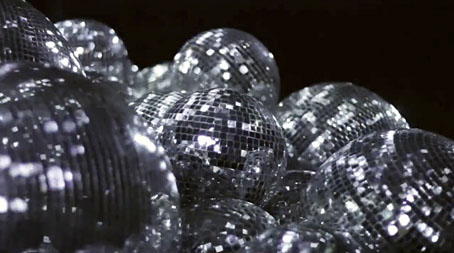
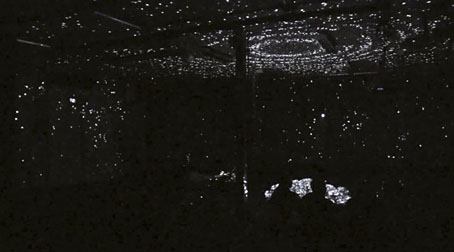
A scattered array of fifty mirror balls reflect light from three projectors, filling a room completely with small reflections, casting patterns that fill the visitor’s peripheral vision. Creating a curious space that alternates between a meditative state, and an uneasy imbalance. An experiment in combining a found object with computer vision to create a profound and unusual experience.

I’ve always liked mirror balls so Kyle McDonald’s combination of the traditional mirror-ball effect (multiplied fifty times) with three-dimensional computer mapping has an obvious appeal. The pictures here link to a small promo video. I’d love to see this in situ; I also wonder what it might look like in a mirrored room like those created by Yayoi Kusama. There’s more at Wired where McDonald discusses the technical aspects.

lightleaks2.jpg

Previously on { feuilleton }
Infinite reflections

Alice in Liverpool

caterpillar.jpg

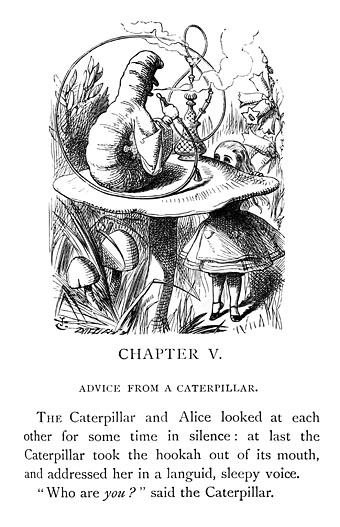
Alice and the Caterpillar (1865) by John Tenniel.

It’s perhaps surprising that an art gallery, rather than a library, is holding a huge survey exhibition about Alice, but then Carroll’s creation has been and still is the inspiration of artists, photographers, theatrical designers, animators, film-makers.

Thus Marina Warner writing about an exhibition of art based on Lewis Carroll’s Alice books opening at Tate Liverpool this Friday:

Alice in Wonderland will offer visitors a rare opportunity to view Carroll’s own drawings and photographs, alongside Victorian Alice memorabilia and John Tenniel’s preliminary drawings for the first edition of the novel.

Carroll’s stories were soon adopted by other artists. Surrealist artists from the 1930s onwards were drawn towards the fantastical world of Wonderland where natural laws were suspended. From the 1960s through the 1970s, Carroll’s Alice tales also prompted conceptual artists to explore language and its relationship to perception, and the stories inspired further responses in Pop and Psychedelic art. Expect to see works by artists ranging from Salvador Dalí and René Magritte, to Peter Blake and Yayoi Kusama. (more)

The exhibition runs to January 29th, 2012, and I suppose this gives me a convenient opportunity to point again to my psychedelic Alice calendars which have been updated for the forthcoming year.

Previously on { feuilleton }
Coulthart calendars for 2012
Scenes from a carriage
Through the Psychedelic Looking-Glass: the 2011 calendar
Jabberwocky
Alice in Acidland
Return to Wonderland
Dalí in Wonderland
Virtual Alice
Psychedelic Wonderland: the 2010 calendar
Charles Robinson’s Alice’s Adventures in Wonderland
Humpty Dumpty variations
Alice in Wonderland by Jonathan Miller
The Illustrators of Alice

Eno’s Luminous Opera House panorama

eno_sydney

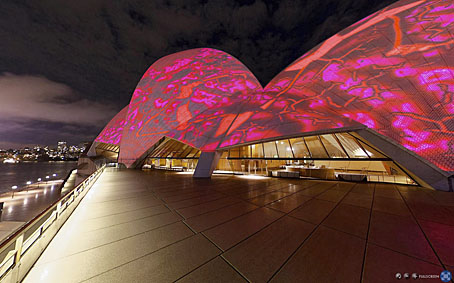
I’m a bit late with this one but better late than never. Brian Eno’s illuminated transformation of the Sydney Opera House, part of the city’s Luminous Festival, was widely publicised last month but I never got round to checking it out properly. This week Thom drew my attention (thanks Thom!) to this panorama by photographer Peter Murphy whose marvellous view inside one of Yayoi Kusama’s mirror rooms I linked to in March. Looking on Murphy’s site I see he has another Kusama panorama showing a view inside Phalli’s Field (or Floor Show). And while we’re on the subject of Ms Kusama, she currently has a room at London’s Hayward Gallery as part of their Walking in My Mind series by different artists. You can see a reaction to that here.

Elsewhere on { feuilleton }
The panoramas archive

Infinite reflections

fireflies.jpg

Fireflies on the Water by Yayoi Kusama (2002).

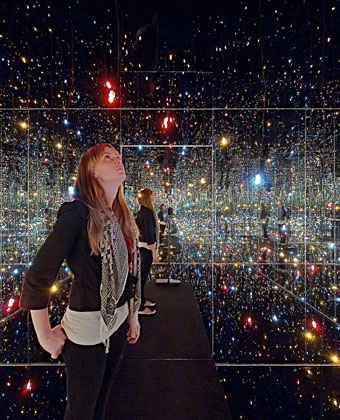
One of my favourite contemporary artworks, Fireflies on the Water by Yayoi Kusama, receives a new showing at Sydney’s Museum of Contemporary Art. Her mirrored room features 150 lights and a pool of water and while most photos show an impressive work, none of them can match this fantastic 360º panorama by Australian photographer Peter Murphy. Kusama isn’t the only artist to use mirrors this way but mirror rooms and reflective surfaces have become as much a recurrent feature of her work as her trademark spots.

Fireflies on the Water is being shown as part of the Yayoi Kusama: Mirrored Years exhibition and can be seen until June 8th, 2009. (Via Nevertheless.)

samaras.jpg

Mirrored Room by Lucas Samaras (1966).

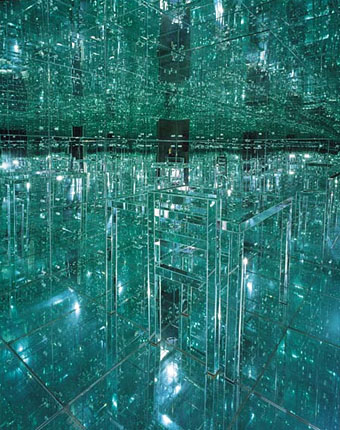
I’ve often wondered how far back the invention of the fully-mirrored room can be traced. Halls of mirrors are historically common but the mirrors tend to be on the walls only. American artist Lucas Samaras produced his Mirrored Room (with mirrored chair and table) in 1966, something which fascinated me when I first encountered it in art books.

frippandeno.jpg

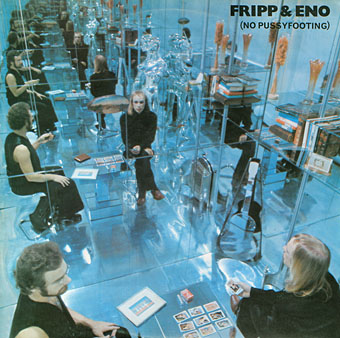
It evidently fascinated ex-art student Brian Eno who I’m sure must have borrowed the idea for the cover of his collaboration with Robert Fripp, (No Pussyfooting), in 1973. I’ve always assumed this was a room in Eno’s home at the time but never seen that confirmed. Anyone know whether this is the case?

Elsewhere on { feuilleton }
The panoramas archive

Previously on { feuilleton }
The art of Josiah McElheny
Yayoi Kusama
The art of Yayoi Kusama
Exposure by Robert Fripp