Weekend links 616

finlay.jpg

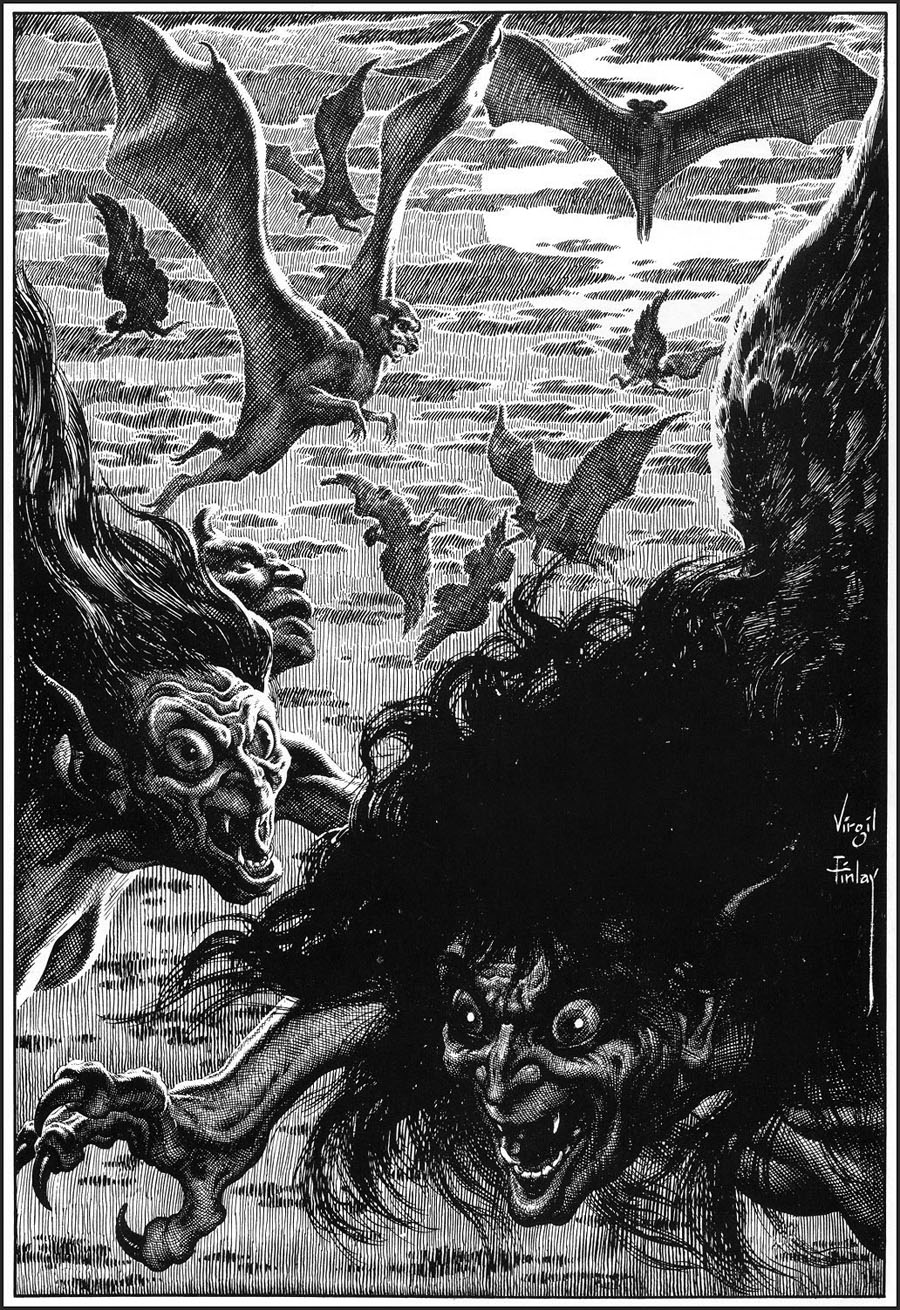
Illustration by Virgil Finlay for The Face in the Abyss by A. Merritt; Famous Fantastic Mysteries, October 1940.

• “The pier was completely outside of the gallery system, which David loved of course. People were just working on the walls, nothing was for sale, nothing could really be bought, although people were coming in and trying to chip things off the walls.” Cynthia Carr on the love letters and legacy of David Wojnarowicz.

• “In pursuit of Pure Form, the Polish artist known as “Witkacy” would consume peyote, cocaine, and other intoxicants before creating pastel portraits.” Juliette Bretan on the artful intoxications of Stanisław Ignacy Witkiewicz.

• Kino Kyiv: Christopher Silvester compiles a list of notable Ukrainian films. I’ve not seen all of these but Shadows of Our Forgotten Ancestors is a great favourite.

Onscreen for nearly the entire runtime, [Laura Dern] pulls off the remarkable feat of being in total control of a scenario organized by undermining her identity, obliterating her characterization, and so scrambling the distinction between Nikki and Susan that one eventually comes to view Inland Empire not as a maze to exit, a puzzle to solve, an ouroboros to gawk at, but rather as both a generalized treatise on the enigma of acting and a very specific, exquisitely perverse mash note to one of Lynch’s most formidable collaborators.

Nathan Lee on Laura Dern, David Lynch and Inland Empire. I’ve always thought Dern’s exceptional performance might have been recognised more widely if Lynch hadn’t filmed most of it on low-grade video.

• New music: Golden Air by Sun’s Signature, a new project from Elizabeth Fraser and Damon Reece.

• Miranda Remington explores The Strange World of…Stomu Yamash’ta.

• Steven Heller’s font of the month is Boucan.

• At Dennis Cooper’s: Labyrinthine.

Labyrinth (2010) by Chrome Hoof | Labyrinths (2018) by Jonathan Fitoussi / Clemens Hourrière | The Seventh Labyrinth (2019) by Pye Corner Audio
Ray Harryhausen’s swords and sorceries

golden1.jpg

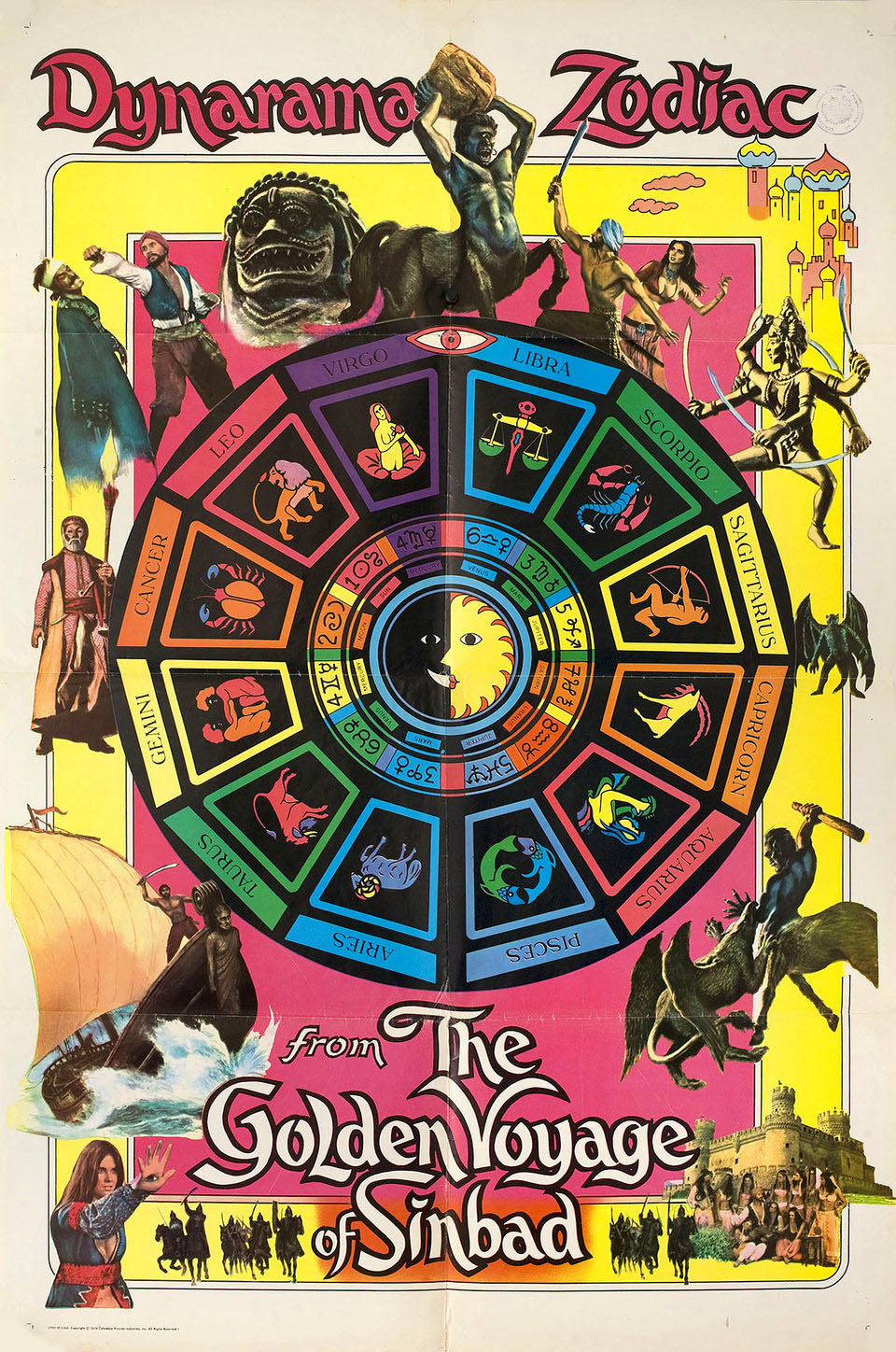
It was the 1970s: promoting Sinbad with a Zodiac poster for the blacklight brigade.

Last month I took advantage of the recent Indicator sale to buy blu-rays of a couple of favourite Ray Harryhausen films, together with Indicator’s reissued box of the three Harryhausen Sinbad features: The 7th Voyage of Sinbad (1958), The Golden Voyage of Sinbad (1973), and Sinbad and the Eye of the Tiger (1977). I’m very familiar with these films but hadn’t seen them for many years. Watching them again made me realise for the first time what perfect examples they are of sword-and-sorcery cinema even though you never see them classed as such. I’ve been reading sword-and-sorcery fiction for almost as long as I’ve been watching Ray Harryhausen films but this rather obvious insight hadn’t occurred to me before, no doubt because I’d always regarded the Sinbad cycle as Arabian Nights fantasies in the manner of The Thief of Bagdad. The 1940 version of the latter happened to be a Harryhausen favourite which prompted his decision to film an Arabian adventure following his monster-on-the-rampage pictures of the 1950s. He subsequently asked The Thief of Bagdad‘s composer, Miklós Rózsa, to score The Golden Voyage when Bernard Herrmann was unable to do so.

seventh.jpg

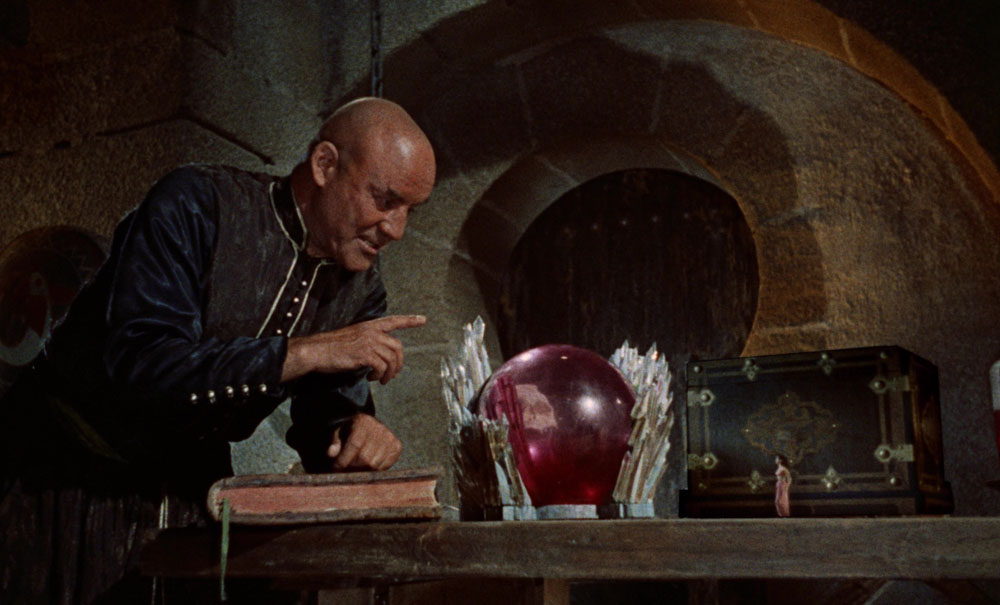
Sokurah (Torin Thatcher) with a shrunken Princess Parisa (Kathryn Grant).

The 7th Voyage is at least based on the original Sinbad tales but the second and third films have little to do with The Arabian Nights beyond Sinbad’s persona and a handful of cultural references. If you swapped the Arabian names for invented ones then you’d be even closer to the stories of Clark Ashton Smith and his colleagues at Weird Tales than the films already are. Smith’s sorcery-infused fiction is the key here even though his stories are light on sword-play. The sight of a shaven-headed Torin Thatcher as Sokurah, the duplicitous magician in The 7th Voyage, was so strongly reminiscent of one of Smith’s many sorcerers—he even looks a little like Virgil Finlay’s depiction of Dwerulas from The Garden of Adompha—that I couldn’t help but watch the films this time as though they were adaptations of Smith’s fantasies. In The 7th Voyage the similarity is most evident in the scene where Sokurah demonstrates his powers to the caliph by temporarily turning a handmaiden into a serpent-woman, and the later scenes in Sokurah’s underground fortress. Smith and his cohorts in the pulp magazines were of course refashioning elements from The Arabian Nights and from other legends so none of this should be surprising. The 7th Voyage may take some of its scenes from The Arabian Nights but the story establishes the template which the sequels follow, with Sinbad pitted against a magic-wielding adversary.

Continue reading “Ray Harryhausen’s swords and sorceries”

Byam Shaw’s illustrated Poe

shaw01.jpg

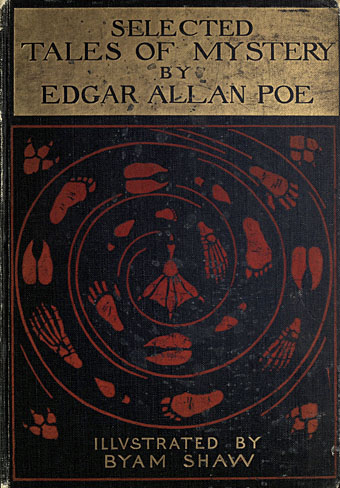
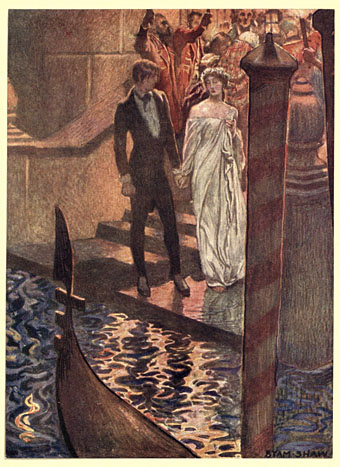
There’s always more Poe. Selected Tales of Mystery was published in 1909, and is one of several illustrated editions produced by British artist Byam Shaw (1872–1919), a painter like Frederick Simpson Coburn who was better suited to the one-off canvas than the illustrated text. There ought to be a term for this kind of illustration—”The Easel School”, perhaps—in which all the techniques and staging of the academic artist are applied to stories or novels, techniques which too often lead to a succession of well-painted figures gesticulating to each other in well-painted rooms. The canvas painter in the first years of the 20th century was also subject to the limitations of print technology which at the time could only reproduce a narrow range of colours.

shaw02.jpg

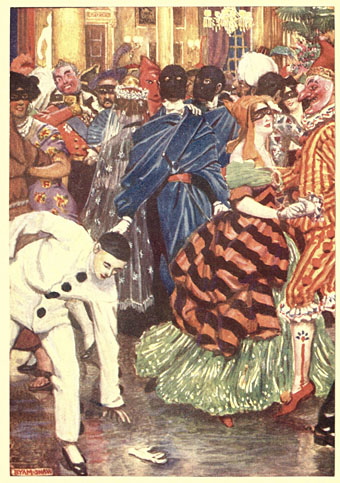
William Wilson

The question of how best to illustrate a story using realism rather than stylistisation has been a recurrent one recently with regard to a commission of my own. I’ll be discussing this later but something that occurred to me while considering the issue was that illustrators today have access to a visual vocabulary derived from cinema that didn’t really exist until the 1920s. An artist like Byam Shaw would never think to depict a scene from a very high or very low angle, even though high- and low-angle views of dramatic scenes had been familiar to theatre audiences for many centuries. (He does use a high angle for A Descent into the Maelström but so do most artists who illustrate that particular story.) Virgil Finlay’s 1952 illustration for The Tell-Tale Heart is a cinematic view with its combination of flattened perspective and deep focus. In the same issue of Fantastic there’s an illustration by Gaylord Welker that could be a still from any film noir of the 1940s.

shaw03.jpg

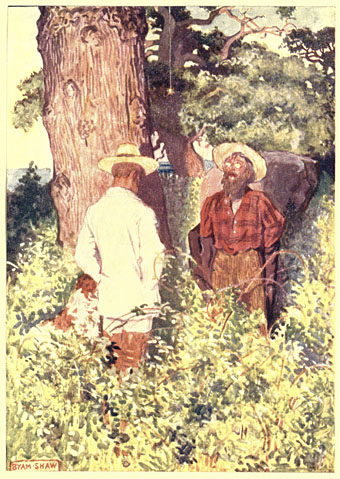
The Gold Bug

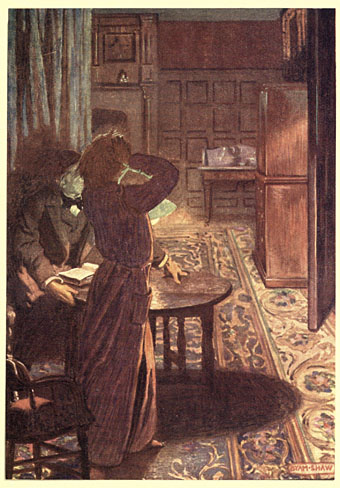
Reservations aside, Shaw’s Poe is worth a look if only to see which moments he chooses to highlight from each of the stories…or those he doesn’t. One of the problems with illustrating a popular writer like Edgar Allan Poe is that you have the choice of attempting to compete with other artists by illustrating the same scene as everybody else or you avoid the obvious moments in favour of something new. Shaw had an advantage in working without the burden of precedent but his climax for The Masque of the Red Death is overwhelmed today by our acquaintance with Harry Clarke’s definitive illustration. The most original thing about the Shaw edition is its cover, with a trail of human and animal footprints spiralling into a maelström towards…what? A webbed foot? This curious design suggests a set of illustrations that the contents don’t deliver.

shaw04.jpg

The Fall of the House of Usher

shaw05.jpg

The Assignation

Continue reading “Byam Shaw’s illustrated Poe”

Dugald Stewart Walker’s Rainbow Gold

dsw01.jpg

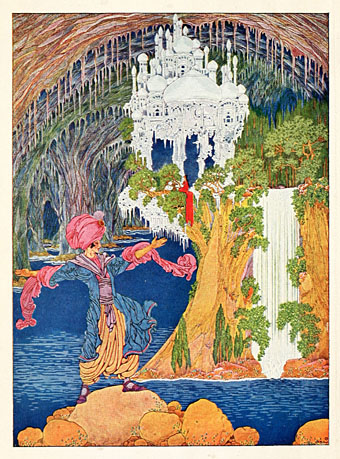
Kubla Khan by Samuel Taylor Coleridge.

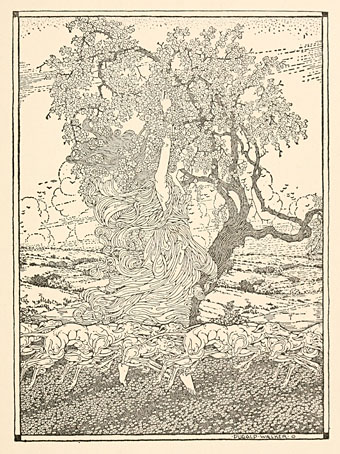
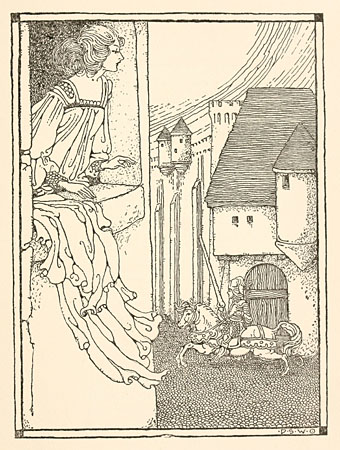
The illustrations of Dugald Stewart Walker (1883–1937) have been featured here on several occasions but this is a book of his that I’d missed until now. The Internet Archive has a huge trove of illustrated editions but the illustrators aren’t always credited on the website pages so you either have to rely on chance discovery or search for books by their titles.

dsw22.jpg

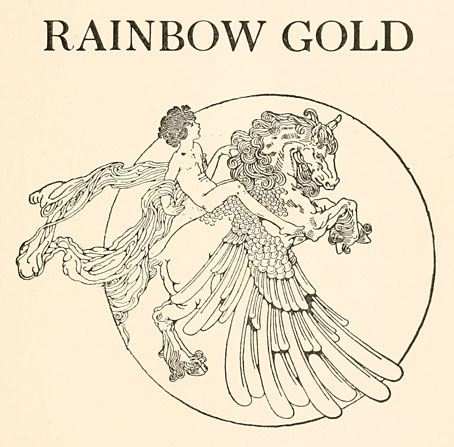
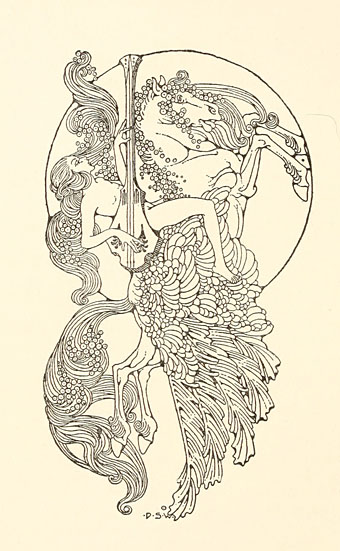
Rainbow Gold: Poems Old and New Selected for Boys and Girls (1922) is a collection compiled by Sara Teasdale that was illustrated throughout by Walker’s full-page drawings and many smaller vignettes. Not all of the poems are given the full-page treatment so some of the omissions are disappointing. I’d liked to have seen what he could do for Yeats’s The Song of Wandering Aengus, for example.

dsw02.jpg

There’s a Virgil Finlay-like quality to a few of these illustrations that I hadn’t noticed in Walker’s art before: the stars in the Israfel drawing, the same kinds of tiny nested circles that Finlay favoured, and dots stippled in white that must have been applied with paint rather than ink. Finlay would have been the right age to have been given (or shown) Walker’s drawings when he was a child which makes me wonder if they exerted a minor influence.

dsw03.jpg

“When the hounds of spring” by Algernon Charles Swinburne.

dsw04.jpg

The Lady of Shalott by Alfred Tennyson.

Continue reading “Dugald Stewart Walker’s Rainbow Gold”

Weekend links 541

finlay.jpg

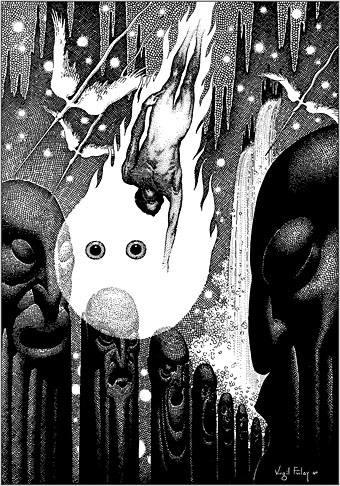
Virgil Finlay illustrates Hallowe’en in a Suburb by HP Lovecraft for Weird Tales, September 1952.

• Literary Hub does Halloween with an abundance with Draculas, a lazy option but the pieces are good ones nonetheless: Olivia Rutigliano attempts to rank the 50 best (screen) Draculas, and also recalls the Broadway production designed by Edward Gorey. At the same site, Katie Yee discovers that The Addams Family (1991) is really about the importance of books.

• The inevitable film lists: the always reliable Anne Billson selects the scariest ghosts in cinema; at Dennis Cooper’s, TheNeanderthalSkull curates…DC’s Weirdo Halloween Horror Movie Marathon, a list featuring a couple of oddities which have appeared in previous weekend links.

• More books bound with human skin: Megan Rosenbloom, author of Dark Archives: A Librarian’s Investigation into the Science and History of Books Bound in Human Skin discusses the subject with S. Elizabeth.

Beyond all this, however, readers are most likely to read De Quincey for his compellingly strange writing on opium and its effect on the mind. For it is opium, rather than the opium-eater, he writes in Confessions, who “is the true hero of the tale”. He explains the drug cannot of itself create imaginative visions—the man “whose talk is of oxen” will probably dream about oxen. But for De Quincey, with his love for reverie, it gives “an inner eye and power of intuition for the vision and the mysteries of our human nature”. Wine “robs a man of his self-possession: opium greatly invigorates it”. It “gives an expansion to the heart and the benevolent affections”. “This”, he claims, “is the doctrine of the true church on the subject of opium: of which church I acknowledge myself to be the only member.”

“Thomas De Quincey’s revelatory writing deserves greater attention,” says Jane Darcy

• New music: Weeping Ghost by John Carpenter is a preview of the forthcoming Lost Themes III; Moments Of Clarity is a new album of psychedelic(ish) songs from Professor Yaffle.

• “How now, you secret, black, and midnight hags!” Sean Connery (RIP) was often playing kings in later life but he started early with this performance as Macbeth in 1961. (Ta to TjZ for the link!)

• Mixes of the week: a (non-Halloween) guest mix by Paul Schütze for Toneshift, and the by-now traditional Samhain Séance Mix from The Ephemeral Man.

Clive Hicks-Jenkins’ big new adventure: an illustrated “reinvention” of Jean Cocteau’s La Belle et la Bête.

Drew McDowall (of Coil, et al) talks Musick, magick and sacred materiality.

• “No one loves the smell of a Kindle,” says Thomas O’Dwyer.

Brüder des Schattens (1979) by Popol Vuh | Nosferatu (1988) by Art Zoyd | Vampires At Large (2012) by John Zorn