Reversible men and Lipský’s Happy End

overloaded.jpg

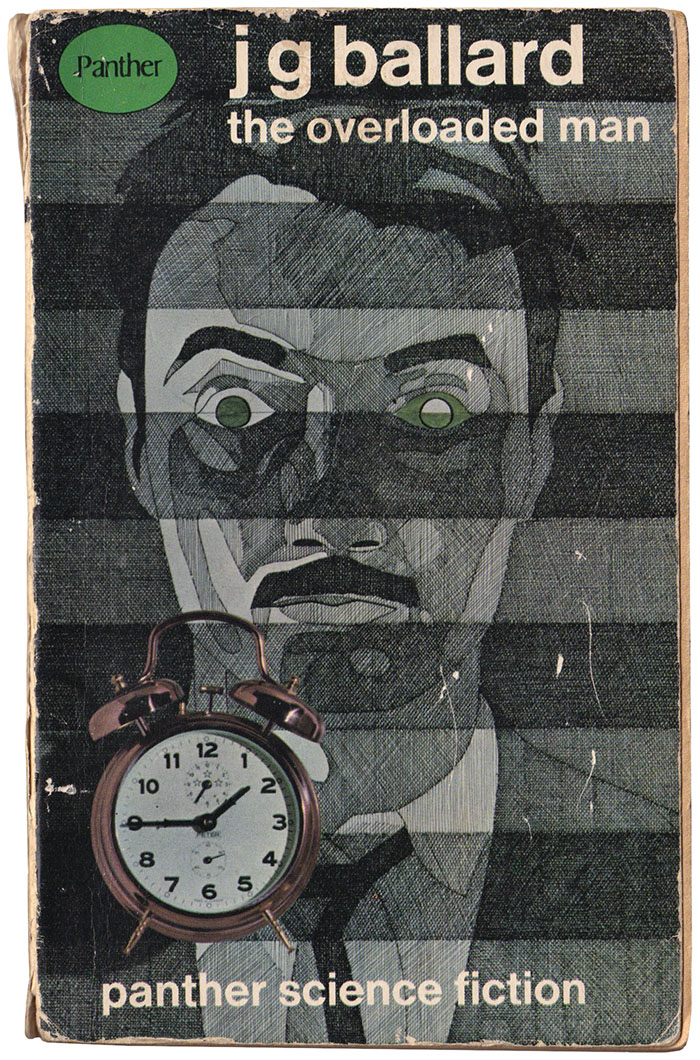
A paperback ravaged by the passage of time. Art by Ray Ginghofer.

Time of Passage, a piece of short fiction by JG Ballard, received its first publication in Science Fantasy magazine in February, 1964. The piece was subsequently collected in two paperbacks, The Impossible Man and Other Stories (Berkley Medallion, 1966), and The Overloaded Man (Panther, 1967). Time of Passage is more of a biographical sketch than a story, describing in reverse the life of a stockbroker, James Falkman, a man “born” in 1963 by being dug out of a grave while surrounded by tearful relatives. Ballard goes on to describe the major events of Falkman’s life, from retirement to career to marriage, charting the man’s gradual descent into youth and eventual infant helplessness. The story ends with Falkman bheing taken to a hospital in 1900 for a final encounter with his mother, his “death” in Ballard’s words.
venus.jpg

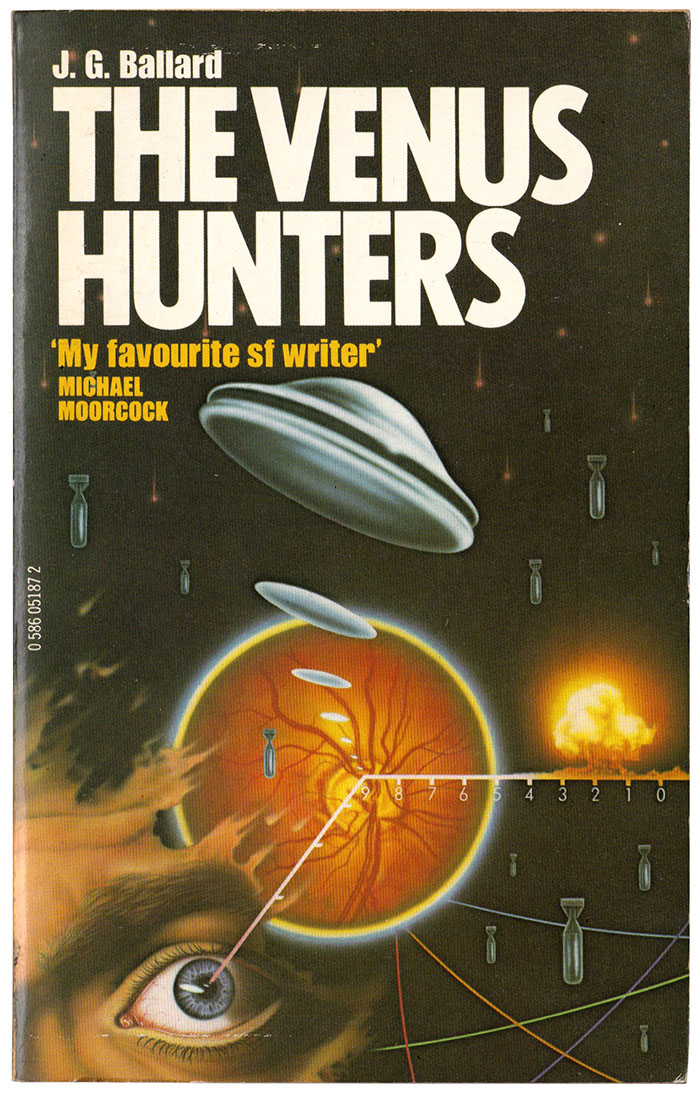
A revised reprint of The Overloaded Man, 1980. The artwork by Peter Gudynas may be the only Ballard cover to feature flying saucers.

There may be earlier literary examples of the life described in reverse but Ballard’s is the earliest one I know of. I’m thinking here of explicit reversals of human circumstance, as opposed to the more common reverse chronology whereby an otherwise forward-flowing story is chopped into episodes which are then presented in a reversed order. Philip K. Dick’s Counter-Clock World (1967) is a novel-length extrapolation of Ballard’s concept, set in a future where time has started to run backwards, and the dead are being born again in cemeteries. The 1960s saw a peculiar spate of fiction along these lines; to paraphrase Charles Fort, it must have been time-reversal time. In an earlier Ballard story, Mr. F is Mr. F, the titular character finds himself aging in reverse while time continues to run forward for his wife and the world outside their home; in An Age (1967) by Brian Aldiss scientific experiments reveal that time is actually moving in reverse despite our perceptions to the contrary.
reversible.jpg

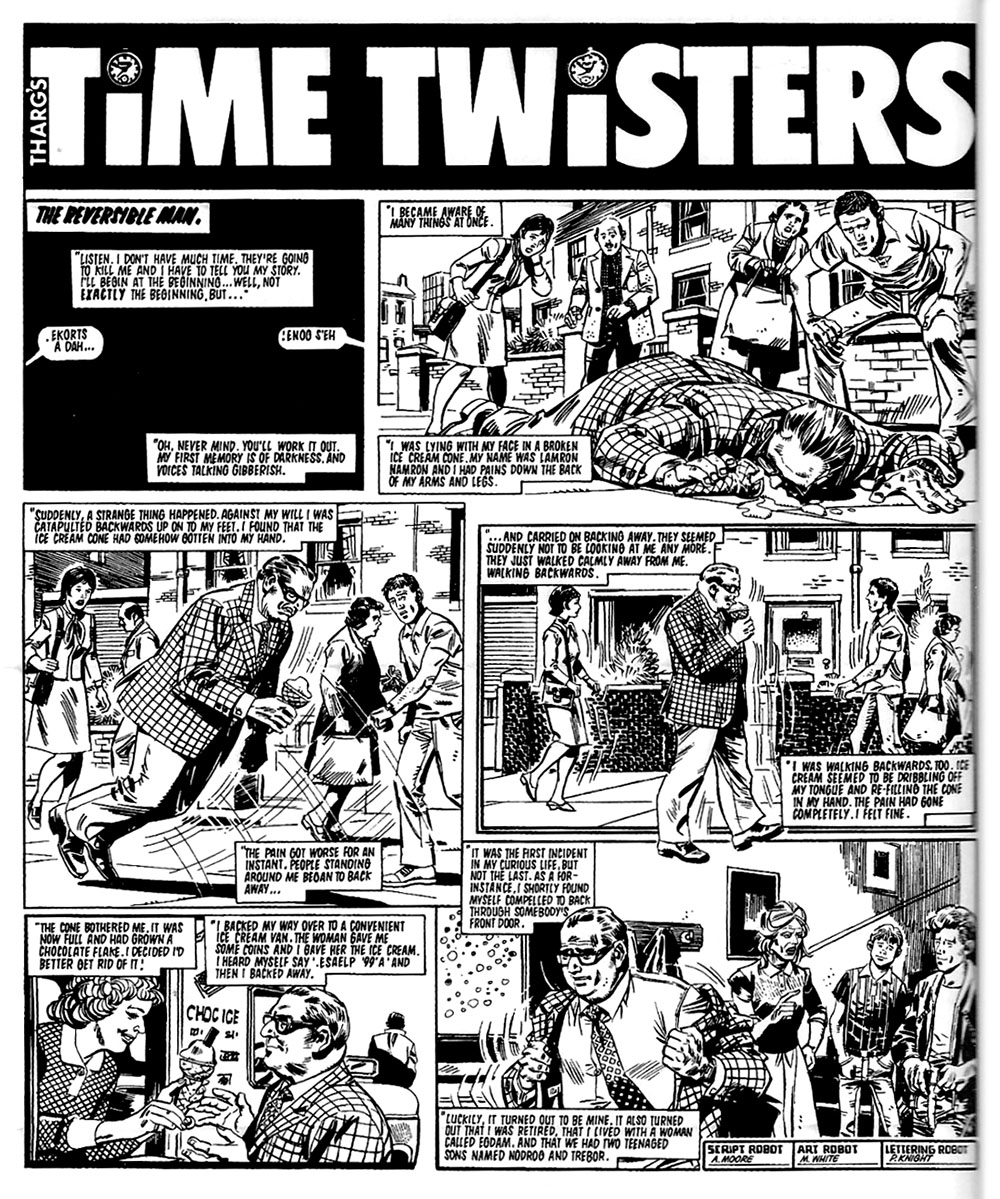
Art by Mike White.

Alan Moore would no doubt have been familiar with one or more of these stories when he wrote The Reversible Man for 2000 AD in 1983, a four-page strip which shows the life of an ordinary man from death to birth. Moore freshens the concept a little by the use of first-person narration. The most well-known treatment of the idea is Time’s Arrow by Martin Amis, a novel whose structure was taken by some reviewers as wholly original even though Amis said he was inspired by a passage in Kurt Vonnegut’s Slaughterhouse-Five. I’ve always felt Amis was being evasive on this point; he was very familiar with Ballard’s fiction, he interviewed Ballard and reviewed his novels on several occasions. Anyone with this much interest in Ballard’s work would have read Time of Passage in one of its many reprintings.
happy-end.jpg

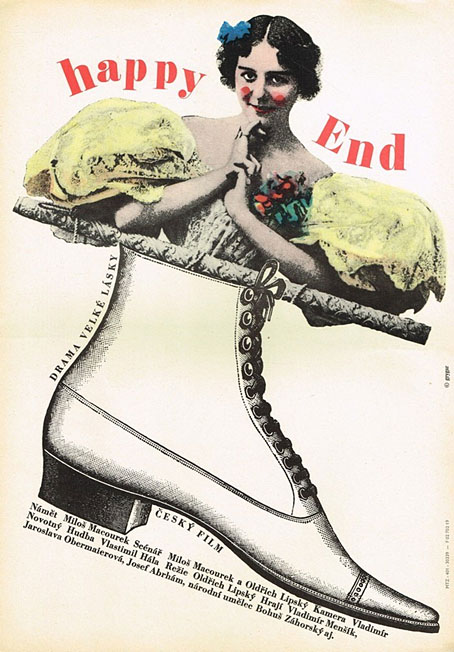
Design by Milan Grygar.

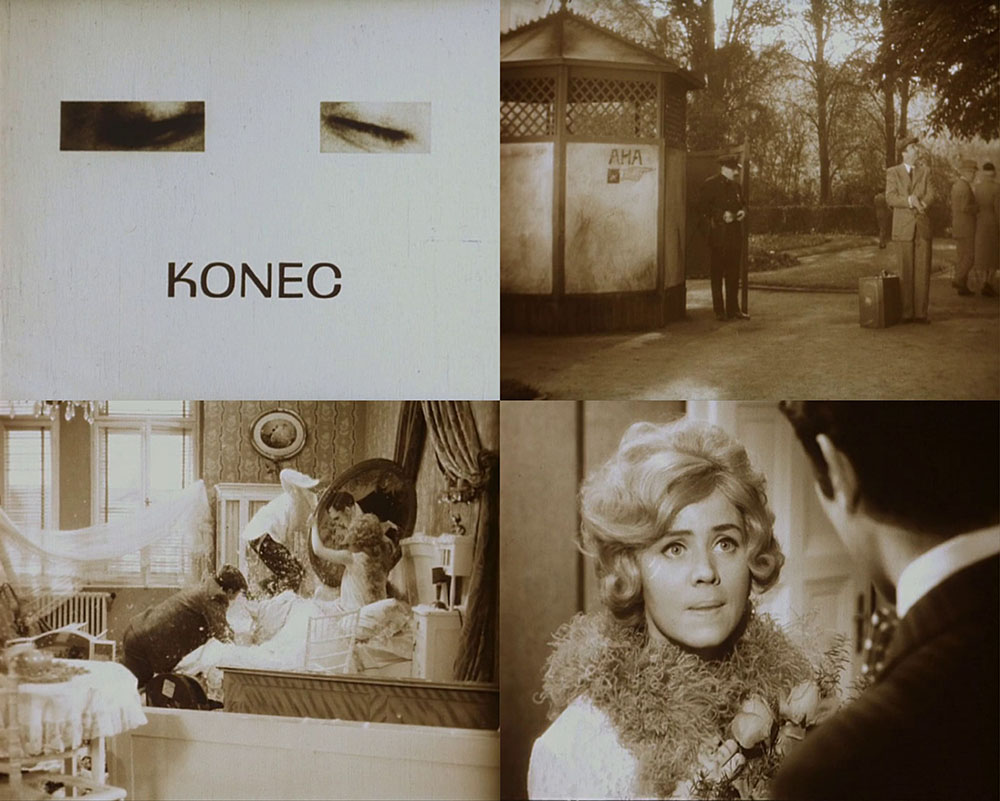
When it comes to authorial influence it seems unlikely that Czech film-maker Oldřich Lipský could have been influenced by Ballard or Dick’s time-reversals, which makes the appearance of Happy End in 1967 all the more remarkable. Lipský’s feature film, which I watched last week, is essentially Ballard’s death-to-life narrative played for its comic potential, with the film itself running in reverse for much of the time. Happy End opens with a title card in Czech—”Konec” (“The End”)—before presenting the “birth” of its protagonist by means of a guillotine. The decapitated head of Bedřich Frydrych (Vladimír Menšík) is attached to his body, after which the guards lead him (backwards) to the place described by his cheerful voiceover as a school (aka prison) where he says he’s being prepared for life in the outside world. Before he sets off to his waiting apartment the police give him a suitcase containing the body of his wife, Julie (Jaroslava Obermaierová), the pieces of which he assembles in the bath in his apartment. Julie is “revived” when Frydrych pulls an axe from her forehead, after which Julie’s lover, Ptáček (Josef Abrhám), makes his first arrival, jumping backwards into the bedroom through the window.
he1.jpg

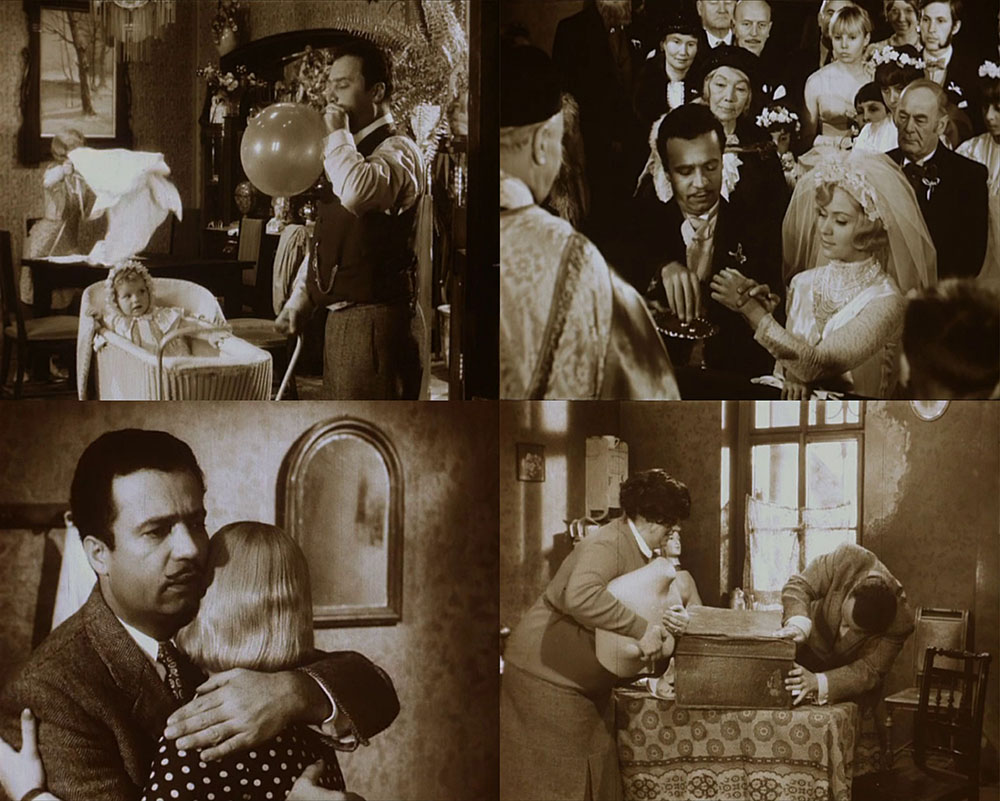
The love-triangle between Frydrych, Julie and Ptáček forms the bulk of the story, and also the basis for much of the film’s black humour. One of the hallmarks of the reversed biography is ironic reinterpretation, something that Amis makes a substantial meal of in his novel. In many cases it’s easier to do this with film than it is with words: a fight between Frydrych and Ptáček becomes an energetic “tidying up” of the apartment, with the cuckolded husband and the wife’s lover reassembling broken furniture and clearing away all the signs of destruction. Happy End is a long procession of these reversals, accompanied by Frydrych’s voiceover narration which persists in giving any tragic and difficult moments a positive gloss. Most of them, anyway. A substantial win at the racetrack becomes a negative incident when the events are played in reverse. But the loss of money is offset by Frydrych and Julie’s young daughter who pulls fresh banknotes out of an impromptu fire on the kitchen floor.
he2.jpg

For non-Czech speakers the humour and invention of Happy End is undermined by the effort required to keep up with the film’s frenetic pace (many of the scenes are speeded-up as well as running in reverse) while reading subtitles which reinterpret everything you’re seeing on the screen. My own viewing was further compromised by amateurish subtitles, but this is all the more reason to watch it again. Second Run have recently released Happy End as a region-free blu-ray with “new and improved English subtitle translation”. This is the second Lipský film I’ve watched to date (thanks, Jay!). I’ll be looking for more.

Previously on { feuilleton }
Art on film: Je t’aime, Je t’aime

Weekend links 687

crane.jpg

The Peacock Garden (1898) by Walter Crane.

• “The trio [Remedios Varo, Leonora Carrington & Kati Horna] became known as the ‘three witches’ for their exploration of the supernatural and metaphysical—which ranged…’from tarot readings to shamanic psychedelics to attempts to stop or slow time.'” Teresa Nowakowski on Remedios Varo: Science Fictions, an exhibition of Varo’s paintings at the Art Institute of Chicago which includes the one that Thomas Pynchon singled out for description in The Crying of Lot 49.

Philip K. Dick giving a lecture on “orthogonal time” to a small audience at the Festival International de la Science-Fiction, Metz, in 1977. Dick’s talks and interviews aren’t exactly scarce, but this one was of interest for me since I recently designed an edition of John Crowley’s Great Work of Time, a novella which involves a similar concept. If you were at the Metz Festival in 1977 you could also see a live performance by Cluster. Lucky you.

• “Our minds remain open when the LSD wears off.” Steve Paulson on psychedelic drugs and their usefulness as therapeutic tools.

• At Cartoon Brew: Stephen Irwin’s animated films “combine the influences of David Lynch, Struwwelpeter, and the Brothers Grimm.”

• Steven Heller looked at NB3, the third book about Neville Brody’s graphic design. Elsewhere, Heller’s font of the month is Scusi.

The glowing, prismatic nervous system of a sea star wins the Scientific Image of the Year.

• At Unquiet Things: Forgotten worlds and wonderlands from The Art of Fantasy.

• “Don’t waste my time with blood-free monster movies,” says Anne Billson.

• At Aquarium Drunkard: King Tubby And Soul Syndicate — Freedom Sounds In Dub.

• Mix of the week is DreamScenes – August 2023 at Ambientblog.

Time Machine (1970) by Stray | Time Captives (1973) by Kingdom Come | The Existence Of Time (2012) by Monolake

Weekend links 586

ertz.jpg

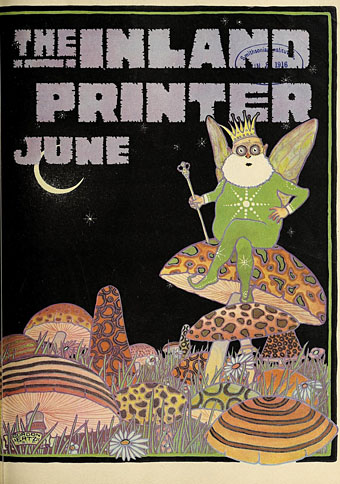
Cover by Gordon Ertz for The Inland Printer, June 1916.

• “I worry that enthusiasm is being mistaken for a moral virtue, and negative criticism for a character flaw.” Dorian Lynskey on the dying art of the hatchet job. Also a reminder (not that we require it) that the word “fan” in this context has always been an abbreviation of “fanatic”.

• Culture.pl explores the work of Stanisław Lem, the science-fiction writer “whose works, abilities and quirky sense of humor convinced Philip K. Dick that he was too brilliant to exist and must have actually been a committee of people”.

• The electronic music of Paul Schütze receives a reappraisal on Phantom Limb in November with a compilation album, The Second Law.

Aliya Whiteley on Amanita Muscaria, the hallucinogenic mushroom seen in hundreds of fairy-tale illustrations.

• Stuart Firestein talks to Roger Payne about changing the world’s attitude to whales by recording their songs.

• Jennifer Lucy Allan talks to Sam Underwood about his unique Acoustic Modular Synth.

Jóna G. Kolbrúnardóttir sings Odi Et Amo from Englabörn by Jóhann Jóhannsson.

• A forthcoming release on Dark Entries: Back Up: Mexican Tecno Pop 1980–1989.

• Luc Sante looks at Jim Jarmusch’s collages.

John Grant‘s favourite albums.

• RIP Michael Chapman.

• The Divination Of The Bowhead Whale (1978) by David Toop & Max Eastley | Keflavik: The Whale Dance (1980) by Richard Pinhas | Ballet For A Blue Whale (1983) by Adrian Belew

Weekend links 382

yoshida.jpg

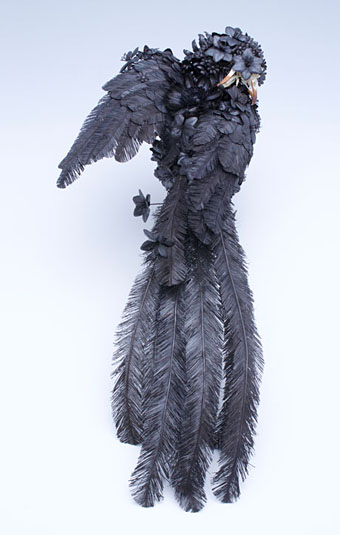
Raven (2015), a metal sculpture by Taiichiro Yoshida.

• “Lumia: Thomas Wilfred and the Art of Light [at the Smithsonian American Art Museum] restores Thomas Wilfred (1889–1968) to his rightful place in the history of modern art.”

• At Brown Noise Unit: a fascinating, lengthy interview by Philip Kaberry with Stephen O’Malley of Sunn O))) et al, with particular focus on O’Malley’s work with Japanese musicians.

• Erik Davis talks to scholar, writer, and mythographer William Rowlandson about Jorge Luis Borges, magical trees, Yankee mysticism, and the power of the weird and murky.

• The first issue of the world’s first magazine of fantastic art and literature, Der Orchideengarten (previously), has been reprinted in full with additional English translation.

• At Muddy Colors: the month in covers for September/October which includes my cover for Under the Pendulum Sun by Jeannette Ng (and which is on sale now).

• At 3:AM Magazine: Adam Scovell talks to horror author Ramsey Campbell about the ghost stories of MR James.

Paralysis: Live at Silent Night #8, a new release on (limited) cassette and digital by The House In The Woods.

• At Dangerous Minds: Jozef van Wissem buries the dead in his new video, Virium Illarum.

PKD Files — A podcast about the life and work of Philip K. Dick.

• Russell Cuzner on The Strange World of Nurse With Wound.

Clark Collis on the rise and fall of Fangoria.

• The North Star Grassman And The Ravens (1971) by Sandy Denny | Flight Of The Raven (1979) by Emerald Web | Kill The Great Raven (1979) by Snakefinger

Philip K. Dick: A Day in the Afterlife

pkd1.jpg

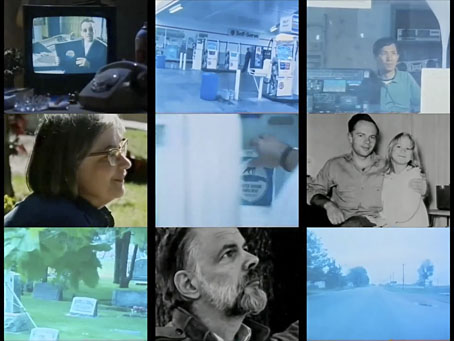
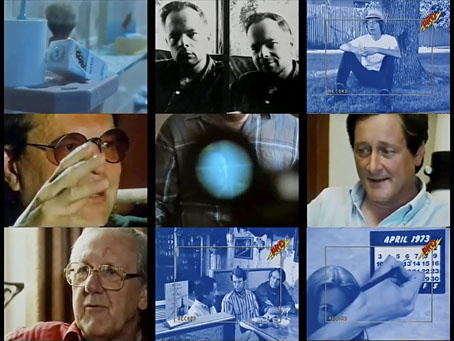
Blade Runner turns up in Nicola Roberts’ television documentary but not for long. Back in 1994 it was still possible to discuss a popular writer by concentrating on the books alone rather than padding the running time with film and TV derivations. The BBC’s Arena strand excelled at these 50-minute biographies of significant cultural figures.

pkd2.jpg

The last time I watched this documentary was on a big TV screen in a house in Los Angeles. Stepping out into the California sun a couple of hours later was like stepping into a Philip K. Dick novel, a slippage between the real and the fictional that Dick himself might have appreciated. Among the luminaries discussing the author’s slippery narratives are Brian Aldiss, Jim Blaylock, Elvis Costello, Anne Dick (PKD’s third wife), Tessa B. Dick (PKD’s fourth wife), Thomas M. Disch, Terry Gilliam, Kleo Mini (PKD’s second wife), Tim Powers, Kim Stanley Robinson and Fay Weldon. There’s also video footage of Dick being interviewed in the late 70s/early 80s. Watch it here.

Previously on { feuilleton }
Blade Runner vs. Metropolis