The Worlds of Mervyn Peake

peake-sphinx.jpg

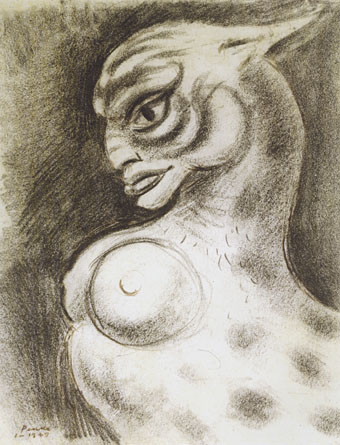
Illustration by Mervyn Peake for The Sphinx by Oscar Wilde (1949).

The centenary of writer, artist and poet Mervyn Peake is being celebrated this year with a number of events in the UK. Mervyn Peake: A Centenary Celebration is a small exhibition of Peake’s drawings which has been running since April at the Pallant House Gallery, Chichester. That show ends on July 17th so if you want to be glared at by Fuchsia Groan you’re advised to get your skates on.

The Worlds of Mervyn Peake is a more substantial affair opening this week at the British Library, London, which promises to have materials from the British Library collection and the Peake archive on display. Two evenings of talks are also scheduled although the first of these, Mervyn Peake’s Gormenghast, is now sold out. The Guardian ran a feature at the weekend with pieces by some of the people who’ll be involved in the discussions, including Michael Moorcock, who’s been championing Peake’s work since the early 1960s, and China Miéville. For those who can’t make it to the exhibitions, there are also books: The Gormenghast Trilogy has been republished in a new illustrated edition, and the British Library is selling an American edition of Maeve Gilmore’s Peake’s Progress, a 592-page selection of writings, drawings and poetry which has been out-of-print in the UK for years. Essential purchases for any Peake enthusiast.

Update: There’s also an exhibition of artwork by Mervyn Peake and Maeve Gilmore at Viktor Wynd, London. Thanks to Vadim for the tip.

Elsewhere on { feuilleton }
The illustrators archive

Previously on { feuilleton }
A profusion of Peake
Joseph Cavalieri’s stained glass
Mervyn Peake at Maison d’Ailleurs
Peake’s Pan
Buccaneers #1
Mervyn Peake in Lilliput
The Illustrators of Alice

Rossetti and His Circle by Max Beerbohm

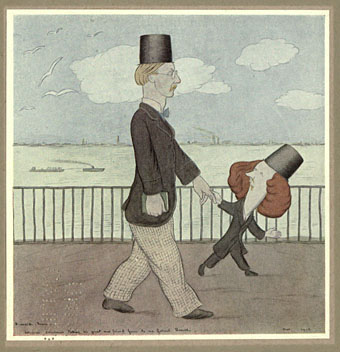
beerbohm1.jpg

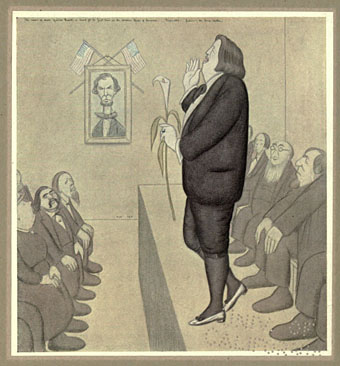
Rossetti’s name is heard in America (Oscar Wilde).

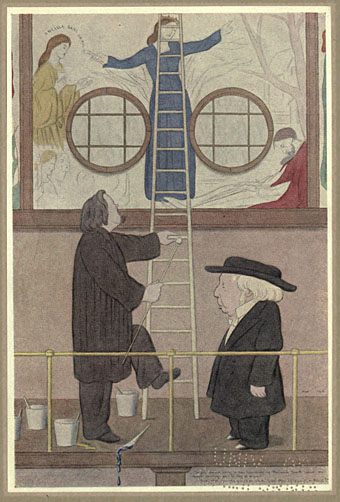
The Happy Hypocrite was Max Beerbohm’s words illustrated by George Sheringham; here we have Beerbohm’s caricatures from a 1922 collection depicting notable figures among the Aesthetes and Pre-Raphaelites from the 1860s on. Beerbohm wasn’t born until 1872 so there’s something of a younger generation’s mockery in these drawings. That said, he was just as happy to mock his London friends of the 1890s, Oscar Wilde included, and often poked fun at himself in his cartoons and his writings.

Some of the pictures in Rossetti and His Circle are familiar from books about the period, the Wilde picture in particular is often reprinted. You don’t always see them in colour, however, so once again the scans at the Internet Archive give us a fuller view provided you ignore the security perforations on each print.

beerbohm2.jpg

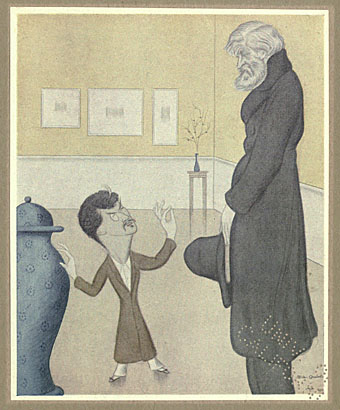
Blue China (JM Whistler and Thomas Carlyle).

A drawing which complements Wilde’s description of Whistler as a “miniature Mephistopheles”. Beerbohm was more succinct in one of his verbal portraits: “Tiny”.

beerbohm3.jpg

Algernon Swinburne taking his great new friend Gosse to see Gabriel Rossetti.

Swinburne, it seems, was another diminutive figure.

beerbohm4.jpg

The sole remark likely to have been made by Benjamin Jowett about the mural paintings at the Oxford Union: “And what were they going to do with the Grail when they found it, Mr. Rossetti?”

Previously on { feuilleton }
The Happy Hypocrite by Max Beerbohm

Valenti Angelo’s Salomé

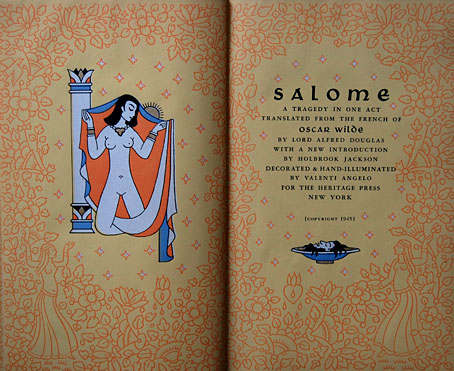
angelo.jpg

And still they come… Valenti Angelo (1897–1982) was an American printmaker, author of several books for children and the illustrator of an estimated 250 classic works of fiction including this 1945 edition of Wilde’s Salomé for Heritage Press. Angelo has an engagingly simple style in this and other works, reminding me of David Sheridan’s Tarot designs. The Internet Archive has a copy of his illustrated The Imitation of Christ with drawings reminscent of Eric Gill’s woodcuts.

Elsewhere on { feuilleton }
The illustrators archive
The Oscar Wilde archive
The Salomé archive

Wild Salomés

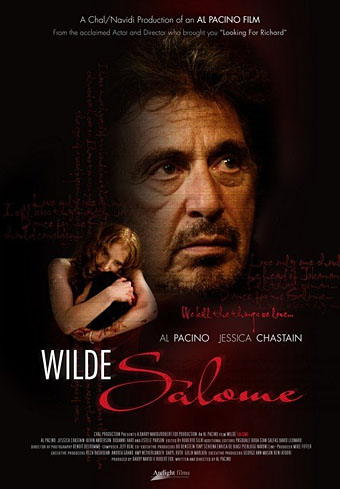
wildesalome.jpg

So there’s a poster for Al Pacino’s forthcoming drama-documentary about the Oscar Wilde play but I’ve yet to see any release details. The tagline connects Salomé with The Ballad of Reading Gaol: “We kill the thing we love.”

salome1986.jpg

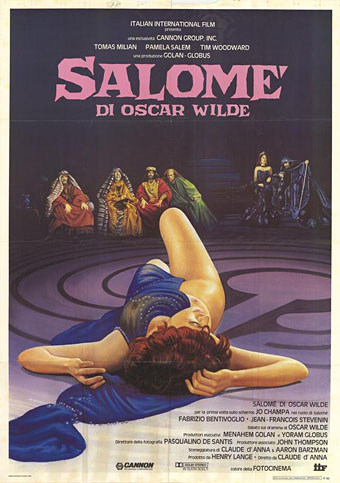
Searching around for posters turned up this item for an Italian-French co-production of the Wilde play directed by Claude d’Anna. I’ve not seen this but it can’t be any worse than Ken Russell’s version so it may be worth seeking out.

salome1953.jpg

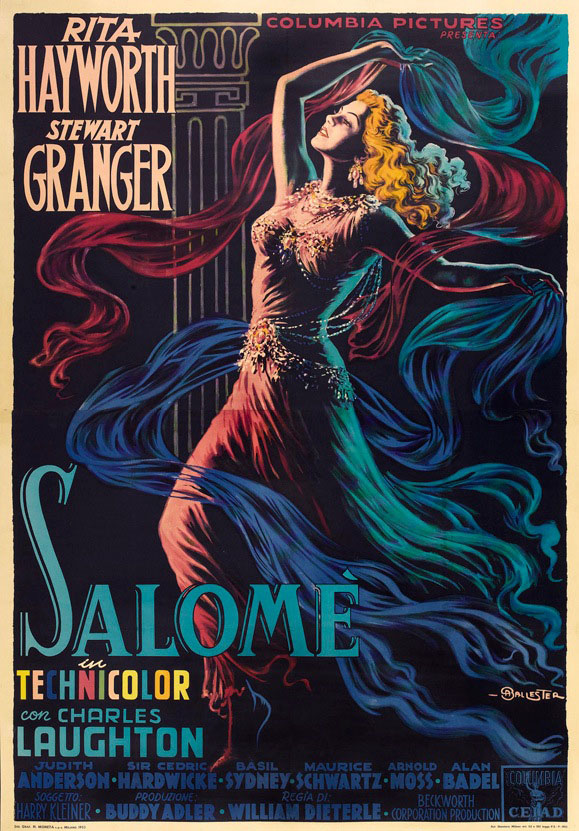
Far better poster-wise is this splendid creation by Anselmo Ballester for the Italian release of the 1953 Hollywood film (which isn’t based on the play). Rita Hayworth was too old for the role, and the film is simultaneously lavish and dull in the way that so many sword-and-sandal epics manage to be, but the poster is a gem. This site has many more examples of Ballester’s poster art.

Elsewhere on { feuilleton }
The Oscar Wilde archive
The Salomé archive

The Rock Drill

epstein.jpg

The Rock Drill (original version, 1913–1914).

Jacob Epstein’s Rock Drill (1913-15) was reconstructed in polyester resin by Ken Cook and Ann Christopher in 1973–74. It is the exemplary Vorticist art work. It shows a man on a tripod who is one with his machine. His drill is also his rigid proboscis, his hard, angled phallus. The tripod has weights (embossed Colman Bros Ltd Camborne England) on each leg, just above midpoint—which look like enlarged joints, or a bee’s pollen knee-pads (only available in black).

The rib cage of the figure is exactly like the twin cylinders on a motorbike. He is recognisably human, true, but the human body, with its curves and trim little bum, has been made-over to the angular machine: it is an armoured exoskeleton. The arms are like greaves. I thought of Seamus Heaney’s description of a motorbike lying in flowers and grass like an unseated knight. And I thought too of “Not My Best Side”, UA Fanthorpe’s marvellous poem about Uccello’s St George and the Dragon in the National Gallery. In it, Fanthorpe imagines the young girl being rather taken by the dragon’s equipment, when suddenly, irritatingly, “this boy [St George] turned up, wearing machinery”.

Thus Craig Raine on Jacob Epstein’s unforgettable sculpture. It’s astonishing to think that this piece in its various forms (lost, reworked, reconstructed) is now nearly a century old. Raine was writing about the forthcoming The Vorticists: Manifesto for the Modern World, an exhibition which will be opening at Tate Britain next month. Epstein’s truncated Torso in Metal from The Rock Drill (the full-figure version was destroyed) was one of the handful of sculptures which stood out for me when I first visited the Tate Gallery (as Tate Britain used to be) and it’s since become a piece I always enjoy seeing again. Epstein’s art was frequently controversial, his Oscar Wilde Memorial of 1911 was famously declared indecent, and The Rock Drill would have seem shockingly angular and aggressive to a British art world where aged academicians were still painting medieval fantasies or trying to sculpt like Praxiteles. To us today it looks unavoidably cybernetic even though the word “robot” didn’t arrive until 1920. Flickr has some views here of the reconstructed version which I’d hope is going to be on show at the Tate. In the meantime, there’s Anthony Gormley discussing the work on BBC Radio 3 (via iPlayer) which he regards as the first Modernist British sculpture, and a favourite work of art.

Previously on { feuilleton }
Wildeana #2
Against Nature: The hybrid forms of modern sculpture
Angels 2: The angels of Paris