The Flatiron Building

flatiron1.jpg

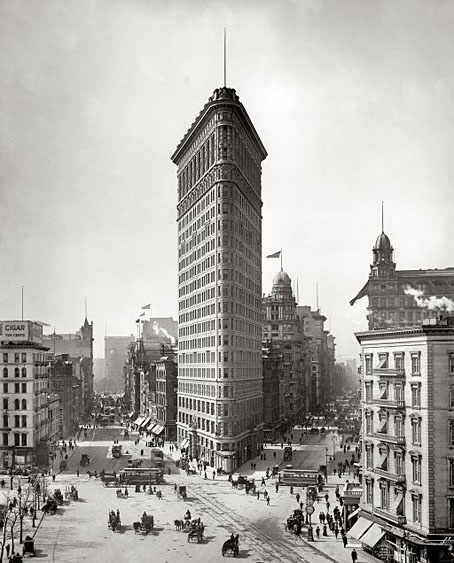
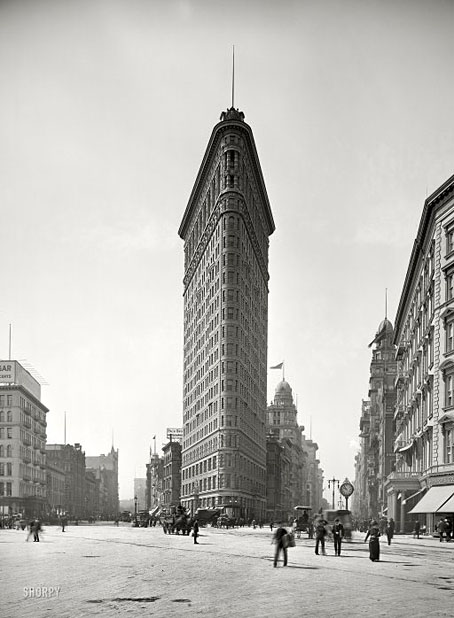
The Flatiron Building, Detroit Publishing Company (1903).

Beautiful Century posted this view of New York’s Flatiron Building at the weekend which had me looking for a larger copy. Happily this is one of the many high-resolution photos at the Shorpy Historical Archive where it’s possible to scrutinise a wealth of detail. Old photos like this are, as Michael Moorcock once said about old postcards, a form of time travel, especially when they’re as good as those in the Shorpy collection. The Flatiron was a popular subject for photographers—famously so in Edward Steichen’s 1904 nocturne—and Shorpy has many more examples such as the street-level view below. Both these photos show a common feature of pictures taken before the age of the motor car: people standing in the middle of the road. The Flatiron also has an oblique connection with Julian Biggs’ film via the mysterious origins of the phrase “23 skidoo“.

flatiron2.jpg

The Flatiron Building, Detroit Publishing Company (c. 1905).

Reinhart Wolf photographed many of New York’s skyscrapers in the late 1970s, the Flatiron included. I have a book of those photos and noticed in his Flatiron view that one of the circular decorations on the foremost angle of the building near the top is now missing (compare his view with the Shorpy photos). Every time I look at the Flatiron now I think of that missing chunk of masonry. Was it removed or did it fall? If the latter, when did this happen and what damage did it cause?

Previously on { feuilleton }
Edward Steichen

Looking for the Wild Boys

wildboys-calder.jpg

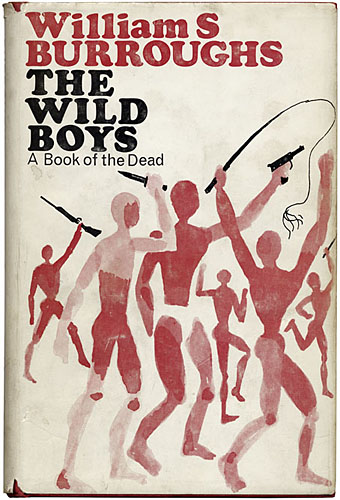
Calder & Boyars, 1972. Design by John Sewell.

This must be the first space novel, the first serious piece of science fiction—the others are entertainment.

Mary McCarthy defending The Naked Lunch in the New York Review of Books, June, 1963.

Mary McCarthy’s view—echoed a year later by Michael Moorcock and JG Ballard in the pages of New Worlds magazine—has never been popular or even particularly acceptable. William Burroughs gets touted as an sf writer by other writers, and John Clute gives him an entry in the Encyclopedia of Science Fiction, but Burroughs’ sf scenarios are guaranteed to offend those readers who prefer their narratives presented in a neat, linear form with detailed explanations of How The Future Would Actually Work, or the physics behind some piece of imaginary technology. The books which immediately follow The Naked LunchThe Soft Machine, The Ticket that Exploded, and Nova Express—all feature sf scenes or ideas. The latter was deemed sufficiently generic to prompt Panther Books in the UK to publish it three times as “Panther Science Fiction” although given the severe criticism that Moorcock sustained for trying to broaden the horizons of readers in the late 60s I don’t expect sales were encouraging.

The Wild Boys, published in 1971 (1972 in the UK), was Burroughs’ first novel after Nova Express, and his first book of fresh material after mining the stack of writing that birthed The Naked Lunch and the titles which followed. The novel is subtitled A Book of the Dead (as in the Egyptian or Tibetan Books of the Dead), and is certainly science fiction although I’ve never seen it marketed as such or noticed any sf reader include it in a list of notable genre novels of the period. My Calder & Boyers hardback offers a précis of the fractured narrative:

The year is 1988. The Wild Boys, adolescent guerilla armies of specialized humanoids, are destroying the armies of the civilized nations and ravaging the earth. The wild boys, who began in the pre-present past as petrol gangs, dousing their victims with petrol and setting them on fire for kicks, have grown to an army, dedicated to violence. One of them is used in a cigarette commercial. He becomes a new cult figure, a demi-god responsible for great destruction, and it is left to strong man Arachnid Ben Driss to exterminate the wild boys. He slaughters them, but the battle continues underground until all civilization collapses, revealing a future of horrifying dimensions. The originality of the theme and the very special Burroughs style together make this one of the most unusual science fiction novels ever, a prophetic exploration of the future, that should quickly establish itself as one of the classics of the present time.

That’s accurate, up to a point, although like many book blurbs it misrepresents the content somewhat. It also neglects to say how funny the book is. For anyone with a black sense of humour Burroughs has always been a great comic writer, and The Wild Boys has some prime examples, not least the opening chapter, Tío Mate Smiles, which is best appreciated in the author’s own reading.

Having gone through the novel in the past week, and going through its follow-up/appendix/remix Port of Saints at the moment, a couple of things occurred to me. The first was the way The Wild Boys strongly prefigures later works like Cities of the Red Night and The Place of Dead Roads. This is a fairly obvious point but it’s one that hadn’t fully clicked until now. The Wild Boys takes the problems of repressive control systems posed in the first few novels and offers a possible solution: a homoerotic utopia/dystopia where gangs of teenage boys hide out in depopulated regions, waging war against the rest of humanity with sex, magic and a mastery of weapons, including biological and viral varieties. While doing this they are steadily mutating so they can leave behind all human concerns with nation, family, laws and written language. Cities of the Red Night was Burroughs first novel after The Wild Boys and presents a less radical proposal, ranging through time with its anarchist pirate colonies and the six cities of the title. In The Place of Dead Roads Kim Carsons has his band of outlaw cowboys, The Wild Fruits, and the book gives us the conflict between the Johnsons—those who “mind their own business”—and the Shits: lawmen, politicians, tycoons, all the usual agents of Control.

Continue reading “Looking for the Wild Boys”

Somnium by Steve Moore

somnium.jpg

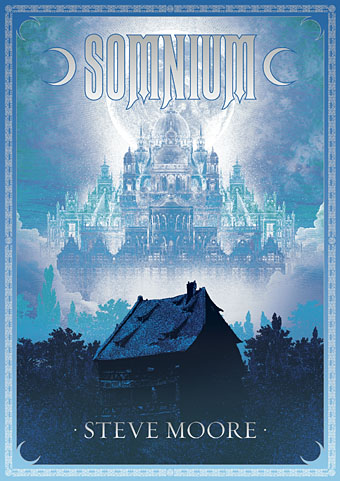
Another new piece of illustration and design. Somnium is an occult novel by Steve Moore being published this month by Strange Attractor. Some readers here may know Steve’s work as a comics writer, ex-editor of Fortean Times and also the subject of Alan Moore’s recent Unearthing text and recording. I’ve not seen the book yet but it comes laden with praise from Michael Moorcock and Iain Sinclair, and features an afterword by Alan Moore:

Written in the early years of the 21st century, when the author was engaged in dream-explorations and mystical practices centred on the Greek moon-goddess Selene, Somnium is an intensely personal and highly-embroidered fictional tapestry that weaves together numerous historical and stylistic variations on the enduring myth of Selene and Endymion. Ranging through the 16th to 21st centuries, it combines mediæval, Elizabethan, Gothic and Decadent elements in a fantastic romance of rare imagination.

With its delirious and heartbroken text spiralling out from the classical myth of Endymion and the Greek lunar goddess Selene, Somnium is an extraordinary odyssey through love and loss and lunacy, illuminated by the silvery moonlight of its exquisite language.

The printed version should incorporate metallic silver ink on the title and border, something you can never quite replicate on a web image, hence the gradient on the title lettering. Somnium is available in a range of signed or unsigned editions and can be purchased direct from the Strange Attractor Shoppe.

Previously on { feuilleton }
Dodgem Logic again
Of Moons and Serpents

Art is magic. Magic is art.

millidge.jpg

Cover concept by Chip Kidd.

I noted the imminent arrival of Gary Spencer Millidge’s labour of love last month and the volume itself turned up this week, and what a book it is, a heavyweight hardback that’s far more lavish than I anticipated. The first surprise comes when removing the dust jacket to find Alan’s scowling visage embossed on the boards. Inside there’s a wealth of Moore ephemera from biographical material (lots of family photos) to insights into the scripting process behind the comics. I already knew Alan made little thumbnail sketches of his comic layouts before writing his scripts, having been fortunate enough to see one of the work-in-progress books for From Hell one time when I was chez Moore. Now everyone can have that opportunity. In addition there’s a thorough overview of Alan’s career, from the earliest juvenilia through to recent issues of Dodgem Logic. The comics career often overshadows his other work but in a later part of the book there’s considerable attention given to his collaborations with musicians, dancers and others for the Moon and Serpent performances. For my part it’s a pleasure to see some of the designs I created for the Moon and Serpent CDs printed large-size and in better quality than pressing plants manage with compact discs. None of those releases sold in great quantities and all are now out-of-print so the artwork often feels lost.

moore01.jpg

The front board.

What else? How about two sections of the book with fold-out pages? How about the first ever public appearance of Alan’s huge chart mapping the progress of every character through the unfinished Big Numbers? How about an introduction by Michael Moorcock where he calls Alan “a Robert Johnson of the Age of Doubt; questioning, confronting, mourning and yearning, representing his readers in profound ways, an intellectual autodidact, one of my few true peers for whom I have limitless respect.”? How about a compact disc featuring extracts from the Moon and Serpent CDs plus many other previously unreleased songs including pieces by the Emperors of Ice Cream? This is a gorgeous production designed by Simon Goggin and art directed by Julie Weir, and I haven’t even begun to read it yet. Is it necessary to state that it’s an essential purchase for anyone with more than a passing interest in Mr Moore and his many talented collaborators? Yours for twenty-five quid from Ilex Press. Some page samples follow.

moore02.jpg

Front endpapers showing Alan’s working notes and sketches.

Continue reading “Art is magic. Magic is art.”

Mervyn Peake in Coronation Street

gormenghast1.jpg

First paperback edition of Titus Groan, 1968.

If you’re British then, no, it isn’t what you think. Having mentioned my hometown of Blackpool yesterday there’s one detail about the town I usually regard as an annex of Hell which, if not quite a saving grace, raises it into some lesser locus of perdition.

There are many Coronation Streets in Britain (and Coronation Roads, Terraces, etc), Manchester has several real ones besides the fake one which provides the setting for the world’s longest-running soap opera. Most are named after a royal event, of course, although I don’t know when the one in Blackpool was built, possibly around 1911 which would mean it takes its name from the coronation of George V. I remember it as being a very undistinguished street of shops, and had no idea all the time I was in Blackpool that Mervyn Peake had lived for a short period in that street (no. 62) with wife Maeve Peake (later Gilmore) and son Sebastian in 1940. Mervyn was in the Royal Artillery in the early years of the war, and was posted to Blackpool as part of an Anti-Aircraft Training Regiment. Once established he found there was little for him to do so he continued work on the manuscript of Titus Groan, still at that point being referred to as Goremenghast (with an extra “e”). Later on the family moved to Bloomfield Road, the home of Blackpool’s football club, before Maeve and Sebastian returned to London.

All this detail can be found in G. Peter Winnington’s Peake biography, Vast Alchemies (2000), and came as something of a shock to me. One thinks of Peake as an inhabitant of Sarke and London, not Blackpool, however brief his stay. But I was stunned most of all to hear about him writing there as well. Peake noted on his manuscript where the chapters were written so Winnington can tell us that some of Titus Groan was set down on the town’s North Pier. The piers are one of the few things I liked about Blackpool, North Pier most of all for being the longest structure with the best views of the sea. It’s also notable for me in being the place where I began my first (and strongest) acid trip in 1980. That’s nothing to do with Peake, of course, but the significance of these separate events tangles in a curious and unexpected way, so that I can’t think of that pier now, or of the early chapters of the Gormenghast trilogy, without this knowledge coming to the surface.

This year is the Peake centenary, and I wrote at the beginning of the month about some of the events and exhibitions being staged in the UK. One of these, Mervyn Peake: A Celebration, will take place at the British Library, London, on Tuesday, 26th July. Described as “an evening of words, memories and images with Peake’s associates, experts and family members”, the speakers will include Fabian Peake, Sebastian Peake, Clare Penate, Brian Sibley, Hilary Spurling and others, with a specially filmed contribution by Michael Moorcock. Further details here. Don’t expect Peake’s presence in Blackpool to be acknowledged this year; the philistine nature of the place is one reason I escaped as soon as I could.

Update: Mervyn Peake’s war paintings unveiled by National Archives.

• G. Peter Winnington’s Peake Studies

Previously on { feuilleton }
The Worlds of Mervyn Peake
A profusion of Peake
Joseph Cavalieri’s stained glass
Mervyn Peake at Maison d’Ailleurs
Peake’s Pan
Buccaneers #1
Mervyn Peake in Lilliput
The Illustrators of Alice