Schalcken the Painter revisited

schalcken1.jpg

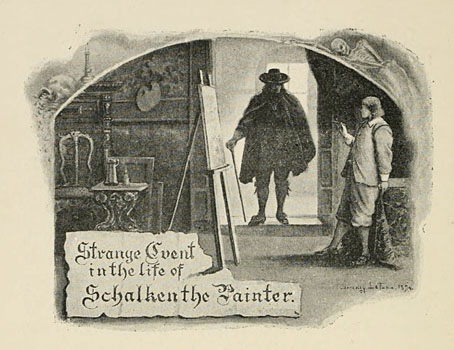
Illustration by Brinsley Sheridan Le Fanu from The Watcher and Other Weird Stories (1894) by J. Sheridan Le Fanu.

The stranger stopped at the door of the room, and displayed his form and face completely. He wore a dark-coloured cloth cloak, which was short and full, not falling quite to the knees; his legs were cased in dark purple silk stockings, and his shoes were adorned with roses of the same colour. The opening of the cloak in front showed the under-suit to consist of some very dark, perhaps sable material, and his hands were enclosed in a pair of heavy leather gloves which ran up considerably above the wrist, in the manner of a gauntlet. In one hand he carried his walking-stick and his hat, which he had removed, and the other hung heavily by his side. A quantity of grizzled hair descended in long tresses from his head, and its folds rested upon the plaits of a stiff ruff, which effectually concealed his neck.

So far all was well; but the face!

Strange Event in the Life of Schalken the Painter (1839) by J. Sheridan Le Fanu.
schalcken2.jpg

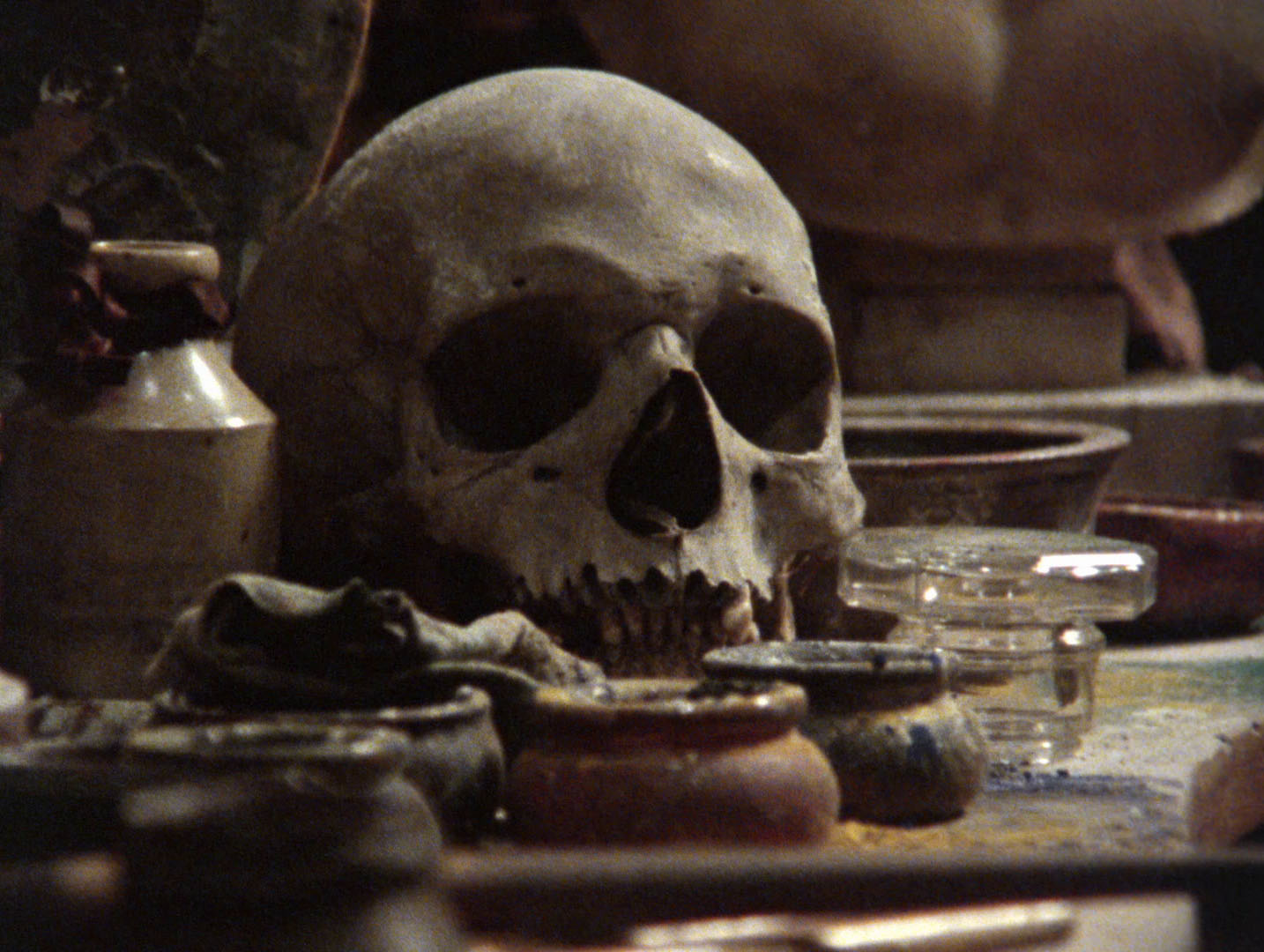
Compare this shot to the inferior YouTube version.

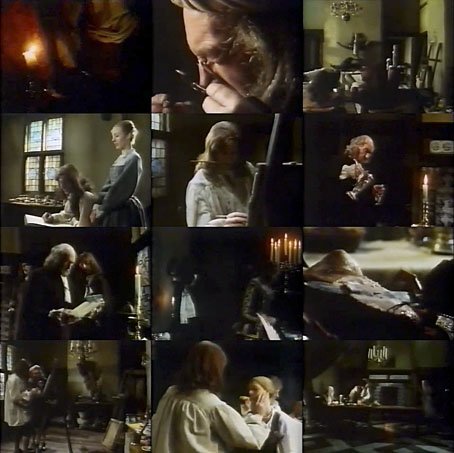
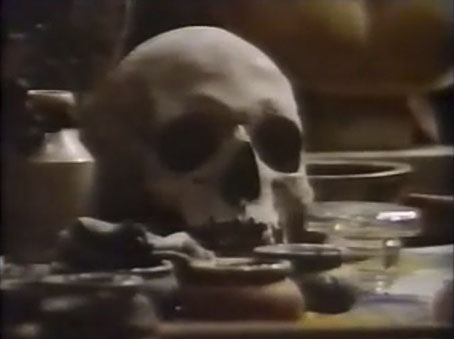
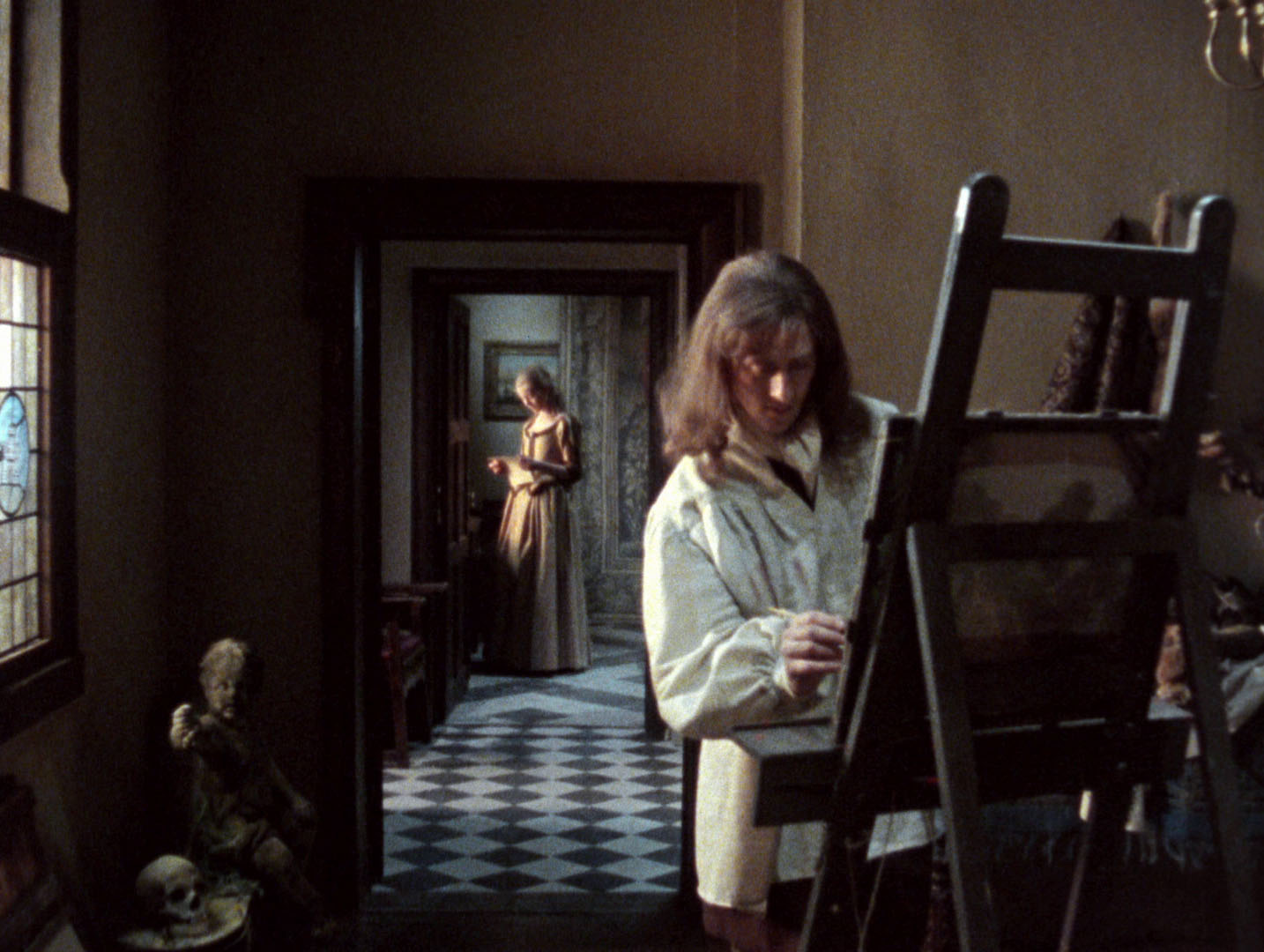
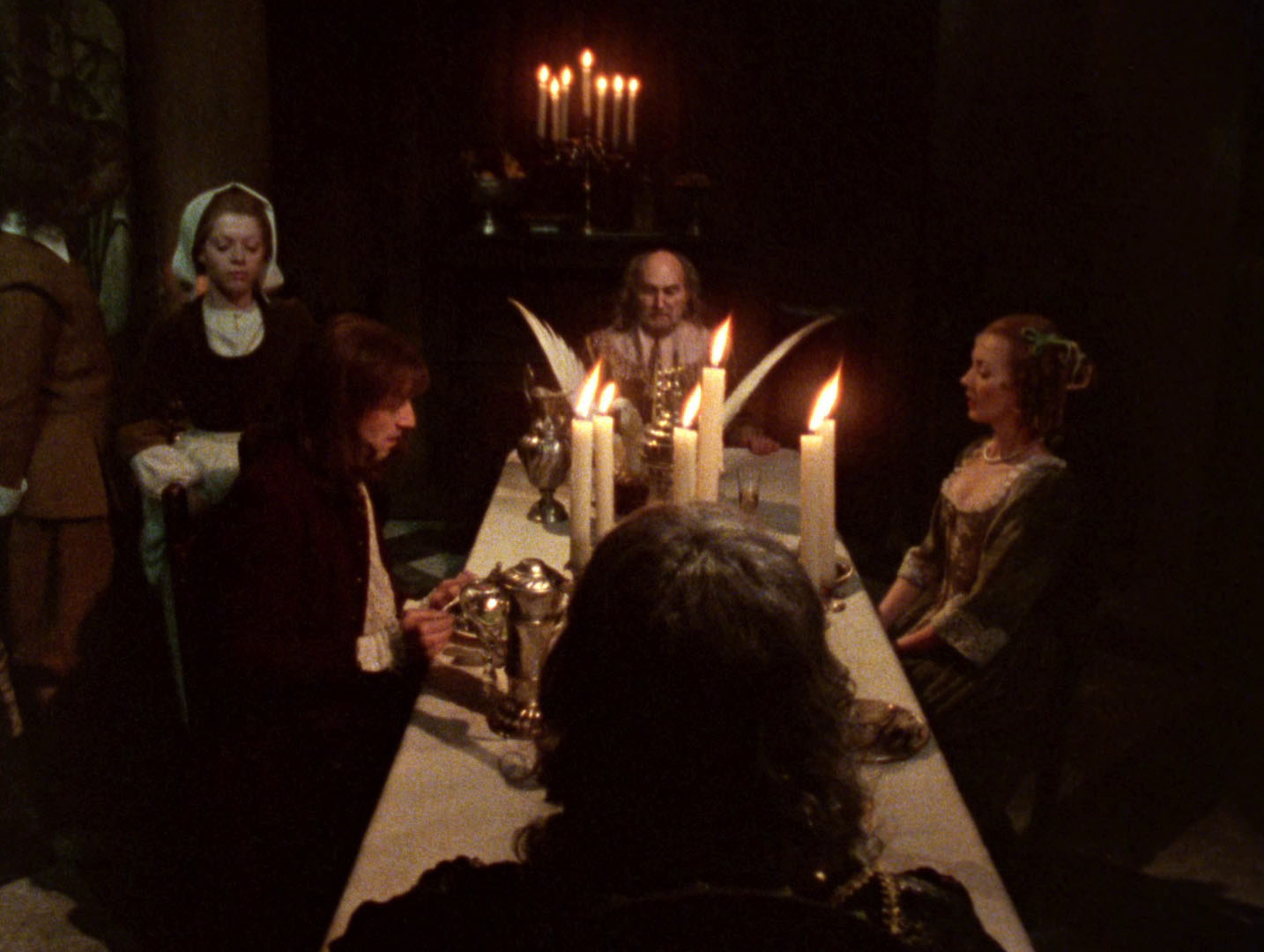
I enthused at some length about Leslie Megahey’s 1979 television film Schalcken the Painter last year so there’s no need to repeat myself. This post serves notice that the film is available at last in another marvellous dual-format release from the BFI, replete with extras, and the usual authoritative booklet notes. The Blu-ray transfer is a revelation after years spent watching an old VHS copy (the versions of YouTube are even worse). I noted before the astonishing lighting by cameraman John Hooper which successfully replicates not only the Dutch interiors so familiar from Vermeer, but also the candlelit chiaroscuro of Godfried Schalcken’s own paintings. (Le Fanu, incidentally, spelled the painter’s name “Schalken”.) Blu-ray quality might seem like overkill for a low-budget TV drama, however well-made, but this film in particular demands it, especially when the interiors begin to darken along with the story.
schalcken3.jpg

Cheryl Kennedy and Jeremy Clyde.

Among the extras there’s a 39-minute interview with Leslie Megahey and John Hooper about the making of the film. The combination of scenes based on period paintings plus candlelit interiors always makes me think of Barry Lyndon so it’s a surprise to discover that Megahey didn’t have this in mind at all. The film owes more, he says, to Blanche (1972) by Walerian Borowczyk, a period feature film which utilises a similarly flat shooting style with scenes based on medieval art. I’ve only seen Borowczyk’s earlier animated films, some of which have featured in previous posts, so this is one to look for in future.
schalcken4.jpg

In addition to the making-of piece there are two short films: The Pit (1962, 27 mins), directed by Edward Abraham, based on Poe’s Pit and the Pendulum, and The Pledge (1981, 21 mins) directed by Digby Rumsey, based on a short story by Lord Dunsany. I’ve not watched either of these yet, it seemed unfair to follow Megahey’s film with lesser fare.

After such unbridled enthusiasm it goes without saying that this is an essential purchase for anyone who enjoys the BBC’s ghost films of the 1970s. I’m biased towards Megahey’s productions but I find this a superior work to many of the MR James films. Megahey filmed another drama about a painter in 1987, Cariani and the Courtesans. It’s a non-supernatural piece but also has Charles Gray narrating and John Hooper behind the camera. I’ve not seen it for years so I’ll continue to hope it may also see a reissue soon.

Previously on { feuilleton }
Schalcken the Painter
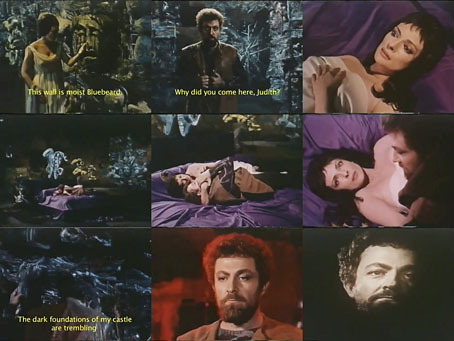
Leslie Megahey’s Bluebeard
The Watcher and Other Weird Stories by J. Sheridan Le Fanu
Chiaroscuro

Weekend links 172

thielker.jpg

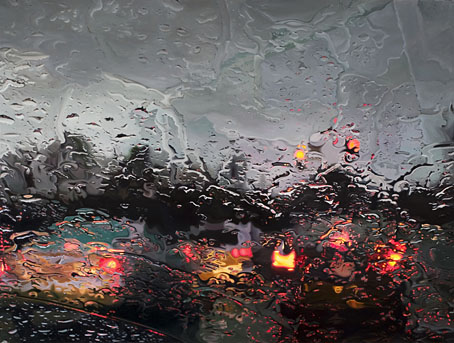
Complete Stop (2008), an oil painting by Gregory Thielker from his Under the Unminding Sky series.

• For Halloween last year I watched a very poor copy of a BBC Play For Today production, Robin Redbreast, a piece of rural horror by John Bowen which received a single screening in 1970. That poor copy—black-and-white, timecoded, multi-generation video—has been circulating for years, so it’s good to know that the BFI will be releasing Robin Redbreast on DVD in time for this year’s Halloween. This might be news enough but the following month the BFI also releases Leslie Megahey’s stunning adaptation of Schalcken the Painter in a dual DVD/Blu-ray edition. I wrote a short review of the latter film last October.

• Mixes of the week: August Sun High from The Advisory Circle, and John Wizards’ Quietus Mix “African music, R&B and chamber pop, filtered through gentle electronic arrangements that cross-pollinate with South African house, Shangaan electro and dub”.

• A trailer has surfaced for The Counselor, a film by Ridley Scott from an original screenplay by Cormac McCarthy. Trailers are too spoilerish so I’m refusing to watch it but for those interested Slate has the details.

Luckhurst makes an admirable attempt to link Lovecraft’s most frustrating writing tic to this theme of the unknown when he claims that Lovecraft’s “catachresis”—deliberate muddling of language through the use of mixed metaphors and the like—is a tool he uses to bolster the atmosphere of futility in the face of “absolute otherness.” The trauma of encountering something so far outside the realms of imagination triggers a collapse of logic in the language itself.

Cate Fricke reviews The Classic Horror Stories of HP Lovecraft, a collection from Oxford University Press edited by Roger Luckhurst.

• “Contemporary audiences found it too weird, too wonky and even borderline distasteful…” Xan Brooks goes looking for the locations from Powell & Pressburger’s 1943 film, A Canterbury Tale.

• Two songs from Julia Holter’s forthcoming album, Loud City Song: World and Maxim’s I. Also unveiled this week: Evangeline, a new track by John Foxx & Jori Hulkkonen.

• Have Ghost, Will Find: Colin Fleming on William Hope Hodgson’s Carnacki, The Ghost Finder.

• At PingMag: Urban Calligraphy: Turning the Streets into Big, Loud Canvases.

• Sex, Spirit, and Porn: Conner Habib talks to Erik Davis.

Serendip-o-matic: Let Your Sources Surprise You

The Pronunciation of European Typefaces

Twilight (2004) by Robin Guthrie & Harold Budd | Luminous (2009) by John Foxx & Robin Guthrie | Cling (2011) by Robin The Fog

Michael Powell’s Bluebeard revisited

powell1.jpg

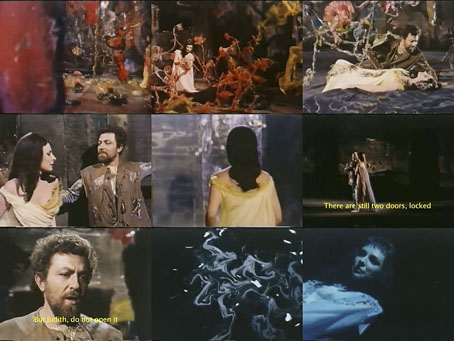
Yesterday’s post prompted me to look again for one of Michael Powell’s scarcest films, his television version of Bartók’s Bluebeard’s Castle made for  Süddeutscher Rundfunk in 1963. Sure enough, it’s now on YouTube in a watchable copy taken from VHS tape. Herzog Blaubarts Burg (to use its German title) was made post-Peeping Tom when the director’s career was at its lowest ebb, and while the production values don’t match those he’d been used to in the 1940s he was no doubt happy to be working at all after being vilified by the UK press. Norman Foster is Bluebeard and Ana Raquel Satre plays Judith, with the libretto being a German translation with English subtitles. I ought to note here that I’ve not read the second volume of Powell’s biography (mea culpa) so the only information I have about this comes from Ian Christie’s Arrows of Desire: The Films of Michael Powell and Emeric Pressburger (1985). Christie doesn’t have much to say about it other than pointing out that Norman Foster financed the film, and that it’s seldom been screened in Britain: IMDB has the first UK screening as 1978, just prior to the time when Powell and Pressburger began to receive to some belated recognition.

powell2.jpg

The YouTube copy suffers in the sound department by being a muffled mono transmission but it’s the visuals which will be of most interest to Powell aficionados. Powell & Pressburger’s regular production designer Hein Heckroth created the multi-coloured labyrinth which serves as the castle. The overall effect is stagey but contains some unique details, such as the rune-etched standing stones shown at the opening and close, and also some painted moments similar to those seen during the celebrated dance sequence in The Red Shoes (1948). Powell’s staging is much more vivid and artificial than Leslie Megahey’s 1988 adaptation whose Gothic gloom remains a personal favourite. Despite its shortcomings, when compared to the other Powell films that came after—the two Australian features, the Children’s Film Foundation commission which reunited him with Pressburger—this is far closer to the greatest works of the Archers era, and provides a more satisfying career coda for the man who directed The Red Shoes and The Tales of Hoffmann.

Previously on { feuilleton }
Joseph Southall’s Bluebeard
Leslie Megahey’s Bluebeard
Powell’s Bluebeard
The Tale of Giulietta

Schalcken the Painter

schalcken.jpg

Next week the BFI releases a box set of the BBC’s Ghost Stories for Christmas, a series of hour-long TV films broadcast during the 1970s, most of which were adaptations of stories by MR James. One film that isn’t among them, unfortunately, is Leslie Megahey‘s superb Schalcken the Painter, a 70-minute drama based on Strange Event in the Life of Schalken the Painter (1839) by J. Sheridan Le Fanu. Megahey gets mentioned here more than any other TV director (see this earlier post), for years he was someone whose productions I looked out for with a kind of cult fervour.

schalcken2.jpg

Schalcken the Painter was first screened on 23rd December, 1979, and repeated two or three times over the next decade. Megahey directed several period dramas for the BBC but this is his only supernatural piece. Its story of real-life Dutch painters Godfried Schalcken (1643–1706) and Gerrit Dou (1613–1675) is beautifully produced, with great attention to period detail, lighting and photography. The BBC used 16mm film for everything at this time but lighting cameraman John Hooper does an excellent job of creating shots that resemble Schalcken’s celebrated chiaroscuro paintings, still life tableaux or scenes from Vermeer. Many of the shots appear, Barry Lyndon-like, to be illuminated with nothing but candles. The acting is equally good, with Jeremy Clyde as Schalcken, Maurice Denham as the heartless Dou, and Cheryl Kennedy as Dou’s daughter, Rose. The narrator is the splendid Charles Gray.

schalcken3.jpg

Self-portrait of Godfried Schalcken (1694).

Given all of this it’s surprising the BFI haven’t included the film in their DVD series, it’s a superior work compared to several of the other inclusions, not least the most recent (and terrible) Whistle and I’ll Come to You. YouTube has a couple of uploads, however, so the curious may choose from a full-length version here or the usual multi-part version here. None of these fuzzy VHS copies do John Hooper’s photography any favours at all but for now this is the only way most people will be able to see Leslie Megahey’s beautiful and chilling ghost story.

Previously on { feuilleton }
Leslie Megahey’s Bluebeard
“Who is this who is coming?”
The Watcher and Other Weird Stories by J. Sheridan Le Fanu
Chiaroscuro

Le Grand Macabre

topor1.jpg

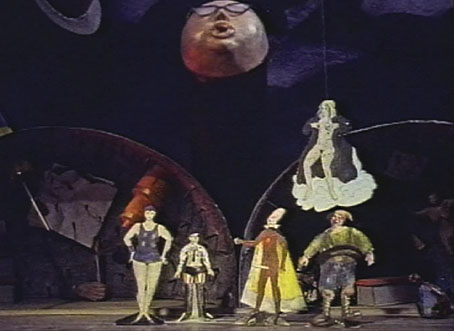
Yesterday I mentioned Leslie Megahey’s Ligeti film, All Clouds Are Clocks, an hour-long documentary based around an interview with György Ligeti filmed in 1976. A unique feature of that film was that Megahey returned to film Ligeti in the same room in 1991 where they discussed the composer’s work during the intervening period. Of these, Le Grand Macabre, written in the late 1970s, was the most ambitious piece.

topor2.jpg

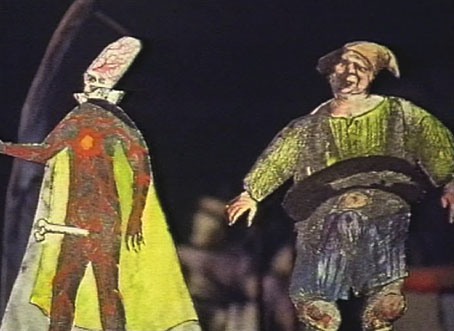
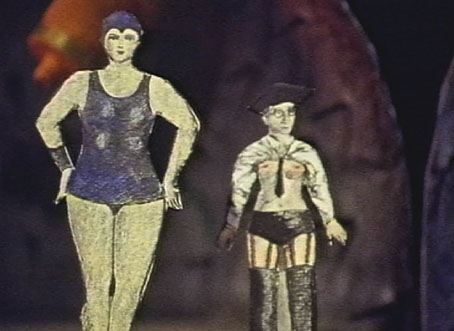
Bartók and Ligeti share some attributes: both were Hungarian, and both were forced to flee their native country. Both composers also wrote only one opera apiece. Le Grand Macabre is Ligeti’s opus, an absurdist drama based on Michel de Ghelderode‘s 1934 play, La Balade du grand macabre. In the film Ligeti explains that he didn’t want to repeat the mid-century concept of the anti-opera but was also dissatisfied with the traditional variety, hence Le Grand Macabre‘s description as an “anti-anti-opera”, a work that combines the tradition and its reaction.

topor3.jpg

Continue reading “Le Grand Macabre”