Weekend links 808

kometen.jpg

Comets from Meyers Konversationslexikon (1885–90).

• At The Daily Heller: Steven Heller reviews A Life in Ink, a new monograph about the art of Ralph Steadman. Heller is full of praise for Steadman, and discusses commissioning his work for The New York Times. But in his bewilderment at Steadman’s lack of a knighthood he seems unaware of the degree to which state honours are frequently refused by Britons, especially those who position themselves in opposition to the established order. Americans are obsessed with awards and “halls of fame”, and appear to regard Britain’s state honours as something like the Oscars with a royal seal, rather than what JG Ballard once described as “a Ruritanian charade that helps to prop up the top-heavy monarchy.” If Steadman has deliberately shunned the honours list he’d be joining a venerable company.

• “In mid-19th century Italy, two eccentric aristocrats set forth on parallel projects: constructing ostentatious castles in a Moorish Revival style. Iván Moure Pazos tours the psychedelic chambers of Rochetta Mattei, optimised for electrohomeopathic healing, and Castello di Sammezzano, an immersive, orientalist fever dream.”

• New music: Ithaqua by Cryo Chamber Collaboration is this year’s installment in the Lovecraft-themed album series (previously) from Cryo Chamber. Also this week: Analog 2025 by Various Artists; and Flux (music for a performance by still still / Marta & Kim) by Rutger Zuydervelt and Lucija Gregov.

For all their bravura and maximalism, Powell and Pressburger understood the power of leaving things out, building into their films chasms that the mind must leap, gaps that the imagination must fill. Like Joan Webster, we discover that we don’t want things to be made too easy. We want to catch our own fish rather than have them delivered, to swim in the ocean rather than in a pool.

Imogen Sara Smith on I Know Where I’m Going, one of the films from Michael Powell and Emeric Pressburger’s golden decade, the 1940s

• Among the new titles at Standard Ebooks, the home of free, high-quality, public-domain texts: In the Days of the Comet by HG Wells.

• At the BFI: David Parkinson selects 10 great Sherlock Holmes films and TV adaptations.

• Winning entries for the Capture The Atlas Northern Lights Photographer of the Year.

• Books and original drawings by Austin Osman Spare on sale at Gerrish Fine Art.

• At Unquiet Things: The art of Chie Yoshii.

Kohoutek-Kometenmelodie (1973) by Kraftwerk | Cometary Wailing (1981) by Bernard Xolotl | Kometenmelodie Part 1 (1994) by 300,000 VK
On Babaluma

babaluma.jpg

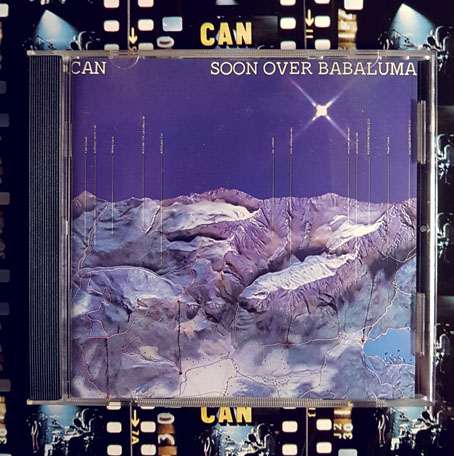
It’s never the same without the foil sleeve.

Since the death of Damo Suzuki I’ve been reading the Rob Young and Irmin Schmidt book about Can, All Gates Open. Can’s history isn’t exactly unfamiliar so it’s taken me a while to get round to it. I’ve been listening to their music for over 40 years, and bought the Can Box when it came out, a release which includes the Can Book, a substantial volume by Hildegard Schmidt and Wolf Kampmann containing career-spanning interviews with the core members of the group. Mysteries persist, however, so it’s been satisfying to have some of them resolved in the newer book, like the question of what exactly the title of the group’s sixth album, Soon Over Babaluma (1974) refers to. I’ve always liked this album, it was the second or third one I bought in 1981 when I found a secondhand copy of the original release in its shiny foil sleeve. Irmin Schmidt sings the words “Soon over Babaluma” on the second track, Come Sta, La Luna, a title which Young reveals as originating with Leonardo da Vinci. Then he has this to say:

Playfully extemporising from this text, Irmin cast his eyes across the studio to where Jaki’s girlfriend of the time, a woman called Christine, was perched on a sofa with accustomed stillness. “She had this really mysterious aura around her… She could sit there for hours like a cat not moving, or just drawing, or maybe doing nothing,” Irmin recalls. “So ‘Come sta, la luna’ was about Christine in a way. I’m talking about this girl who is going through walls. I don’t remember the words any more and I have never written it down. But there is something very spacey in the words—’Dancer on the rope, in the space’ or something. But when I wrote that, she was sitting in the studio and I was looking at her… I found her very mysterious and very beautiful.”

Almost by accident, the phrase “soon over Babaluma” emerged out of this stream of consciousness. “The word ‘Babaluma’ came out of a conversation with Jaki about the words. He maybe thought I had another word before, and he said, ‘What did you say? Babaluma?’ And because it rhymed with ‘luna’, it was a kind of playing with words—it didn’t mean anything. And it’s true surrealism. But the whole text is about something happening in space, out there. Seeing the moon and, from there, soon being over Babaluma—which must be another star or something. So it has another story behind it.”

So it was automatic writing after all. For a group whose compositions evolved out of endless improvisation this almost seems inevitable. Young makes a good argument for Soon Over Babaluma being Can’s cosmic album, made at a time when the kosmische idiom was peaking in Germany; even Kraftwerk were a little cosmic in 1973/74, with their Kohoutek-Kometenmelodie single being reworked for side 2 of Autobahn. There’s a lot of enlightening detail in All Gates Open, I recommend it. (Although I’m sure that’s a Stylophone solo on Moonshake, not a melodica as he seems to think.)

Meanwhile, Damo returns to the world this month with an official release for the Paris, 1973 concert. This one has circulated for years as a bootleg, and it’s a better showing by the band than some of the other recordings in the recent live series. More, please.

Previously on { feuilleton }
Holger’s Radio Pictures
Jaki Liebezeit times ten
Can esoterics
Can soundtracks
Can’s Lost Tapes

Weekend links 707

genkosai.jpg

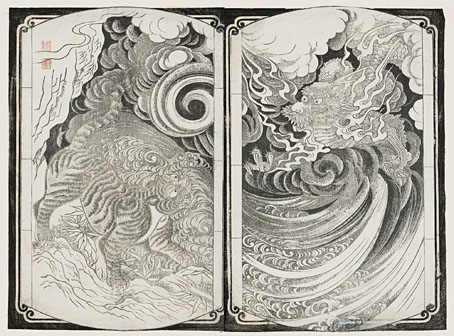
Dragon and Tiger—Designs for Lacquer Inro (no date) by Mori Genkosai.

• “But where have all those copies of Corridor of Mirrors gone? Sometimes I entertain the thought that an obsessive collector has amassed them in his library lined with looking-glasses, so that nobody else can possess the book but he, and he can see them all, multiplied to infinity, as he stalks up and down in his scarlet smoking hat and velvet coat, and gloats.” Mark Valentine on the mysterious unavailability of Corridor of Mirrors (1941), a novel by Chris Massie. The film adaptation made a few years later is one I’ve managed to miss, despite its starring Eric Portman and featuring the first screen appearance of Christopher Lee. Future viewing, I think.

• “The intrepid logician Kurt Gödel believed in the afterlife. In four heartfelt letters to his mother he explained why.” Alexander T Englert explains Gödel’s explanations.

• At Open Culture: Hortus Eystettensis (1613), “the beautifully illustrated book of plants that changed botanical art overnight”.

• Mix of the week: Aquarium Drunkard presents The Secret Hemisphere: New Age, Fusion and Fourth World, 1970–2002.

• New music: Phases Of This And Other Moons by Field Lines Cartographer.

• Why Graphic Culture Matters is a new book of essays by Rick Poynor.

• At Spoon & Tamago: Japanese Designer New Year’s Cards of 2024.

• Steven Heller’s font of the month is Chutz.

• At Dennis Cooper’s it’s Barbara Steele Day.

The Hall Of Mirrors In The Palace At Versailles (1970) by John Cale & Terry Riley | The Hall Of Mirrors (1977) by Kraftwerk | The Room Of Mirrors (2000) by Harold Budd

Weekend links 690

sosnowski.jpg

The Voice of St. Teresa (1928) by Oskar Sosnowski.

• The House is the Monster: Roger Corman’s Poe Cycle forms “a body of work not only deeply coherent but uniquely inspired,” says Geoffrey O’Brien.

• Steven Heller’s font of the month is Amberwood, while at The Daily Heller there’s a profile of Otto Bettmann, “an unsung visionary of commercial art”.

• At Public Domain review: The Works of Mars (1671), plans for military architecture by Allain Manesson Mallet.

The “underlying oneness of all things,” the conviction “that everything is connected” (Gravity’s Rainbow 703), is a thesis that appeals to many mystics and even to some scientists, but Fort complains that the latter too quickly dismiss unexplainable coincidences, or feebly explain them away. Scorning “scientific procedure” and inept police investigations, Fort turns for answers to denizens of the occult—poltergeists, invisible people, vampires, werewolves, miracle healers, fakirs, psychic criminals, dowsers—and to such notions as teleportation, human-animal metamorphoses, spontaneous combustion and pyrokinesis, “psychic bombardment,” telekinesis, animism, “secret rays,” telepathy, spirit-photography, clairvoyance, and modern instances of witchcraft.

Steven Moore in a perceptive essay about the overlooked connections between Thomas Pynchon, William Gaddis and Charles Fort. Having discussed Fort’s preoccupation with coincidences, the author notes that he shares a name with the late Steve Moore, former editor of Fortean Times magazine

• Pynchonesque headline of the week: The Paradox of the Radioactive Boars.

James Balmont’s guide to the masterworks of New Taiwanese Cinema.

• New music: Solo for Tamburium by Catherine Christer Hennix.

Winners of Bird Photographer of the Year 2023.

Idris Ackamoor’s favourite music.

Radio-Active (1984) by Steps Ahead | Radioactivity (William Orbit Remix) (1991) by Kraftwerk | Radioactivity (1998) by Hikasu

The exposition moiré

expo2000-1.jpg

Logos designed by QWER, Iris Utikal and Michael Gais.

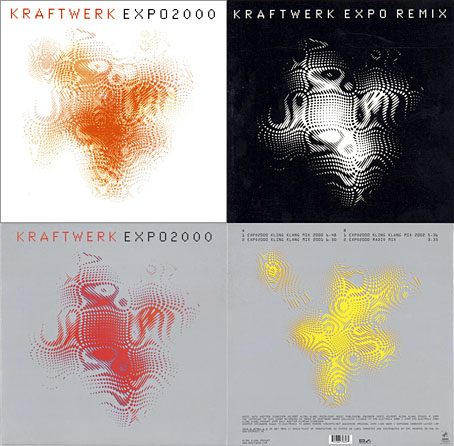
Hannover’s Expo 2000 wasn’t very successful as expositions go but it had an attractive logo, a combination of bold sans-serif type with a moiré background pattern which ideally had to be seen in its animated form. World expositions tend to be concerned with technical innovations and novelties, and this animated design was certainly novel, if impossible to replicate in print. All the static versions of the logo are essentially screenshots of the moving version, with the moiré image frozen at a various places to generate many shape and colour variations. Not all of these are satisfactory. I think it was Matisse who said that anyone can put two colours together; the real challenge is putting three together in a harmonious manner.

expo_logo.gifThe pattern was a little more animated on the original exposition website, albeit reduced to this tiny gif. The site is mostly intact and browsable at the Internet Archive, a primitive thing by today’s standards but Expo 2000 was the first world exposition with a dedicated website, something which really did set it apart from its predecessors. Many of the exposition’s buildings and exhibits would have seemed bizarre or alarmingly ugly to the people who attended the Paris Exposition Universelle in 1900 but much that was on display in Hannover would at least have been comprehensible to a visitor from the past. Trying to explain what “a website” was to someone in 1900, even a futurologist like HG Wells, would have required considerable effort.
expo2000-2.jpg

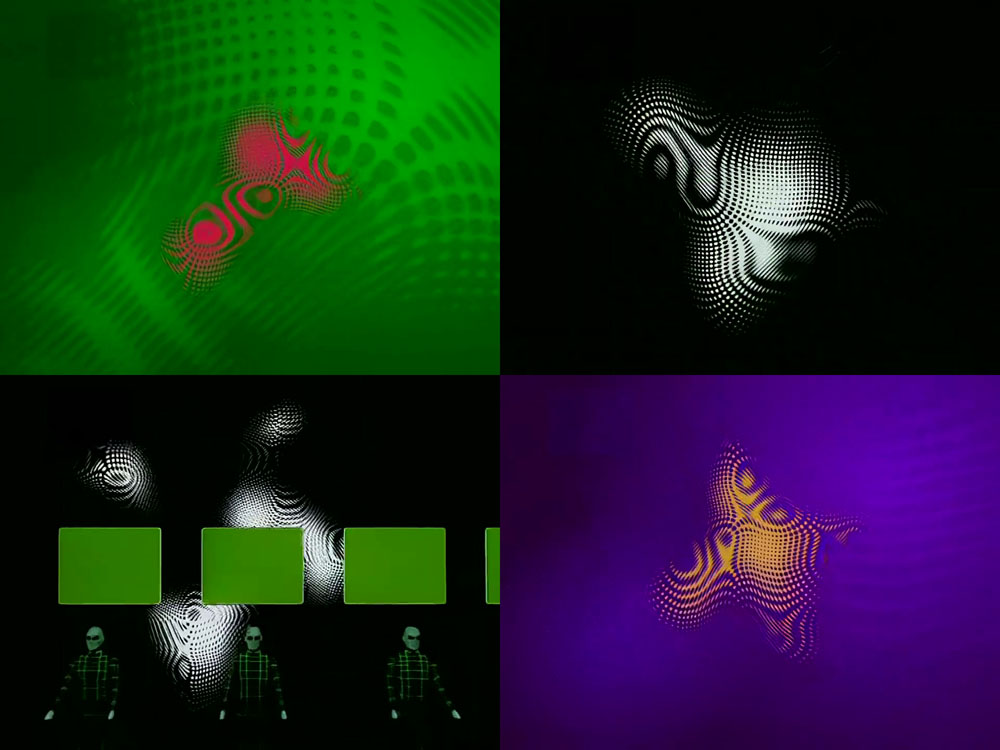
Video for Expo 2000 by Kraftwerk.

Ephemerality is a distinguishing characteristic of world expositions, all those splendid pavilions and eye-catching constructions don’t last very long even though the events themselves involve years of planning. A list of exposition features that have managed to survive would be a disparate collection, taking in well-known landmarks like the Eiffel Tower, Seattle’s Space Needle and the Atomium in Brussels, architectural projects such as the Grand Palais in Paris and the Biosphere in Montreal, and one-off oddities like the Unisphere in Queens and the cement dinosaurs in Crystal Palace Park. If Expo 2000 is remembered for anything today it’s the one-off song that Kraftwerk wrote for the occasion, Expo 2000, which arrived with graphics and visuals based on the expo logo. Kraftwerk had been hired at great cost to create the jingles in different languages that accompany the animated logo. This is turn led to the song, the group’s first new studio composition in 14 years.

expo2000-4.jpg

I thought these abstract images were a good match for Kraftwerk, I prefer them to the other designs for the single which show the four computer-generated figures that later appeared on the cover of Minimum-Maximum. The CD case at the top left was made with lenticular plastic which imitated the moiré effect of the animated logo. I didn’t buy this one when I had the chance, choosing instead the “enhanced” version which came with a minuscule copy of the video in a CD-ROM section. Like most CD-ROM singles, the audio tracks still play but the enhanced section no longer works. Welcome to the future.

Continue reading “The exposition moiré”