Dreams That Money Can Buy

dreams1.jpg

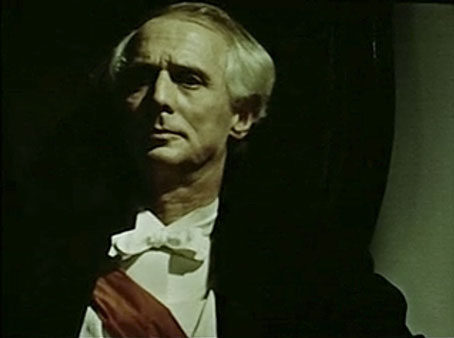
Max Ernst.

The posts this week have all followed a Surrealist theme so I feel compelled to draw attention to the DVD-quality copy of Hans Richter’s Dreams That Money Can Buy (1947) at the Internet Archive. As mentioned before, Richter’s film is one of the key works of Surrealist cinema, made at the time when the art movement had been overwhelmed by the war in Europe but was finding a brief resurgence of interest in the United States. Hitchcock had drafted Salvador Dalí to design the dream sequences in Spellbound two years earlier which may have helped Richter to raise the funds for a colour feature film. The budget was low but the production values are a lot higher than other experimental films of the time, and Richter was able to find in New York a roster of world-class collaborators including Max Ernst, Paul Bowles, Fernand Léger, Man Ray, Marcel Duchamp, John Cage and Alexander Calder.
dreams2.jpg

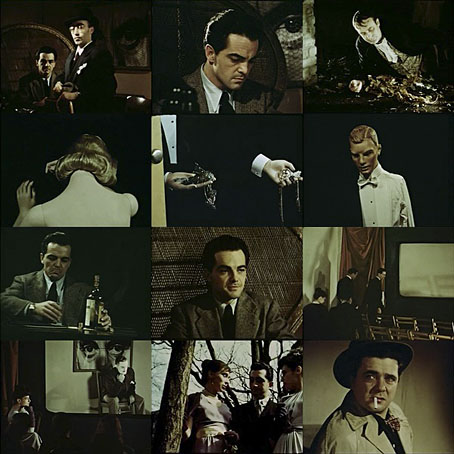
The seven artists provide (and in Ernst’s case, perform in) the dreams that lead character Joe is selling to cover his rent. Fernand Léger’s contribution is a song sequence, The Girl with the Prefabricated Heart, about love among the showroom dummies, while Marcel Duchamp’s spinning discs are given another outing accompanied by music from John Cage. Dreams That Money Can Buy is a fascinating film that’s essential viewing for anyone interested in the art of this period. It’s also a film to which Kenneth Anger owes a small debt: the sleeping woman in Ernst’s Desire sequence is seen at one point swallowing a golden ball that hovers above her mouth, a trick that Anger later borrowed for Inauguration of the Pleasure Dome.
dreams3.jpg

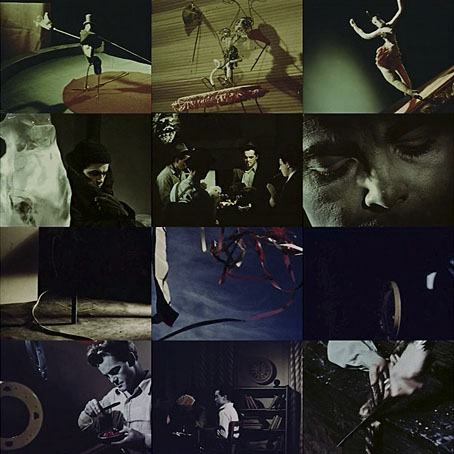
Also at the Internet Archive are three further Richter films: two short works, Rhythmus 21 (1921) and Filmstudie (1925), and also Ghosts Before Breakfast (1927), an inventive experimental piece using cut-up imagery, simple animation and trick photography.

Previously on { feuilleton }
La femme 100 têtes by Eric Duvivier
Entr’acte by René Clair

Weekend links: 2012 edition

life1912.jpg

The Hand of Fate, Life magazine, October, 1912. Artist unknown.

In Search of Barney Bubbles: the great graphic designer is profiled on BBC Radio 4, Monday, 2nd January. And speaking of album cover designers, Cool Hunting talked to Storm Thorgerson about his work.

• FACT mix 310 is a hugely eclectic two-parter from Moon Wiring Club. Grab it while it’s still available. And there’s also Solstmas 2011/2: The Final Countdown, a mix by El Minko Misterioso.

• One of the music events of the new year will be the release of Captain Beefheart’s Bat Chain Puller album. Pre-order it here.

In 1972, at the age of thirty-one, [Fred] Halsted released L.A. Plays Itself, a film which drew upon Kenneth Anger’s surrealist eroto-expressionism, and went way beyond Anger’s sublimated homoeroticism to explicitly portray gay male S/M sex. In 1969, when Halsted first decided to make a sexually explicit film, he decided to create a part for himself, and then be that part.

Halsted Plays Himself by William E. Jones reviewed at Lambda Literary

• Lunar Rover: An interview with Steve Moore and extract from Somnium.

Battersea Power Station, a graveyard of architectural schemes.

Editors might admire a fine book, but are overridden by marketing and accounting departments who now have the final say. I know of a novel that wasn’t accepted by one publisher after the manuscript was first submitted to W.H. Smith, who said that it wouldn’t sell enough.

Jenny Diski on the state of fiction publishing in the UK

• EU copyright on James Joyce‘s works ended at midnight.

Dressed to Kill: Dispelling the Myths of Men in Drag.

The Geology of the Mountains of Madness

Mandala of the Day

Chomeography

The Floppy Boot Stomp (1978 mix) by Captain Beefheart and the Magic Band.

Tom Phillips album covers

phillips00.jpg

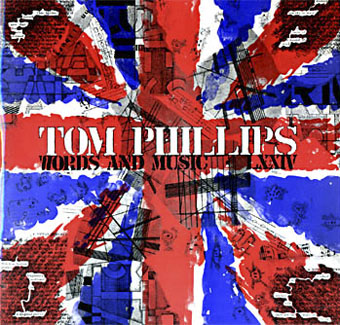
Words and Music (1975) by Tom Phillips.

Two related posts is coincidence, three is a series. Earlier posts from the past couple of weeks looked at album covers created by designers better known for their work in other areas. Tom Phillips is a British artist, writer and composer who I continue to insist is one of our greatest living artists, a figure of singular intelligence, invention and versatility whose lack of grandstanding has never raised his profile to, say, the Hockney level. Phillips’ involvement with the music world, both as composer/librettist, and his oft-cited position as Brian Eno’s art teacher in the 1960s, have led to the creation of a handful of record and CD covers from the mid-70s on. Before we get onto those I’ll note that Phillips has a piece in the latest edition of Eye magazine where he reviews a book of postcards from the Wiener Werkstätte. I happen to have a review in the same issue looking at a republished Kenneth Anger study.

Words and Music above has a January 1975 release date although the cover clearly states “LXXIV” in Phillips’ customary stencil lettering. The pressing was limited to 500 copies and doesn’t seem to have been reissued since which means that copies for sale command excessive prices. Side A comprises recordings of Phillips’ compositions while on the flip the artist/author reads extracts from A Humument, the treated book/experimental novel which is not only his most celebrated work but a project whose influence permeates all of the Phillips oeuvre, including the sleeve art.

phillips01.jpg

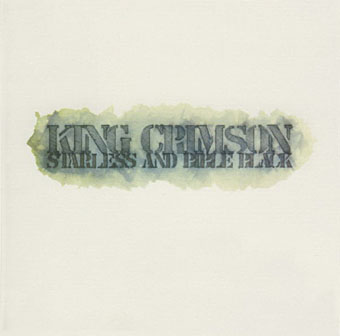
Starless and Bible Black (1974) by King Crimson.

phillips02.jpg

A year before Words and Music, Phillips created the cover art for this King Crimson album, and he’s also credited with the design. The fractured stencil lettering on the gatefold interior resembles similar effects in some of Phillips’ paintings while on the back cover there’s a tiny extract from A Humument bearing the enigmatic phrase “this night wounds time”. I’ve wondered for years how this cover came about: Robert Fripp often selects the art for King Crimson’s covers so was Phillips his choice as artist/designer? Or was it a result of the Fripp and Eno connection? If anyone knows the answer, please leave a comment.

Continue reading “Tom Phillips album covers”

Secret Societies and Spirit Boards

marti.jpg

Komposition für einen Rhombus (2007) by Fabian Marti.

Fabian Marti’s print is one of the few works that stood out for me in the press materials for the Secret Societies exhibition which has just opened at the CAPC Museum of Contemporary Art, Bordeaux:

[Secret Societies] deals with the general theme of secret societies through the prism of contemporary art in the current context of media super-exposure – from WikiLeaks to Credit Rating Agencies (CRA), just to quote two current examples. Artists have always been fascinated by the unknown and the occult. But unlike journalists who are mainly focused on investigating present-day news, artists work around the mechanisms of the secret and are better equipped to question the very limits of the ideology of transparency in our era of super-exposure.

Unfortunately many of the works look like the customary state of affairs, with a bunch of contemporary artists doing their usual schtick and not really questioning (familiar gallery buzzword) anything much at all. On the plus side they have a screening of Kenneth Anger’s Invocation of My Demon Brother, and also a contribution from Cerith Wyn Evans whose Acephalé reworks in neon the André Masson design for Georges Bataille’s Surrealist secret society. Gary Lachman has created an audio guide for the exhibition which is curated by Cristina Ricupero and Alexis Vaillant, and which runs until February 26th, 2012.

For a more determinedly occult showing this month, there’s Spirit Board curated by JL Schnabel at the Articulated Gallery, San Francisco. And elsewhere I’d recommend the work of Scott Treleaven and Jesse Bransford.

Previously on { feuilleton }
The art of Scott Treleaven

William Burroughs interviews

bunker.jpg

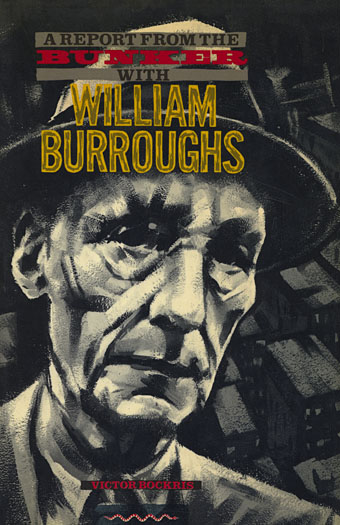
With William Burroughs: A Report from the Bunker (1982) by Victor Bockris. Design by Neville Brody.

If it’s interviews you want, some of the most entertaining are in Victor Bockris’s collection of conversations between El Hombre Invisible and the various New York notables ferried round to sit at Burroughs’ table in his Bowery Bunker. The British edition published by Vermilion was always preferrable for its Neville Brody cover design beside which the US original looks very dull indeed. The encyclopedic Burroughs site Reality Studio has copious lists of earlier Burroughs interviews. They also note the occasions when he put on his journalist hat and went out to interview someone equally famous, usually at the behest of a music magazine. A couple of those pieces are online thanks to the diligence of various fans.

diamond_dogs.jpg

Diamond Dogs (1974), a blend of Lou Reed, George Orwell and William Burroughs.

One such is the 1974 interview with David Bowie for Rolling Stone in which Bowie discusses Burroughs as an influence while Burroughs informs the singer that the heroes of his latest novel, The Wild Boys, favour the Bowie knife as a weapon:

Bowie: Nova Express really reminded me of Ziggy Stardust, which I am going to be putting into a theatrical performance. Forty scenes are in it and it would be nice if the characters and actors learned the scenes and we all shuffled them around in a hat the afternoon of the performance and just performed it as the scenes come out. I got this all from you Bill… so it would change every night.

burroughspage.jpg

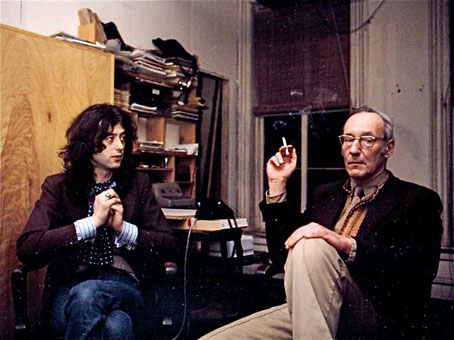
A year later Burroughs got together with Jimmy Page for Crawdaddy magazine where the discussion circles around some of the same subjects, notably the writer’s obsession with sound as a weapon. There’s also this comment from Burroughs which is the kind of thing that always gets my neurons firing:

Antony Balch and I collaborated on a film called Cut-Ups, in which the film was cut into segments and rearranged at random. Nicolas Roeg and Donald Cammell saw a screening of the film not long before they made Performance.

Roeg later directed Bowie, of course, and is one of the dinner guests in With William Burroughs, while Jimmy Page and Donald Cammell both appear in Kenneth Anger’s Lucifer Rising. The connections go round and round… Read the whole piece in a post I made a few years ago at the late, lamented Arthur magazine site.

Elsewhere on { feuilleton }
The William Burroughs archive