H.P.L.

hpl.jpg

It’s that man again. Presenting the latest reworked page from the ongoing reconstruction/improvement of my Haunter of the Dark book. The picture will illustrate “Abdul Alhazred”, the final section of Alan Moore’s text for The Great Old Ones in which HP Lovecraft is positioned at Malkuth, the “Kingdom” in Alan’s eldritch Kabbalah. This makes Lovecraft himself the receptive vessel of the energies descending from the spheres above, while paradoxically being the source of those energies. Or some of them at least… The Great Old Ones is a Mythos Kabbalah which features Dagon, Hastur, Tsathoggua and Yig as well as Cthulhu and the rest. Alan doesn’t subscribe to Kenneth Grant’s baseless theory that Lovecraft really was a receptacle for transmissions from interdimensional entities, but the incorporation of the writer into his own pantheon isn’t unprecedented. Abdul Alhazred was a childhood persona of Lovecraft’s before he assigned the name to the author of Al Azif, or the Necronomicon; further personas may be found in Through the Gates of the Silver Key (“Ward Phillips”), Robert Bloch’s The Suicide in the Study (“Luveh-Keraph, priest of Bast”), and other fictions.
hpl.jpg

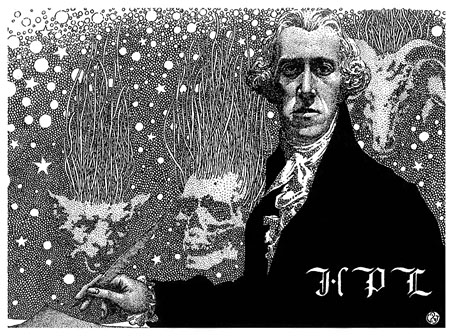
HPL (1937) by Virgil Finlay.

Whether this literary sport warrants the apparently limitless production of Lovecraftian art featuring the man himself, usually sprouting or festooned with tentacles, is a debatable matter. Virgil Finlay began the fantastic portrait trend in 1937 with his memorial depiction of the author writing with a quill pen while dressed in 18th-century garb. The earliest example that I can think of showing Lovecraft paired with the ubiquitous tentacles was the Moebius cover for Lettres d’Arkham in 1975, although there may well be other drawings prior to this. I’ve often wondered what Lovecraft would have made of the deluge of publications and images derived from his work, especially those that place him inside the products of his imagination.

moebius.jpg

Cover art by Moebius, 1975.

And speaking of which… I was at a loss at first with how to approach a new Lovecraft portrait, all I knew was that one was necessary. The original Malkuth picture from 1999 is another poor Photoshop job which has nevertheless been reused elsewhere on a few occasions, even appearing in 2007 on the cover of an issue of FATE magazine. For the new version I started with the portrait itself, using white lines on black to copy the same portrait photograph that formed the centre of the older picture. This was then duplicated and flipped horizontally to create a kind of Janus head which gives the portrait a suitably weird quality without wreathing it in tentacles. The mirrored head harks back to a sequence of treated photos by JK Potter which I first saw in the Heavy Metal Lovecraft special in 1979. Potter had used the same portrait photo to create effects that were somewhat compromised by poor reproduction, leading me to be believe that I’d created something slightly different to the first panel in his sequence. While researching this post I turned up an earlier version of the artwork which appeared on the back of the first issue of a US fanzine, Fantasy Mongers, also in 1979. The clearer reproduction revealed that the first head in Potter’s sequence is almost identical to my own. Ah well…

jkpotter.jpg

Photo art by JK Potter from the back cover of Fantasy Mongers #1, 1979.

The rest of the picture was improvised around this central image. Having drawn the portrait in white-on-black I decided to use a similar technique for the other elements. The Cthulhoid pillars are based on those in my Red-Night Rites painting from 1997, one of which appeared in the 1999 picture. The smaller figure on the right is from one of the photos that Wilfred Talman took while wandering the streets of New York with Lovecraft and Frank Belknap Long. This also appeared in the 1999 picture but for the new version I’ve emphasised what appears to be a book that Lovecraft is carrying in his right hand. Searching around for a complementary figure that might represent Abdul Alhazred turned up a 19th-century photo of a character who not only looked the part but is also standing in a manner similar to the Talman Lovecraft. If you look closely he’s also carrying a book, an addition of my own which turns him into the author of Al Azif. The polyhedra supporting the pair aren’t as arbitrary as they may seem. The spheres serve a dual purpose, preventing the figures from floating in space (or standing in water) while also relating to the Sephiroth of Malkuth which is identified with the Earth in the Kabbalistic scheme of planetary associations.

The next reworked picture will be Tsathoggua which is being polished rather than completely overhauled. I’m hoping I might have this done by the end of the month but I’m still chipping away at The Dunwich Horror while doing all this, as well as working on things which pay the bills. (I’ve just finished designing and illustrating another book.) Further progress will be announced in due course.

Elsewhere on { feuilleton }
The Lovecraft archive

Previously on { feuilleton }
The Return of the Crawling Chaos
Lettering Lovecraft
Weird ekphrasis and the Dunwich Horrors
Kadath and Yog-Sothoth
Another view over Yuggoth
The art of Jean-Michel Nicollet

nicollet12.jpg

French artist Jean-Michel Nicollet isn’t really known as a comic artist but one of his strips appeared in the Métal Hurlant Lovecraft special in September, 1978, and was reprinted in the Heavy Metal Lovecraft special a year later. Nicollet’s three-page story, H.P.L., is a slight thing which you can read below but his paintings present more of the atmosphere of Lovecraft’s fictional worlds than many of the other strips in those issues, including the equally slight contribution from Moebius. Prior to this, Métal Hurlant had been using some of Nicollet’s paintings for cover art, as a result of which one of the same illustrations appeared on the cover of the very first issue of Heavy Metal magazine in 1977. The winged Lovecraft from his comic strip turned up again on the cover of a Robert Bloch story collection for French publisher Nouvelles Éditions Oswald (NéO) in 1980.

nicollet09.jpg

Nicollet seems to have retired now from cover work but during the 1970s and 80s he was a very prolific illustrator, especially for NéO. NooSFere has a gallery of his covers which are mostly for reprints of early 20th-century horror, fantasy and adventure tales, also a few detective stories. He seems to have enjoyed illustrating classic detective fiction (photos show him posing with a large Holmesian pipe) so there may well be more covers which aren’t included in the NooSFere list.

nicollet11.jpg

The selections I’ve chosen here match my own preferences for cosmic horror and weird fiction, and represent another attempt to look further afield for this type of illustration. French cover design can be unsympathetic to cover illustration, crowding the paintings with poor type choices and purposeless graphics. The uniform layouts of NéO treat the artwork with more respect.

nicollet13.jpg

nicollet14.jpg

Continue reading “The art of Jean-Michel Nicollet”

Lettering Lovecraft

font.jpg

A font design.

I’m still working on the new edition of my Lovecraft book, other projects permitting. The restoration gained a substantial boost last week when I finished re-lettering all the old comics pages, something I was initially reluctant to do given the amount of work involved. To date, there are 71 finished comics pages, 69 of which contain one or more lettered captions. This has never been a book where I’d want to use a typical US-style comics font, and with drawn pages you often want to avoid using book fonts which look too mechanical and precise when set among drawings. The thing to do—if I was going to do it at all—would be to design a font that would be a neater version of my hand-drawn lettering without looking so different that it changed the character of the pages. I’ve made fonts in the past but never taken the time to make one that would have to work this well.

There were two reasons for committing to all the effort. The first was that my lettering on the old pages had never been all that good to begin with. When I started work on The Haunter of the Dark in January 1986 the only comic strips I’d drawn had been jokey four-panel things while still at school. For the Lovecraft adaptations I was inventing my own method of comics adaptation from the ground up, paying little attention to prior examples beyond being vaguely inspired by Bryan Talbot’s first Luther Arkwright book, and the strips I enjoyed in Heavy Metal magazine. The Heavy Metal strips generally gave primacy to the art, with artwork that was more like illustration than production-line comic art. As with underground comics, most of the strips were also lettered by the artists themselves. The captions I drew on the second page of The Haunter of the Dark were pretty much invented on the spot, and since I tended to go along with these decisions once they’d been made, the first few pages established the look of all those that followed.

stone.jpg

The weathered reference page from A Book of Lettering.

The lettering style I ended up with was an awkward amalgam of three different designs: my own lower-case letters, plus two sets of capitals taken from a page in A Book of Lettering (1939) by Reynolds Stone, one of my mother’s books from art school that she gave me when I was about 10 years old. For some reason I thought it would be a good idea to use the Black Letter (or Gothic) capitals at the beginning of each new text box, with the uncials being used for any other capitals in the following sentences. By the time I’d finished the first story I was starting to think that using the Gothic caps was a bad idea, but rather than correct all the pages I stuck with the decision through The Call of Cthulhu and on into The Dunwich Horror. More of a problem for readers was that my lower-case letters were made with the same very thin pen I was using for most of the drawing, so they weren’t always easy to read. Once again, I stuck with the original decision.

All of which leads to the second reason for re-lettering the pages: if I was going to finish The Dunwich Horror then I’d have to letter any new pages in the old manner, hand-drawing boxes that matched the earlier pages. It was this factor that made me decide I’d much rather design a font based on my hand-drawn letters then apply this to all the pages in order to create a more satisfying and unified body of work.

BBOM-font.jpg

The Bumper Book of Magic font.

If you’re used to working with vector shapes—something I do almost every day—dropping shapes you’ve designed into a font-making application is easy enough. The time-consuming part—and the thing that makes me avoid creating more fonts of my own—is applying all the kerning settings to every single character. Kerning is the name for the process that causes all the letters to sit neatly beside each other without any unsightly gaps. When I was working on The Bumper Book of Magic I created a font based on the book’s magical alphabet so I could type out words to use on some of the pages. I didn’t bother tuning the kerning for this design since it was only being used for headings, not passages of text; any uneven spaces were adjusted manually. My Lovecraft font isn’t as finely tuned as those produced by professional font designers but it does function as intended, and is much more readable than its hand-drawn equivalent.

text1.jpg

Hand-drawn lettering from The Call of Cthulhu, 1987.

In digitising the letters I made a number of small adjustments. The upper-case letters are still rather uneven, being for the most part based on the uncial set from the lettering book. The lower-case letters have been tweaked a little so that the “t” isn’t so easily confused with the “e”, while all the loops on “g”, “j”, “p”, “q” and “y” now match each other. I’ve followed the original design by creating two sets of tails for these letters. The looped tails were an affectation that had a tendency to impinge on any letters running underneath which meant I had draw half loops to avoid having a tall letter or a capital collide with the loop above it. I’ve grown used to seeing the looped tails, and I wanted to keep them for the font design, so to evade collisions I made an extra set of letters with half tails which can be used at appropriate instances. In doing this I was pleased to see that some of the loops made ligature-style joins with the ascenders of letters like “h” or “k”. I can imagine typesetters frowning at the occasional overlaps of tails with ascenders but I don’t mind this so long as the readability of the sentence isn’t affected too much.

text2.jpg

The same passage re-lettered (and slightly rewritten), 2025.

The results of all the effort have been hugely beneficial. All the pages are now much neater and more readable yet they don’t look substantially different from the older printed versions. I also weeded out a couple of unforgivable spelling errors which had been sitting uncorrected for far too long. And I was able to get rid of the ruled lines that I used to end the captions where the hand-drawn letters didn’t quite fill out the box. One advantage of lettering a pre-existing story is that you can add extra words to the captions, or even rewrite whole sentences. In a few instances I’ve been able add in more of the adjectives that were omitted to save space, so that some of the pages now have more of Lovecraft’s text than they had before.

This week I’m back at work on The Dunwich Horror which is now proceeding without my having to worry about the lettering. Further updates will follow.

Elsewhere on { feuilleton }
The Lovecraft archive

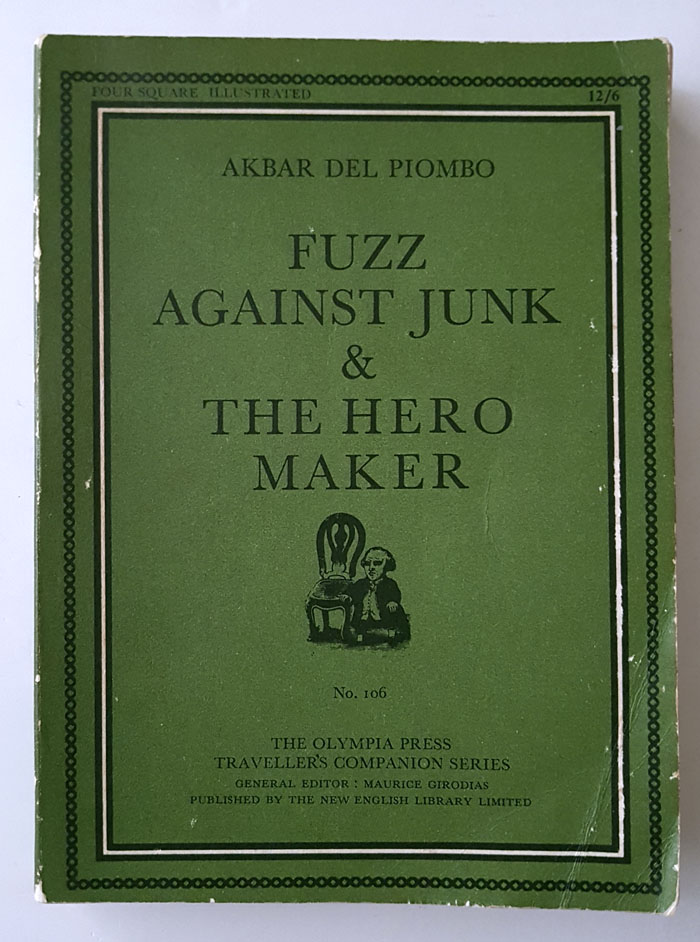
Fuzz Against Junk & The Hero Maker

rubington1.jpg

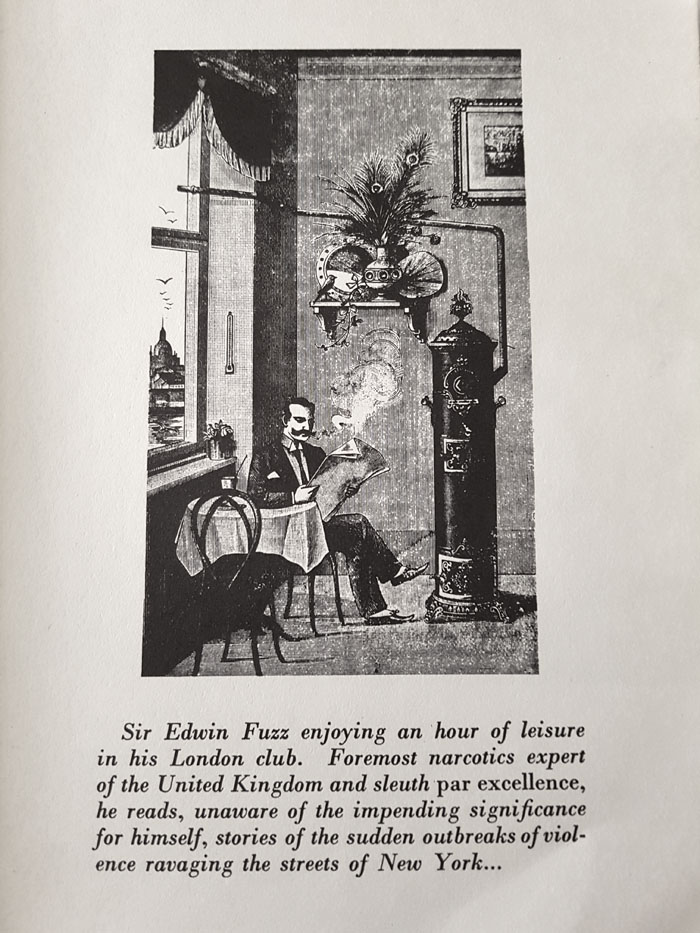
This is another of those posts in which I brag about finding an old book in a charity shop for a lot less than you’d have to pay for it online. But it does give me the opportunity to say something about American writer/artist Norman Rubington and his alter ego Akbar Del Piombo, something I was sure I’d done already. One of the weekend posts linked to an article about Rubington’s work but my discussion of his collages is in the essay I wrote about Wilfried Sätty for the Strange Attractor Journal, a piece which isn’t available here.

rubington8.jpg

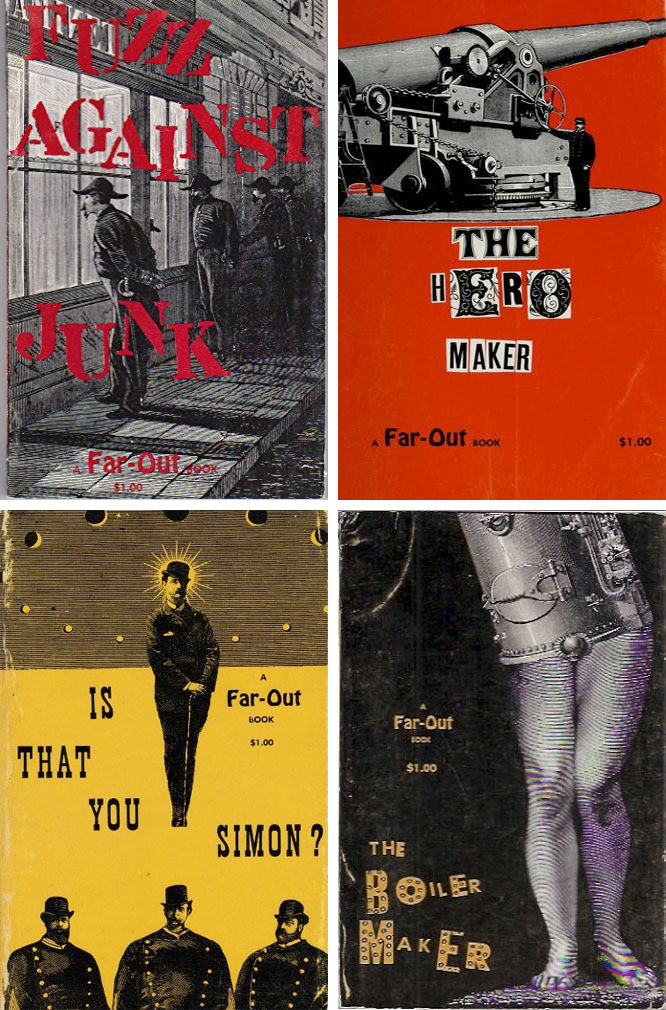
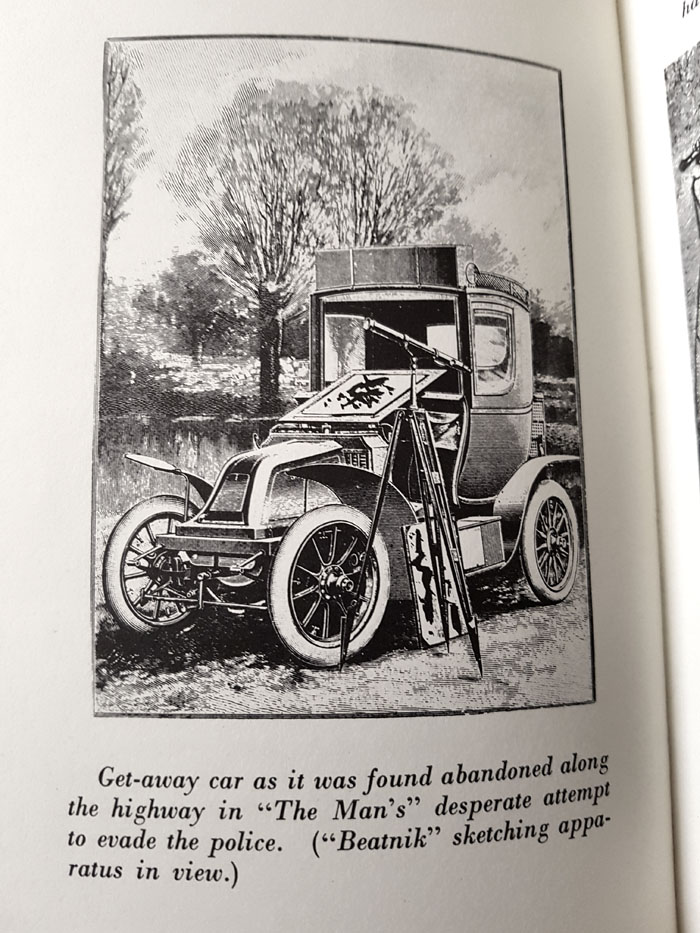
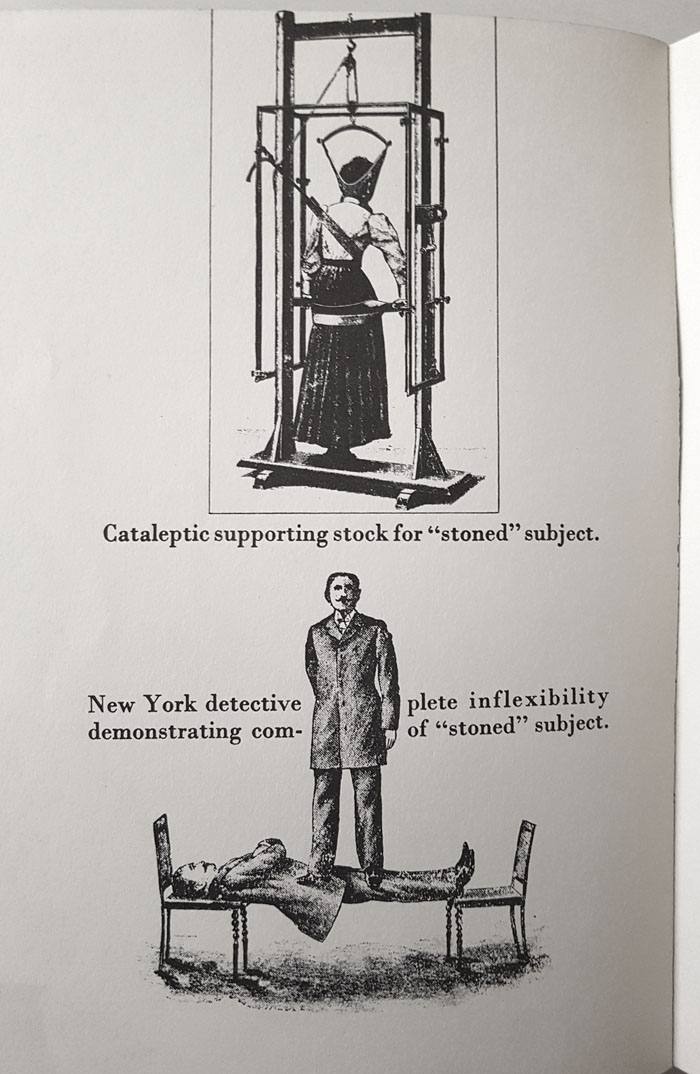
The engraving collages of Norman Rubington (1921–1991) were probably the first to use the form developed by Max Ernst for explicitly humorous purposes. They’re certainly among the earliest to take the lead from Ernst while aiming themselves at an audience outside the art world. There is humour in some of Ernst’s collages, of course, but it tends to be the black variety favoured by the Surrealists (and actually defined by them; André Breton’s 1940 Anthology of Black Humour was a pioneering study). Rubington’s small books exploit the comic potential of antique illustrations by repurposing them as the primary content in a series of absurd narratives; these aren’t “graphic novels”, they’re more like heavily-illustrated comedy routines. There were four books in the original series—Fuzz Against Junk (1959), The Hero Maker (1959), Is That You Simon? (1961) and The Boiler Maker (1961)—with a fifth title, Moonglow, appearing in 1969. Olympia Press published the books in France, with US editions appearing around the same time under the Far-Out imprint used by Citadel Press. My charity purchase is the 1966 New English Library reprint of an Olympia Press collection of the first two volumes. The olive-green Olympia covers always provoke a Pavlovian grab response when I see one on a shelf although I’ve yet to find a copy that wasn’t an NEL reprint.

rubington2.jpg

rubington3.jpg

rubington4.jpg

Continue reading “Fuzz Against Junk & The Hero Maker”

Weekend links 599

achilleos.jpg

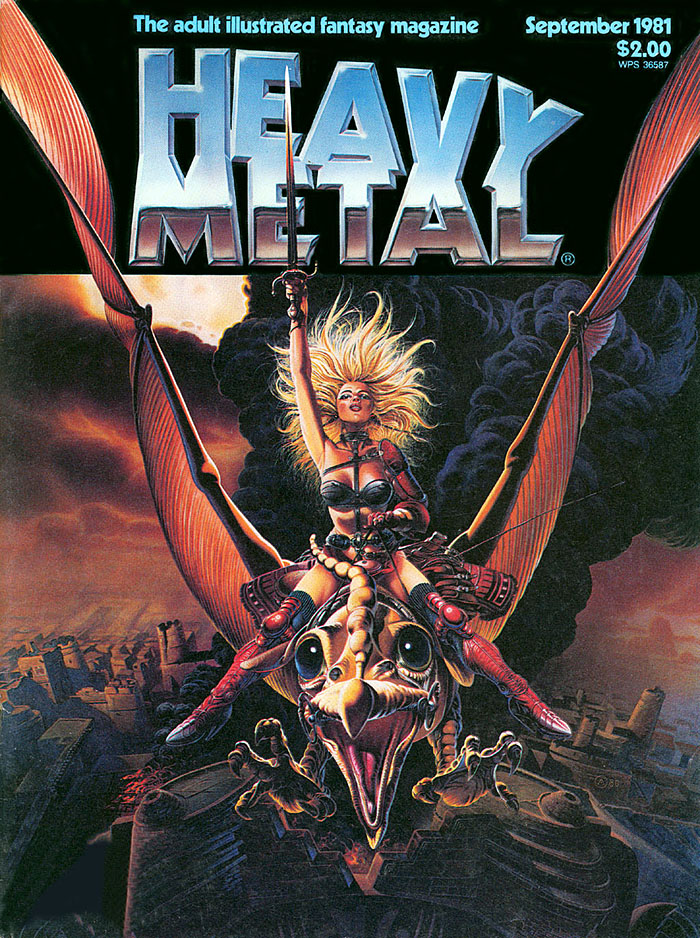
Taarna by Chris Achilleos for Heavy Metal, September 1981. A typical piece by Achilleos, whose death was announced this week, and very typical for a Heavy Metal cover. Achilleos was a prolific illustrator.

• New music: The Truth, the Glow, the Fall (Live At Montreux) by Anna von Hausswolff, from her forthcoming album, Live At Montreux Jazz Festival. The last gig I went to was in October 2019, to see Sunn O))) supported by Anna von Hausswolff. Easily one of the best things I’ve ever experienced. Meanwhile, Anna von Hausswolff has had to cancel a Paris church concert following protests by a rabble of outraged Catholics. Bravo les crétins!

• “…it is easy to forget that Montesquiou—regardless of his own work—was not merely emblematic of Decadence, he was essentially patient zero in its viral spread.” Strange Flowers explores the exquisite life of the bat-obsessed, hydrangea-cultivating Robert de Montesquiou.

• “Kotatsu have been around longer than we imagine. And art history has the proof.” Spoon & Tamago on an old Japanese method for warming a room during winter. Also further evidence that cats always find the warmest place in any house.

Dennis Cooper‘s favourite fiction, poetry, non-fiction, film, art, and internet of 2021. Thanks again for the link here!

The Wire magazine has opened its collection of articles by the late Greg Tate so they may be read by non-subscribers.

• “Neil Bartlett is a gay writer’s gay writer,” says Jeremy Atherton Lin reviewing Bartlett’s latest, Address Book.

• James Balmont on the psychedelic cinema of Nobuhiko Obayashi.

• Steven Heller’s font of the month is Erotique.

Northern lights photographer of the year.

• The Strange World of…Takuroku.

• RIP Robbie Shakespeare.

• Robbie Shakespeare’s bass x 3: King Tubby Meets Rockers Uptown (1974) by Augustus Pablo | Nightclubbing (1981) by Grace Jones | Bass And Trouble (1985) by Sly & Robbie