Copying Clarke

clarke.jpg

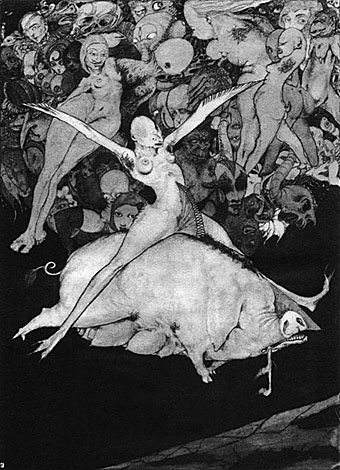
“On to the brocken the witches are flocking.” From Faust (1925) by Harry Clarke.

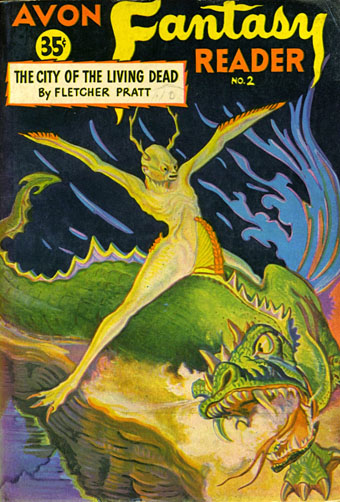
Spotted earlier this week, a rather blatant swipe from Harry Clarke’s Faust by an unknown cover artist for the Avon Fantasy Reader. Such borrowings weren’t uncommon in the pulp magazines—the pressure of deadlines no doubt encouraged them—and I’ve logged a couple of other examples in the past, here and here. Clarke’s scene shows a crowd of his mutated witches flaunting themselves in a manner that was too strong for a fantasy magazine. The Avon cover is probably illustrating The Day of the Dragon (1934), a novelette by Guy Endore. Everything in this edition was a reprint, and among the contents there’s also The Yellow Sign by Robert Chambers.

avon.jpg

Avon Fantasy Reader, No. 2, 1947.

Previously on { feuilleton }
Harry Clarke’s Fairy Tales of Charles Perrault
Harry Clarke in colour
The Tinderbox
Harry Clarke and the Elixir of Life
Cardwell Higgins versus Harry Clarke
Modern book illustrators, 1914
Illustrating Poe #3: Harry Clarke
Strangest Genius: The Stained Glass of Harry Clarke
Harry Clarke’s stained glass
Harry Clarke’s The Year’s at the Spring
The art of Harry Clarke, 1889–1931

Harry Clarke’s Fairy Tales of Charles Perrault

clarke01.jpg

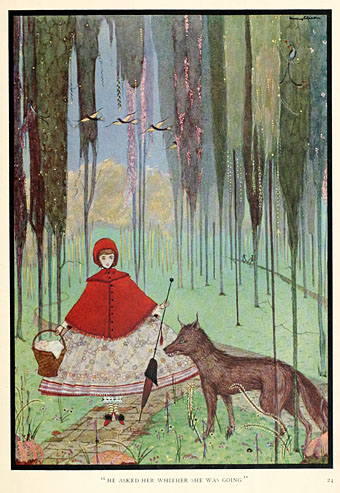
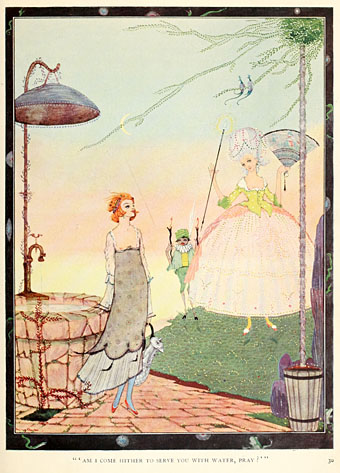
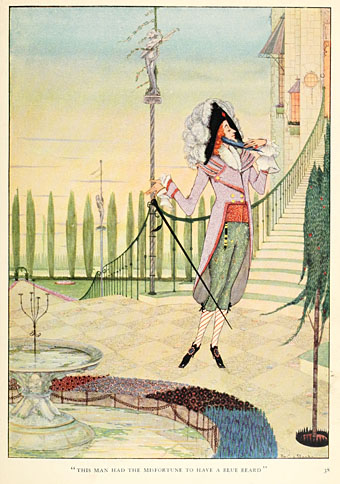
After posting John Austen’s Perrault illustrations I intended to follow-up with other versions but work has been non-stop lately so it’s taken most of this month to do so. Harry Clarke’s edition of Perrault was published in 1922, and while it’s not exactly unfamiliar its one of his illustrated editions that gets overshadowed by the grotesque masterpieces of Faust and Edgar Allan Poe. This is Clarke employing his most delicate Beardsley-like style, the only hint of anything unwholesome being the animated black pudding that fixes itself to a woman’s nose in The Ridiculous Wishes. Bluebeard, by contrast, seems a delightful fellow despite his unfortunate wife-killing propensities.

I’ve only included the colour plates here but the copy at the Internet Archive contains many full-page black-and-white drawings along with vignettes. The plate showing Cinderella and the Prince has been stolen from their edition so I’ve added a scan from my own copy of the book.

clarke02.jpg

clarke03.jpg

Continue reading “Harry Clarke’s Fairy Tales of Charles Perrault”

Albin Grau’s Nosferatu

nosferatu01.jpg

For many directors a film like Nosferatu: A Symphony of Horror (1922) would have been a career peak, but Friedrich Murnau went on to make The Last Laugh (1924), Faust (1926) and Sunrise (1927). All those films improve cinematically on Nosferatu but the vampire film continues to cast the longest shadow: quoted, remade, and with even its production fictionalised in Shadow of the Vampire (2000). The lasting success of Nosferatu wasn’t all Murnau’s doing, however.

nosferatu05.jpg

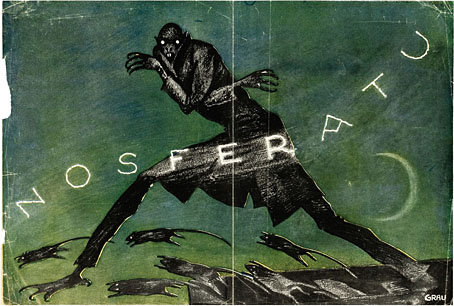
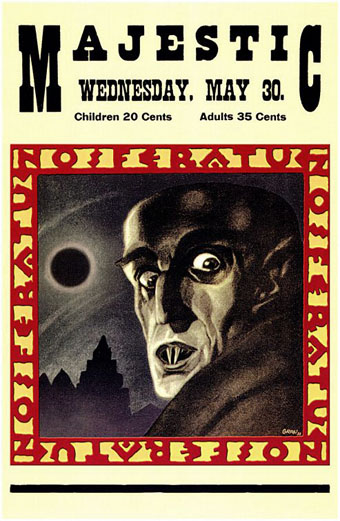
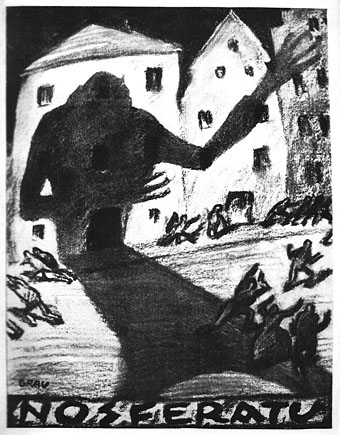
It’s arguable that without the preliminary work of production designer Albin Grau (1884–1971) the film might have been little more than a curious precursor of the Universal Dracula (1931). Grau was responsible for the set design and the extraordinary appearance of Max Schreck’s Count Orlok; Grau also created the film’s memorable poster and advertising imagery in which the vampire’s appearance hints at something even more terrible than the figure that stalks before the camera.

nosferatu03.jpg

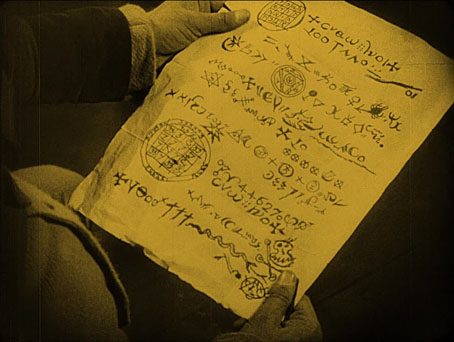
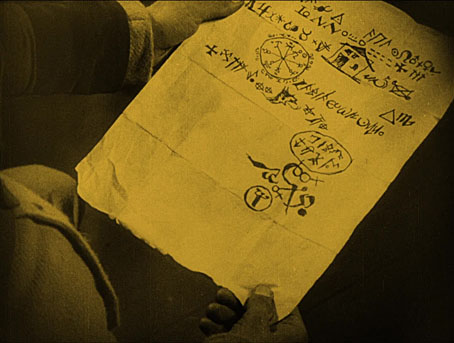
A great deal of German silent cinema is labelled “Expressionist” even if the films themselves show little in the way of overt Expressionism. Nosferatu isn’t very Expressionist at all but Albin Grau’s sketches and posters certainly tend in that direction, so much so that they make me wonder how different the film might have been if it had been as stylised as The Cabinet of Dr. Caligari (1919). In addition to his artistic pursuits, Grau was an occultist which explains the attention to detail in the bizarre contract drawn up between Knock and Count Orlok, a document that looks more like a page from a grimoire than anything used by an estate agent. There’s a quote from Grau in his occult capacity in John Symonds’ Aleister Crowley biography, The Great Beast, complaining in 1925 about Crowley’s ascension to the heights of the Ordo Templi Orientis.

nosferatu11.jpg

Nosferatu: The Knock-Orlok contract.

nosferatu12.jpg

Nosferatu comes out of the occult preoccupations, having been Grau’s project from the beginning when he formed a film company, Prana-Film, with Enrico Dieckmann. The pair announced plans for three films: Dreams of Hell, The Devil of the Swamp, and a drama about a vampire. Only Nosferatu materialised then sank the company almost as soon as it was finished: Prana-Film had spent more on publicity than on the film itself, and went deep into debt. The success of the film might have helped their finances but the death blow was struck by Florence Stoker and the British Society of Authors who won a court case against the company for filming Dracula without permission. The efforts of the Stoker estate to destroy Nosferatu are recounted in detail in David J. Skal’s fascinating Hollywood Gothic (1990). Many of Murnau’s minor films were lost through various misfortunes, and it’s a fluke that a handful of prints of Nosferatu survived. Happily for us, it’s not only vampires that manage to remain undead.

Continue reading “Albin Grau’s Nosferatu”

Weekend links 225

mori.jpg

Still from The Shaman-Girl’s Prayer (1997), a video piece by Mariko Mori. This page has pictures of Mori’s futuristic/cosmic performances, films & environments.

Time Out of Mind (1979) was a BBC TV series about science fiction writers, five short films concentrating on Arthur C. Clarke, John Brunner, Michael Moorcock, Anne McCaffrey and an sf convention. I was only interested in the Moorcock film at the time, not least because it featured a short clip of Hawkwind playing Silver Machine, and inserted scenes from the film of The Final Programme (1973) between the interviews. The Moorcock episode is less about his books than about New Worlds magazine and the so-called New Wave of sf in general, so you also see rare footage of M. John Harrison in a Barney Bubbles “Blockhead” T-shirt talking then ascending a limestone cliff, and bits of interviews with Brian Aldiss and Thomas Disch. Ballard isn’t interviewed but is present via a scene from the Harley Cokeliss film Crash! (1971) in which Gabrielle Drake slides in and out of a car while someone reads Elements of an Orgasm from The Atrocity Exhibition.

• “…there happened to be a book on Ritual Magick that talked about John Dee and summonings and Dr. Faust and all that kind of stuff. So then obviously at that age, too, I read HP Lovecraft and then Michael Moorcock and what they call fantasy literature. Through HP Lovecraft I discovered Arthur Machen, and I think that sort of percolated down inside…” Dylan Carlson of Earth talking to Steel for Brains. The Wire has the vinyl-only track from the new Earth album, Primitive And Deadly, and a track from Carlson’s solo album, Gold. Related: Artwork by Samantha Muljat, designer/photographer for the new Earth album.

Phantasmaphile has details of the next two issues of deluxe occult magazine Abraxas. Issue 6 includes a major feature on Leonora Carrington while Luminous Screen is a special issue devoted to occult cinema.

• More Broadcast: Video of a performance at Teatro Comunale di Carpi, March 2010 (part 2 here), and “constellators and artifacts” at A Year In The Country.

• “Petition demands return of ‘Penis Satan’ statue to Vancouver.” There’s an uncensored photo of the contentious statue here.

• Literary Alchemy and Graphic Design: Adrian Shaughnessy on James Joyce’s writings among graphic designers.

• Frank Pizzoli talks to John Rechy about “the gay sensibility”, melding truth and fiction, and his literary legacy.

• Mixes of the week: Secret Thirteen Mix 127 by Roberto Crippa, and FACT Mix 459 by Craig Leon.

Alan Moore has finished the first draft of his million-word novel, Jerusalem.

• Crazy pavings: Alex Bellos on Craig Kaplan’s parquet deformations.

Noise Not Music: “Live recordings, obscure cassettes and more…”

Pylon of the Month

Zoot Kook (1980) by Sandii | Rose Garden (1981) by Akiko Yano | Telstar (1997) by Takako Minekawa

Paul Konewka’s Faust

faust01.jpg

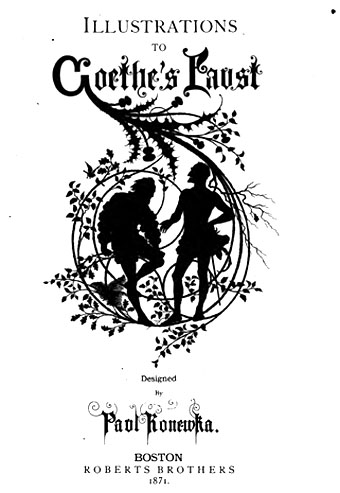
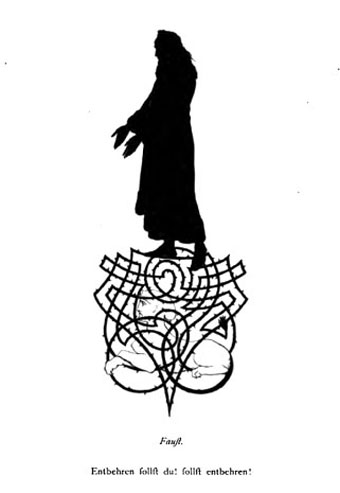
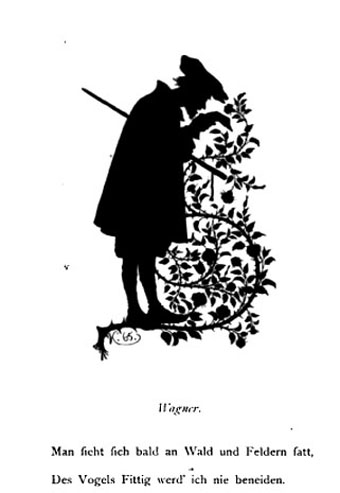
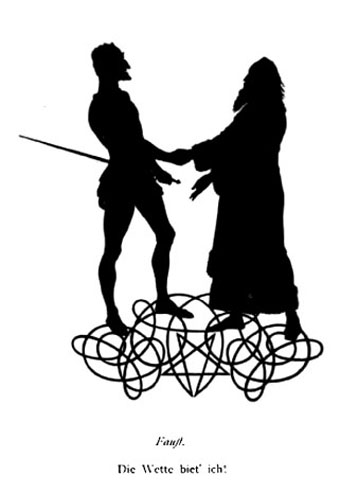
Discovered via the GoetheZeitPortal, these illustrations for Faust by German artist Paul Konewka (1841–1871) date from 1865, although the copies here are from a later edition. Konewka was a silhouette cutter so while these may look like ink illustrations they’re actually paper silhouettes displaying a formidable level of detail and complexity. Whatever the technique, the story itself is immediately recognisable from the characters even if none of the more dramatic scenes are represented. There aren’t many books you could treat in this fashion since the story has to be almost universally familiar; Shakespeare would be an obvious candidate—Konewka subsequently produced illustrations for A Midsummer Night’s Dream—fairy tales (like Arthur Rackham’s Sleeping Beauty), and also Lewis Carroll’s Alice books come to mind.

The copies shown here are from another shoddy Google scan at the Internet Archive but you do get to see all the pages. The Goethe site has better copies of the illustrations.

faust02.jpg

faust03.jpg

faust04.jpg

Continue reading “Paul Konewka’s Faust”