The Dream Machine

dreamachine1.jpg

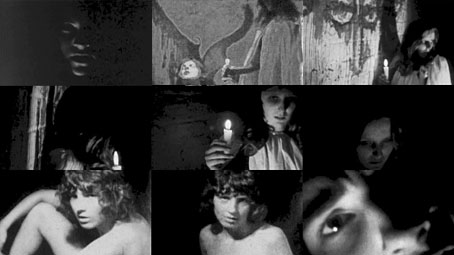
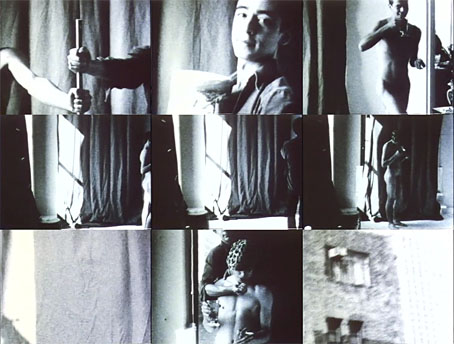
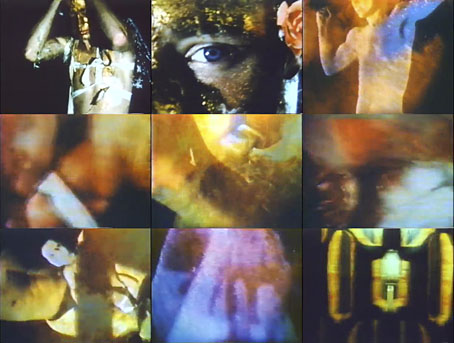
This is a 35-minute anthology film from 1986 with a very painterly, poetic (for want of a better term) quality of a kind I’ve not seen for some time in queer cinema. The reasons for this can be debated at greater length than I care to attempt, but it’s notable that a feature of the work of Derek Jarman—one of the featured directors—was an approach that was always happy to dispense with naturalism and the aping of familiar film and television narratives. In place of Jarman’s visionary approach we now have the “ordinary gay lives” of Weekend and Looking. This may satisfy those eager to see their own lives reflected on the screen but I’m usually expecting more from my cinema than another mirror held up to mundane reality. (And a very circumscribed reality, at that.)

dreamachine2.jpg

The theme of The Dream Machine is Bryon Gysin’s hallucination-inducing artwork of the same name. Brief clips by Tim Burke of Gysin sat with eyes closed in front of his flickering cylinder form the connective tissue between sections by directors Jarman, Michael Kostiff, Cerith Wyn Evans, and John Maybury. We can take these as either the dreams of those behind the camera or perhaps the visions seen by Gysin behind his eyelids. Needless to say there’s a fair amount of naked male flesh on offer, presented in a matter-of-fact manner or as the embodiments of some personal symbolism. The film can be seen here in not very flattering quality. Both Cerith Wyn Evans and John Maybury started out as assistants on Jarman’s films. Wyn Evans appears briefly in Caravaggio (1986) but is now better known as an artist, while Maybury went on to direct another excellent artist biopic, Love Is the Devil: Study for a Portrait of Francis Bacon (1998).
dreamachine3.jpg

Previously on { feuilleton }
Jarman (all this maddening beauty)
Sebastiane by Derek Jarman
A Journey to Avebury by Derek Jarman
Derek Jarman’s music videos
Derek Jarman’s Neutron
Mister Jarman, Mister Moore and Doctor Dee
The Tempest illustrated
In the Shadow of the Sun by Derek Jarman
Derek Jarman at the Serpentine
The Angelic Conversation
The life and work of Derek Jarman
Weekend links 196

wellcome1.jpg

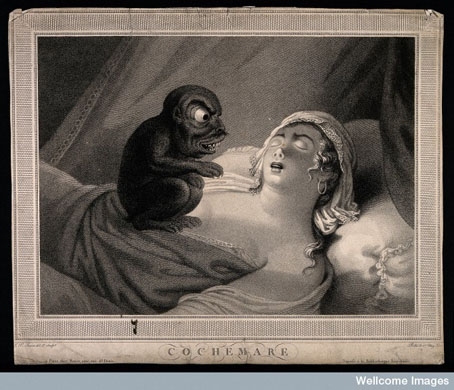
Cochemare (1810) by Jean Pierre Simon. One of 100,000 high-resolution images now available from Wellcome Images.

• Ted Morgan’s Literary Outlaw: The Life and Times of William S. Burroughs (1990) was a solid biography blighted by a bizarrely bad-tempered and judgemental attitude towards many of Burroughs’ friends and colleagues. Morgan says Burroughs disliked the book (he also says his subject died in 1993, not 1997…) so I’m looking forward to the new biography by Barry Miles, Call Me Burroughs: A Life. There’s a curious detail in Jeremy Lybarger’s piece about August Derleth, HP Lovecraft’s publisher and lifetime champion, causing a fuss after the Chicago Review published extracts from Naked Lunch in 1958. Burroughs enjoyed Lovecraft’s fiction but it’s unlikely that Lovecraft would have been anything other than appalled by Burroughs’s work. Barry Miles will be holding a Q&A session at the ICA, London, next month following a screening of Howard Brookner’s restored documentary, Burroughs: The Movie.

• Mix of the week: Secret Thirteen Mix 105 by Sturqen. At 3quarksdaily Dave Maier writes in praise of drones (the musical variety), and links to three mixes.

• Interviews: Haakon Nelson talks to Harold Budd, Joseph Burnett talks to William Basinski, John Stezaker talks to Nicolas Roeg.

Derek responded to an invitation to address [AIDS] hysteria by lining the gallery with a set of tarred and feathered mattresses loaded with the traces of queer love-making and then framing them against wallpaper made from Xeroxed, blood-spattered front pages. In the middle of all this he then constructed a makeshift barbed-wire cage that imprisoned and protected a pair of apparently naked lovers – usually a pair of handsome, sleeping boys, but for one afternoon at least Tilda Swinton dropped by, just to make the point that the boys didn’t have an exclusive stake in or artistic rights to this crisis. Between the walls and the cage, the air of the gallery was thick with tension and hatred – sometimes literally so, as visitors to the gallery objected vociferously to what they were seeing.

Neil Bartlett on celebrating Derek Jarman 20 years after his death.

• William Friedkin’s Wages of Fear remake, Sorcerer (1977), receives an overdue reissue on DVD/Blu-ray in April.

James Knowlson asks “What lies beneath Samuel Beckett’s half-buried woman in Happy Days?”

• The UK’s web filtering seems to be blocking common sense says Jane Fae.

wellcome2.jpg

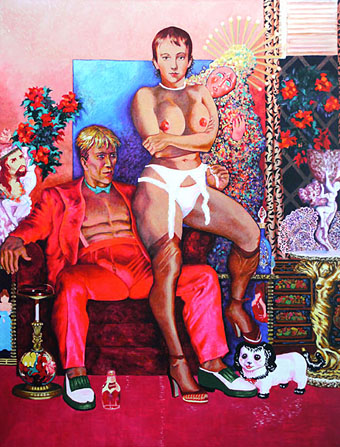
A devil buggering a man (19th century).

• The poetry of Hart Crane, from the American epic to personal belonging.

The Sonny Sharrock Quartet play Stupid Fuck, live 1988.

Pinterest nightmares

Borogoves

• Lutinemusic: Espera | Died Of Love | All I Have Is Gold

Weekend links 191

strongowski.jpg

Two cover designs from Eliash Strongowski’s 30 Days—30 Covers project.

My thanks once again to Dennis Cooper for placing this blog on his end-of-year lists. Meanwhile. one of the albums I designed earlier this year, Cold Mission by Logos, made the 30 Best Album Covers of 2013 list at FACT.

• “Many of their more outlandish ideas never saw fruition: an organ powered by an entire factory, an electro-acoustic orchestra mounted on a fleet of airplanes.” Colin McSwiggen reviews Sound in Z: Experiments in Sound and Electronic Music in Early 20th Century Russia by Andrey Smirnov.

Queer Pagan Punk, a major film retrospective of the work of Derek Jarman, will take place in February and March 2014 at the BFI Southbank, London.

• “For over forty years, Iain Sinclair’s work has combined obsessive myth-making with urban despair. But what do we know about him?” asks Fatema Ahmed.

• “Rather than trying to intercept alien communications, perhaps we should go looking for alien artefacts.”

• Mix of the week: Radio Belbury Programme 12, and Winter Hours, the Cafe Kaput 2013 winter mix.

BEEP BEEP. BLOOP BLEEP: Road Runner cartoons soundtracked by a Eurorack synthesizer.

Historia Discordia: Documenting the Origins, History & Chaos of the Discordian Society.

gebbie.jpg

Pink Boy by Melinda Gebbie.

Suffered From The Night: Queering Stoker’s Dracula edited by Steve Berman.

• At Dangerous Minds: An interview with soundtrack composer Cliff Martinez.

Sarah Schoenfeld puts recreational drugs under the microscope.

• Powerplant Art-déco, a set of photos by Romain Veillon.

Adrian Curry chooses the best film posters of 2013.

Portent’s Content Idea Generator

Tarkovsky at Pinterest

The Sea Named Solaris (1977) by Tomita | Is That What Everybody Wants? (2002) by Cliff Martinez | Reyja (2011) by Ben Frost & Daníel Bjarnason

Jarman (all this maddening beauty)

jarman1.jpg

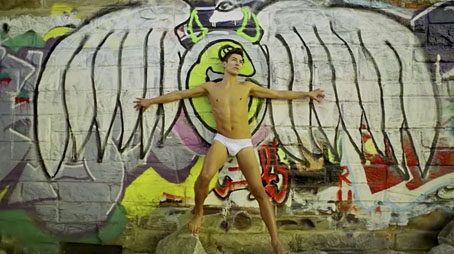
February 2014 will see the 20th anniversary of the death of Derek Jarman. Between then and now I expect we’ll see some retrospectives, although we’ve already had an excellent cinematic one, Isaac Julien and Tilda Swinton’s memorial/documentary Derek (2008). I’d be pleased to see more of Jarman’s films given a decent release on disc: In the Shadow of the Sun has never been available on DVD, and Sebastiane has yet to be released in an uncensored print. When the BFI is releasing Peter de Rome’s gay porn uncut on DVD there’s no longer any excuse for this.

jarman2.jpg

Stephen Benedicto filmed by Ben Carver.

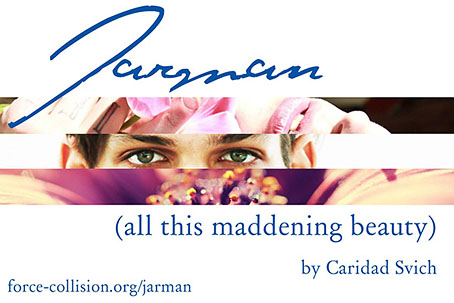
Jarman (all this maddening beauty) is a multimedia solo performance work by playwright Caridad Svich currently in production, with plans for performance in the US later next year. Most of us are unlikely to see this but there is a short promo/trailer by Ben Carver featuring some Jarmanesque imagery, albeit a lot more high-def than Derek was usually allowed. I’d have been tempted to use slowed-down Super-8 if you can still find the cameras or film stock. Production company force/collision has more information about the project in pdf form. Via Towleroad.

jarman3.jpg

jarman4.jpg

Previously on { feuilleton }
Sebastiane by Derek Jarman
A Journey to Avebury by Derek Jarman
Derek Jarman’s music videos
Derek Jarman’s Neutron
Mister Jarman, Mister Moore and Doctor Dee
The Tempest illustrated
In the Shadow of the Sun by Derek Jarman
Derek Jarman at the Serpentine
The Angelic Conversation
The life and work of Derek Jarman
Two films by Clive Barker: The Forbidden and Salome

forbidden1.jpg

The Forbidden.

Clive Barker announced late last month that arrangements were being made for a remake of Hellraiser. This isn’t the first time such an announcement has been made so we’ll have to wait and see what comes of that. I think I’m in a minority of people who’ve always been well-disposed to Barker and his works (the early stories in particular) but have never really enjoyed Hellraiser. I saw it when it was first released, and was disappointed that Barker and co. hadn’t manage to successfully negotiate the pitfalls of making a British film for demanding American producers. The soundtrack that Barker commissioned from Coil was dropped (a serious error); the film’s awkward mid-Atlantic tone makes suspension of disbelief difficult, and considering Barker’s success as a storyteller the narrative is often confused and disjointed. Without all the memorable imagery it’s doubtful it would have had much of a lasting reputation, or birthed so many sequels.

forbidden2.jpg

The Forbidden.

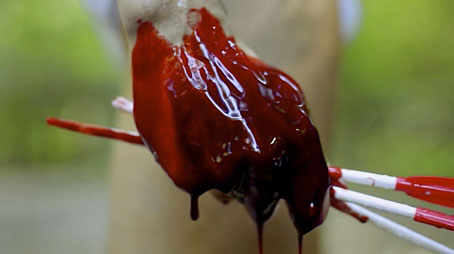
Barker and his theatre colleagues made The Forbidden in 1978, a 35-minute 16mm film of entirely negative images which shows how different Hellraiser might have been if fewer capitulations had been made to the marketplace, and to the clichés of horror cinema. Both films concern an occult ritual, an occult puzzle, and the subsequent consequences of the ritual. Where Hellraiser has to connect its most striking scenes with mundane business such as Julia’s murder spree and screaming teens, The Forbidden presents its imagery as raw data, leaving it to the viewer to piece together its fragments.

Barker’s work since Hellraiser has been almost completely generic so it’s surprising to see something of his that’s this open and abstract. In tone it’s closer to the films of Derek Jarman or Kenneth Anger than anything else, especially the sequence of Barker himself dancing with an erection, something which will ensure this doesn’t get many TV screenings. (Barker has referred to Kenneth Anger when discussing the film.) The final section, featuring a man being lovingly flayed by a number of scalpel-wielding hands, offers the same spectacle as Hellraiser‘s skinless Frank but without any of the accompanying frenzy. This won’t necessarily be on YouTube for very long so watch it while you can. The uploaded version is from the Redemption DVD, music included. Since the film is silent you can watch it with a score of your choice; I’d suggest Coil’s themes for Hellraiser.

salome.jpg

Salome.

Where The Forbidden is a successful piece of avant-garde cinema, Barker’s 17-minute dramatisation of Salome (1973) is closer to a well-made home movie. This is silent as well, and even has the quality and feel of a very old silent film. For an amateur work it still manages to convey a greater sense of dread than some of the other Salomé-related films which have been featured here, and I believe that’s the director himself playing the femme fatale.

Elsewhere on { feuilleton }
The Salomé archive

Previously on { feuilleton }
Clive Barker, Imaginer