The Edge Is Where The Centre Is

pf1.jpg

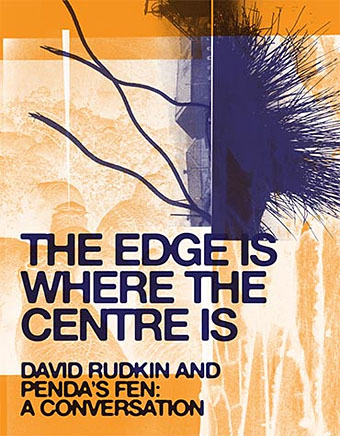
Design by Rob Carmichael.

“I am afflicted by images, by things that are seen, pictures of things. They are extraordinary, momentary, but they stay with me.” (David Rudkin, 1964)

“The pattern under the plough, the occult history of Albion – the British Dreamtime – lies waiting to be discovered by anyone with the right mental equipment.” (Rob Young, Electric Eden)

Penda’s Fen, written by David Rudkin and directed by Alan Clarke, is one of the key films in the pantheon of what has been called The Old Weird Albion. A radical archaeology of Deep England, a work of dark pastoral, a praise-song to anarchistic transformation, as militant a rejection of imperial identity as Lindsay Anderson’s If…, it culminates with perhaps the most euphoric revelation in British cinema: “My race is mixed. My sex is mixed. I am woman and man, light with darkness, nothing pure!”

The Edge Is Where The Centre Is, the first book devoted to this visionary and never-commercially-released film, has at its heart a rare and far-ranging interview with Rudkin (b. 1936), a writer who for more than fifty years has, in the words of Gareth Evans, “charted a vast topology of viscerally-realised primary narratives for our troubled times”. It also features new essays by its editors — Gareth Evans, William Fowler and Sukhdev Sandhu – that explore the film’s status as a radical horror film, an experimental topography, a work that anticipates subsequent political debates about Englishness. (more)
pf2.jpg

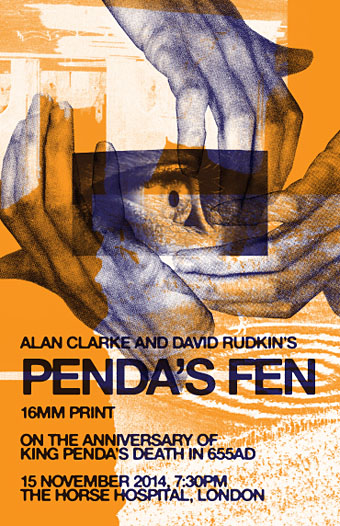
What could be more essential than a book (and poster) devoted to my No. 1 Cult Thing Of All Time? My copies are already on order. Even better, this is a publication from the same team—editor and designer—that produced The Twilight Language of Nigel Kneale last year, a celebration of another British television dramatist that sent me on a full-scale re-viewing of Kneale’s major works.

There’s no need to enthuse about Penda’s Fen when I did all that four years ago but there’s a couple of points worth making in the light of this publication. The first is that it’s surprising that a wider reappraisal of Rudkin and Clarke’s film has lagged behind the resurrection of so many other British TV dramas, especially those that deal with rural horror, those that share a mythic resonance or impart an atmosphere of dread. Surprising because almost all the recent resurrections—the BBC ghost films (one of which was written by Rudkin), Robin Redbreast, The Children of the Stones, etc.—are primarily entertainments with little subtextual meat on their bones. That’s not to say that a subtext can’t be found if you apply the usual academic tools but Alan Garner’s adaptation of Red Shift is one of the few films of this school that has much going on under the surface.

Penda’s Fen doesn’t need a subtext when so much of its polemic is out in the open. It’s one of the most interesting of these films in being so directly political on several levels at once, even when it’s also being directly metaphysical: a call for disobedience and nonconformity on a sexual as well as a social level that (unlike Ken Loach et al) manages to generate a succession of indelible images.

This leads to the second point, the comparison made above to Lindsay’s Anderson’s If…. The similarity between the two films has always been unavoidable for me when If…. is another film that sits at the top of the cult list (see this post). Both films share a rejection of school and society, and also share an approach to sexuality that was very unusual for the late 60s/early 70s. The difference between the two films lies in their conclusions: If…. ends with riot and massacre, and while this may be a cathartic moment Lindsay Anderson wrote in the published script: “It doesn’t look to me as though Mick can win. The world rallies as it always will, and brings its overwhelming firepower to bear on the man who says ‘No.'” By contrast, Stephen in Penda’s Fen defeats his mental demons. If the final shot is of him walking down the hill into darkness we can at least feel he’s on his way to a better life. “Cherish the flame.”

The Edge Is Where The Centre Is is limited to only 200 copies so if you’d like a copy I’d suggest you place your order now.

Previously on { feuilleton }
Afore Night Come by David Rudkin
White Lady by David Rudkin
The Horror Fields
Robin Redbreast by John Bowen
Red Shift by Alan Garner
Children of the Stones
Penda’s Fen by David Rudkin
If….
David Rudkin on Carl Dreyer’s Vampyr
Weekend links 234

dezso.jpg

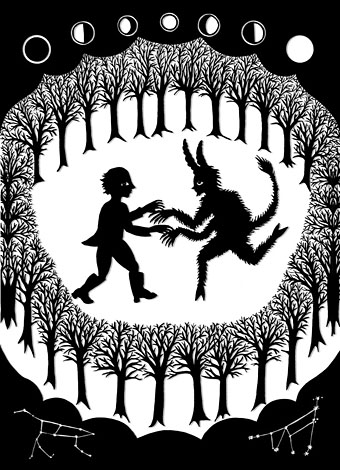
The Devil in the Green Coat by Andrea Dezsö, an illustration for a new, uncensored edition of the Grimm Brothers’ Fairy Tales.

• That { feuilleton } object of cult attention, Penda’s Fen, a 1974 television film by David Rudkin directed by Alan Clarke, continues its long journey out of the shadows. To coincide with a screening in London of a 16mm print, Sukhdev Sandhu looks back at a unique drama, and examines its connections to other British films of the period. There’s still no sign of a DVD release although rumours persist. Related: Penda’s Fen at A Year In The Country.

• “One of the reasons I’m sure I found the horror genre congenial is that it’s almost always focused on the body. The body is the center of all horror films.” David Cronenberg talking to Calum Marsh about his novel, Consumed.

• Mix of the week: Antony Hegarty’s Future Feminist Playlist, and Secret Thirteen Mix 134 by James Ginzburg & Yair Elazar Glotman. Related: Nimbes by Joaniele Mercier & James Ginzburg.

• Another week, another Kickstarter: Suzanne Ciani: A Life in Waves is a planned feature-length documentary about the American synthesist and composer.

• “[Marjorie] Cameron’s connections to Scientology and powerful men once drew headlines, but now her art is getting its due,” says Tanja M. Laden.

Jay Babcock found a Hawkwind Tarot spread in International Times for 1971. Is this an overlooked Barney Bubbles design?

• “Tempered in the flames of hell”: Helen Grant on the precursors of Robert Louis Stevenson’s The Bottle Imp.

Hawthonn: Phil and Layla Legard (and others) remember John Balance with a special musical project.

Derek Jarman Super 8 by James Mackay, a book of stills from Derek Jarman’s Super 8 films.

• “Coltrane’s free jazz wasn’t just ‘a lot of noise’,” says Richard Brody.

This might be the world’s first book on colour palettes.

Paris 1971 (1971) by Suzanne Ciani | The Fifth Wave: Water Lullaby (1982) by Suzanne Ciani | Blue Amiga (2014) by NeoTantrik & Suzanne Ciani

Weekend links 232

hackett.jpg

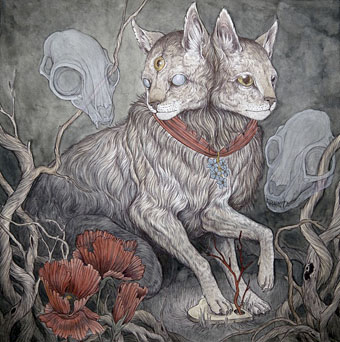
Forget Me Not (no date) by Caitlin Hackett.

• Halloween brings out the articles about weird fiction: “No one would now write of [HP Lovecraft] as the critic Edmund Wilson did, in the New Yorker in 1945: ‘The only real horror in most of these fictions is the horror of bad taste and bad art.’ The true horror was in fact that of judging Lovecraft by the standards of a defunct literary culture,” says John Gray. At The Atlantic there’s Jeff VanderMeer on the uncanny power of weird fiction, while Matt Seidel at The Millions explores the mysteries and attractions of Robert Aickman’s “strange stories”.

The Witching Hour is a video essay by Pam Grossman “examining the many different faces of witches in film”. Pam’s video opens with a scene from Suspiria; over at FACT, Goblin’s Claudio Simonetti talks about the creation of Suspiria‘s peerless soundtrack.

• David Rudkin and Alan Clarke’s uncanny television film, Penda’s Fen, is given a 40th anniversary screening later this month at the Horse Hospital, London. For those who can’t attend (and those who haven’t already read it) there’s my post from 2010.

Nabokov sees each day’s weather as a palette: “The weather this morning was soso: dullish, but warm, a boiled milk sky, with skin – but if you pushed it aside with a teaspoon, the sun was really nice, so I wore my white trousers”. He listens carefully to the sound of the rain, which his letters brilliantly orchestrate. He provides fantastic descriptions of puddles, some of which contain shifts in perspective reminiscent of the nearly cinematic transitions found in the novel he would write shortly afterwards, King, Queen, Knave:

“I looked out of the window and saw: a red-haired housepainter caught a mouse in his wheelbarrow and killed it with the stroke of a brush, then he tossed it in a puddle. The puddle reflected the dark-blue sky, quick black upsilons (reflections of swallows flying high) and the knees of a squatting child, who was attentively studying the little grey round corpse.”

Eric Naiman on Vladimir Nabokov’s Letters to Véra

• Occult rock: Peter Bebergal talks to Expanding Minds about his new book, Season of the Witch: How the Occult Saved Rock and Roll. There’s an hour-long film of Black Sabbath saving rock and roll in Paris, 1970, here.

• Mixes of the week: Burning The Existence, “a three-hour sonic exploration of the outer fringes of Goth”, and a horror soundtrack mix by Death Waltz.

• “‘Capital loathes the old,’ [Gareth] Evans said, ‘for anchoring us in the reality of the lived.'” Iain Sinclair on London’s lost cinemas.

Desirina Boskovich, co-editor of the Steampunk Users Manual, offers “7 Reasons Why Steampunk Is Totally ‘Now'”.

• Penguin has new collage covers by Julian House for The Cut-Up Trilogy by William Burroughs.

Hear a homemade synthesizer turn weather into music.

• Grotesque doodles by William Makepeace Thackeray.

full fathom five is Thom’s new blog.

Weird Dream (1976) by Harmonia 76 | Weird Caravan (1980) by Klaus Schulze | Weird Gear (1991) by Ultramarine

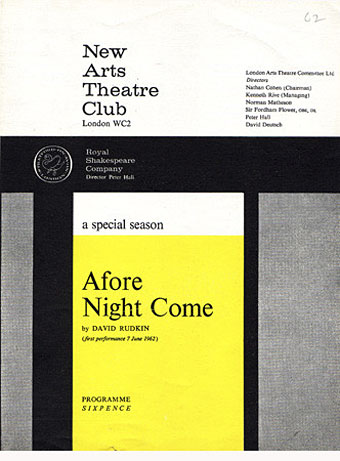
Afore Night Come by David Rudkin

rudkin.jpg

RSC programme, 1962.

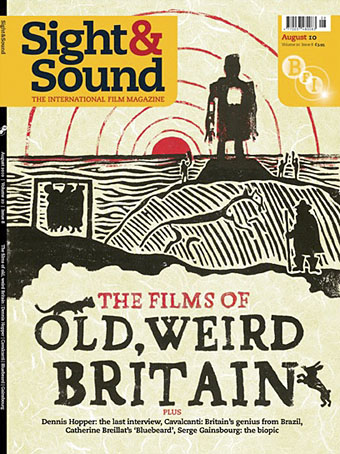
Not a review, this, you can’t really review a stage play you’ve never seen. Following the re-viewing of David Rudkin’s White Lady I’ve gone back to some of the published plays. If all you know of Rudkin’s work is his television drama, the plays are instructive for showing the consistency of his themes across the years. The recent resurgence of interest in Penda’s Fen and Artemis 81 has seen Rudkin’s work included among that group of film and TV dramas that Rob Young memorably labelled Old Weird Britain (after Greil Marcus and The Old, Weird America), a loose affiliate that would include films such as The Wicker Man and Blood on Satan’s Claw, television works by Nigel Kneale and Alan Garner (The Owl Service, Red Shift), and the BBC MR James adaptations, one of which, The Ash Tree, was also written by Rudkin.

If the Old Weird Britain lies at an intersection between different dramatic forms—ghost story, horror story, science fiction, historical drama—then not all of Rudkin’s work would fall into the intersection, but two of the plays—The Sons of Light and his first staged work, Afore Night Come—could be coaxed into the charmed circle: The Sons of Light, with its sinister human experiments taking place underground, has ties to Artemis 81, while Afore Night Come is another piece about (intentional or otherwise) human sacrifice in rural England. I hadn’t read Afore Night Come until last week, and was struck by its similarity to John Bowen’s Robin Redbreast (1970), a more deliberately ritualistic piece of work. In its first act Afore Night Come is an almost documentary-like account of a day in the life of workers hired to pick the pear harvest in an orchard outside Birmingham; the eruption of violence in the second act is certainly foreshadowed but seems less premeditated than in Robin Redbreast, a factor which has apparently shocked many audiences. During its performances in the early 1960s the tendency was to see the play in the light of Harold Pinter and Artaud’s Theatre of Cruelty, it’s only in retrospect that a connection with more generic works emerges. There’s also a connection to White Lady via the pesticide spraying about which the workers are continually warned, and whose advent coincides with the moments of violence.

oldweird.jpg

Sight and Sound, August 2010. Illustration by Becca Thorne.

A couple of other things are worth noting: until 1968 all the plays performed in Britain were vetted by the Lord Chamberlain’s office who would routinely strike out any material deemed offensive or irreligious. Knowing this I was surprised by the recurrence of the word “fuck” in Rudkin’s script, and also the hint of same-sex attraction between two of the male characters, a detail that would usually have been removed. It seems that plays pre-1968 could be performed without censorship if the theatre was declared to be a private club for the evening (a similar state of affairs helped evade some film censorship) which is what happened with Afore Night Come in 1962. Given this, and the incident of a decapitated head being rolled across a London stage (probably the first since the Jacobeans, says Rudkin), it’s easy to see why audiences at the time might have felt assaulted, although the play still won the Evening Standard Drama Award that year. Sexual ambiguity/ambivalence or outright homosexuality have been a continual thread in Rudkin’s drama yet he’s seldom been given much credit for this pioneering work. A year after Afore Night Come there was Rudkin’s first play for television, The Stone Dance, a piece which sounds like another potential addition to the works in the Old Weird Britain catalogue. Rudkin describes it thus:

A Revivalist pastor pitches his crusade tent within a Cornish stone circle. His repressed son becomes sexually obsessed with an outward-going local boy, and suffers a hysterical loss of speech. A storm blows the pastor’s tent away, and amid the stones, their primal purity reasserted, by the boy’s accepting touch the son is healed.

I believe that, prior to this, no tv play had overtly treated homosexual emotions as a central theme. (In Britain at this time, any gay sex could incur a prison sentence of up to two years.)

Many of the TV plays from the 1960s are now lost so there’s no guarantee that we’ll ever see this, a shame considering that Michael Hordern and John Hurt were the leads. No guarantee either that we’ll see any staging of the more interesting plays like The Sons of Light and The Triumph of Death which seem to be too eccentric for theatre directors. The scripts can at least be picked up relatively cheaply. To date there’s only Afore Night Come that seems to be revived with any regularity. Michael Billington, a long-time champion of Rudkin, reviews the Young Vic production from 2001 here.

Previously on { feuilleton }
White Lady by David Rudkin
The Horror Fields
Robin Redbreast by John Bowen
Red Shift by Alan Garner
Children of the Stones
Penda’s Fen by David Rudkin
David Rudkin on Carl Dreyer’s Vampyr
White Lady by David Rudkin

whitelady1.jpg

Amy: Dad? What’s a parable.

Gil: Parable? A sort of story, with something in it…strange. To help you remember it. And think. About something important.

I first heard about David Rudkin’s White Lady (1987) from Grant Morrison during a conversation about Penda’s Fen, Morrison having been a Rudkin-head as far back as the original screening of that TV film in 1974. This was at a time when you couldn’t call up details of somebody’s entire career in a couple of seconds, so all I knew of Rudkin’s television work aside from Penda’s Fen was Artemis 81 (1981) and his adaptation of The Ash Tree (1975) by MR James, one of the BBC’s Christmas ghost stories.

vampyr.jpg

Vampyr (1932).

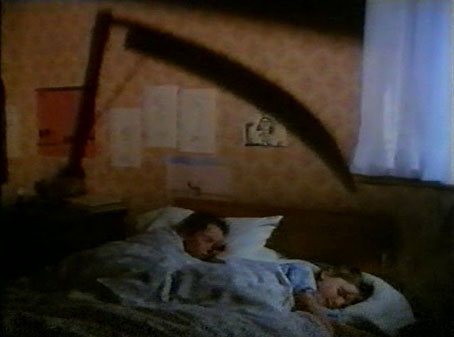
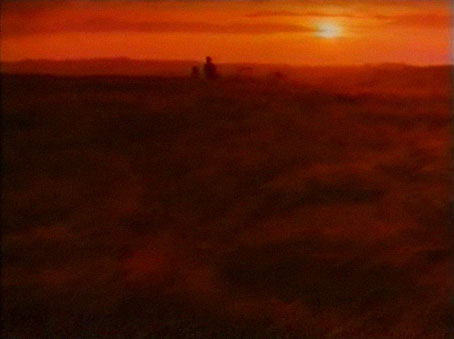
All of those films feature sinister, possibly supernatural events taking place in the English countryside, and this theme is continued in White Lady, a 45-minute drama which Rudkin wrote and also directed. In dramatic terms the film is a minimal piece concerning a divorced father trying to set himself up as a farmer while also taking care of two young daughters. In the fields surrounding the farm pesticides are being used, although we see little direct evidence of this. More overt are the disturbing interjections and animated graphics which show photographs and X-rays of laboratory animals suffering from pesticide exposure. Rudkin’s dialogue tells us at the outset that this is a parable, hence the deadly effects of the pesticide being embodied by the White Lady of the title, a spectral figure who carries a scythe.

whitelady2.jpg

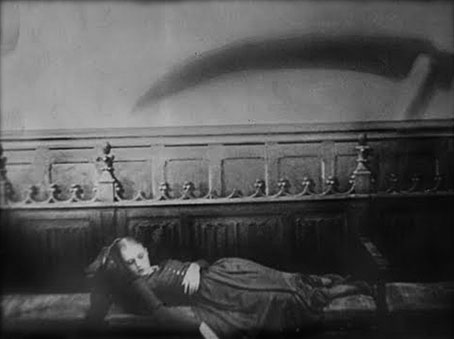
The first time I saw this I thought the scythe was a heavy-handed device, despite its obvious farming connections; watched again I realise that Rudkin would have been alluding (if only for himself) to the scythe-bearing ferryman in Carl Dreyer’s Vampyr (1932), a film Rudkin subjected to very close scrutiny in 2005 for the BFI’s Film Classics series. In his book Rudkin notes a shot in which a sleeping figure is menaced by the shadow of a scythe on a wall; that shot is recapitulated in White Lady.

whitelady3.jpg

It’s unfair to compare this to the eerie, intellectual masterpiece that is Penda’s Fen, but White Lady is still worth a look for anyone interested in Rudkin’s dramas, especially with it being his sole directing credit. If the dire warnings of genetic mutation haven’t come to pass there’s relevance in our present concern about the effects of nicotinoids on bee and bird populations. The White Lady still has plenty of work to do.

White Lady: part one | part two

Previously on { feuilleton }
The Horror Fields
Robin Redbreast by John Bowen
Red Shift by Alan Garner
Children of the Stones
Penda’s Fen by David Rudkin
David Rudkin on Carl Dreyer’s Vampyr