Nigel Kneale’s Woman in Black

wib1.jpg

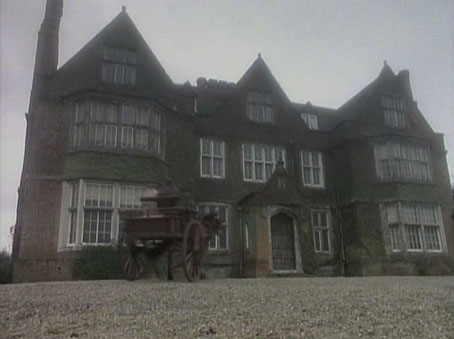
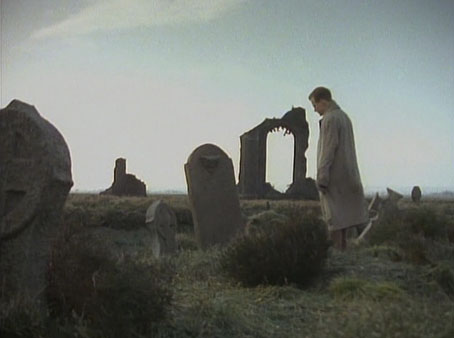
The British television tradition of screening a ghost story at Christmas was filled in 1989 with Nigel Kneale’s adaptation of Susan Hill’s novel The Woman in Black. This isn’t one of the best contributions to the annual ghost drama but at 100 minutes it’s one of the longest, and it has its supporters, some of whom value it above the recent Hammer film production. Seeing as I’d re-watched Nigel Kneale’s major film and TV works earlier this year I thought I’d give The Woman in Black another look. It was better than I remembered although it still left me feeling unsatisfied.

I’ve not read Susan Hill’s book so can’t say how it compares to the television version in any detail. (Wikipedia has a spoiler-heavy list of the differences.) I did see Stephen Mallatratt’s play in 1988, however, the first adaptation of the book which has since become one of London’s most popular theatre productions. The play conjures an effective sense of dread but relies a little too much on loud noises to shock the audience at crucial moments. This is a cheap trick in bad horror films (Wes Craven does it a lot), and it’s just as cheap a trick on a stage. Nigel Kneale may have altered Hill’s story to a degree which apparently displeased her but he didn’t resort to any Craven tricks.
wib2.jpg

The BBC’s Christmas ghost stories have tended to be MR James stories, and The Woman in Black is very much a James pastiche which no doubt helped make it attractive to ITV. All the James hallmarks are there: a man of letters (solicitor rather than a scholar) visiting an isolated part of the English countryside; a lonely house; fearful locals; mysterious deaths; documentary evidence that requires examination; a haunting.

Adrian Rawlins is the young solicitor, Arthur Kidd, given the task of putting the estate of a dead woman in order. Rawlins would have been fine in a smaller role but he wasn’t a good choice for a central character, not when Kidd is on screen every minute of the running time. Far better is the always excellent Bernard Hepton as a genial landowner, a very different role to his sinister Fisher in Robin Redbreast. There’s a lot of solid period detail—Kneale’s dialogue fixes the date at around 1925—and the writing and direction manages to avoid insulting the intelligence. In place of the usual voiceover reading of letters we have Kidd listening to a succession of recording cylinders, an unlikely thing for an elderly woman to be using but it does give the film a connection back to Van Helsing’s device in Dracula. There’s even a surreptitious reference to Kneale’s “stone tape” theory when Kidd says that the ghostly sounds he keeps hearing are like a recording of a terrible event. Director Herbert Wise does some clever hide-and-seek business with the spectral woman, only fumbling things near the end when he makes the mistake of trying to imitate Jack Clayton’s The Innocents. So why does this version still remain unsatisfying?
Continue reading “Nigel Kneale’s Woman in Black”

Steampunk Calendar

00steampunkcalendar.jpg

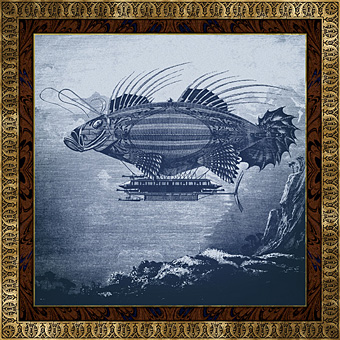
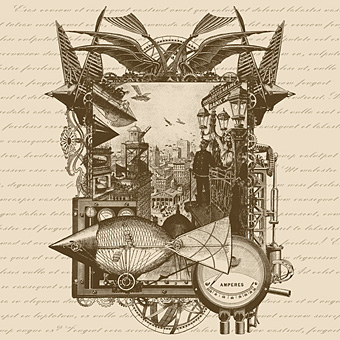
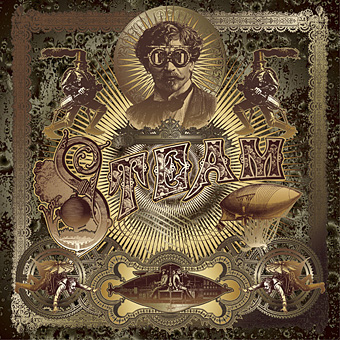
This one arrives two months late, the months of October and November being overly preoccupied with other work. I chose a steampunk theme for this year since this has been a productive area recently. The idea was one of those simple notions—rework some book covers into calendar pages—that in practice ended up taking much longer than anticipated. Larger copies of the pages may be seen here while the CafePress purchase page is here. My thanks to everyone who’s been buying things recently.

For those who dislike over-decorated 19th-century science fiction but may still want a Coulthart calendar there’s the Cthulhu Calendar (still a popular item), the Psychedelic Wonderland calendar, and the Through the Psychedelic Looking-Glass calendar. Note: Calendars at CafePress can now be purchased throughout the year so make sure that you select January as the starting month if you want the months to run for a single year only.

01steampunkcalendar.jpg

02steampunkcalendar.jpg

03steampunkcalendar.jpg

Continue reading “Steampunk Calendar”

Lovecraft’s Monsters

Lovecraft's Monsters

Graphic for the title page and ends of chapters.

I don’t usually post things so far away from publication, but editor Ellen Datlow put these pictures on her Facebook page a few hours ago so I may as well do the same here.

Back in February I bought a Wacom Intuos drawing tablet, something I’ve been using with regularity for the past few months. The Alas Vegas Tarot cards I designed in the summer were the first major attempt at getting used to working with it; Lovecraft’s Monsters, a forthcoming fiction anthology for Tachyon is the second, and I now feel very comfortable working with it. More than that, I’m increasingly pleased with the way it’s possible to combine the drawing techniques I’ve been using for years with the additional possibilities provided by working in Photoshop. As always, it’s the end result that counts but arriving at an end result can be easy or difficult. Some of these illustrations look no different than they would have done had I used ink on paper but they took half the time to create, a considerable benefit when a deadline is looming.

The stories Ellen Datlow has chosen for this collection all present different aspects of monstrosity seen through the lens of Lovecraft’s fiction and his cosmic menagerie. Some are full-on extensions of the Mythos, others are more allusive; all the pieces bar one have been published before but I’d not read any of them so for me this was fresh material. Having spent the past few years saying I was finished with Lovecraft’s fiction I was excited to be working on this book. The stories are good, and I welcomed the challenge of having to illustrate such a variety of material.

Larger copies of all the pictures can be seen here.

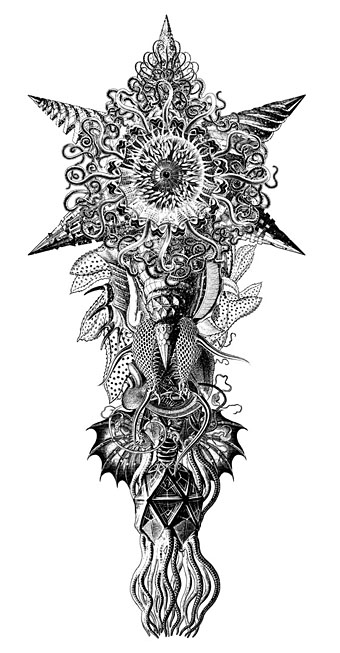
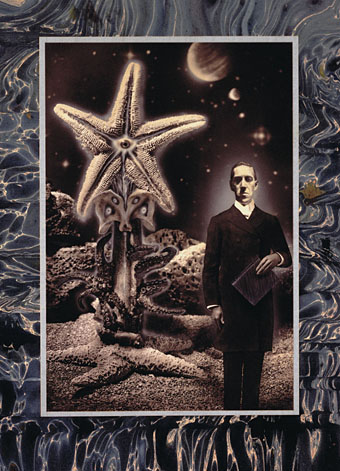
The star-headed thing at the top of this page is another amalgam of elements plundered from Haeckel’s Kunstformen der Natur and other sources. I’ve leaned rather heavily on Haeckel in the past, something I wanted to avoid here; this serves as a kind of visual punctuation separating the stories.

Lovecraft's Monsters

Cthulhu.

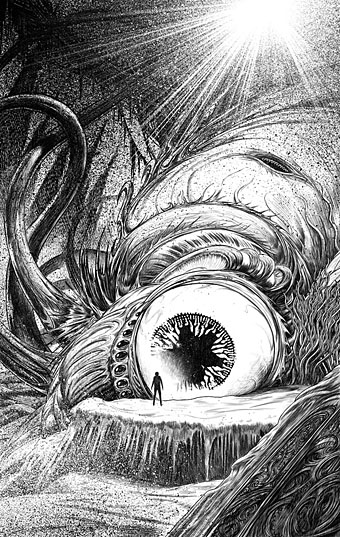
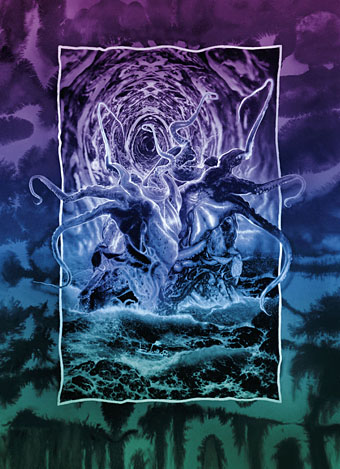
The drawing I’ve called Cthulhu is a piece for the introductory pages. Having already produced a lot of Cthulhoid art I didn’t want to repeat myself. The initial idea was of a tiny human figure faced with something enormous and nightmarish; that could be a vast eyeball or it could be a mouth or some other organ/aperture, the vagueness was intentional. Lovecraft continually impresses upon his readers how difficult things are to describe or apprehend but you seldom find this quality in art based upon his stories. Cthulhu especially has devolved into little more than an outsize man-in-a-rubber-suit à la the Creature from the Black Lagoon. In The Call of Cthulhu the figure on the mysterious statuette is described as having a humanoid shape but Lovecraft doesn’t describe the appalling reality in any detail at all. When Cthulhu is struck by a ship at the end of the story it breaks apart and is then seen recombining, the implication being that the creature is corporeally amorphous.

Lovecraft's Monsters

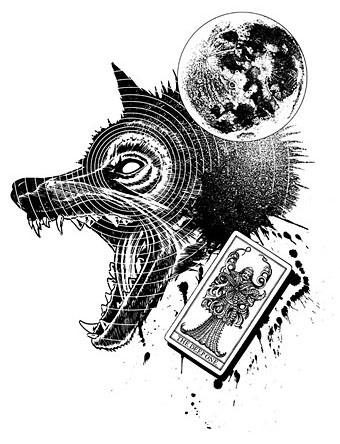
Only the End of the World Again by Neil Gaiman.

Neil Gaiman’s entry concerns a werewolf private detective in Innsmouth. Lovecraft’s decaying fishing village and its inhabitants turn up in several of the stories so care was taken to avoid repetition.

Lovecraft's Monsters

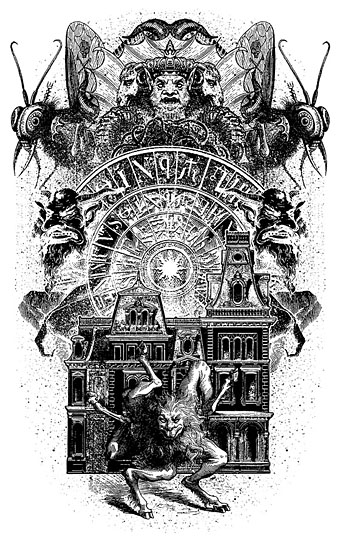
Bulldozer by Laird Barron.

A great story about another detective, a Pinkerton agent this time, hunting his quarry through the Old West. Collin de Plancy’s Dictionnaire Infernal is mentioned so I used some of Louis Breton’s illustrations from the third edition.

Continue reading “Lovecraft’s Monsters”

Weekend links 184

lefler.jpg

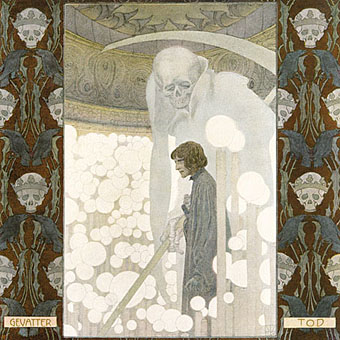
Gevatter Tod (Godfather Death, 1905) by Heinrich Lefler. Via Beautiful Century.

An inevitable hangover from Halloween this week. At 50 Watts: A Modern Dance of Death (c. 1894) by Joseph Sattler, Harry Clarke Revisited, and more Ex Libris Mr Reaper | At Design Observer: Keith Eggener on When Buildings Kill: Sentient Houses in Fiction and Film | At Dangerous Minds: An interview with horror soundtrack composer Fabio Frizzi | Clive Hicks-Jenkins on illustrating the ghost stories of MR James.

Punk 45: The Singles Cover Art of Punk 1976–80, a book by Jon Savage & Stuart Baker with an accompanying compilation album on Soul Jazz Records. Savage & Baker selected a handful of favourite covers here.

De humani corporis fabrica by Vesalius is back in print as a beautiful two-volume hardback edition. See sample pages here.

…the business of the writer is to find something out for yourself and to stick by it. To forge a new mythology out of materials pertinent to the moment. Otherwise you’re at the mercy of their mythology, which is a destruction of language, above everything else. This non-language, this bureaucratic-speak of the global corporate entities, is a horror in the world. So that strange language we started with – that piece of Kerouac – I think is more valuable than ever.

Iain Sinclair (yes, him again) talking to James Campbell about his new book, American Smoke.

Bob Mizer & Tom of Finland, an exhibition at the Museum of Contemporary Art, Los Angeles.

• From 2010: The Bridget Riley Look, The Bridget Riley Sound, Bridget Riley’s Rolling Papers.

The Strange and Mysterious History of the Ouija Board. Related: Ouija Boards at Pinterest.

Highway 62 posted some close-ups of my adaptation of The Call of Cthulhu.

• “This is not a coincidence”: Max Dax talks to Andrey A. Tarkovsky.

Anthony Lane‘s Foreword to The Big New Yorker Book of Cats.

• At AnOther: Nicolas Roeg on Mirrors and Memory.

Toys and Techniques: a blog.

Death And The Lady (1970) by Shirley & Dolly Collins | Clang Of The Yankee Reaper (1975) Van Dyke Parks | All And Everyone (2011) by PJ Harvey

JK Potter and HP Lovecraft

hm1.jpg

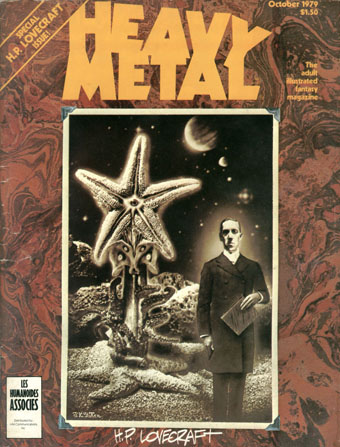
American artist JK Potter is another photo-montagist whose work since the 1970s has been very popular as illustration for books of horror, fantasy and science fiction. Potter’s portrait of HP Lovecraft on the October 1979 issue of Heavy Metal was my first introduction to his work. The original version of that picture can be seen below. Despite Potter’s flair for horror imagery there’s fewer Lovecraft illustrations than you might expect, certainly fewer than I used to hope there might be, although tentacles—real ones—do feature in a number of his other pictures.

While we’re on the subject, HPL continues to dog my footsteps. I recently autographed an enormous block of contributor signing sheets for a new doorstop anthology from Centipede Press. A Mountain Walked is a 636-page collection edited by Lovecraft scholar ST Joshi which will be published in March, 2014. Be warned that like many other Centipede volumes it won’t be cheap! Meanwhile I’m currently working on a new series of illustrations for a completely different anthology of Lovecraftian fiction. That will also be out early next year. It’s going to be a good one but I’ll say more about it at a later date.

potter1.jpg

potter2.jpg

potter3.jpg

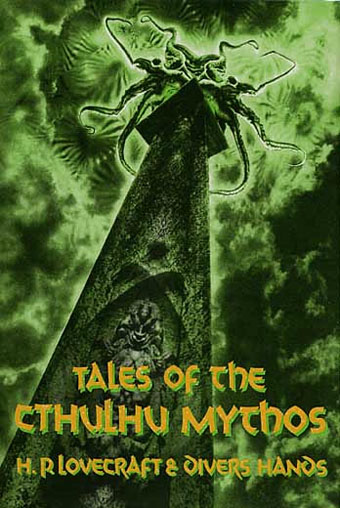
Tales of the Cthulhu Mythos (1990).

Elsewhere on { feuilleton }
The Lovecraft archive