In Germany before the war

1: Fritz Haarmann (1879–1925)

hanover.jpg

Arrow shows Haarmann’s attic residence in Rote Reihe, Hanover.

Haarmann was one of several serial murderers haunting Weimar Germany, variously nicknamed “the Butcher of Hanover”, “the Vampire of Hanover”, “the Wolf Man”, etc. for his sexual assault, murder and dismemberment of at least 24 boys and young men between 1918 and 1924. Haarmann also sold meat on the black market which led to rumours that some of the mince and other produce he sold was human flesh.

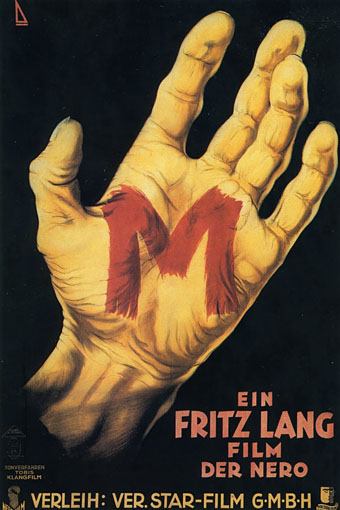
2: M (1931), a film by Fritz Lang.

m-poster.jpg

Thea von Harbou’s script for M is based in part on the Haarmann case although Lang’s child-killer is shown preying on girls rather than boys. Peter Lorre is superb in his first major role as the murderer, while Lang’s use of the new sound technology is remarkably inventive when compared to his stagey contemporaries in Hollywood.

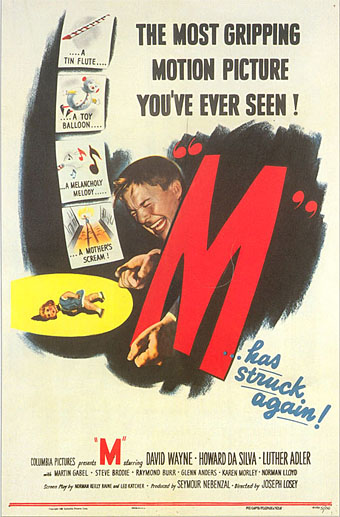
3: M (1953), a film by Joseph Losey.

m-1951.jpg

Lang’s masterwork reworked as a Los Angeles film noir by Joseph Losey before McCarthyism sent him to Europe. This is one noir I still haven’t seen even though a major sequence takes place in that cult location, the Bradbury Building.

Continue reading “In Germany before the war”

Weekend links 293

meyohas.jpg

Red Petals by Sarah Meyohas.

• “For MMoB, I want it to be like a [Werner] Herzog movie, so at our concerts the people on stage aren’t necessarily people who are named. We’re trying to create an entity that is beyond music and relates visually and sonically with everything in a way that’s different.” Randall Dunn talks to Simona Mantarlian and Daniel Jones about the Master Musicians of Bukkake and his production work for other artists.

• “Is reel-to-reel tape the new vinyl?” asks FACT mag. It’s certainly better than cassette tape (if less convenient) but it was always a niche format for albums, even in the 1970s. Rene Chun made a similar argument for an emerging trend last October. Those expensive machines do look tempting… Early adopters should start collecting here before prices rise.

Airwaves: Songs From The Sirens is a new release of spectral audio transmissions by A Year In The Country: “…a gathering of scattered signals plucked from the ether, cryptograms that wander amongst the airwaves…” Physical versions come with the usual plethora of monochrome artefacts.

A vivid memory to his friends, Litvinoff was one of those people whose performance was their life. His most lasting achievement was the profound influence he had on Performance – the hallucinatory film directed by Nic Roeg and Donald Cammell, and starring Mick Jagger, which captured the London of the late 1960s, merging pop stardom, violent criminality, illegal drugs, gender-blurring, the occult and Jorge Luis Borges.

Jon Savage on David Litvinoff

• Virgin Prunes “are THE #1 most underrated group of the post-punk era” says Richard Metzger. I’d say that honour goes to The Passage but the Virgin Prunes were unique even if they’re too often dismissed as a freak footnote in the U2 story.

Magic, Witches & Devils in the Early Modern World is a free exhibition at the John Rylands Library, Manchester, that will run until August 2016. Related: “John Dee painting originally had circle of human skulls, x-ray imaging reveals.”

• “What I’m seeing now is an awful lot of people just following things. We tried to find our own thing and ask, ‘What else is there?'” Charles Hayward on the past and present of post-punk band This Heat.

• “I’ve never been tempted to write anything that was not essentially nightmarish.” Thomas Ligotti in a comprehensive profile (originally run in 2010) at Dennis Cooper’s blog.

• Mixes of the week: An introduction to Stereolab by Jon Dale, and Silent Radio Transmission Jan 2016 by SilentServant.

• Kicked Toward Saintliness: Max Nelson on the dark erotics of Jean Genet’s Our Lady of the Flowers.

• Reverse Engineering: Danny Hyde on Coil, Backwards and NIN.

Fuck Yeah! Anna von Hausswolff

Harry Flowers (1970) by Jack Nitzsche | Flowers In The Air (1970) by Sally Eaton | Darkness: Flowers Must Die (1972) by Ash Ra Tempel


Digging the Rubble

rubble01.jpg

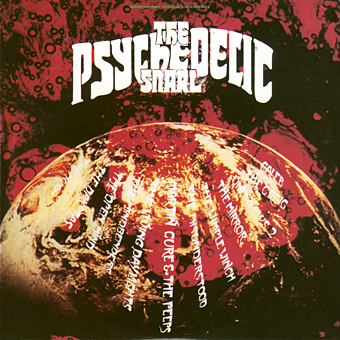
1: The Psychedelic Snarl.

A few words in praise of Rubble, the 20-disc collection of (mostly) British psychedelic singles released by the Bam Caruso label from 1984 to 1991. A reader of Rob Chapman’s Psychedelia and Other Colours would find the Rubble series an indispensable companion to the second half of the book which explores the unique styles of British psych. Ideally you’d read the book while having these and other compilations close at hand, something I didn’t manage so I’ve been going through the discs myself this week, listening out for some of the many singles that Chapman discusses. The Rubble title is a nod to Lenny Kaye’s 1972 collection Nuggets: Original Artyfacts from the First Psychedelic Era, 1965–1968, the first reappraisal of the garage/psych era whose success spawned Nuggets II: Original Artyfacts from the British Empire and Beyond, 1964-1969, a not-so-good attempt to do the same for the UK, and Children of Nuggets: Original Artyfacts from the Second Psychedelic Era, 1976-1995. The original Nuggets was followed by the long-running Pebbles series which sprawls over 28 discs collecting obscure garage singles.

rubble02.jpg

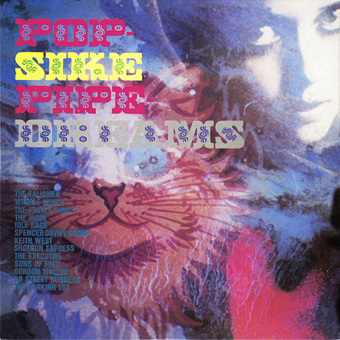
2: Pop-Sike Pipe Dreams.

What I like about the Rubble series, apart from its covering a favourite zone of musical history, is the way that each volume is titled in a suitable manner beyond a mere number: the title of volume 8, All The Colours Of Darkness could have been used by Coil during their LSD period. Then there’s the sleeve designs by the great Phil Smee, one of the founders of Bam Caruso, the collector of many of the featured singles, and a first-rate artisan of psychedelic graphics: there’s a Louis Wain cat on volume 2, and more of those letterforms by Roman Cieślewicz on volume 10. Smee deserves a post of his own but covering such a lengthy career would be a daunting task: Discogs lists 784 separate releases, and that’s only his design work. The design on the first run of Rubble albums was credited to “Harvey S. Williams”, a Smee pseudonym playing on the name of Elektra Records art director William S. Harvey. Harvey S. Williams was also the designer of the short-lived and rather wonderful Bam Caruso magazine, Strange Things Are Happening, issues of which are advertised in the inner sleeves of the early Rubble albums. (The magazine borrowed its title from a 1968 single by Rings and Things which is featured on Rubble 4.)

rubble03.jpg

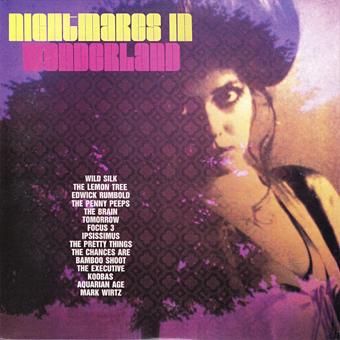
3: Nightmares In Wonderland.

The Rubble series has been reissued on CD many times, and is currently available as The Rubble Collection, a glossy cube containing all 20 discs in card sleeves together with two booklets that reprint Phil Smee’s original sleeve notes and band photos. The Rubble albums sound a little rough today when many of the songs which were taken directly from old singles have been resurrected and can be heard elsewhere in better quality. Subsequent compilations have also cherry-picked many of the better selections but this is still the ideal place to start if you want to immerse yourself in the toyshop/kitchen sink surrealism that is British psychedelia.

• See also: Richard Norris reminiscing about working at Bam Caruso, and choosing 20 favourite British psych records.

rubble04.jpg

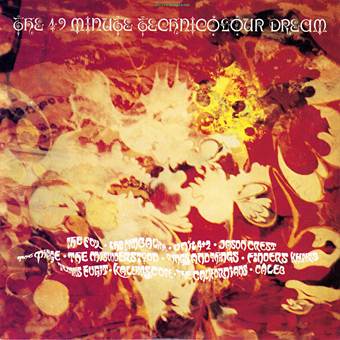
4: The 49 Minute Technicolour Dream.

Continue reading “Digging the Rubble”

A mix for Halloween: Teatro Grottesco

Teatro Grottesco by Feuilleton on Mixcloud

Presenting the tenth Halloween playlist, and another mix of my own. This year the compilation honours the recent Penguin collection of stories by Thomas Ligotti, hence the title and dedication. Whether a Ligotti theme can be perceived in the arrangement depends on the familiarity of the listener with Ligotti’s brand of weird fiction, but even if the mix communicates little in this direction having something to aim for helped me narrow the focus. The presence of David Lynch-related pieces is justified by Ligotti’s inclusion in a collection of fiction inspired by Lynch’s films.

As to some of the other selections: French composer Igor Wakhévitch is a {feuilleton} favourite whose orchestral works are unique, bizarre and often disturbing; Jean-Claude Eloy is another French composer who (like Tod Dockstader) has used electronics to create doom-laden dronescapes; and the piece by Sinoia Caves is an extract from the nightmarish bad-trip sequence in Beyond the Black Rainbow, a film directed by Panos Cosmatos.

Recent changes at Mixcloud mean that listeners can no longer see a tracklist before playback so here’s the detail:

Alan R. Splet, David Lynch, Ann KroeberTextured Night Wind Gently Rises And Falls (2000)
Igor WakhévitchErgon (1970)
CoilCardinal Points (1988)
Tod DockstaderMyst (2005)
Julee CruiseInto The Night (1989)
Jean-Claude EloyFushike-e (1er Extrait) (1979)
Mica LeviLonely Void (2014)
Stars Of The LidTaphead (1996)
Belbury PolyA Thin Place (2005)
Einstürzende NeubautenArmenia (1983)
Igor WakhévitchAmenthi (Attente De La Seconde Mort) (1973)
Sinoia Caves1966 – Let The New Age Of Enlightenment Begin (2014)
Angelo BadalamentiDark Mood Woods/The Red Room (2007)
Bohren & Der Club Of GoreThe Art Of Coffins (2002)

Previously on { feuilleton }
A mix for Halloween: Unheimlich Manoeuvres
A mix for Halloween: Ectoplasm Forming
A playlist for Halloween: Hauntology
A playlist for Halloween: Orchestral and electro-acoustic
A playlist for Halloween: Drones and atmospheres
A playlist for Halloween: Voodoo!
Dead on the Dancefloor
Another playlist for Halloween
A playlist for Halloween

Weekend links 280

crisafi.jpg

Keepers of the Moon by Bill Crisafi.

• More Thomas Ligotti for obvious reasons: Weird Fiction Review now has two Ligotti interviews, one from 2011, and a new one prompted by the Penguin edition of his stories. Also at Weird Fiction Review, two Ligotti narratives: The Night School, and The Red Tower. The latter demonstrates how weird fiction can dispense with character and story and still have a powerful effect.

• Related to the above: Terrors supernatural and psychological: Laird Barron on Ray Russell’s The Case Against Satan; Russell’s novel is also being reprinted by Penguin this month. And at Dangerous Minds: a collection of vintage dolls and ventriloquist dummies.

• “Time and again his books—even as they tell of remote planets and their inhabitants—foresee something perplexingly close to our present-day society, from visionary constructions to machines of destruction.” Strange Flowers on Paul Scheerbart.

Coil’s out-of-print discography gets a career-spanning reissue through Threshold Archives. Related: Russell Cuzner interviews Thighpaulsandra.

• Mixes of the week: The Ivy-Strangled Path Vol. XI by David Colohan, and Sounds From Beyond (October 2015) by Glossop Record Club.

Bill Crisafi: Artist, Dreamer, Feral Mystic. An interview with the artist by S. Elizabeth for Dirge magazine.

• Also being given the revenant treatment, out-of-print short stories by Aleister Crowley.

Alex Mar on the powerful appeal of modern witchcraft—even for a skeptic.

A Rest Before The Walk is a new album by Keith Seatman.

The Wounded Kings set out their stall at Bandcamp.

The Witch Queen Of New Orleans (1971) by Redbone | Witch (1977) by Goblin | Ditch Witch (2009) by Pink Mountain