Weekend links 221

cornell.jpg

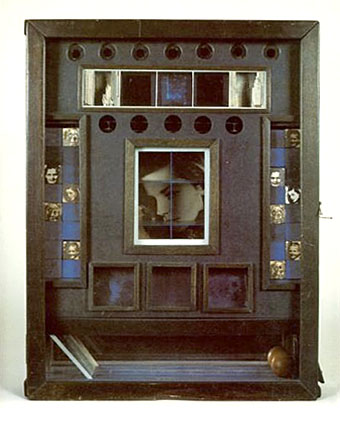
Untitled (Penny Arcade Portrait of Lauren Bacall) (1946) by Joseph Cornell.

• Having been a Bernard Szajner enthusiast for many years it’s good to see his music receiving some belated reappraisal. David McKenna talked to Szajner about his Visions Of Dune album (which is being reissued by InFiné next month), laser harps, The (Hypothetical) Prophets, and working with Howard Devoto.

• Priscilla Frank posts some big views of Marjorie Cameron’s occult paintings as a preview of the forthcoming exhibition at MOCA Pacific Design Center, Los Angeles.

• Fascinating reading in light of the recent kerfuffle over True Detective, Christopher Loring Knowles on the possible sources of HP Lovecraft’s Cthulhu Mythos.

Those who set up oppositions between the electronic technology and that of the printing press perpetuate Frollo’s fallacy. They want us to believe that the book—an instrument as perfect as the wheel or the knife, capable of holding memory and experience, an instrument that is truly interactive, allowing us to begin and end a text wherever we choose, to annotate in the margins, to give its reading a rhythm at will—should be discarded in favor of a newer tool. Such intransigent choices result in technocratic extremism. In an intelligent world, electronic devices and printed books share the space of our work desks and offer each of us different qualities and reading possibilities. Context, whether intellectual or material, matters, as most readers know.

Alberto Manguel, lucid as always, on the act and import of reading.

• “It’s time to give prog rock’s artist-in-residence Roger Dean his due,” says Amber Frost. No argument there, I did my bit in 2010.

• “Why do the covers of so many self-published books look like shit?” asks B. David Zarley.

• Mixes of the week: FACT mix 455 by Airhead, and Secret Thirteen mix 225 by Clock DVA.

• At Core77: Rain Noe chooses favourite skyscraper photos by Russian urban explorers.

• “O, Excellent Air Bag”: Mike Jay on the nitrous oxide fad of the early 19th century.

Nick Carr goes in search of Manhattan’s last remaining skybridges.

Lauren Bacall at Pinterest.

• Shaï Hulud (1979) by Zed (Bernard Szajner) | Welcome (To Death Row) (1980) by Bernard Szajner | Person To Person (1982) by The (Hypothetical) Prophets
Les Chants de Maldoror by Shuji Terayama

terayama.jpg

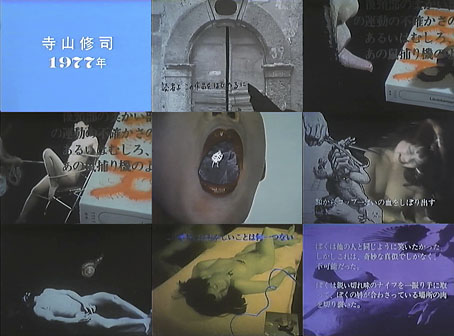
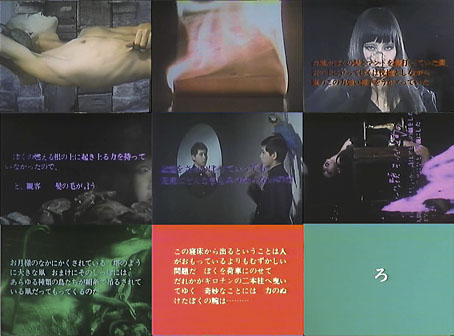
27 minutes of experimental video from 1977 in which director Shuji Terayama retrieves some predictably unorthodox images from the bottomless pit of Lautréamont’s text. The preoccupations here seem to belong as much to the director’s mind as to that of Isidore Ducasse, what with the emphasis on various forms of bondage and unusual erotics. (Not that Maldoror lacks sexual material but what there is adopts a different guise.) With a score that sounds like outtakes from a Clock DVA studio session it’s very much a product of its time, but not without interest. Terayama was (among other things) the director of Emperor Tomato Ketchup (1971), a film whose title was later swiped by Stereolab. Les Chants de Maldoror may be viewed at Ubuweb.

terayama2.jpg

Previously on { feuilleton }
Polypodes
Ulysses versus Maldoror
Maldoror
Books of blood
Magritte’s Maldoror
Frans De Geetere’s illustrated Maldoror
Maldoror illustrated

Night Music in two parts

Night Music One by Feuilleton on Mixcloud

Night Music I
The Hafler Trio – Soundtrack To “Alternation, Perception, And Resistance” — A Comprehension Exercise (1985)
Aphex Twin – Selected Ambient Works Volume II: Untitled 4/1 (Hankie) (1994)
Michael Brook – Earth Floor (1985)
Aphex Twin – Selected Ambient Works Volume II: Untitled 10/1 (Tree) (1994)
Biosphere – Startoucher (1994)
Black Lung – Rex 84 (1995)
Biosphere – Biosphere (1992)
Holger Czukay – Radio In An Hourglass (1993)
Rapoon – Rains (1993)
Clock DVA – Memories Of Sound (1992)

Night Music Two by Feuilleton on Mixcloud

Night Music II
Psychick Warriors Ov Gaia – Dust (At The Crossroads) (1994)
Aphex Twin – Selected Ambient Works Volume II: Untitled 2/2 (Parallel Stripes) (1994)
Harold Budd – The Gunfighter (1986)
Divination – Errata (1993)
Coil – Dismal Orb (1992)
Biosphere – Mir (1994)
David Toop and Max Eastley – Rising Up Before Us Like Things (1994)
Angelo Badalamenti – Night Life In Twin Peaks (1990)
Coil – The Sleeper II (1992)
Jon Hassell – Empire II (1983)
The Grid – Virtual (1990)
Biosphere – En-trance (1994)

After signing up to Mixcloud earlier this year I’ve only managed to compile one mix so here’s an unseasonal attempt to compensate.

Night Music was a bona fide mix on cassette tape that I put together in 1994, intended as a response to Kevin Martin’s double-disc compilation from the same year, Ambient 4: Isolationism. The three previous entries in Virgin’s Ambient… series were fairly routine reworkings of the label’s back catalogue, collections of more-or-less ambient material with light electronica. Martin’s compilation concentrated on the darker, doomier end of the musical spectrum, and also pulled in music from outside the Virgin fold. It arrived as a considerable tonic after several years of diluted techno and psychedelic clichés being marketed as “ambient”.

Night Music is much more of a genuine DJ mix than Ectoplasm Forming. I didn’t have any proper mixing equipment at the time so had to record every other track onto stereo videotape then play back the tape while fading the rest of the tracks in and out from the CD player. The whole thing was recorded live to a C-100 cassette. Rather than run the mix as a single track I’ve kept the two sides separate; both sides were programmed with beginnings and endings so work better this way. I transferred the mix to CD several years ago, and still listen to it every so often. There’s a little too much Biosphere but apart from that I wouldn’t alter the track list.

As usual I’ll be away for a few days so the { feuilleton } archive feature will be activated to summon posts from the past below this one. Enjoy your wassail.

Previously on { feuilleton }
A mix for Halloween: Ectoplasm Forming

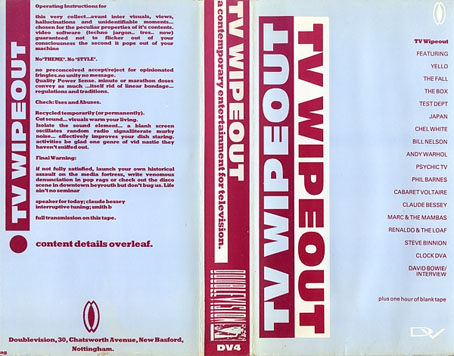
TV Wipeout

tvwipeout1.jpg

Another of the videocassette releases on Cabaret Voltaire’s Doublevision label, TV Wipeout was released in 1984 as a “video magazine”. This and Johnny YesNo were the two Doublevision releases I was most interested in, and I did get to see some of the former release when Cabaret Voltaire’s first appearance at the Haçienda in 1983 was preceded by an hour of “Doublevision Presents…”. The most memorable sights from that screening were the weird and scary Renaldo & The Loaf film and the video for Terminus by Psychic TV, a very Wild Boys-esque piece directed by Peter Christopherson. The Cabs’ Stephen Mallinder explained why the contents of the tape tended to be more commercial than other releases on the label:

Q: The next Doublevision was the TV Wipeout video which was a sort of disposable magazine compilation. It contained a fairly wide variety of contributors, from people like The Fall and Test Dept to some more mainstream groups like Bill Nelson and Japan.

Mal: The point was that Virgin Films were quite happy to work with us; they even gave us money in the form of advertising revenue for using some film clips from the Virgin catalogue. We were then able to camouflage them into the whole set-up and make them look as if they were part of the whole nature of the video compilation.

Q: One of those clips was a particularly inane interview with David Bowie. Was its inclusion merely a selling point?

Mal: Yes, it was purely that. There are a lot of people who will buy anything with David Bowie on it. So we said “Fuck it, why not use that as a selling point!” Actually the interview is appalling, it’s terrible. Our including it was almost like a piss-take. We were saying “you really will buy anything with David Bowie on it if you buy this”.

From Cabaret Voltaire: The Art of the Sixth Sense by M. Fish and D. Hallbery

Unlike some of the other Doublevision releases this one doesn’t seem to have been uploaded anywhere but since much of the content was music videos it’s possible to compile an incomplete playlist. The Paul Morrissey films (Heat and Flesh), Eating Raoul and Plan 9 from Outer Space were cult items that weren’t being screened on TV so this was an opportunity to see them outside a cinema. Some of the other selections—the Chel White, Steve Binnion and Space Movie—are still a mystery. Lost Possibilities Of Modern Dreams was footage of a painting exhibition by Phil Barnes soundtracked by the Cabs. The Claude Bessy piece is the only one from the original tape, a short film of the Haçienda’s VJ shot by Ikon Video’s Malcolm Whitehead in the basement of the club.

Bill Nelson: Flaming Desire
Bill Nelson interview
Plan 9 from Outer Space excerpt
Clock DVA: Resistance
Chel White: Industrial Park
Cabaret Voltaire: Just Fascination
Steve Binnion: Mediaevil
Renaldo & The Loaf: Songs For Swinging Larvae
David Bowie interview for Merry Christmas, Mr. Lawrence
Andy Warhol: excerpt from Heat
The Fall: Live at The Venue (1983) with documentary footage
Space Movie excerpt
The Box: Old Style Drop Down
IKON FCL advertisement featuring various groups on the Factory label
Japan: excerpt from Oil On Canvas
Andy Warhol: excerpt from Flesh
Test Dept: Shockwork
Dieter Meier interview
Yello: excerpt from Jetzt Und Alles
Eating Raoul excerpt
Psychic TV: Terminus
Phil Barnes featuring Cabaret Voltaire: Lost Possibilities Of Modern Dreams
Marc & The Mambas: Caroline Says
Claude Bessy: Operating Instructions

Previously on { feuilleton }
Seven Songs by 23 Skidoo
Elemental 7 by CTI
The Crackdown by Cabaret Voltaire
Network 21 TV