The art of Josiah McElheny

mcelheny1.jpg

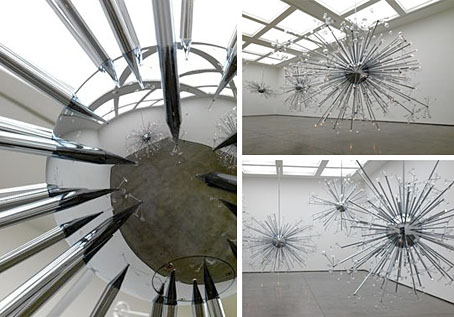
Island Universe (2008).

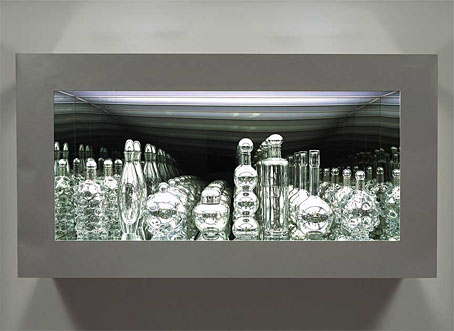
Island Universe is a new work by American artist Josiah McElheny at London’s White Cube gallery. McElheny’s recurrent use of glass and mirrors would be enough to capture my attention anyway—I particularly like the Modernity piece below—but Island Universe also features a specially-commissioned sound accompaniment by one of my favourite musicians, Paul Schütze.
mcelheny2.jpg

Modernity circa 1952, Mirrored and Reflected Infinitely (2004).

McElheny collaborated with cosmologist David Weinberg for Island Universe to create abstract sculptures that are scientifically accurate models of Big Bang theory as well as illustrations of the ideas that followed the general acceptance of the theory. The varying lengths of the rods are based on measurements of time, the clusters of glass discs and spheres accurately represent the clustering of galaxies in the universe, and the light bulbs mimic the brightest objects that exist, quasars. Island Universe proposes a set of possibilities that could have burst into existence depending on the amount of energy or matter present at the universe’s origin.

I can’t help but compare that description of McElheny’s new work with another exhibition that opened this week, TH.2058 by Dominique Gonzales-Foerster which will be filling Tate Modern’s vast Turbine Hall for the next few months. Josiah McElheny extrapolates from documentary fact and creates something beautiful at the same time. Ms Gonzales-Foerster borrows from pre-existing works of written and filmed science fiction and has to rely on those works to sustain much of the interest:

It rains incessantly in London – not a day, not an hour without rain, a deluge that has now lasted for years and changed the way people travel, their clothes, leisure activities, imagination and desires. They dream about infinitely dry deserts.

This continual watering has had a strange effect on urban sculptures. As well as erosion and rust, they have started to grow like giant, thirsty tropical plants, to become even more monumental. In order to hold this organic growth in check, it has been decided to store them in the Turbine Hall, surrounded by hundreds of bunks that shelter – day and night – refugees from the rain.

A giant screen shows a strange film, which seems to be as much experimental cinema as science fiction. Fragments of Solaris, Fahrenheit 451 and Planet of the Apes are mixed with more abstract sequences such as Johanna Vaude’s L’Oeil Sauvage but also images from Chris Marker’s La Jetée. Could this possibly be the last film?

On the beds are books saved from the damp and treated to prevent the pages going mouldy and disintegrating. On every bunk there is at least one book, such as JG Ballard’s The Drowned World, Jeff Noon’s Vurt, Philip K Dick’s The Man in the High Castle, but also Jorge Luis Borges’s Ficciones and Roberto Bolaño’s 2666.

On one of the beds, hidden among the giant sculptures, a lonely radio plays what sounds like distressed 1958 bossa nova. The mass bedding, the books, images, works of art and music produce a strange effect reminiscent of a Jean-Luc Godard film, a culture of quotation in a context of catastrophe.

There’s a list of works used in the Tate installation, nearly all of which are far more stimulating artworks in their own right than the one which is hijacking them into its “culture of quotation”. I’m sure I can’t be the only person to think that the Tate would have been better served asking McElheny and Schütze to expand their work to fill the Turbine Hall instead. Those Island Universes could only get better if they were bigger.
mcelheny3.jpg

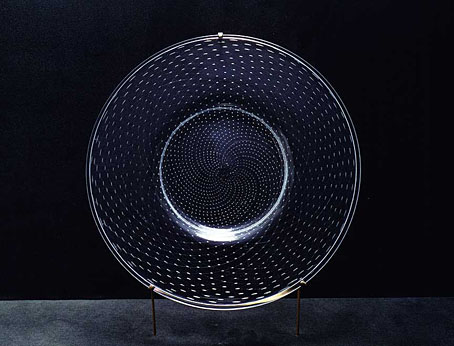
Studies in the Search for Infinity (detail, 1997-1998).

A PBS feature on Josiah McElheny

Update: Writer M John Harrison reviews TH.2058 for the Guardian and fails to be impressed:

It occurred to me that the biggest disaster in that room is the disaster for art. TH.2058 seems to finalise the hollowing-out of everything into the shallowest of semiotics. Foerster’s reading list is more powerful and important than her installation. Every one of the books on those bunk beds will give you a frisson that you don’t get from the show, so you would be as well just reading them for yourself.

Previously on { feuilleton }
Doris Salcedo’s Shibboleth
The Garden of Instruments

Penguin Labyrinths and the Thief’s Journal

labyrinths1.jpg

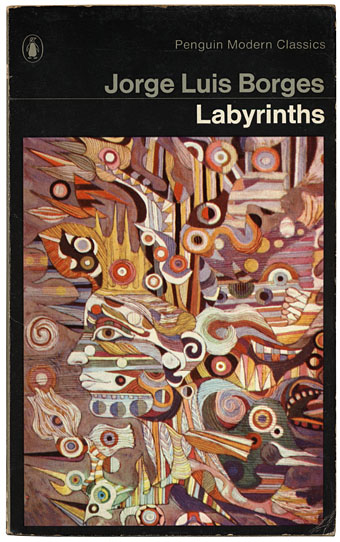
Detail from La Havane by René Portocarrero; photo by C. Marker.

This week’s book finds are a pair of titles I hadn’t come across before in these particular editions, another haul from the vast continent that is the Penguin Books back catalogue. Labyrinths I’ve had for years in a later edition (see below) but the cover of this one seems more suited to Borges (as much as he can be illustrated) than the somewhat bland Surrealism of illustrator Peter Goodfellow. René Portocarrero (1912–1985) was a Cuban painter with a post-Picasso style who specialised in hallucinogenic profiles like the one here. And it’s a guess but I’d bet the “C. Marker” who photographed the painting is French filmmaker Chris Marker (who I compared to Borges last year), director of La Jetée and Sans Soleil. Marker worked as a photo-journalist for many years and made a documentary entitled ¡Cuba Sí! in 1961.

Continue reading “Penguin Labyrinths and the Thief’s Journal”

Short films by Walerian Borowczyk

borowczyk.jpg

Les Astronautes (1959).

A nice collection of shorts by Walerian Borowczyk (1923–2006) at Ubuweb including this animated piece from 1959 which was co-directed by Chris Marker. The style is immediately reminiscent of that employed by Raoul Servais in Harpya and other films; it’s also not far removed from Terry Gilliam’s animation but it predates both. Also of note is Une Collection Particulière from 1973, a brief but fascinating look at a collection of antique pornographic toys and other adult items from the collection of Pieyre De Mandiargues. And L’Amour Monstre de tous les Temps from 1977 is a portrait of contemporary erotic Surrealist painter Ljuba Popovic at work. Borowczyk spent the Seventies making soft porn features such as Immoral Tales and The Beast, so the subject matter of the later films isn’t so surprising.

Previously on { feuilleton }
Taxandria, or Raoul Servais meets Paul Delvaux
Monsieur Chat
The Brothers Quay on DVD
Sans Soleil
Barta’s Golem
The art of Ljuba Popovic

The 14-Hour Technicolor Dream revisited

it.jpg

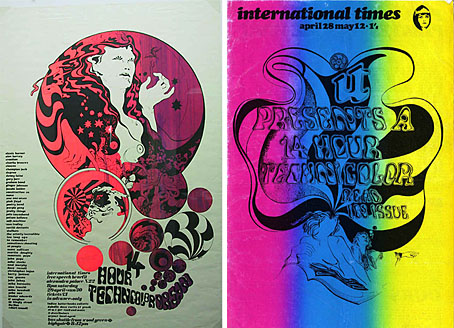
left: event poster by Hapshash & the Coloured Coat.
right: International Times 14-Hour Technicolor Dream special issue, April 1967.

The ICA goes psychedelic, baby. Lucky Londoners get to gorge themselves on this lot next Saturday.

2007 is a year of many anniversaries: twenty years since Acid House, thirty since the release of Never Mind The Bollocks, forty since Sgt. Pepper’s and fifty since the publication of Jack Kerouac’s On The Road.

One event that gets far less publicity, but that was at the heart of everything that came both before and after it also sees its 40th anniversary this year. The 14-Hour Technicolor Dream took place on April the 29th 1967 and was the UK’s first mass-participational all-night psychedelic freakout!

Organised and in a matter of weeks, the event was held in the cavernous confines of Alexandra Palace. The vision of Hoppy Hopkins and Miles, the night saw a glorious mingling of freaks, beats, mods, squares, proto-punks, pop stars and heads come together to dance, trip, love and be.

To celebrate the anniversary, the ICA presents Our Technicolor Dream—a one-off multi-media event that features an array of cult 60s films and animation, full-on psychedelic lightshows, groovy DJs, avant-garde theatre, a Q&A session with the leading lights of the 60s underground and live music with The Amazing World of Arthur Brown, The Pretty Things, Circulus and Mick Farren!

Tell It Like It Was: The Round Table Speaks: Joe Boyd, Miles, Hoppy Hopkins & John Dunbar.
Freak Out, Ethel! An Evening of Musical Mayhem: Malcolm Boyle’s play plus The Amazing World of Arthur Brown, Circulus, The Pretty Things and Optikinetics lightshow.
Boyle Family Films With Music by The Soft Machine
Weird and Wonderful 60s Animation: Films by Jan Lenica, Jan Švankmajer, Walerian Borowczyk, Chris Marker and Ryan Larkin.
What’s A Happening? “90 minutes of rare, lost and unseen psychedelic masterpieces”.

Retrospective newspaper features: The Independent | The Times

Previously on { feuilleton }
Verner Panton’s Visiona II
The art of Yayoi Kusama
All you need is…
Sans Soleil
Summer of Love Redux
The Invasion of Thunderbolt Pagoda
Oz magazine, 1967–73
Strange Things Are Happening, 1988–1990

Monsieur Chat

m_chat.jpg

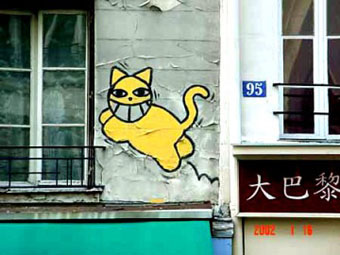
Who or what is the mysterious, grinning yellow cat? Wikipedia explains:

M. Chat (also known as Monsieur Chat and Mr Chat) is the name of a graffiti cat that appeared in Paris and other European cities in the months and years following the 9/11 terrorist attacks. The graffiti appeared most frequently on chimneys, but has been sighted in other places such as train platforms as well. It has also made appearances at political rallies. The originator of the street art remains anonymous.

The yellow cartoon cat is characterized by its large Cheshire Cat grin. The cat is most often portrayed in a running pose, but has also been variously depicted waving signal flags, bouncing on a ball, sporting angel wings, and waving in greeting at the entrance to a train station. It is sometimes accompanied by the tagline M. CHAT in small letters.

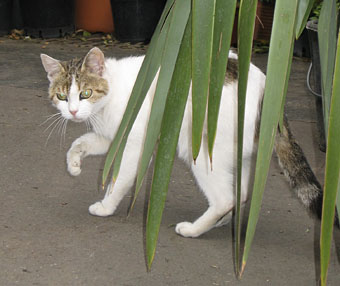
A shame I didn’t discover this phenomenon before I went to Paris last year, the city is cluttered with reproductions of Théophile Steinlen’s Chat Noir poster so it would have been fun to look for a more subversive animal. I found the wary creature below near the gardening market on the Ile de la Cité.

cat.jpg

French filmmaker Chris Marker is famously a feline aficionado so it’s no surprise that he’s made a documentary entitled The Case of the Grinning Cat (Chats perchés) examining the appearance of M Chat through the twin lenses of his video camera and his political concerns. A French site, Monsieur Chat (et autres…), similarly documents occurrences of the mysterious animal and this is their page about Marker’s film. Finally, there’s a Flickr pool although with fewer photographs than one might hope.

Via City of Sound.

Update: Monsieur Chat’s creator revealed (in French).

Previously on { feuilleton }
Sans Soleil