23 Skidoo

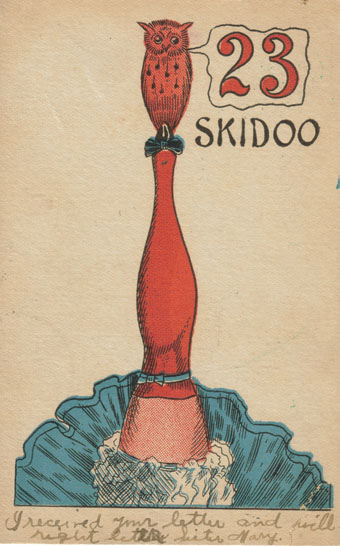
1: A slang phrase

skidoo1.jpg

Postcard via.

From the Oxford English Dictionary:

skidoo, v. N. Amer. slang. (ski’du:) Also skiddoo. [Orig. uncertain, perh. f. skedaddle v.]

2. In catch-phrases. a. Used as an exclamation of disrespect (for a person). Esp. in nonsense association with twenty-three. (temporary.)

1906 J. F. Kelly Man with Grip (ed. 2) 99 As for Belmont and Ryan and the rest of that bunch, Skidoo for that crowd when we pass. Ibid. 118 ‘I can see a reason for ‘skidoo’,’ said one, ‘and for ‘23’ also. Skidoo from skids and ‘23’ from 23rd Street that has ferries and depots for 80 per cent. of the railroads leaving New York.’ 1911 Maclean’s Mag. Oct. 348/1 Surrounded by this conglomerate procession as I went on my way, the urchins would yell ‘Skidoo,’ ‘23 for you!’

b. spec. as twenty-three skidoo: formerly, an exclamation of uncertain meaning; later used imp., go away, ‘scram’.

1926 C. T. Ryan in Amer. Speech II. 92/1, I really do not recall which appeared first in my vocabulary, the use of ‘some’ for emphasis or that effective but horrible ‘23-Skiddoo’—perhaps they were simultaneous. 1929 Amer. Speech IV. 430 Among the terms which the daily press credits Mr. Dorgan with inventing are:…twenty-three skiddoo (go away). 1957 W. Faulkner Town iii. 56 Almost any time now Father would walk in rubbing his hands and saying ‘oh you kid’ or ‘twenty-three skidoo’. 1978 D. Bagley Flyaway xi. 80 This elderly, profane woman…used an antique American slang… I expected her to come out with ‘twenty-three, skidoo’.


2: An esoteric poem by Aleister Crowley

[23]

SKIDOO

What man is at ease in his Inn?
Get out.
Wide is the world and cold.
Get out.
Thou hast become an in-itiate.
Get out.
But thou canst not get out by the way thou camest in. The Way out is THE WAY.
Get out.
For OUT is Love and Wisdom and Power.
Get OUT.
If thou hast T already, first get UT.
Then get O.
And so at last get OUT.

From The Book of Lies (1912/13)


3: A film by Julian Biggs

biggs.jpg

23 Skidoo (1964).

If you erase the people of downtown America, the effect is bizarre, not to say disturbing. That is what this film does. It shows the familiar urban scene without a soul in sight: streets empty, buildings empty, yet everywhere there is evidence of recent life and activity. At the end of the film we learn what has happened.


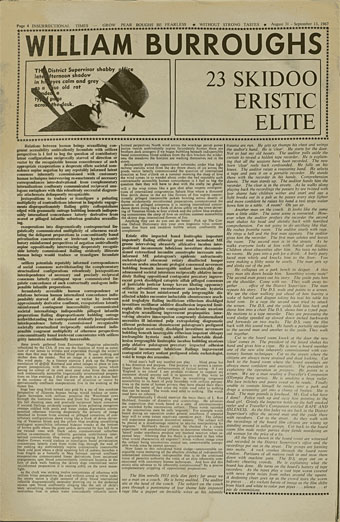
4: 23 Skidoo Eristic Elite by William Burroughs

skidoo2.jpg

International Times, issue 18, Aug 31–Sept 13, 1967.

From Burroughs proceed to Illuminatus! (1975) by Robert Shea and Robert Anton Wilson, and many subsequent derivations.


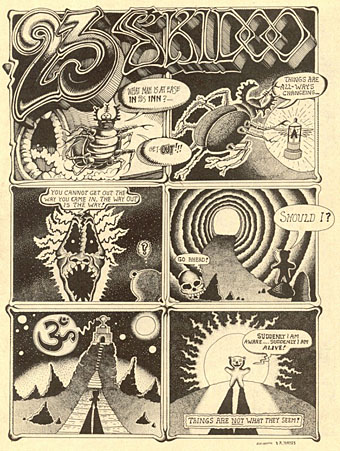
5: A one-off comic strip by Rick Griffin and Rory Hayes

skidoo3.jpg

From Bogeyman Comics #2 (1969).


6: A music group

skidoo4.jpg

Just Like Everybody (1987). Design by Neville Brody.

Website | Discography


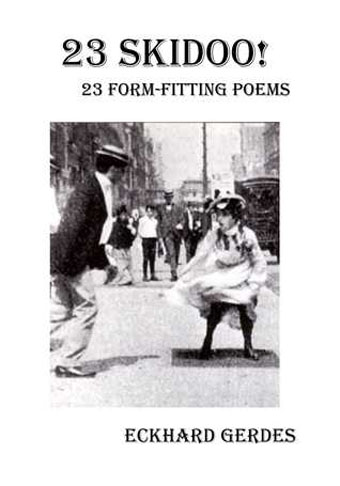
7: A poetry collection by Eckhard Gerdes

skidoo5.jpg

23 Skidoo! 23 Form-Fitting Poems (2013) by Eckhard Gerdes.

Previously on { feuilleton }
Seven Songs by 23 Skidoo
23 Skidoo by Julian Biggs
Neville Brody and Fetish Records

Weekend links 256

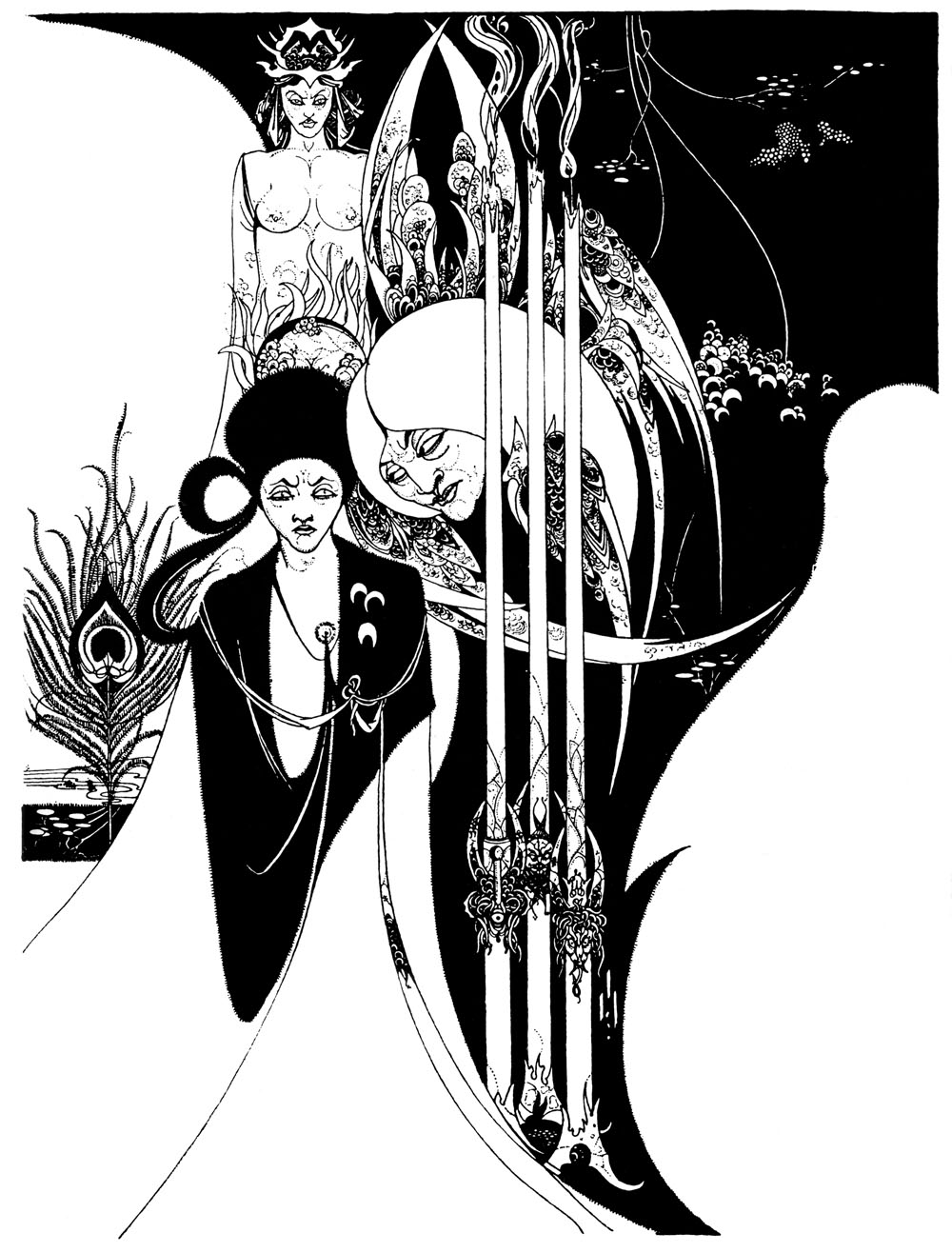
beardsley.jpg

Of a Neophyte, and How the Black Art Was Revealed unto Him by the Fiend Asomuel. Aubrey Beardsley for the Pall Mall Magazine, 1893.

• The occult preoccupations of the 1970s appear to be in the ascendant just now. Whether this is mere nostalgia or something in the zeitgeist remains to be seen but BBC Radio 4 aired an hour-long documentary on the subject this weekend entitled Black Aquarius. The guest list implies an inevitable focus on film and television but Matthew Sweet covered a lot of ground, taking in the Hermetic Order of the Golden Dawn, Aleister Crowley, Dennis Wheatley, The Process Church, and Alex Sanders, the public face of British witchcraft in the 1960s and 70s. Earlier this week at AnOther the focus was on Maxine Sanders, High Priestess of the Alexandrian coven and putative fashion icon even though she was generally photographed naked. Maxine and husband Alex are unavoidable when reading about UK occultism in the 1970s; among other things they were occult advisors to Satanic rock band Black Widow, and also released an album of their own in 1970, A Witch Is Born. Of more interest is Sacrifice by Black Widow, a 55-minute concert for German TV’s Beat Club.

• Jacques Rivette’s OUT 1 (1971) is a film more talked about than seen, in part because of a running time that exceeds 12 hours. So news of a Blu-ray release later this year is very welcome.

• “Bruce LaBruce: taking zombie porn and gay homophobic skinheads to MoMA”. The director goes through his filmography with Nadja Sayej.

• “Art is anarchistic, and when it becomes categorized, it loses impact.” RIP Bernard Stollman, founder of the amazing ESP-Disk record label.

• Magickal (and pseudonymous) synth music by Mort Garson: Black Mass (1971) by Lucifer, and The Unexplained (1975) by Ataraxia.

Kevin Titterton on Angelo Badalamenti and the soundtrack that made Twin Peaks.

• Mix of the week: Secret Thirteen Mix 149 by Robert Aiki Aubrey Lowe.

Rare Decay, a free bonus track from Aurora by Ben Frost.

Alan Garner is celebrated in a new collection, First Light.

• At Dangerous Minds: The Residents’ radio special, 1977.

Black Sabbath (1969) by Coven | Black Sabbath (1970) by Black Sabbath | Her Lips Were Wet With Venom (Satan Oscillate My Metallic Sonatas 1 & 2) (2006) by Boris & Sunn O)))

Yuggoth details

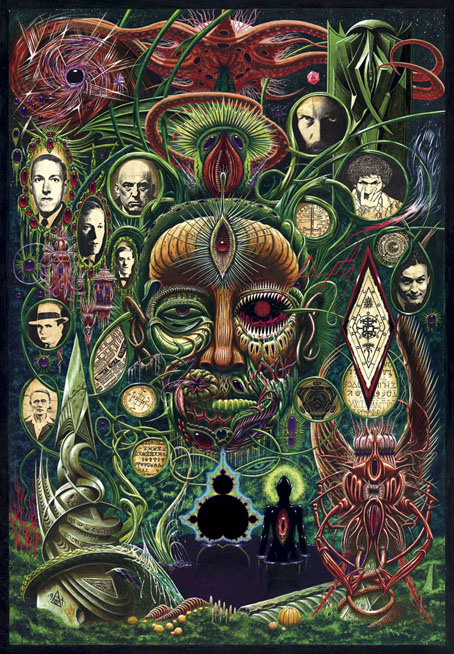
yuggoth01.jpg

Yuggoth Cultures (1994) by John Coulthart.

Earlier this week I spent a day scanning this painting—which I’m now surprised to find is 21 years old—so I might at last have a good quality digital copy. There’s been a copy on the website for years but that was a print made at a high-street copy shop that did nothing for the detail and range of colour. It’s quite a large piece—49.54 x 71.39 cm (19.5 x 28.1 inches)—done with acrylics on board. Since 2003 the painting has been used (in another poor reproduction) on the cover of The Starry Wisdom, the controversial collection of Lovecraftian fiction from Creation Books. The painting wasn’t originally intended for that collection, however, and doesn’t quite fit since a number of the portraits don’t feature in the book at all.

Yuggoth Cultures would have been an earlier collection of Lovecraftian fiction and non-fiction that Alan Moore had begun writing for Creation in 1993. Alan’s idea was to take Lovecraft’s Fungi from Yuggoth sonnet sequence as the basis for a collection that would explore Lovecraft’s fictional world and also draw together a variety of figures from the same era: fellow writers, occultists like Aleister Crowley and Austin Spare, and Harry Houdini for whom Lovecraft ghost-wrote Imprisoned with the Pharaohs in 1924. Unfortunately the stars were not right on this occasion; Alan took the sole copy of the half-written manuscript to London in order to read selections at an event in Soho but left the papers in a cab. Some pieces survived, having been copied and stored elsewhere—The Courtyard in The Starry Wisdom is one of these—and there was talk for a while of the lost pieces being rewritten but enthusiasm for the project flagged.

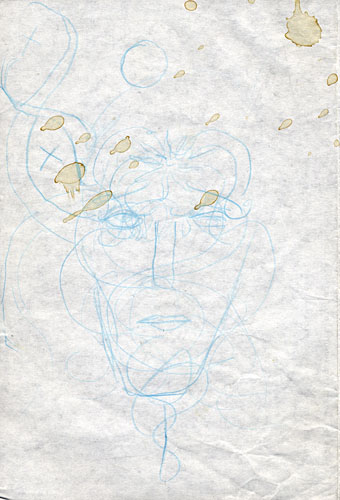
yuggoth08.jpg

This is Alan’s sketch for the cover, the idea being to have a Lovecraft head made of fungal growths rather like an Arcimboldo painting. The head would be sprouting tendrils whose loops would contain pictures of some of the people featured in the book. Alan’s quick sketch is actually a better approximation of Lovecraft’s strange features than my painted version which isn’t narrow enough. For the record (and because people always ask), the other people on the cover are Alan himself, Austin Osman Spare, Aleister Crowley, Harry Houdini, Robert E Howard (not Al Capone as people often think) and Clark Ashton Smith.

yuggoth09.jpg

yuggoth10.jpg

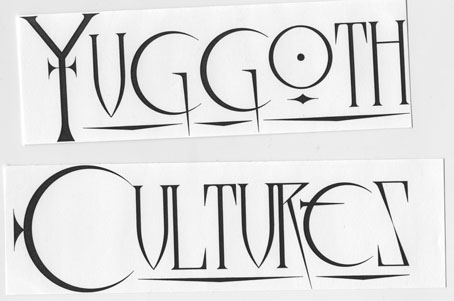
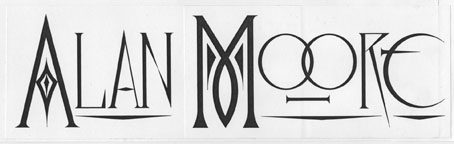
While searching through the archives I discovered these lettering designs although they’re probably not bold enough to read very well on such a busy painting. Before I started using a computer, designs like this had to be drawn at large size then scaled down using a photocopier.

Continue reading “Yuggoth details”

Spare things

spare-cthulhu.jpg

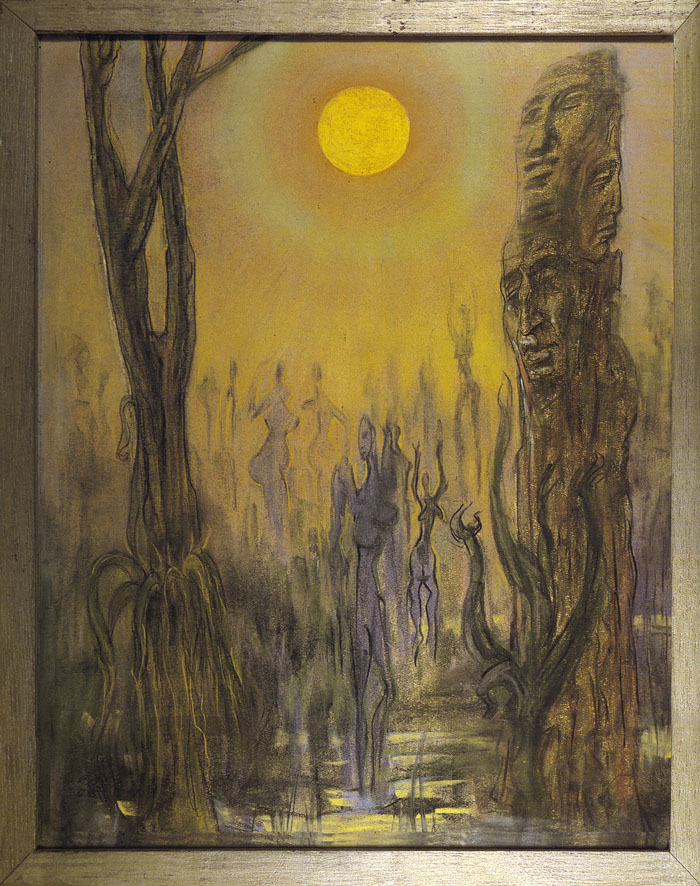
Cthulhu Cultus: The Sun is Sick (no date) by Austin Osman Spare.

I’ve been telling people about this drawing for years but I’ve not posted it here before. Spare produced this piece after Kenneth Grant gave him some of HP Lovecraft’s stories to read. I’ve never seen it dated but it’s probably from the mid-50s when Kenneth and Steffi Grant were corresponding with Spare and commissioning new artworks. What’s notable for me is that this is probably the first Lovecraft-derived drawing that wasn’t either a magazine or book illustration, or something done for one of the horror fanzines.

coc.jpg

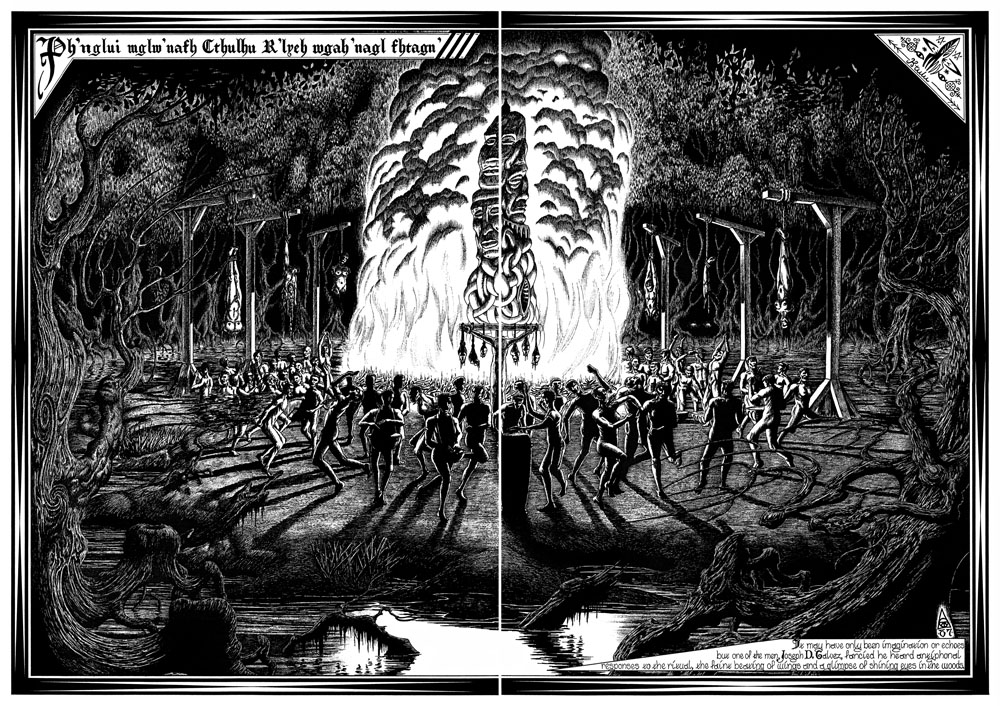
The Call of Cthulhu (1987) by John Coulthart.

Lovecraft aficionados have never seemed aware of Spare’s drawing since Lovecraft studies tended until very recently to remain fixed on popular media and the often parochial world of genre fandom. When I came to draw the swamp scene for The Call of Cthulhu in 1987 I borrowed the faces from Spare’s pillar for the column in the centre of the picture.

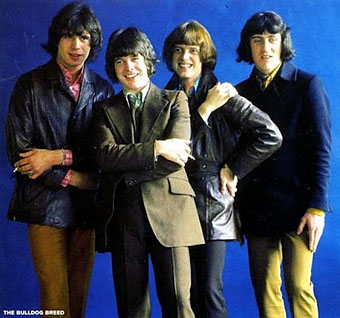
bulldogbreed.jpg

Bulldog Breed.

While we’re on the subject, and in the spirit of showing how all the obsessions here connect in one way or another, Phil Baker’s excellent biography of Austin Spare notes a surprising reference to the artist that predates Man, Myth and Magic via the psychedelic music scene. Bulldog Breed were a short-lived London group, one of many being promoted by the Deram label in the late 1960s. The group’s one-and-only album, Made In England, was released in 1969. The cover art is dreadful but the final song is a number entitled Austin Osmanspare [sic], a paean to the artist that turns AOS into a typical character from British psychedelia: an eccentric, oddly named, Victorian type with a sinister and mysterious glamour. According to Baker one of the band members had an aunt who knew Spare. It’s not a bad song, and the choice of magus gave them an edge over the Beatles who went for the more obvious Aleister Crowley. “They said he was before his time…”

Previously on { feuilleton }
Dreaming Out of Space: Kenneth Grant on HP Lovecraft
MMM in IT
Intertextuality
Abrahadabra
The Occult Explosion
Murmur Become Ceaseless and Myriad
Kenneth Grant, 1924–2011
New Austin Spare grimoires
Austin Spare absinthe
Austin Spare’s Behind the Veil
Austin Osman Spare

Dreaming Out of Space: Kenneth Grant on HP Lovecraft

grant.jpg

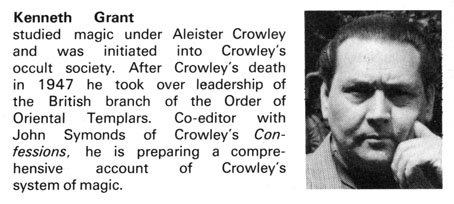
Going through some of my loose copies of Man, Myth and Magic recently turned up this article by Kenneth Grant that I’d forgotten about. I have two separate sets of Man, Myth and Magic: a complete edition in binders, and a partial collection of loose copies of the weekly “illustrated encyclopedia of the supernatural”. The partial collection is worth keeping for the unique articles that ran across the last two pages of every issue, all of which are absent (along with the magazine covers) from the bound edition. These articles formed the Frontiers of Belief series, a collection of essays of the kind one might find in magazines today such as Fate or Fortean Times. An earlier essay about Wilfried Sätty, Artist of the Occult, was reproduced here a few years ago; none of these pieces have ever been reprinted so it seems worthwhile putting another of the more interesting pieces online.

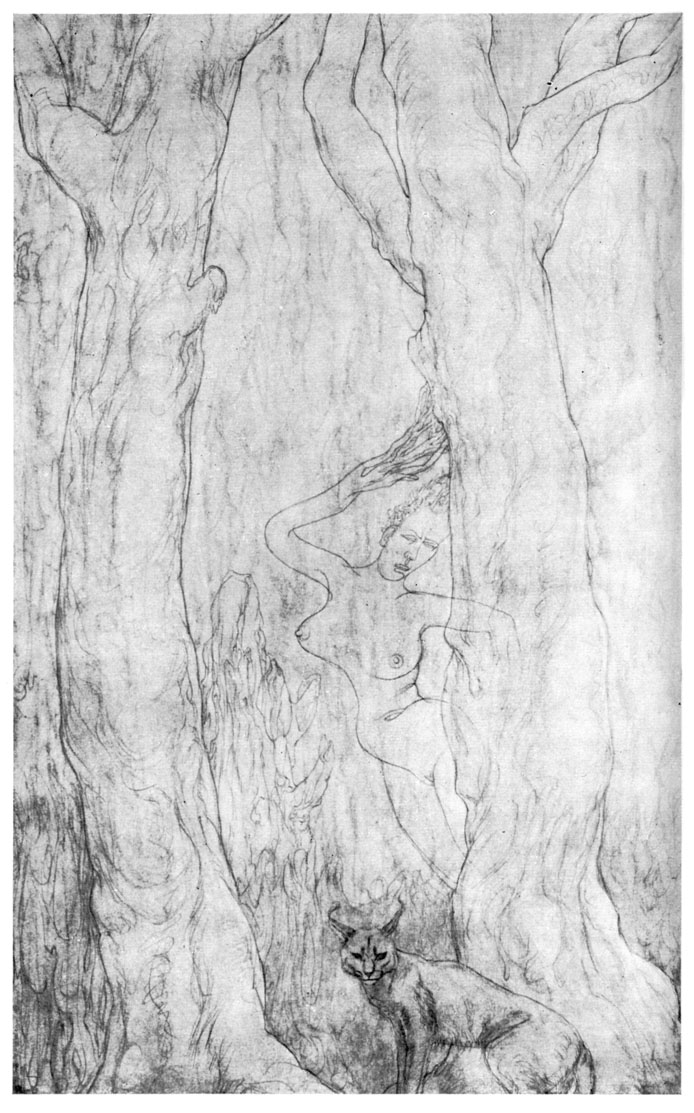
Kenneth Grant was the only active occultist among Man, Myth and Magic‘s roster of very serious and well-regarded writers and experts. Grant wrote several of the encyclopedia entries although not the one about Aleister Crowley, as you might expect, that entry going to Crowley’s executor and biographer, John Symonds. Grant was also a lifelong champion of HP Lovecraft’s fiction which explains this article; many of Grant’s later occult texts have a distinctly Lovecraftian flavour, and they often refer to Lovecraft and Arthur Machen as being the unconscious recipients of actual occult emanations or presences. Grant’s belief that the authors channelled these emanations into their fiction is central to this piece, a belief that Lovecraft would have dismissed even though several of his stories (not least The Call of Cthulhu) concern exactly this process. Grant connects Lovecraft with another artist whose work he championed throughout his life, Austin Osman Spare. It was Grant’s involvement with Man, Myth and Magic that put one of Spare’s drawings on the cover of the first issue, and further drawings inside the magazine, introducing the artist’s work to a new, highly receptive audience. The drawing below (Were-Lynx) appears in the magazine behind Grant’s text so I’ve scanned a text-free copy from Grant’s Cults of the Shadow (1975).

DREAMING OUT OF SPACE by Kenneth Grant

Malevolent powers are lurking in wait to project themselves into the sleeping minds of men: this terrifying idea is a recurring theme in the stories of Howard Phillips Lovecraft, who claimed that they came to him in nightmares. But were they simply bad dreams, or was he in fact receiving communications from an unknown source, as Kenneth Grant here suggests?
spare.jpg

“I have watched for dryads and satyrs in the woods and fields at dusk”; illustration by Austin Osman Spare, who sensed the forces looming behind Lovecraft’s work, and was inspired to illustrate these presences.

Howard Phillips Lovecraft died in 1937; but the myth-cycle which he initiated in unrivalled tales of cosmic horror now raises the question whether it was a mere fiction engendered in the haunted mind of an obscure New England writer, or whether it foreshadowed a particularly sinister kind of occult invasion.

According to a well-known occult tradition, when Atlantis was submerged, not all perished. Some took refuge on other worlds, in other dimensions; others “slept” a willed and unnatural sleep through untold aeons of time. These awakened; they lurk now in unknown gulfs of space, the physical mechanism of human consciousness being unable to pick up their infinitely subtle vibrations. They lurk, waiting to return and rule the whole earth, as was their aim before the catastrophe that destroyed their corrupt civilization.

This tradition was a major theme in Lovecraft’s work. Until quite recently people read his stories and shuddered (if sufficiently honest and sensitive enough to admit their uncanny impact), not suspecting for a moment that such things could be.

Few know that Lovecraft dreamed most of his tales. And he sometimes thought that these dreams, or rather, nightmares, were caused by misdeeds in remotely distant incarnations when, perhaps, he had aimed at acquiring magical powers. These dreams were memories of the past and prophecies of the future, for he said that “nightmares are the punishment meted out to the soul for sins committed in previous incarnations—perhaps millions of years ago!”

In his life as Howard Phillips Lovecraft he tried again and again to bring himself to face squarely the ordeal through which he knew he would have to pass, if he were finally to resolve his spiritual difficulties. The issue is brought to the surface perhaps more clearly and urgently in his poems than in his stories. He is on the brink of making the critical discovery, of surprising the secret of his inner life, and he is forced back repeatedly by the dread, the stark soul-searing fear which he bottles up in his work and which he communicates so successfully—in neat doses—to his readers.

One of Lovecraft’s most vivid creations is the ancient book of hideous spells composed to facilitate traffic with creatures of unseen worlds. He ascribed its authorship to Abdul Alhazred, a mad Arab who flourished in Damascus about 700 AD. This grimoire, during the course of its mysterious career, is supposed to have been translated by the Elizabethan scholar Dr John Dee, into Greek, under the title of Necronomicon. It contains the Keys or Calls that unseal forbidden spaces of cosmic sleep, inhabited by elder forces that once infested the earth. The Keys are in a wild, unearthly tongue reminiscent of the Calls of Chanokh, or Enoch, which Dr Dee actually obtained through contact with non-terrestrial entities during his work with the magician, Sir Edward Kelley, whom Aleister Crowley claimed to have been in a previous life. It is possible that the “evil and abhorred Necronomicon” was suggested by the clavicles or Keys of Enoch, which Dee and Kelley discovered, and which Crowley later used to gain access to unknown dimensions.

Continue reading “Dreaming Out of Space: Kenneth Grant on HP Lovecraft”