Kenneth Anger on DVD again

anger2.jpg

Nearly two years after their American release, and not a moment too soon, the films which comprise Kenneth Anger‘s superb Magick Lantern Cycle turn up at last in the UK. Good to see these being produced by the BFI, their previous collections of shorts by the Brothers Quay and Jan Švankmajer are distinguished by quality transfers, great packaging and very thorough documentation. Surprising, then, that the box art of the BFI set is rather naff-looking compared to the Fantoma releases. On the plus side, those of us in Region 2 receive the additional extra of an Anger documentary by Elio Gelminis. The BFI is also making these films available for the first time on Blu-ray. Now I’m hoping they might get round to doing a decent job with all the films of Sergei Parajanov, especially that cult favourite of mine, Shadows of Our Forgotten Ancestors.

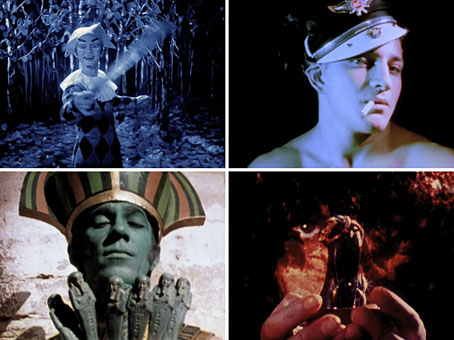
Renowned as the author of the scandalous best-selling book Hollywood Babylon, Kenneth Anger is a legend in this own time. The mythology that has grown around him has many sources, from his involvement with the occult, astrology and the pop world of Mick Jagger, Marianne Faithfull and Jimmy Page, to the announcement of his own death in the pages of the Village Voice, and the destruction, loss and banning of his films. At the heart of all this mythology is a filmmaker of prodigious talent, whose skill and imagination create films of great visual force, influencing filmmakers such as Martin Scorsese, David Lynch and RW Fassbinder.

Disc one:
* Fireworks (1947)
* Puce Moment (1949)
* Rabbit’s Moon (1950/1971, the rarely seen 16mins version)
* Eaux d’Artifice (1953)
* Inauguration of the Pleasure Dome (1954)
* Scorpio Rising (1964)
* Kustom Kar Kommandos (1965)
* Invocation of My Demon Brother (1969)
* Rabbit’s Moon (1979 version)
* Lucifer Rising (1981)

Disc two:
* Anger Me (2006) – Elio Gelminis documentary on Kenneth Anger

Extras
* Newly recorded commentaries by Kenneth Anger
* The Man We Want to Hang (2002) – Anger’s film on the paintings of Aleister Crowley

Previously on { feuilleton }
Mouse Heaven by Kenneth Anger
The Man We Want to Hang by Kenneth Anger
Relighting the Magick Lantern
Jan Švankmajer: The Complete Short Films
Kenneth Anger on DVD…finally
The Brothers Quay on DVD

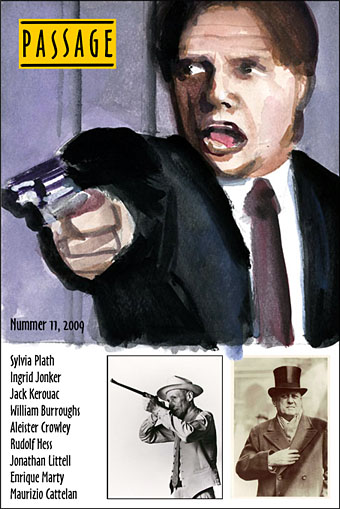
Passage 11

passage11.jpg

Ed Jansen writes to let me know that the latest edition of his web magazine, Passage, is now online. Once again, most of the features listed below are in Dutch but that doesn’t exclude all visitors here. David Britton has been recommending Jonathan Littell’s The Kindly Ones to me so I guess I’ll be reading that soon.

• Sylvia Plath, a biography.
• Ingrid Jonker, poet from South-Africa, essay on her life and work.
• Jack Kerouac & William Burroughs, a review of And The Hippos Were Boiled In Their Tanks.
• William Burroughs in Texas, a review of Rob Johnson’s, The Lost Years of William S. Burroughs.
• Aleister Crowley, an article about Crowley’s possible involvement with the Secret Service.
• Rudolf Hess, double agent? A view on his flight to Britain.
• Jonathan Littell, an in-depth review of his work The Kindly Ones. War as hallucination.
• Enrique Marty & Maurizio Cattelan, a review of the work from two conceptual artists.

Previously on { feuilleton }
Passage 10

Design as virus 7: eyes and triangles

eye0.jpg

Continuing this occasional series. The above motif is the Golden Dawn’s Wedjat or Eye of Horus emblem as reproduced in the hardback edition of The Confessions of Aleister Crowley, an “autohagiography”. Crowley was under discussion here a few days ago and the eye in a triangle symbol can also be seen on the sleeve of the single featured in that posting, forming a part of the seal of the Ordo Templi Orientis, the occult order which Crowley joined in 1910. Crowley’s use of the eye in a triangle caught the attention of writer Robert Anton Wilson and the first part of his Illuminatus! trilogy (written with Robert Shea) is titled The Eye in the Pyramid. That latter symbol appears on the reverse of the American dollar bill, of course, and some of the conspiracy theories surrounding that usage are explored in the novel. Wilson went on to make the eye in a triangle something of a personal symbol and his obsessive use of the motif caught my attention in turn when I began reading his books.

All of which leads us to Hawkwind and a person whose name keeps turning up on these pages, designer Barney Bubbles.

eye1.jpg

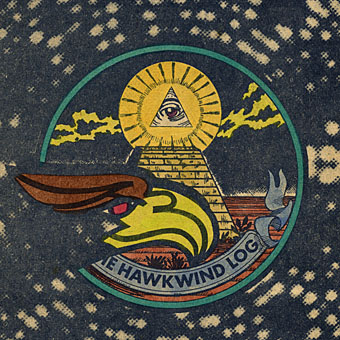
Hawklog cover (detail) by Barney Bubbles.

The booklet which BB designed for Hawkwind’s second album, In Search of Space (1971), featured a version of the dollar bill symbol on its cover. This is the only eye in a triangle design I’ve seen among Barney Bubbles’ work although he was so prolific there may well be others. When I began producing my own significantly inferior Hawkwind graphics in the late Seventies I incorporated eyes in triangles partly as a way of avoiding having to draw hawks all the time but mainly because of Robert Anton Wilson. BB had already established a precedent and it so happens that the eye in the Golden Dawn/Crowley version is the eye of a hawk-headed Egyptian god.

Continue reading “Design as virus 7: eyes and triangles”

Aleister Crowley on vinyl

ac1.jpgThe appearance of occultist Aleister Crowley on the sleeve of Sgt Pepper is well-documented—here he is looking rather grainy on my CD insert—although I always forget which of the Beatles it was who put him in the list of “people that we like”. I’d guess John Lennon who would have appreciated Crowley’s obscene poetry, copious drug intake and ability to consistently épater la bourgeoisie.

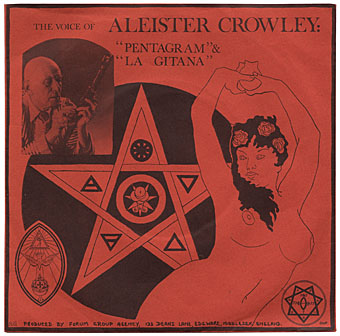
Less well-known is what I presume must be the first outing for Crowley’s voice on this rare undated single from the mid-Seventies. Along with the cassette tapes I discussed earlier, this was another item turned up during a recent clearout of household junk. I’ve yet to see a detailed description of the origin of these Crowley recordings. I have the first CD pressing and haven’t looked at later editions so can’t say whether they contain more information about what are supposed to be wax cylinder recordings copied to acetates. The first complete collection of the recordings was a vinyl release produced by David Tibet in a limited edition in 1986. I was among those that ordered a copy.

ac4.jpg

The Marabo single features two of the same recordings, of course, albeit in slightly poorer quality. (And I love the way it has a removable centre, as though it might well end up in a jukebox.) One feature of the continual reissuing of Crowley the recordings is that sound quality has improved over the years. The versions of The Pentagram and La Gitana on YouTube sound better than the ones on my CD. The occult resonance of Crowley’s voice (which always reminds me of Winston Churchill) have inevitably made it a popular sampling source. In the pre-sampling era 23 Skidoo and Psychic TV (both with David Tibet) used loops of the Enochian Calls. Bill Laswell later took to using samples on his ambient releases, while the most recent CD version includes an entire disc of ambience with Crowley’s voice subjected to digital processing.

ac2.jpg

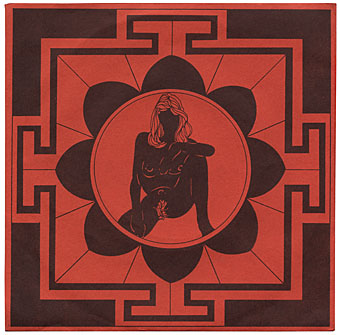
The sleeve art for the single was by Steffi Grant, occultist wife of occultist Kenneth Grant, and it’s possible the pair sing backing vocals on the less-than-compelling B-side, a soft rock number entitled Scarlet Woman by Chakra. The song is credited to “Ponton/Ayers/Grant/Magee” so even if one or other of the Grants didn’t sing they helped with the lyrics. It should be noted that Mrs Grant’s artwork is often better than these illustrations and does much to enliven her husband’s volumes of occult philosophy. Some of their work was also featured in the seven-volume encyclopedia, Man, Myth and Magic, which featured Kenneth among the staff of consultants.

ac3.jpg

Before anyone asks: no, the single isn’t for sale. I’ve sold a lot of old vinyl over the past few years but I’m keeping this particular item. I know a couple of unreleased recordings by Chakra exist; if anyone has further information about the group, please leave a comment.

Update: Jok posted a link which resolves the mystery. It was indeed Kenneth Grant on backing vocals.

Previously on { feuilleton }
Old music and old technology
The Man We Want to Hang by Kenneth Anger
The art of Cameron, 1922–1995
Austin Osman Spare

The Man We Want to Hang by Kenneth Anger

anger_crowley.jpg

The title comes from a newspaper headline, one of many that the tabloid press bestowed on occultist Aleister Crowley whilst titillating their readers with lurid descriptions of orgies and Black Masses throughout the 1920s. Before the Second World War it was still possible to label a self-aggrandising magus “The Wickedest Man in the World”. If only they knew what was coming…

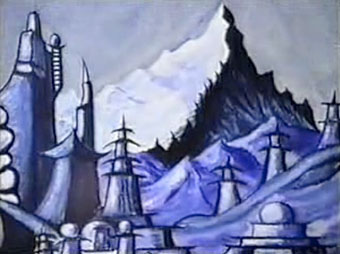
The picture above is a still from Kenneth Anger’s 2002 film of Crowley’s paintings which you can see in two parts at YouTube. The paintings were filmed in exhibition at the October Gallery in 1998 and Anger turns the original tabloid headline around by making the “hang” refer to hanging a painting. Crowley’s crude artwork often turns up in books but there are several pictures in the film I hadn’t come across before. Crowley’s depiction of the Himalayas, where he spent some time mountaineering, look very similar to those of Nicholas Roerich, the painter whose work HP Lovecraft references in At the Mountains of Madness. It would have been nice to have some more information about the pictures but that’s not Anger’s style.

The Man We Want to Hang pt 1 | pt 2

Previously on { feuilleton }
Relighting the Magick Lantern
Kenneth Anger on DVD…finally
The art of Cameron, 1922–1995
Austin Osman Spare