Palladini’s Aquarian Tarot

palladini01.jpg

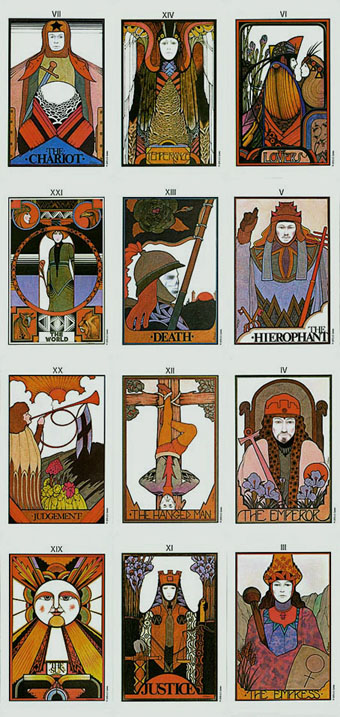
For the past two months I’ve been busy drawing a new set of Tarot designs. More about these later, but sporadic research has naturally led to me to look at a few earlier sets, although my Trumps have mostly been following Pamela Colman Smith’s illustrations for the Waite deck. Tarot designs have really proliferated in the past few years (Is there a Lego Tarot? Yes, of course there is), so much so that many previous designs which would once have been notable are now swamped by mediocre decks.

David Palladini’s Aquarian Tarot first appeared in 1970 when the occult revival was getting into its stride. Palladini had contributed to the Linweave Tarot in 1967 along with three other artists, something you can read more about at the excellent Sweet Jane’s Pop Boutique. I’m sure I must have seen the Aquarian Tarot in the past but probably dismissed it for being too modish and not occult enough; for a long time Aleister Crowley’s Thoth deck was the only one I’d look at. Palladini’s art is a lot more familiar now that his fabulous poster for Nosferatu the Vampyre looks down on me every day, and I’ve grown to enjoy his combination of Art Nouveau and Deco motifs so much that I wouldn’t mind a pack of these cards. The Aeclectic site reviews the deck, and has a few more examples of the designs. They also review the New Palladini Tarot which the artist produced in 1996. Given the choice I’d still go for the earlier set.

palladini02.jpg

Continue reading “Palladini’s Aquarian Tarot”

Abraxas: The International Journal of Esoteric Studies

abraxas.jpg

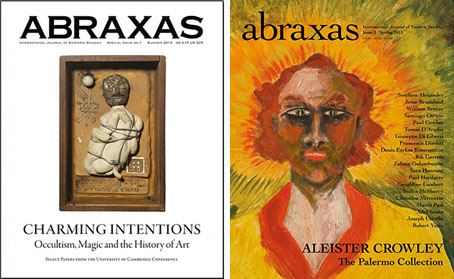
A welcome arrival in the post recently was two issues of Abraxas, the book-format journal of esoteric studies from Fulgur Esoterica. I’ve always observed the contemporary occult scene from a distance, being more interested in cultural spin-offs whether those happen to be music-oriented—as was the late, lamented Coil—or art-oriented. Something I always enjoyed about Kenneth Grant’s books was the amount of unique art material they contained, much of it by his wife, Steffi Grant, or previously unseen work by Austin Osman Spare. Fulgur have for many years continued this artistic focus, starting out by reprinting Spare’s books (and publishing new ones, such as the revelatory Zos Speaks!), and more recently turning their attention to the work of contemporary artists following similar paths.
kostromitin2.jpg

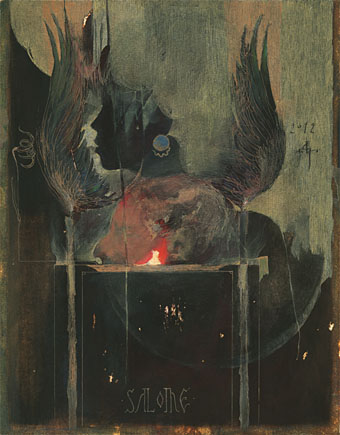
Study for Salome (2012) by Denis Forkas Kostromitin.

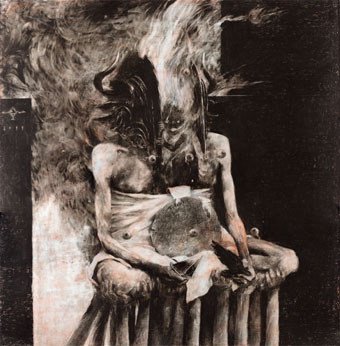
Abraxas is a venue for the latter group, especially in the most recent issue, no. 3, which features a wealth of new art, photography, essays and poetry. In the past I’ve complained about the misunderstandings Austin Spare’s work used to generate among otherwise intelligent and sensitive critics when faced with the artist’s occult obsessions; the usual response would be to lazily dismiss this side of his work as “black magic”, and therefore either kitsch or nonsense. Things have improved in recent years but it’s taken a long time for critics and curators who would show the greatest respect to a minority belief from South America, say, to offer the same respect to equally sincere artists who happen to be working in London or New York. One of the values of Abraxas for artists such as Jesse Bransford and Denis Forkas Kostromitin, both of whom are interviewed here, is that they can have a conversation with someone who won’t treat their work or their interests in a condescending manner. I’m particularly taken with Kostromitin, a Russian artist whose work I only discovered recently.
kostromitin3.jpg

M L K (Moloch) (2011) by Denis Forkas Kostromitin.

Elsewhere in Abraxas 3 there’s a feature on the recent exhibition of Aleister Crowley’s extravagant daubs, an article by Francesco Dimitri about tarantism in southern Italy, a piece about Dada by Adel Souto, and text by Paracelsus with illustrations by Joseph Uccello which is printed on a different paper stock. The production quality is as good as any art book but then that’s standard for a Fulgur publication. Mention should be made of the interior design of this issue which far exceeds the often perfunctory layout of many publications from smaller publishers. Tony Hill is credited on the masthead as Creative Director so I’m assuming he’s the person responsible. Abraxas is an essential purchase for anyone interested in contemporary occult art. The hardback of no. 3 is a limited edition that includes a signed and numbered lithograph by Denis Forkas Kostromitin.

Previously on { feuilleton }
I:MAGE: An Exhibition of Esoteric Artists

Abrahadabra

abrahadabra01.jpg

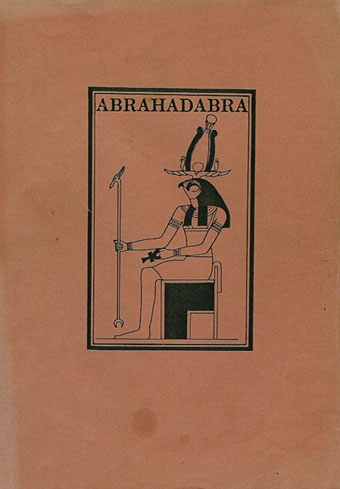
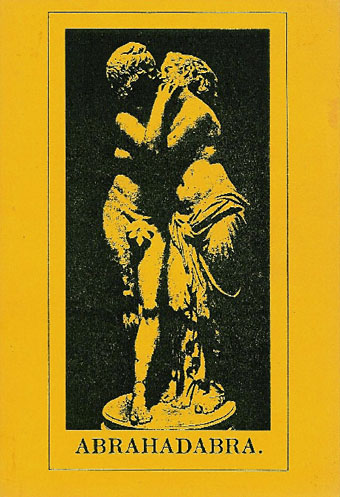
01 First (1985).

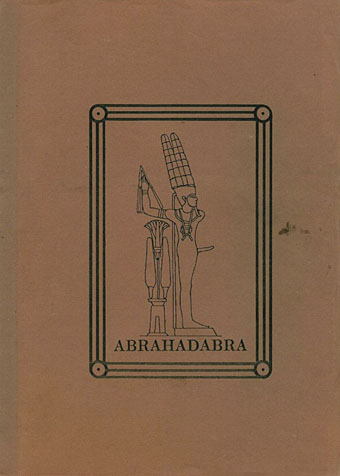
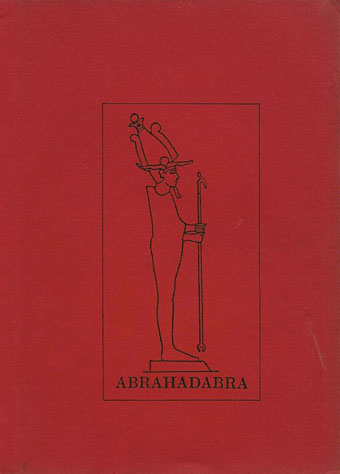
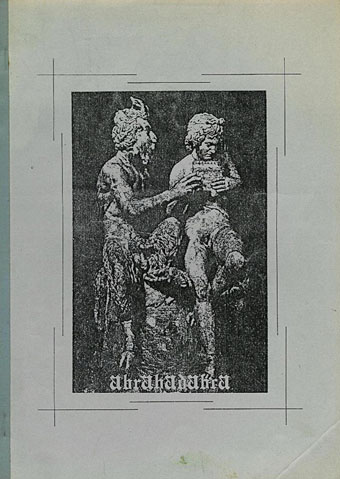
I’ve linked to so many publications at the Internet Archive I’m a little surprised it’s taken me this long to find something featuring my own work. Abrahadabra was a Dutch periodical covering subjects familiar to readers of the esoteric magazines of the 1980s (RE/Search, Rapid Eye, etc): Industrial music of the TG/Psychic TV/Coil variety, transgressive writers such as Burroughs, Ballard and Bataille, weird fiction of the Lovecraft/Machen school, and a heavy emphasis on occultism. My friend Ed was one of the contributors which is how my Pan drawing ended up in the Witches issue in 1987.

For a publication with minimal resources the production was often impressive, the drawing on the cover of the Austin Spare issue, for instance, being printed in silver ink on black paper. The contents were mostly in Dutch but each issue featured interesting and often original graphics. I also drew a small Horus head for issue 11 (which I’d forgotten about until I saw it again), whose title design was used on the cover of issue 12. Some of the other issues I hadn’t seen before so it’s good to find them scanned and easily available. The 1980s was the last time print was used as the primary medium for underground culture to talk to and disseminate itself. By the end of the decade many of the small magazines had either evolved—both RE/Search and Rapid Eye turned into books—or expired. The final Abrahadabra is dated 1990.

abrahadabra02.jpg

02 Second (1985).

abrahadabra03.jpg

03 Third (1985).

abrahadabra04.jpg

04 Sex (1985).

abrahadabra05.jpg

05 Derangement (1985).

Continue reading “Abrahadabra”

Brush of Baphomet by Kenneth Anger

anger2.jpg

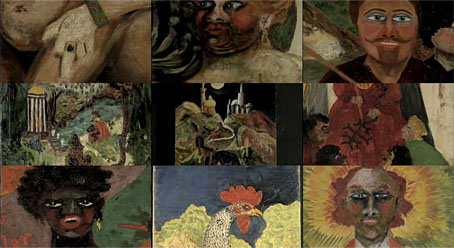
Another recent piece of Angeriana, and another short video sketch, Brush of Baphomet (2009) is a kind of addendum to Anger’s The Man We Want to Hang (2002), being a further look at Aleister Crowley’s paintings. The title refers to one of Crowley’s many occult names. As a painter Crowley’s technical ability was almost nil but that never dissuaded him from trying, and I’m sure I’m not alone in finding his work to have a naive malevolence. Anger has had a lifelong interest in Crowley’s paintings, famously journeying in 1955 to the abandoned villa in Cefalù, Sicily, where he cleaned whitewash from the walls to reveal the remains of the murals Crowley had painted there.

anger3.jpg

The music in Brush of Baphomet is a surprising choice, an extract from the second part of Morton Subotnick’s Silver Apples of the Moon (1967). Anger’s musical selections have never been random ones so you have to wonder why this particular score. Was it because the electronics are reminiscent of the Moog drones Mick Jagger supplied for Invocation of My Demon Brother (1969)? Subotnick’s title is borrowed from The Song of Wandering Aengus by WB Yeats, a poet for whom Crowley (also a poet) had little affection. In Crowley’s occult novel Moonchild, Yeats appears as “Gates”, a mediocre painter (yes, well…), who ends up being killed in an act of magical revenge. Crowley must have been mortified a few years later when Yeats was awarded a Nobel Prize.

Previously on { feuilleton }
Anger Sees Red
Kenneth Anger’s Hollywood Babylon
Lucifer Rising posters
Externsteine panoramas
Missoni by Kenneth Anger
Anger in London
Arabesque for Kenneth Anger by Marie Menken
Edmund Teske
Kenneth Anger on DVD again
Mouse Heaven by Kenneth Anger
The Man We Want to Hang by Kenneth Anger
Relighting the Magick Lantern
Kenneth Anger on DVD…finally

MMM

macgregor1.jpg

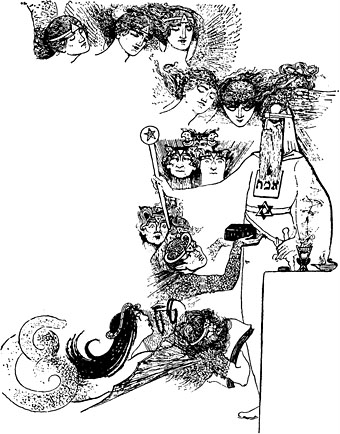
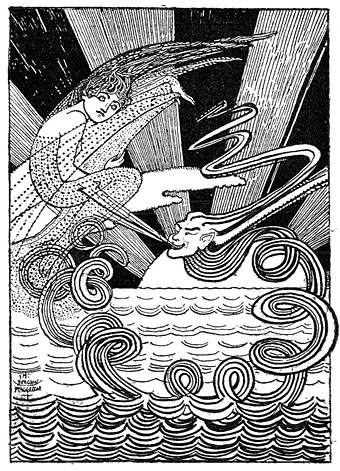
Post number three thousand, and searching the memory for anything which might be filed under MMM led to more occult art. Moina MacGregor Mathers (1865–1928) was the wife of Samuel Liddell MacGregor Mathers, one of the founders of the Hermetic Order of the Golden Dawn in the 1880s. Moina was the sister of the French philosopher Henri Bergson, and later took to signing her illustration work “M. Bergson MacGregor”. The illustration above, however, a frontispiece for her husband’s translation of The Sacred Magic of Abramelin the Mage (1897) was signed “M.M.M.” (The signature has been removed in this reproduction but is visible here.) That triplet of initials is typical of western occultism; when Aleister Crowley (no friend of the Mathers) was appointed head of the O.T.O. in Britain his new lodge was named Mysteria Mystica Maxima, or M.M.M.

Ms Mathers wasn’t the greatest of artists but her few works have a fin de siècle charm, and are informed by occult study which she and her husband took seriously. The example below is from yet another slim volume of mystical poetry, Poems (1897) by Golden Dawn adept Charles Rosher. No need to wonder why Max Beerbohm made Enoch Soames a poet; it often seems that those who weren’t writing poetry in the 1890s were in the minority.

macgregor2.jpg

Previously on { feuilleton }
Whirlpools
The Sapphire Museum of Magic and Occultism