Weekend links 83

hackett.jpg

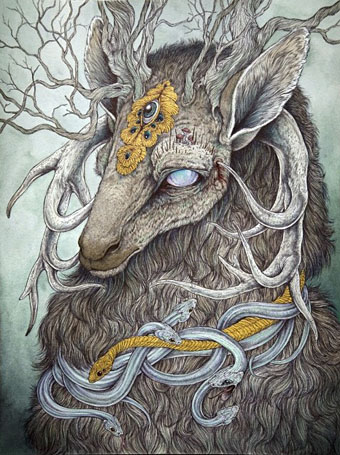
In Memory by Caitlin Hackett who describes her astonishing drawings as “contemporary mythology”.

• David Lynch’s solo album, Crazy Clown Time has just been released so The Guardian last Friday let the artist/director/musician edit their G2 supplement. Xan Brooks tried to get Lynch to open up about his inspirations while elsewhere Lynch had a chat with ZZ Top’s Billy Gibbons. Of more interest to me was news that some of the deleted sequences from Blue Velvet have been discovered. I’ve known about these for years from a feature in Video Watchdog magazine but never thought we might get to see them. Related: a mixtape by David Lynch & musical collaborator/engineer ‘Big’ Dean Hurley.

• “Book jackets these days, for reasons I won’t unpack, seem to revel, overtly, in wit, conceptual deviousness, unusual clever or droll juxtapositions – we, as a professional community, seem to have elevated the visual bon mot above all other virtues.” Peter Mendelsund in a great post about certain problems in book design, starting with the very problematic question of what to do with Nabokov’s Lolita. Related: Covering Lolita, a gallery of covers through the ages which run the gamut of bad decisions.

• “For his sins Pinocchio is not only hanged but robbed, kidnapped, stabbed, whipped, starved, jailed, punched in the head, and has his legs burned off.” Nathaniel Rich goes back to Carlo Collodi’s original Pinocchio. Disney it ain’t.

wolpe.jpg

Some of Berthold Wolpe’s Faber cover designs are now available as prints from wire-frame whose Pelham/Ballard prints were mentioned here recently. Related (and worth another visit): Faber 20th century classics at Flickr.

Technical Vocabularies – Games for May, a small collection of poems by Alan Moore & Steve Moore, is now online with authorial permission. Alan’s Beardsley pastiche on the cover is a bonus.

• Cabaret Voltaire’s Richard H. Kirk says the group’s Virgin albums will be reissued next year by Mute. A new edition of The Crackdown? Yes, please.

• “Homo Riot can only think of six or seven street artists in the world who regularly feature gay themes in their work, and he knows all of them.”

Rub Out The Words: Letters from William Burroughs and Philip K. Dick on the language virus theory of William Burroughs.

L’exilé de Capri: the connections between Jacques d’Adelswärd-Fersen and Roger Peyrefitte explored at Strange Flowers.

• Flying cars and monorails: Soviet Russia in the 1960s also had a Gerry Anderson view of the future.

Are You An Anarchist? The Answer May Surprise You.

Baby’s On Fire (1973) by Brian Eno | Baby’s On Fire (live, 1974) by Eno & The Winkies | Baby’s On Fire (live, 1976) by 801 | Baby’s On Fire (1998) by The Venus In Furs.

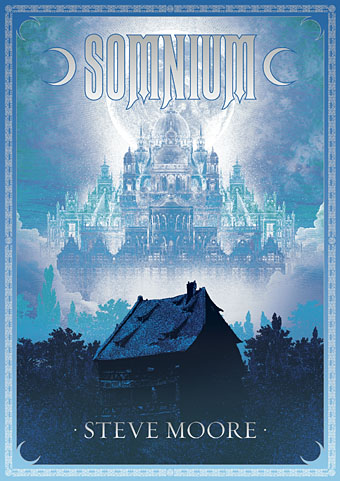
Somnium by Steve Moore

somnium.jpg

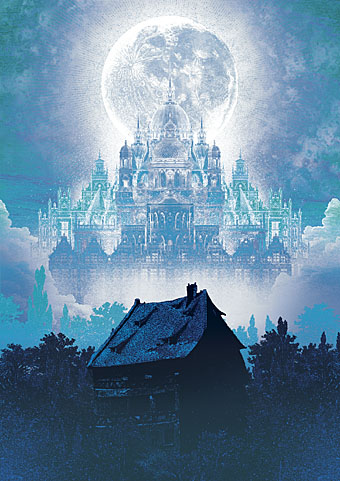
Another new piece of illustration and design. Somnium is an occult novel by Steve Moore being published this month by Strange Attractor. Some readers here may know Steve’s work as a comics writer, ex-editor of Fortean Times and also the subject of Alan Moore’s recent Unearthing text and recording. I’ve not seen the book yet but it comes laden with praise from Michael Moorcock and Iain Sinclair, and features an afterword by Alan Moore:

Written in the early years of the 21st century, when the author was engaged in dream-explorations and mystical practices centred on the Greek moon-goddess Selene, Somnium is an intensely personal and highly-embroidered fictional tapestry that weaves together numerous historical and stylistic variations on the enduring myth of Selene and Endymion. Ranging through the 16th to 21st centuries, it combines mediæval, Elizabethan, Gothic and Decadent elements in a fantastic romance of rare imagination.

With its delirious and heartbroken text spiralling out from the classical myth of Endymion and the Greek lunar goddess Selene, Somnium is an extraordinary odyssey through love and loss and lunacy, illuminated by the silvery moonlight of its exquisite language.

The printed version should incorporate metallic silver ink on the title and border, something you can never quite replicate on a web image, hence the gradient on the title lettering. Somnium is available in a range of signed or unsigned editions and can be purchased direct from the Strange Attractor Shoppe.

Previously on { feuilleton }
Dodgem Logic again
Of Moons and Serpents

Murmur Become Ceaseless and Myriad

spare.jpg

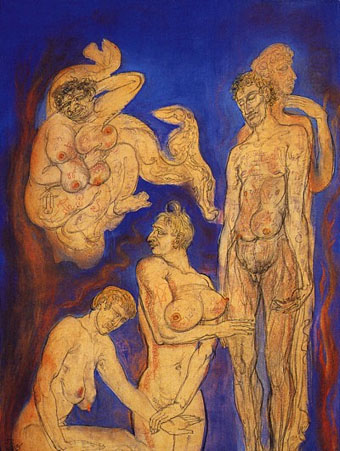
Efflaration (1952) by Austin Osman Spare.

The Austin Spare revival continues with another exhibition, Murmur Become Ceaseless and Myriad at Flat Time House, London, curated by Mark Titchner. Unless I’ve missed something this is a significant moment since it’s the first time Spare’s work has been paired with that of a more contemporary artist, the late John Latham (1921–2006) whose former home provides the exhibition space.

Biographically, the artists have a lot in common: a reticence to engage with the art establishment or the commercial art market; superficial correspondences with the work of their contemporaries but isolation by force of their ideas. The artistic genius of both these artists was, in the main, recognised by their peers, even if the subject of their work was not entirely understood.

In spite of this, discussion of Spare’s practice has largely related to arcana and magic, despite his training in fine art and early mainstream successes. Conversely, Latham’s work has been understood primarily in relation to the conceptual art practices of the 1960s and 70s. This exhibition broadens these perspectives, presenting their work in the context of two parallel experimental practices. (more)

There’s also a somewhat tenuous connection between the pair in the figure of Alan Moore, a Spare enthusiast who in 1992 appeared with John Latham and a number of other literary and artistic types in The Cardinal and the Corpse, a TV film by Iain Sinclair and Chris Petit which really ought to be on YouTube but isn’t. It’s worth a watch if you can find a copy. Murmur Become Ceaseless and Myriad runs until 30th October.

Previously on { feuilleton }
Kenneth Grant, 1924–2011
New Austin Spare grimoires
Austin Spare absinthe
Austin Spare’s Behind the Veil
Austin Osman Spare

Art is magic. Magic is art.

millidge.jpg

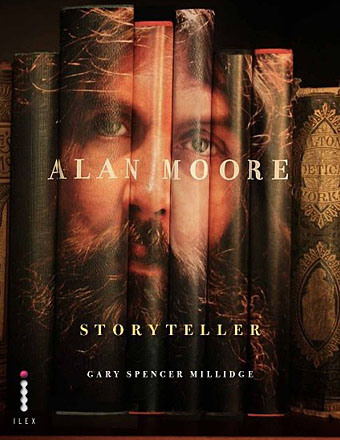
Cover concept by Chip Kidd.

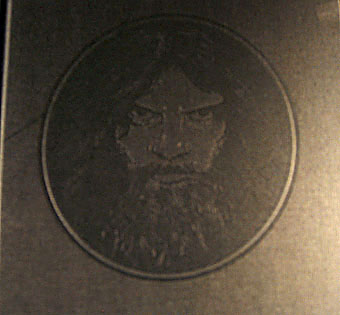
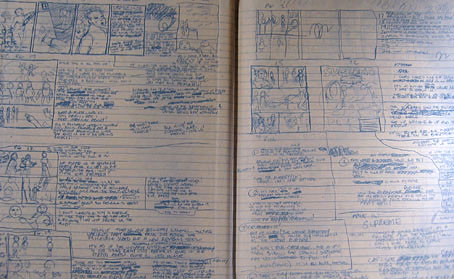
I noted the imminent arrival of Gary Spencer Millidge’s labour of love last month and the volume itself turned up this week, and what a book it is, a heavyweight hardback that’s far more lavish than I anticipated. The first surprise comes when removing the dust jacket to find Alan’s scowling visage embossed on the boards. Inside there’s a wealth of Moore ephemera from biographical material (lots of family photos) to insights into the scripting process behind the comics. I already knew Alan made little thumbnail sketches of his comic layouts before writing his scripts, having been fortunate enough to see one of the work-in-progress books for From Hell one time when I was chez Moore. Now everyone can have that opportunity. In addition there’s a thorough overview of Alan’s career, from the earliest juvenilia through to recent issues of Dodgem Logic. The comics career often overshadows his other work but in a later part of the book there’s considerable attention given to his collaborations with musicians, dancers and others for the Moon and Serpent performances. For my part it’s a pleasure to see some of the designs I created for the Moon and Serpent CDs printed large-size and in better quality than pressing plants manage with compact discs. None of those releases sold in great quantities and all are now out-of-print so the artwork often feels lost.

moore01.jpg

The front board.

What else? How about two sections of the book with fold-out pages? How about the first ever public appearance of Alan’s huge chart mapping the progress of every character through the unfinished Big Numbers? How about an introduction by Michael Moorcock where he calls Alan “a Robert Johnson of the Age of Doubt; questioning, confronting, mourning and yearning, representing his readers in profound ways, an intellectual autodidact, one of my few true peers for whom I have limitless respect.”? How about a compact disc featuring extracts from the Moon and Serpent CDs plus many other previously unreleased songs including pieces by the Emperors of Ice Cream? This is a gorgeous production designed by Simon Goggin and art directed by Julie Weir, and I haven’t even begun to read it yet. Is it necessary to state that it’s an essential purchase for anyone with more than a passing interest in Mr Moore and his many talented collaborators? Yours for twenty-five quid from Ilex Press. Some page samples follow.

moore02.jpg

Front endpapers showing Alan’s working notes and sketches.

Continue reading “Art is magic. Magic is art.”

Weekend links 69

evans.jpg

Peacock Apocalypse (detail) by Julie Evans in collaboration with Ajay Sharma.

Here at { feuilleton }, home of the curly bracket affectation, your correspondent is still surprised to find his postings the subject of a critique by Rick Poynor in the latest edition of Eye magazine, the international review of graphic design. I haven’t seen a print copy yet but you can read Mr Poynor’s appraisal here. Meanwhile, over at Design Observer this week there’s another Poynor piece about the collage illustrations of Andrzej Klimowski.

Alan Moore (yes, him again) discusses the moment when the League of Extraordinary Gentlemen gets all swinging and psychedelic. And Iain Sinclair (yes, him again) is still doing the interview rounds promoting his current book, Ghost Milk.

Ayin Acla, a short film by Anna Thew with a soundtrack by Cyclobe. The most recent Cyclobe album, Wounded Galaxies Tap at the Window, was previously vinyl-only but is now available on CD.

• Bones and beads and other things in Wren Britton’s Pure Vile clothing and accessories. Related: Patrick Veillet’s wearable bone sculptures.

Lambshead Cabinet of Curiosities Q&A: Ann & Jeff VanderMeer answer questions about their latest anthology at Fangoria.

• Being a lifelong introvert, I’m sympathetic to Four Ways Technology Can Enable Your Inner Introvert by Philip Bump.

• In an all-too-rare meeting of minds and talents, Roy Harper talks to Joanna Newsom.

Jon Macy’s Teleny and Camille is reviewed at Lambda Literary.

• Author Carol Birch tells us how best to read Finnegans Wake.

Joel Pirela’s Design Classics posters.

Each And Every Word Must Die (1999) by Cyclobe | Brightness Falls From The Air (2001) by Cyclobe | Indulge Yourselves With Our Delicious Monster (2006) by Cyclobe