The New World: a misunderstood masterpiece? | John Patterson on Terrence Malick’s film.
Jewelled butterflies and cephalopods
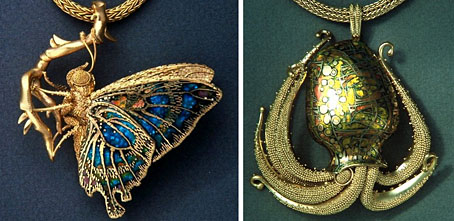
Above: gold, silver & enamel butterfly and squid, both by John Paul Miller. More at this Flickr page.
Below: Tintenfisch und Schmetterling (Octopus and Butterfly; 1900) by Wilhelm Lucas von Cranach, a master jeweller who liked his octopuses.
Tips by Chateau Thombeau and Fine & Dandy (NSFW).

Previously on { feuilleton }
• Geoffrey Haberman’s brass insects
• Elizabeth Goluch’s precious metal insects
• Kelly McCallum’s insect art
• The art of Jo Whaley
• The art of Philippe Wolfers, 1858–1929
• Lalique’s dragonflies
• Lucien Gaillard
Ronald Balfour’s Rubáiyát
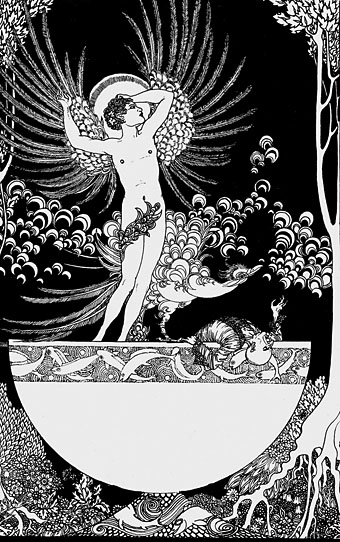
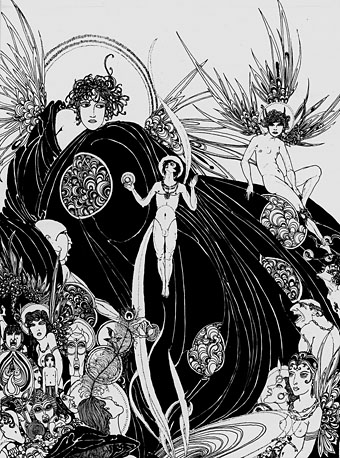
If the work of illustrator Ronald Balfour (1896–1941) isn’t as well-known as it should be it’s probably because his 1920 edition of the Rubáiyát is his sole major work according to a recent feature in Book & Magazine Collector. These illustrations were produced when he was 24 and while the drawing can be uncertain in places, they’re really splendid examples of the post-Beardsley style, owing far more to Aubrey’s flourishes and details than to the usual Arabian exotica found in other Omar Khayyam adaptations. As usual I love the profusion of peacocks and winged figures, and, unlike many rare editions of this period, we’re fortunate that someone has put all the illustrations onto Flickr. Feast your eyes here.
Elsewhere on { feuilleton }
• The illustrators archive
Eros: From Hesiod’s Theogony to Late Antiquity
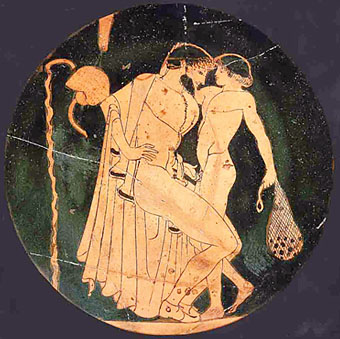
Man courting a boy at the palaestra (530–430 BCE).
Greek love seems to be the theme this week. Having been reading in Margaret Walters’s The Nude Male about the sodomitical habits of the Spartans (are you listening, Frank Miller?), and the general enthusiasm (a Greek term, incidentally) for the youthful male body, news arrives of an exhibition at the Museum of Cycladic Art in Athens “dedicated (to) Eros and its various manifestations in antiquity”.
There in three rooms reserved for artistic renditions of sexual congress, pederasty (socially accepted in ancient times), homoerotic love, and the quaintly named “bucolic love affair”, viewers are bombarded with what the ancients were clearly good at: being bawdy. From scenes of anal copulation to mutual oral sex, to lucky charms of giant phalluses and engravings of frenzied sex with the half-man, half beast satyrs and silens, Eros is depicted in all its glory.
“I delight in the prime of a boy at 12,” one scribe declares in a text highlighted on a wall. “One of 13 is much more desirable. He who is 14 is a still sweeter flower of the lovers. And one who is just beginning his 15th year is yet more delightful. The 16th year is that of the gods. And as for the 17th, it is not for me but for Zeus to seek it.”
Aristophanes, the 5th century BC comic, who embraced the obscene, devising 106 ways of describing the male genitals and 91 those of the female, would not have been disappointed. (More.)
There’s a catalogue available but their website is saying it’s out of stock at the moment. Eros: From Hesiod’s Theogony to Late Antiquity runs to April 5, 2010.
• Sex and sanctity: Eros exhibition bares all in Athens
Elsewhere on { feuilleton }
• The gay artists archive
Previously on { feuilleton }
• The fascinating phallus
• Hadrian and Greek love
Return to Wonderland
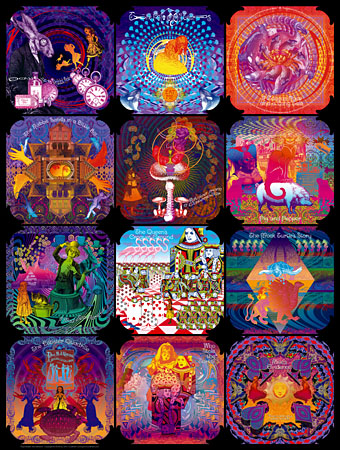
As the festive season shambles into view I’ve reworked my psychedelic interpretation of Alice’s Adventures in Wonderland from calendar to poster format for those who might prefer the latter. There are two poster sizes, the standard CafePress large and small, and the calendar is still on sale, of course. By coincidence, the dreadfully-named Syfy channel is currently running its own TV adaptation of the Lewis Carroll books. I haven’t seen Alice but the reviews I’ve read have been mixed. From the description I can’t imagine I’d enjoy it (Tim Burton’s film is the one I’m waiting for) but it shows once again how endlessly mutable the Alice stories have become.
Previously on { feuilleton }
• Dalí in Wonderland
• Virtual Alice
• Psychedelic Wonderland: the 2010 calendar
• Charles Robinson’s Alice’s Adventures in Wonderland
• Humpty Dumpty variations
• Alice in Wonderland by Jonathan Miller
• The Illustrators of Alice