Konx om Pax

konx1.jpg

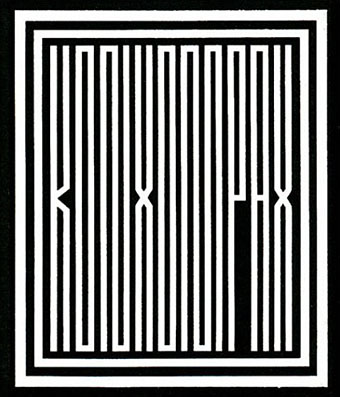
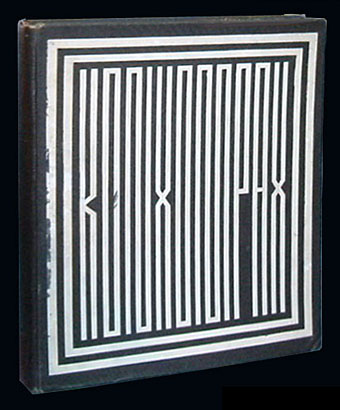
Not the musician but the book of “Essays in Light” published by Aleister Crowley in 1907. I’ve been familiar with this for years but only via the many reprints. It was only recently that I discovered the striking cover design of the first edition which, we’re told, was designed by Crowley himself during a hashish bout. I’ve not been able to find the source for this piece of information but it’s not in the chapter of his autobiography where he discusses the writing of the book. (Matters aren’t helped by Konx om Pax not being listed in the index.) If anyone has the relevant details then please leave a comment.

konx2.jpg

In design terms this cover might seem radical for 1907 but if Crowley did design it I’d guess he was thinking of a quite common geometric variation of Kufic script. Crowley travelled East as far as China, and had an abiding interest in languages of all kinds. Konx om Pax opens with a quote in Arabic from the Qur’an which is followed by a succession of quotes in different languages including Hebrew, Chinese, Ancient Greek, Sanskrit and hieroglyphic Egyptian.

konx3.jpg

Konx om Pax (2011) by Fredrik Söderberg.

Crowley’s lettering turns up much later in this painting by Fredrik Söderberg. The phrase was also referenced during the 1990s on many of Bill Laswell’s recordings, often by cryptic phrasing on CD stickers. The name forms part of one of the tracks on Laswell’s Axiom Ambient album from 1994, an album which includes a sample of Crowley’s voice. Also in the 1990s, Laswell was making frequent use of what MacGregor Mathers claimed was the English translation of the Egyptian origin of the phrase: “Khabs am Pekht” or “Light in extension”. One of Laswell’s many dub projects, Divination, released two compilation albums called Light In Extension, while the phrase “Khabs am Pekht” (which had me mystified for years) appears on the back of Material’s magnificent Hallucination Engine (1994). One of my favourite albums, which also includes a portion of a Crowley Tarot card in its James Koehnline artwork.

Previously on { feuilleton }
Burroughs at 100
Aleister Crowley: Wandering The Waste
Brush of Baphomet by Kenneth Anger
Rex Ingram’s The Magician
The Mysteries of Myra
Aleister Crowley on vinyl

Narcose, a film by Julie Gautier

narcose1.jpg

Hallucinations without drugs:

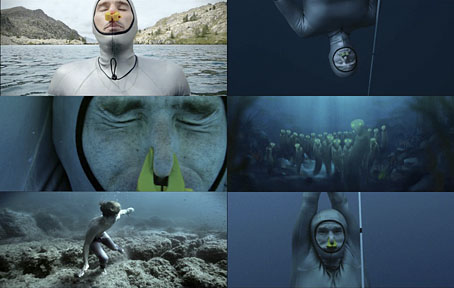
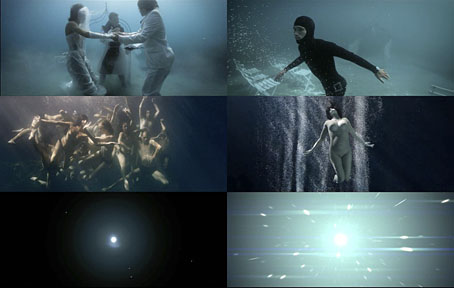
Deep water freediving exposes its practitioners to a form of narcosis, which induces several symptoms, among which a feeling of euphoria and levity that earned this phenomenon its nickname of “raptures of the deep”. The short film relates the interior journey of Guillaume Néry, the apnea world champion, during one of his deep water dives. It draws its inspiration from his physical experience and the narrative of his hallucinations.

Also without much CGI trickery since most of the shots in Julie Gaultier’s film have been filmed underwater by actor-divers. Guillaume Néry reenacts a dive without oxygen tank to a depth of 125 metres. The effect is a little like Altered States crammed into 10 minutes, albeit without Ken Russell’s religious preoccupations.

narcose2.jpg

Weekend links 220

waliszewska.jpg

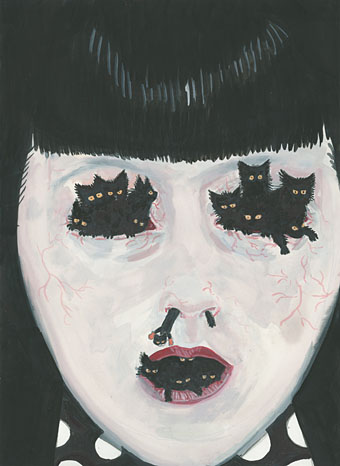
Untitled painting by Aleksandra Waliszewska.

• Ben Wheatley’s forthcoming film of High-Rise by JG Ballard now has its own Tumblr. This will no doubt be spoilerific so I won’t keep on visiting but it’s there if you require it. More Ballardianism: “Worshipping the Crash” at BLDGBLOG.

• “Aickman wandered through the sixties fantasy landscape like some curmudgeonly fetch, returning from the fin de siècle heyday of the ghost story.” Boyd Tonkin profiles Robert Aickman, writer of peerless “strange stories”.

• At Dangerous Minds: “Raise a glass to Cthulhu at the Lovecraft Bar”. Looks more like a Captain Nemo bar to me (not that there’s anything wrong with that) but I appreciate the gesture.

But to demand that a work be “relatable” expresses a different expectation: that the work itself be somehow accommodating to, or reflective of, the experience of the reader or viewer. The reader or viewer remains passive in the face of the book or movie or play: she expects the work to be done for her.

Rebecca Mead on The Scourge of Relatability

• “Space as a paranoid, static rumble featuring: 20jfg, Ben Frost & Daníel Bjarnason, Coil & Eduard Artemiev”. 20 Jazz Funk Greats on the pleasures of the Solaris soundtrack.

• What do Hawkwind, Harry Nilsson, Stereolab and The Supremes have in common? David Stubbs examines the legacy of Neu! and Klaus Dinger’s “Dingerbeat”.

• A reminder that A Year in the Country features a host of worthwhile links and associations for the Hauntologically persuaded.

Rouge Louboutin, an ad by David Lynch. Related: An improptu biscuit ad by the Eccentronic Research Council.

• Mix of the week (a year old but no matter): JG Ballard Zoom Lens Mix by Bernholz.

• At 50 Watts: More illustrated sheet music covers by Einar Nerman.

Five book cover designers and the books that inspire them.

Tove Jansson would have been 100 this week.

Pangaea with modern borders

Solaris: Dream (1990) by Edward Artemyev [sic] | Solaris (2000) by Photek | Simulacra I (2011) by Ben Frost & Daníel Bjarnason
Lodela, a film by Philippe Baylaucq

lodela.jpg

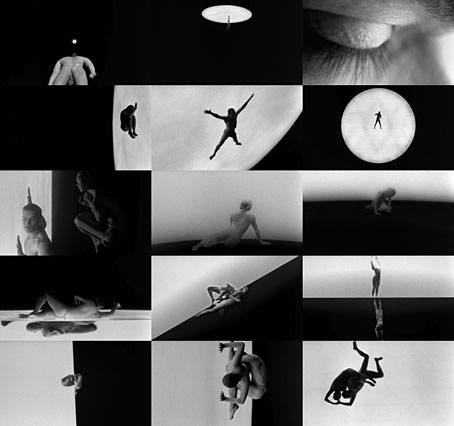
The soul leaves the body. Drawn by intense light, the spirit discovers its twin self, its feminine side…its guide in the beyond. Inspired by the myths of the afterlife, this allegorical dance piece illuminates the soul’s quest by exploring movement and the human body in new and astonishing ways. An evocation of the origins of the world. A hymn to the beauty of the human form. A celebration of movement.

Lodela (1996) was a production for the National Film Board of Canada, and in many ways it acts as a response to (or evolution from) an earlier NFBC film, Norman McLaren’s justly-celebrated Pas de Deux (1968). Both films depict an encounter between two dancers in an abstract black-and-white space; both films also take advantage of their medium to present dance in a manner that would be impossible on a stage. In McLaren’s film the dancers’ movements are multiplied via optical printing, a process that gives their gestures a liquid, hallucinatory grace.

For Lodela Philippe Baylaucq has his dancers (José Navas and Chi Long) situated on an illuminated circle surrounded by the dark, one side of which is shown in negative. He also does some simple things with the camera which are nevertheless strikingly effective and unusual in a dance piece, such as filming the dancers upside down, and attaching the camera to their bodies for dizzying close-ups. Choreographers (and dancers, for that matter) often get agitated if dancers’ bodies aren’t shown in full so this latter piece of direction is very unusual. Watch the film here. Pas de Deux, incidentally, is also on the National Film Board of Canada’s Vimeo channel, and in much better quality than earlier YouTube versions. Watch them together.

Previously on { feuilleton }
Pas de Deux by Norman McLaren
Norman McLaren