High-Rise posters

highrise.jpg

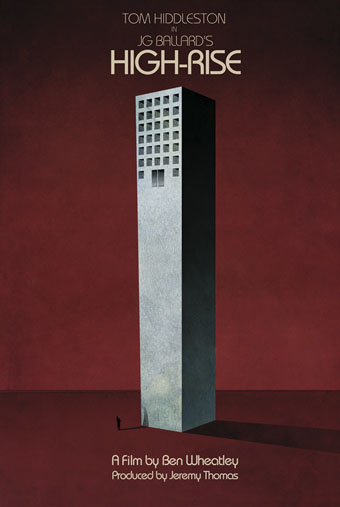
An early promotional poster from 2014 by Jay Shaw.

Ben Wheatley’s film of the novel by JG Ballard approaches. As is my custom, I’ve been avoiding the trailers of this and any other film of interest but the posters are increasingly impressive. Ben Wheatley and fellow Brit filmmaker Peter Strickland (whose The Duke of Burgundy was produced by Wheatley’s Rook Films) have distinguished themselves not only by the quality of their films but also by caring about the designs used to advertise their work. Last month I linked to a story about the dire state of the US poster world where design-by-committee is the order of the day. The designs for Wheatley’s films have been a welcome riposte to this trend. Can the film live up to its posters? Find out in March.

highrise1.jpg

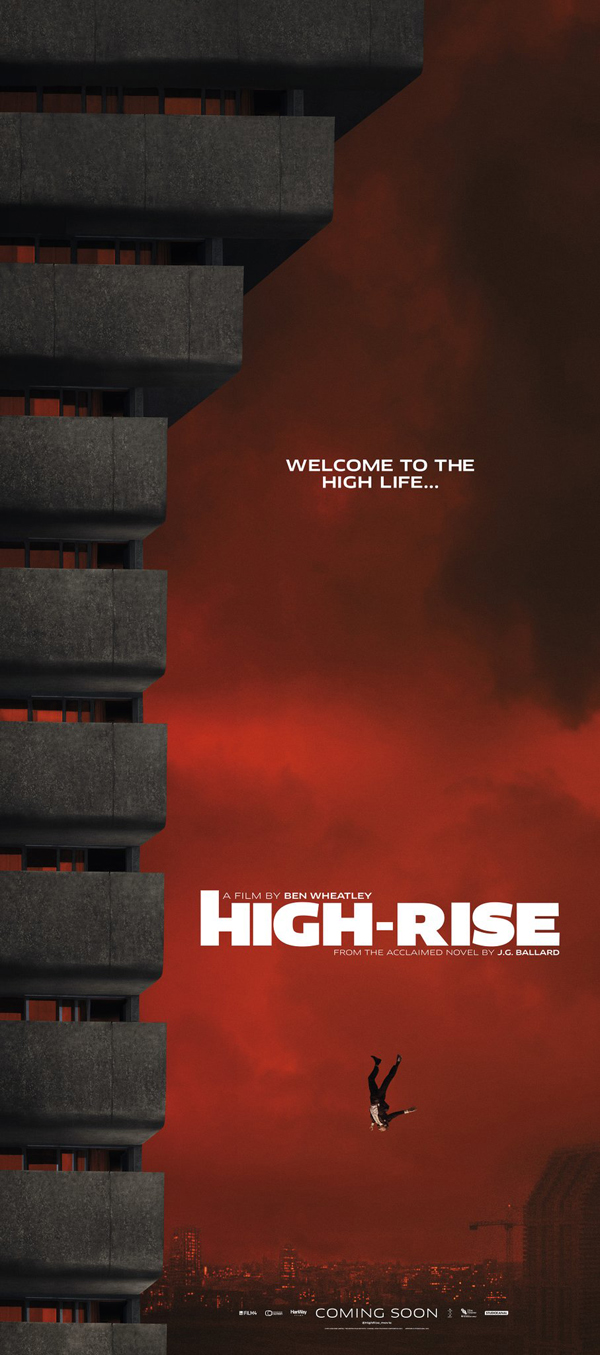
The first poster shows the doomed jeweller heading earthwards for his rendezvous with a parked car. Easy to imagine this design giving a Hollywood marketing committee the vapours.

Continue reading “High-Rise posters”

Weekend links 296

invisiblecreature.jpg

Mars (variant design): one of three new posters for NASA by Invisible Creature.

• “If the point of Sade’s work was to marry sexual frustration and release to the practice of interpersonal violence, he could confidently gaze out on the landscape of our popular culture and declare it a fait accompli.” Hussein Ibish on The United Sades of America.

• Gravitational Waves Exist: The Inside Story of How Scientists Finally Found Them by Nicola Twilley. Sean Carroll explains the importance of the discovery.

• Another This Heat interview: Bruce Tantum interrogates Charles Bullen and Charles Hayward about being a group ahead of their time.

The English word comes ultimately from Greek magike (in which the original Persian word is spliced with tekhne, “art”), while the Persian magos “one of the members of the learned and priestly class” ultimately derives from magush, “to be able, to have power”, from which we may also derive the word “machine”. So my social hierarchy is your magic, and my magic might be your craft—or even your machinery. My religion is your magic. Your religion is my fairy lore. Or your religions might be a mass of fakery and trickery and foolery. Hence in making magic into an intellectual discipline, I theorize based on my observations, which might not be mine but those of others, heritable observations. But because what I do looks very like empiricism, as I examine materials for the tricks or fooleries, or for the real alterations, checking my results against descriptions of previous experiments, what I do feels like science, feels like the template for Baconian empiricism and its great instauration.

Diane Purkiss reviewing The Book of Magic: From Antiquity to the Enlightenment, edited by Brian Copenhaver

• The Strange World Of…The Residents: Sean Kitching talks to The Residents’ resident artist, Homer Flynn.

• At Strange Flowers: film of Natalie Barney in 1962 reminiscing about Oscar Wilde and Marcel Proust.

• From Battleship Potemkin to Baker Street: Ian Christie on Sergei Eisenstein’s trip to London.

• Mixes of the week: Krautrock Mix by Tarotplane, and Mix #15 (Transversales) by Jon Brooks.

• From Rock en Stock (France, 1973): Can and Agitation Free in live performance.

• Twenty classic British folk-horror stories: a selection by Kai Roberts.

Immemory: a Flash version of Chris Marker’s CD-ROM.

Cronenberg Valentines

Static Gravity (1980) by Chrome | Zero Gravity (2001) by Monolake | Gravity (2013) by Roly Porter

Ten

maruyama.jpg

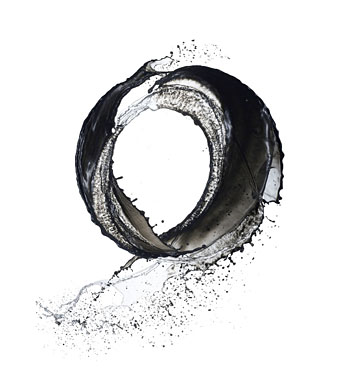
From the Kusho series by Shinichi Maruyama.

It was February 13th, 2006, when I sat down and wrote some words from Charles Fort—”One measures a circle, beginning anywhere”—as a title of the first post here. Ten years on, and the circle has turned ten times, or once if you’re measuring in decades. This time last year I made the decision that when I reached the tenth anniversary I was going to reduce the activity a little. Writing a blog post on a different subject every single day of the week requires discipline even if it’s your main line of work. This has never been my main line of work, but I’ve nonetheless managed to rack up 4,035 posts while juggling design and illustration work, and while (somehow) writing an as-yet-unpublished 217,000-word novel. When the workload has been heavy it’s been a chore having to write another daily post yet the improvisational nature of the thing has always been fun. Writing something new every day puts you on the spot; it forces you to get your thoughts in order (or scale them back), and it also hones your writing skills. I don’t know what I expected of this blog in 2006 but I’m fairly sure I didn’t expect to be writing it daily for ten years. And yet here we are.

So with that said, I’m going to discontinue the daily posting for the time being although the weekend post will follow tomorrow as usual. One thing that’s become apparent is that the first five years were easier than the second five because I seemed to have more time on my hands. The increased visibility of my work in recent years has meant that I’ve been more in demand, and I’ve been subject to increasing periods of all work and no play. When that happens, something has to give, and not having to write something here every single day will give me an hour (or more) free time each day. There will still be posts, of course: this forum is too useful to abandon, and on the work level alone I have some high-profile projects due out this year. I’d also like to be able to write longer posts from time to time. One hazard of the daily post is that longer pieces have to be written over several days while still writing a daily post as well.

My thanks, as always, to regular readers and commenters. Don’t be alarmed by a few days’ silence. Things will continue but at a slower pace.

John x

An Optical Poem by Oskar Fischinger

fischinger.jpg

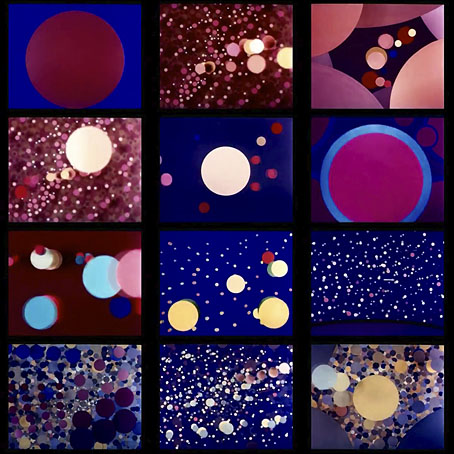
Oskar Fischinger’s only successful collaboration with a Hollywood studio was this 7-minute animation made for MGM in 1937. As with some of Fischinger’s earlier films, a piece of classical music is illustrated with dancing shapes of cut-out paper. The music in this instance is Liszt’s Second Hungarian Rhapsody, and this short was one of the films that brought Fischinger’s to Walt Disney’s attention when the Disney studio was planning a similarly abstract sequence for Fantasia. Fischinger worked on the Toccata and Fugue opening but his early efforts for Disney were dismissed as “too dinky” by the man responsible for a ubiquitous anthropomorphic mouse.

Elsewhere on { feuilleton }
The abstract cinema archive

Can esoterics

aumgn.jpg

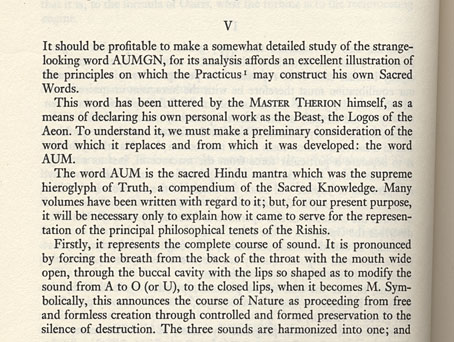
As usual, one thing leads to another. Most people who listen to Tago Mago (1971), the third album by Can, won’t be aware of the Aleister Crowley reference in the long improvisation that fills side three (track 5 on the CD). Aumgn was a spontaneous creation that includes one member of the band intoning an OM-like mantra while the other musicians clatter their way around the studio. The Crowley connection is in the unusual spelling of the title which is Crowley’s own amendment of the more familiar AUM. He explains the reasoning over several pages in Magick in Theory and Practice (1929), some of which involves the numerical values of the five letters. Not that this marks Can as Crowleyans but anyone unacquainted with Crowley’s augmented word would simply have used OM or AUM instead.

Update: I’ve been re-reading the book that came with the Can Box (1999), and came across this forgotten passage in Michael Karoli’s interview:

At the time I was very interested in magic spells, and Irmin knew of the spell “Aumgn” through me. But I had a completely different concept of what one could do with it, than to irreverently quote it in a piece of music. At the age of 21, I wouldn’t have dared to put this recklessly on an album. For me it was black magic. It was Aleister Crowley and all of that, and it gave me the creeps. I told Irmin to stop pronouncing magic spells in the room, but Irmin naturally overrode that with his arrogant grin.
futuredays.jpg

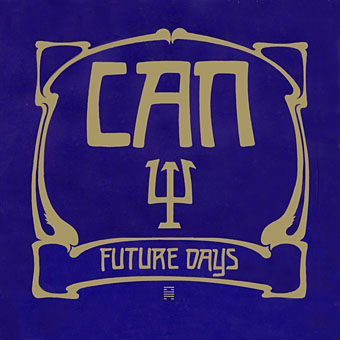
Design by Ingo Trauer & Richard J. Rudow.

The fifth studio album, Future Days (1973) has another esoteric detail on the front and back of its elegant Art Nouveau sleeve: Hexagram 50 from the I Ching, translated in the Richard Wilhelm edition as Ting / The Cauldron. The same text has the judgement for Ting as “great good success”, and the album happens to be considered one of their best musically, although it was also the end of an era when vocalist Damo Suzuki left after its release. On a more mundane level, a cauldron is a container, as is a can.

There’s also the unexplained Greek letter in the centre of the sleeve: Psi is the 23rd letter of the Greek alphabet, and is commonly used as a symbol for psychology although it’s also used as a symbol in quantum mechanics. This last reference might be relevant given that the piece that ends their next album, Soon Over Babaluma (1974), is entitled Quantum Physics.
flowmotion.jpg

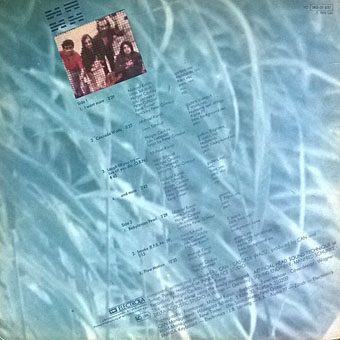
Design by Wagner Design Unit. Cover photos by Michael Karoli & Peter Hehner.

There are more I Ching hexagrams on the back of Flow Motion (1976), the group’s eighth album. Hexagram 29 is K’an / The Abysmal (Water) also known as “gorge” or “abyss”. Hexagram 59 is Huan / Dispersal (Dissolution). Taken together these could be interpreted as “flow motion” (and may well be the origin of the title—interviews with the group have seldom discussed these things) although they might also be seen as ominous signs for Can’s future. Flow Motion gave them a hit single in the UK (I Want More) but it’s also the last album that’s musically satisfying throughout. Can persevered for another two years (minus Holger Czukay) before disbanding in 1978. As to the esoterics, Rob Young is apparently writing a biography of the band so we may learn more about all of this when his book is published.

Previously on { feuilleton }
Can soundtracks
Can’s Lost Tapes