Michael Powell’s Bluebeard revisited

powell1.jpg

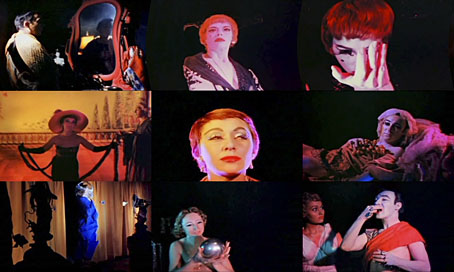
Yesterday’s post prompted me to look again for one of Michael Powell’s scarcest films, his television version of Bartók’s Bluebeard’s Castle made for  Süddeutscher Rundfunk in 1963. Sure enough, it’s now on YouTube in a watchable copy taken from VHS tape. Herzog Blaubarts Burg (to use its German title) was made post-Peeping Tom when the director’s career was at its lowest ebb, and while the production values don’t match those he’d been used to in the 1940s he was no doubt happy to be working at all after being vilified by the UK press. Norman Foster is Bluebeard and Ana Raquel Satre plays Judith, with the libretto being a German translation with English subtitles. I ought to note here that I’ve not read the second volume of Powell’s biography (mea culpa) so the only information I have about this comes from Ian Christie’s Arrows of Desire: The Films of Michael Powell and Emeric Pressburger (1985). Christie doesn’t have much to say about it other than pointing out that Norman Foster financed the film, and that it’s seldom been screened in Britain: IMDB has the first UK screening as 1978, just prior to the time when Powell and Pressburger began to receive to some belated recognition.

powell2.jpg

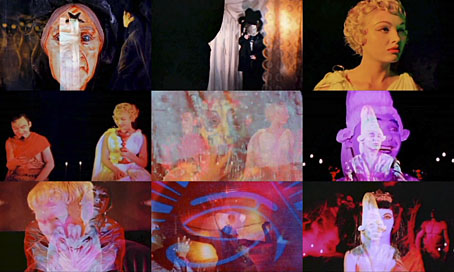
The YouTube copy suffers in the sound department by being a muffled mono transmission but it’s the visuals which will be of most interest to Powell aficionados. Powell & Pressburger’s regular production designer Hein Heckroth created the multi-coloured labyrinth which serves as the castle. The overall effect is stagey but contains some unique details, such as the rune-etched standing stones shown at the opening and close, and also some painted moments similar to those seen during the celebrated dance sequence in The Red Shoes (1948). Powell’s staging is much more vivid and artificial than Leslie Megahey’s 1988 adaptation whose Gothic gloom remains a personal favourite. Despite its shortcomings, when compared to the other Powell films that came after—the two Australian features, the Children’s Film Foundation commission which reunited him with Pressburger—this is far closer to the greatest works of the Archers era, and provides a more satisfying career coda for the man who directed The Red Shoes and The Tales of Hoffmann.

Previously on { feuilleton }
Joseph Southall’s Bluebeard
Leslie Megahey’s Bluebeard
Powell’s Bluebeard
The Tale of Giulietta

Le labyrinthe and Coeur de secours

kamler1.jpg

Le labyrinthe (1969).

Among the new arrivals at Ubuweb there’s the very welcome addition of more animated films by Polish director Piotr Kamler. Kamler’s incredible Chronopolis (1982) was posted there late last year, a longer work than these shorter films which are nonetheless fascinating in themselves. For a start they show the range of Kamler’s animation which differs radically from film to film. Le labyrinthe is the kind of thing SF artist Richard Powers might have made had he been offered an animation commission: a human figure paces through increasingly threatening corridors and empty spaces until the winged creatures that haunt the zone bear down on him. Coeur de secours is more a sequence of events than anything that might be easily summarised; I’d seen this one years ago on Channel 4 but didn’t remember a thing about it. Chronopolis was notable for its electronic score by Luc Ferrari, and both the earlier films have similar soundtracks created by Bernard Parmegiani and Francois Bayle respectively. All these films, Chronopolis included, are collected on a recent DVD which I’ll definitely be buying. Kamler’s work, like that of Patrick Bokanowski and the Quay Brothers, goes places that films with much larger budgets can never reach.

kamler2.jpg

Coeur de secours (1973).

Previously on { feuilleton }
Chronopolis by Piotr Kamler

Weekend links 157

focusgroup.jpg

Elektrik Karousel, a new release on the Ghost Box label by The Focus Group. “For a clue to its moods, think Czech animation, Italian Giallo, early Radiophonics, HP Lovecraft stories, 1960s underground cinema, Lewis Carroll and baroque psych.” Julian House’s package design is “heavily inspired by 1960s underground press and conceived as a kind of mind altering DIY board game”.

Joseph Stannard of The Outer Church compiles a mix for Kit Records, and talks about rural psychedelia and malevolent lighthouses, among other things.

• At Sci-Fi-O-Rama: a sampling of Dan Nadel & Norman Hathaway’s Electrical Banana – Masters of Psychedelic Art (2012).

Stranger than Paradise: Tilda Swinton photographed by Tim Walker in the Surrealist Wonderland of Las Pozas, Mexico.

Whistler in Limehouse & Wapping: stunning etchings by the 25-year-old artist when he was newly arrived in London.

• The complete catalogue of Sunn O))) recordings is now on Bandcamp for preview and purchase.

La Danza de la Realidad: Alejandro Jodorowsky returns to his childhood in Tocopilla, Chile.

• Enjoy The Silence: Jude Rogers talks to Michael Rother about joy of quiet.

Dressing the Air, “the Bureau of Sensory Intelligence”, had a relaunch.

Fast forward – and press play again: Cassettes are back

The Lovecraft Expert: An Interview with S.T. Joshi

Book Graphics: an illustration blog.

Paint Box (1967) by Pink Floyd | Beat Box (1984) by Art of Noise | Glory Box (1994) by Portishead

Wear Your Love Like Heaven

donovan.jpg

It’s unlikely that many people have been crying out for yet another Donovan compilation but that’s what EMI released earlier this month. Breezes of Patchouli (His Studio Recordings 1966–1969) is the prime psychedelic material, and for me looks tempting since I only have one of those albums. The latest Shindig! magazine gives the collection a favourable review (unsurprisingly), and has a related article about Donovan’s elaborate double album, A Gift From a Flower to a Garden (1968), which in its original form was two vinyl albums in a box with coloured lyric-sheet inserts. The article mentions a short promo film, Wear Your Love Like Heaven, directed by photographer Karl Ferris who shot the infra-red photos used for the album covers. A quick dash to YouTube turned up Ferris’s film in which the singer rides a white horse through some woods then enters a cave whereupon the film bursts Wizard-of-Oz-like into colour. It looks to have been filmed in either Cornwall or Ireland, and features the inevitable crew of kaftaned flower children playing with musical instruments, kites and peacock feathers. Very much of the period, but worth a look if you like this sort of thing.

Previously on { feuilleton }
Tomorrow Never Knows

Street Fair, 1959

sf1.jpg

The street is upper Grant Avenue, San Francisco, seven minutes of local colour captured on silent 16mm film by Edward Silverstone Taylor:

This edited Ektachrome home movie with professional titles documents a 1959 street fair, upper Grant Avenue, San Francisco—the center of Beat culture. The film includes shots of filmmaker Dion Vigne and his wife Loreon, artist and occultist Marjorie Cameron, and artist Wallace Berman, displaying and selling their art works.

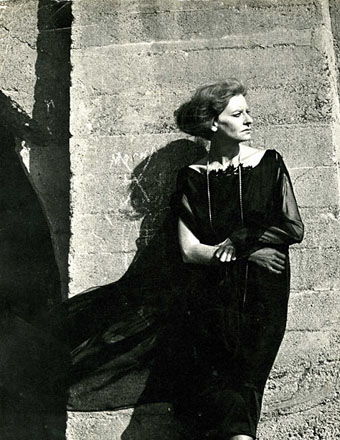
The presence of Marjorie Cameron (below) is what fascinates in these quarters, recognisable thanks to her red hair and the distinctive profile seen when she played the Scarlet Woman in Kenneth Anger’s Inauguration of the Pleasure Dome five years earlier. You also see what appear to be a couple of her paintings. The street fair looks pretty bohemian for the late 50s but a glance at Anthony Stern’s frenetic San Francisco short from a decade later shows a much wilder place. (Via Dangerous Minds.)

sf2.jpg

Previously on { feuilleton }
San Francisco by Anthony Stern
Kenneth Anger on DVD again