La femme qui se poudre

bokanowski1.jpg

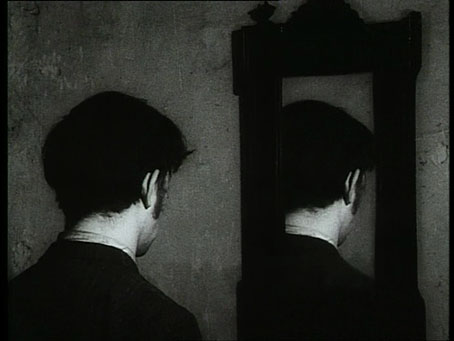
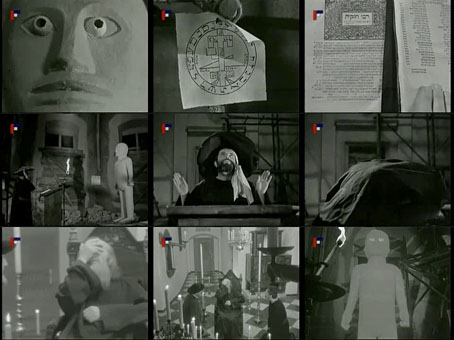
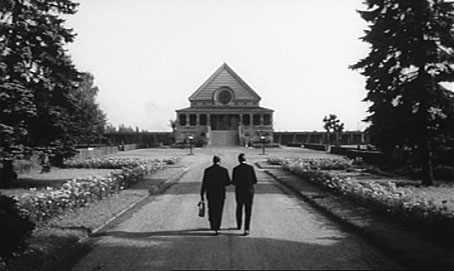
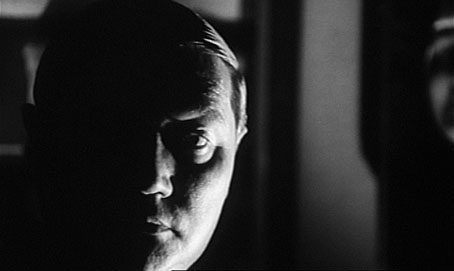
The DVD collection of films by Piotr Kamler turned up last week so I’ve been alternating viewing of that with shorts by Patrick Bokanowski. The latter is less an animator than a filmmaker who uses animation or film effects to achieve his aims, together with masks and very stylised performances. Bokanowski’s early film La femme qui se poudre (The Woman Who Powders Herself, 1972) runs for 15 minutes, and is as remarkable in its own way as his feature-length L’Ange (1982). La femme qui se poudre has the same masked figures engaged in activities which often lack easy interpretation; in both films the atmosphere can shift from absurdity to the edge of horror and back again. For me what’s most remarkable about this particular short is the way it anticipates both Eraserhead and the early films of the Brothers Quay yet still seems little known. The Quays are on record as admiring L’Ange but I’ve yet to see any sign that David Lynch knew of this film in the 1970s. I’d be wary of assuming that Lynch was imitating Bokanowski, artists are quite capable of finding themselves working in similar areas independently.

bokanowski2.jpg

Films of this nature always benefit from well-matched soundtracks: Piotr Kamler uses recordings by different electronic composers; Eraserhead had Fats Waller and the rumblings and hissings of Alan Splet; the Quays have unique compositions by Lech Jankowski. La femme qui se poudre and L’Ange have outstanding soundtracks by Michèle Bokanowski, the director’s wife and an accomplished avant-garde composer. Her work is as deserving of further attention as that of her husband. DVDs of L’Ange and a collection of Patrick Bokanowski’s short films may be purchased here.

Previously on { feuilleton }
Le labyrinthe and Coeur de secours
Chronopolis by Piotr Kamler
Brothers Quay scarcities
Patrick Bokanowski again
L’Ange by Patrick Bokanowski

Weekend links 159

francov2.jpg

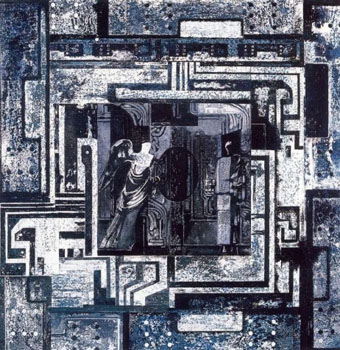
El Banquete Magnético (2011) by Cristina Francov.

Did Vertigo Introduce Computer Graphics to Cinema? asks Tom McCormack. He means Saul Bass’s title sequence which mostly uses still harmonographs but also features some animated moments by John Whitney.

•  Temple of the Vanities by Thomas Jorion. “Pictured here are political monuments and munitions depots, hulking concrete forms that marked the edges of empires.” Related: Paintings by Minoru Nomata.

• Musical reminiscences: Matt Domino on the Small Faces’ psychedelic magnum opus Ogden’s Nut Gone Flake, and Richard Metzger on the sombre splendours of Tuxedomoon.

Harrison is best known as one of the restless fathers of modern SF, but to my mind he is among the most brilliant novelists writing today, with regard to whom the question of genre is an irrelevance. To read his work is to encounter fiction doing what fiction must: carrying out the kinds of thinking and expression that would be possible in no other form. I pass through his novels feeling a mixture of wonder, calmness and disturbance; I end them brain-jarred and unsettled. Metaphysical echoes persist for days afterwards. It feels as if I have had a strabismus induced, causing illusions that slowly resolve into insights.

Robert Macfarlane on M. John Harrison and the reissue of Climbers.

• Divine Machinery: An Interview with Paul Jebanasam. Arvo Pärt, Cormac McCarthy and Algernon Blackwood are folded into his new album, Rites.

Autostraddle shows the evolution of twelve queer book cover designs. As is often the case in cover design, latest isn’t always best.

• “My Definition Of Hell? It’s Other People, At The Cinema!” Anne Billson on the very thing that finished me as a cinema-goer.

• “London in the 1830s was a truly weird and terrifying place.” Spring-Heeled Jack, The Terror of London.

• At Scientific American: The Reading Brain in the Digital Age: The Science of Paper versus Screens.

Van Dyke Parks: “I was victimised by Brian Wilson’s buffoonery.”

Colour film of London in 1927.

Abandonedography

Social Dead Zone

• Tuxedomoon: Tritone (Musica Diablo) (1980) | Desire (1981) | Incubus (Blue Suit) (1981)

Ray Harryhausen, 1920–2013

harryhausen.jpg

Concept art for Jason and the Argonauts (1963).

He could also draw, something the obituaries won’t necessarily mention. I wasn’t aware of Ray Harryhausen’s many detailed preliminary drawings until I had the good fortune to see him give a talk at the Preston SF Group in the early 1990s. I recall mention being made of Gustave Doré as an influence, something that wasn’t so surprising given that Harryhausen’s animation career began with Willis O’Brien, animator of the original Kong. The Skull Island sets for King Kong owed much to Doré’s illustrations, and the film also made use of equally detailed preliminary drawings by O’Brien, Byron Crabbe and Mario Larrinaga.

I was going to link to Jason and company’s celebrated fight with the skeletons but the only clips on YouTube at the moment lack Bernard Herrmann’s superb score. The Harryhausen/Schneer films always had low budgets but the producers understood the importance of music, and employed Herrmann on four of their films: The 7th Voyage of Sinbad (1958), The Three Worlds of Gulliver (1960), Mysterious Island (1961) and Jason and the Argonauts (1963). Miklós Rózsa provided the score for The Golden Voyage of Sinbad (1974) so here’s a favourite moment from that film with John Philip Law and Martin Shaw tackling Tom Baker’s sword-wielding Kali statue.

Ray Harryhausen’s production drawings can be seen in The Art of Ray Harryhausen (2005).

Previously on { feuilleton }
Swords against death

The Planets by Ken Russell

planets0.jpg

This 1983 film from Ken Russell bears comparison with Michael Powell’s film of Bluebeard’s Castle in being another television adaptation by a famous director of a well-known piece of music that few people have heard about or managed to see. (Derek Jarman often spoke of Powell and Russell as two rare talents frequently ignored or slighted in their own country.) Russell’s film was made specially for The South Bank Show, the weekly arts programme of the ITV network in Britain. As with most South Bank Show films it was screened once then vanished into the archives. There was a later laserdisc release in the US but laserdiscs are now as redundant as CD-ROMs. I’ve yet to hear of a DVD release.

planets1.jpg

Mars, the Bringer of War.

The Planets was Russell’s first film after Altered States (1980), and shares some of that feature’s cosmic moments, especially in the Neptune section. The Planets also seems heavily indebted to Godfrey Reggio’s Koyaanisqatsi which had been released to great acclaim the year before. Where Reggio matched unique shots to a unique score by Philip Glass, Russell produced a collage work that matches stock footage to each section of the Holst suite. The result is very effective in places, although after subsequent decades of music videos and YouTube mixology the effect is less impressive than it was when first broadcast. Among the hundreds of images some familiar Russell obsessions appear: Nazis, naked women and the inevitable crucifixion. I don’t think he managed to get any nuns into this one but the Pope gives a Catholic flavour to the Uranus section. Since the whole piece is wordless it’s left to the viewer to decide how much these juxtapositions are ironic or sincere. The music is performed by the Philadelphia Orchestra conducted by Eugene Ormandy.

planets2.jpg

Venus, the Bringer of Peace.

The Planets can’t be viewed on YouTube at the moment, probably for the usual copyright reasons, but there is a watchable copy on this Russian video site. Given the quantity of recordings of The Planets it’s understandable if there isn’t a great demand for Russell’s version but it still seems unfairly overlooked.

Continue reading “The Planets by Ken Russell”

OffOn by Scott Bartlett

bartlett1.jpg

Another gem of experimental filmmaking, Scott Bartlett’s short from 1967 hits all the buttons of psychedelic imagery: disembodied eyes, moiré patterns, solarisation, dancing figures, naked women, oil effects, oversatured hues, and superimposition. The difference between this film and others of the period is that OffOn is largely a product of video techniques, some of which—video feedback, for example—are unique to the medium. As a bonus there’s that standard feature of so much experimental film from the period, the electronic score. The soundtrack for OffOn is by Manny Meyer, and sounds in places like a precursor to Gil Mellé’s buzzing and shrieking music for The Andromeda Strain (1971).

bartlett2.jpg

Elsewhere on { feuilleton }
The abstract cinema archive