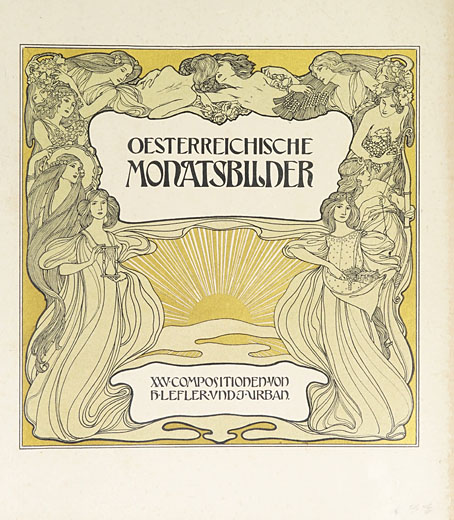
Oesterreichische Monatsbilder

lefler01.jpg

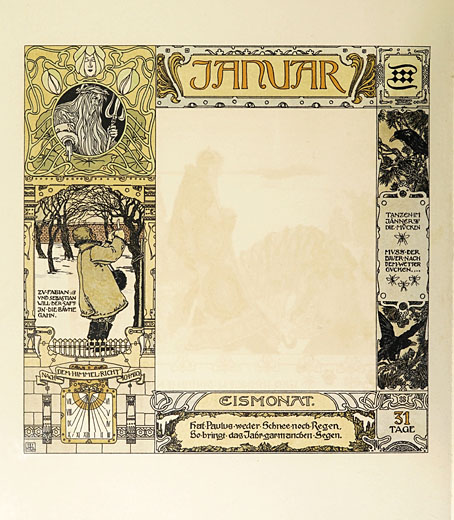
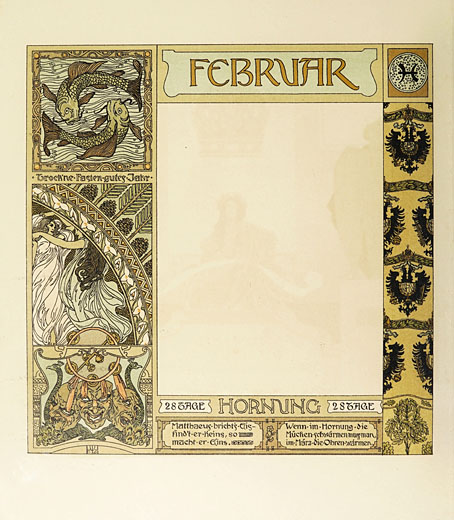
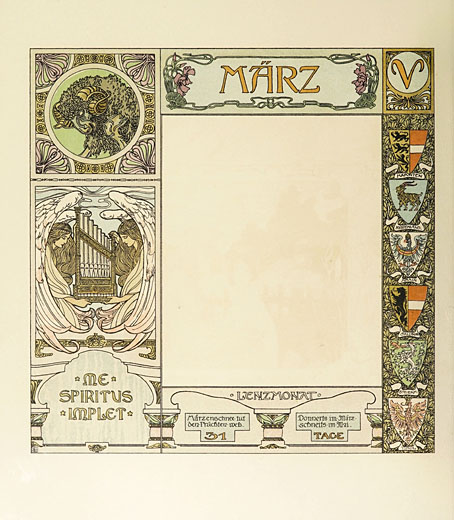
Oesterreichische Monatsbilder (1900) is an Austrian calendar in book form, and a good reminder that the Art Nouveau style produced a huge amount of high-quality work in a very short space of time. The artists, Heinrich Lefler and Joseph Urban, were featured in a post a couple of years ago with their work for Die Buecher der Chronika der drei Schwestern, a book whose drawings were probably produced in tandem with the ones here. For the Monatsbilder the pair present a calendar whose dates are absent (so it could easily be used today) with each month featuring a variety of symbolic details: astrological signs and figures, birds, plants and other items relating to the month in question. Many of these are specific to Austria, as are the illustrations on the facing pages which depict the patron saints of the provinces. The book may be browsed in full or downloaded here.

lefler02.jpg

lefler03.jpg

lefler04.jpg

Continue reading “Oesterreichische Monatsbilder”

Weekend links 457

tanaka.jpg

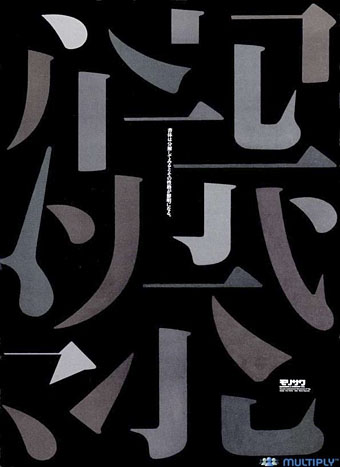
Imagination of Letters by Ikko Tanaka.

Kankyo Ongaku: Japanese Ambient, Environmental & New Age Music 1980–1990 is the latest compilation from Light In The Attic, and another excellent package both musically, physically and design-wise. The album was compiled by Spencer Doran of Visible Cloaks who talked to The Quietus a couple of years ago about his favourite Japanese (and other) music. Simon Reynolds reviewed Kankyo Ongaku last month, and drew attention to Spencer Doran’s Fairlights, Mallets and Bamboo mixes which may be heard here and here.

Michael O’Shea playing his home-made musical instrument (an old door, paintbrushes, etc) on RTÉ in 1980. Shea’s one-and-only album has been deleted for years but was reissued in January. The story of O’Shea’s surprising involvement with Bruce Gilbert and Graham Lewis of Wire (which led to the recording of his album) is recounted here.

Lou Thomas suggests five reasons to watch Shinya Tsukamoto’s Tetsuo: The Iron Man on its 30th anniversary.

…Topor generates a world in which the great unsaid realities of human life are painfully laid bare, amplified through a series of confrontations with “le sang, la merde et le sexe” (“blood, shit, and sex”). While few of his texts have been made available in English, they are nevertheless representative of his wider body of work, in which the reader constantly trips over these same themes as if stumbling upon a naked corpse in a darkened room. They predicate an oeuvre of carnivalesque and necrophilic eroticism, and draw out the pungent, animalistic core hidden within the norms of our everyday existence. Topor’s narratives are shot through with macabre irony, orgiastic scatology, and physical and psychological cruelty, which constitutes a fundamental reframing of the characteristics of human interaction with others.

Andrew Hodgson on Roland Topor’s neglected writings

An anciente mappe of Fairyland: newly discovered and set forth (1920) by Bernard Sleigh.

Maggot Brain: an impromptu Funkadelic cover by Albatross Project.

Anne Billson on purr evil: cinematic cats with hidden agendas.

Sayonara: one of the most Japanese words in the dictionary.

• Painting the Beyond: Susan Tallman on Hilma af Klint.

• RB Russell on bookseller’s labels: part one & part two.

Christopher G. Moore on The Immortals and Time.

• Fuck the Vessel,” says Kate Wagner.

• Japanese Farewell Song (Sayonara) (1957) by Martin Denny | Sayonara: The Japanese Farewell Song (1976) by Haruomi Hosono | Sayonara (1991) by Ryuichi Sakamoto

Waves and clouds

mori01.jpg

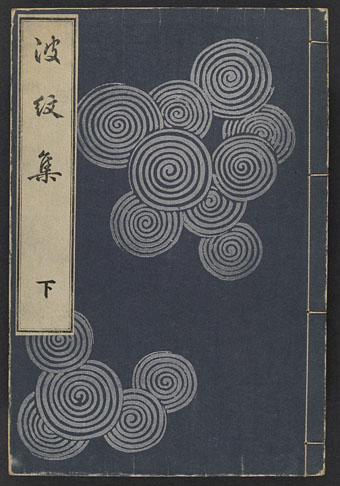
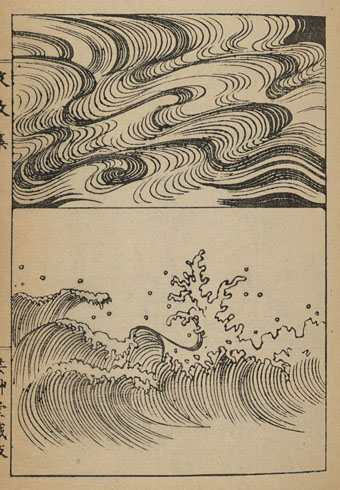
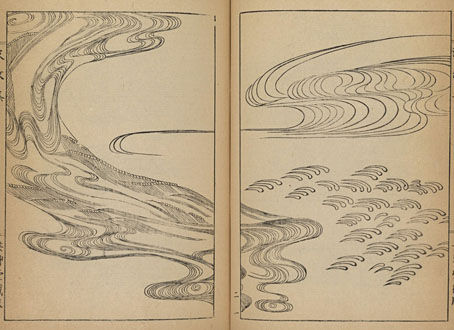
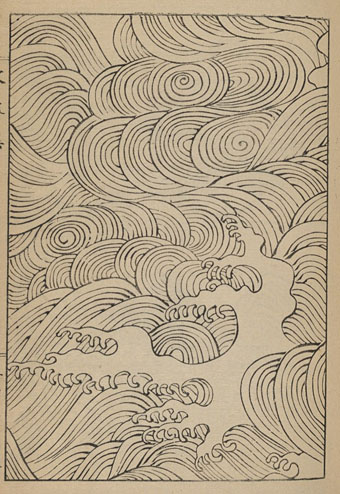
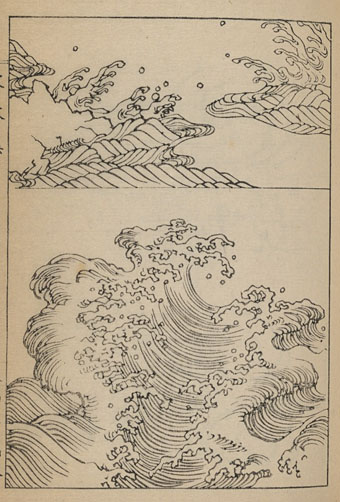
Every so often it’s necessary for me to deploy some stylised Japanese graphics in a piece of art or illustration, an occasion which always prompts a laborious search through books or websites for suitable source material. Quite often what you require is an isolated example of a single motif, something that isn’t easy to find if you’re looking at a lot of detailed prints. The pages here are the kinds of thing I’ve been after for years, being a series of books showing the many ways an artist or craftsman might render flowing water, waves, ripples and clouds.

mori02.jpg

The books of waves by Yuzan Mori date from 1903, and are in three short volumes here, here and here. Mori’s drawings run through every possible style, from realistic linework to abstract tessellations. The books of clouds by Korin Furuya are in two volumes (also from 1903) here and here. Many of these are like the clouds you find in Chinese and Tibetan art but the books also feature one or two abstract suggestions which are strikingly advanced for the period. All of these books are from the Smithsonian Libraries whose archive of rare Japanese art books includes a Hokusai collection of 82 (!) volumes. Try this one for some vintage grotesquery and weirdness.

mori03.jpg

mori04.jpg

mori05.jpg

Continue reading “Waves and clouds”

Weekend links 456

tanning.jpg

A Mrs Radcliffe Called Today (1944) by Dorothea Tanning.

Darran Anderson on how the Bauhaus kept things weird. “Many imitators of the famous art school’s output have missed the surreal, sensual, irrational, and instinctual spirit that drove its creativity.”

• Notes on the Fourth Dimension: Hyperspace, ghosts, and colourful cubes—Jon Crabb on the work of Charles Howard Hinton and the cultural history of higher dimensions.

• “[Edward] Gorey is slowly emerging as one of the more unclubbable American greats, like Lovecraft or Joseph Cornell,” says Phil Baker.

The label “homosexual writer” stuck for the rest of his career, with Purdy confined to what Gore Vidal called “the large cemetery of gay literature…where unalike writers are thrown together in a lot, well off the beaten track of family values”. In later years, Purdy moved further off the beaten track, as much by intention as circumstance. “I’m not a gay writer,” he would tell interviewers. “I’m a monster. Gay writers are too conservative.”

Speaking to Penthouse magazine in 1978, Purdy said being published was like “throwing a party for friends and all these coarse wicked people come instead, and break the furniture and vomit all over the house”. He added that, in order to protect oneself, “a writer needs to be completely unavailable”.

Andrew Male on writer James Purdy

• The Necessity of Being Judgmental: Roger Luckhurst on k-punk: The Collected and Unpublished Writings of Mark Fisher.

Faunus: The Decorative Imagination of Arthur Machen, edited by James Machin with an introduction by Stewart Lee.

• More James Purdy: “His poetry displays a softness that readers of his fiction might not expect,” says Daniel Green.

Drag Star! is a 150,000-word interactive novel/text adventure by Evan J. Peterson.

• At Dangerous Minds: Dave Ball discusses his years as the other half of Soft Cell.

Daisy Woodward on the story of radical female Surrealist Dorothea Tanning.

• Inside the bascule chamber: photos of Tower Bridge, inside and out.

Tim Smith-Laing on the meaning of Miró’s doodles.

• Galerie Dennis Cooper presents…Emma Kunz.

rarecinema: a shop at Redbubble.

Apollo Press Kits

The Fourth Dimension (1964) by The Ventures | Dimension Soleils (1983) by Gilles Tremblay | Into The Fourth Dimension (1991) by The Orb
Sundial and Mile End Purgatorio

blacktower.jpg

The Black Tower.

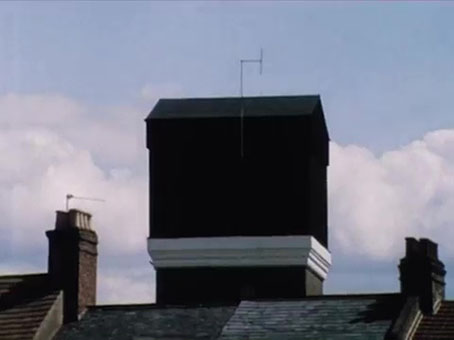
I ought to have devoted this post to The Black Tower (1987), John Smith’s short and sinister film which I linked to at the weekend. It was good to watch it again after seeing a TV screening (no doubt the only one) on the UK’s Channel 4 in 1988. It also reminded me of the two shorter films linked here, both of which were also shown on Channel 4 a few years later in Benjamin Woolley’s excellent Midnight Underground series. All three films are linked by their London locations and their different solutions to the perennial problem of the micro-budget filmmaker looking to make the most of limited resources.

sundial.jpg

Sundial.

Smith’s film is the more substantial work, and of particular interest to those looking for examples of weird (or horror) cinema that avoids Hollywood cliches. The Black Tower combines static views of an unusual building with voiceover and sound effects to turn a mundane piece of architecture into a growing menace. Using a voiceover to craft a narrative from unrelated shots has always been a useful and flexible technique, especially if money is limited; Peter Greenaway did this with all of his early films, and it’s an approach also favoured by Patrick Keiller and Terrence Malick.

mileend.jpg

Mile End Purgatorio.

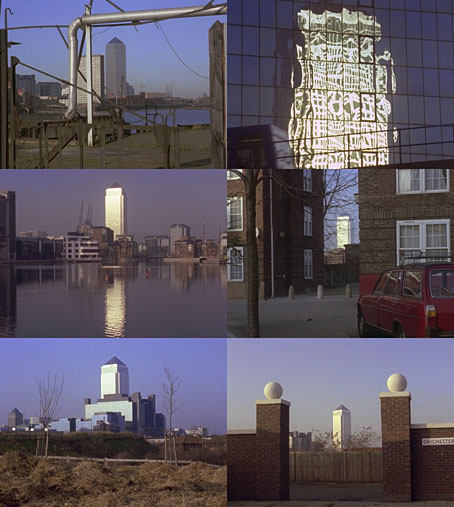
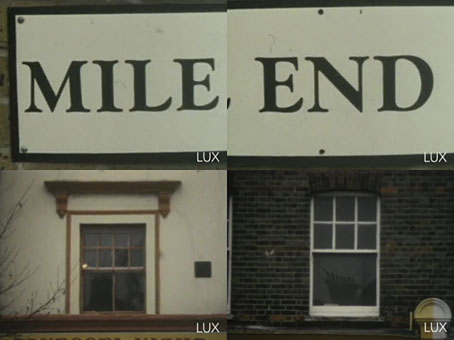
Guy Sherwin uses the same technique for Mile End Purgatorio (1991), an East-End riff on Dante, Hamlet and the Bible, with words by Martin Doyle. William Raban’s Sundial (1993) has no voiceover but it follows The Black Tower in making the Canary Wharf tower the centre of its attention, the fixed point in the passing of a single day. Sherwin and Raban also show how much can be done with a single minute of film.