Never Forever by Prince Rama

princerama1.jpg

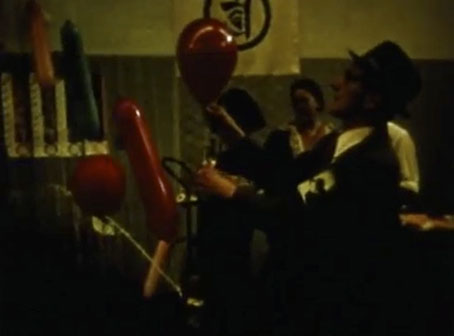
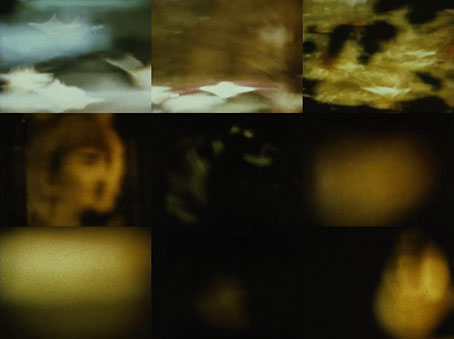
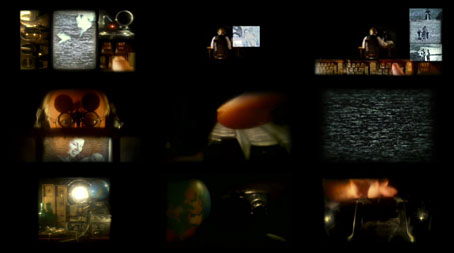
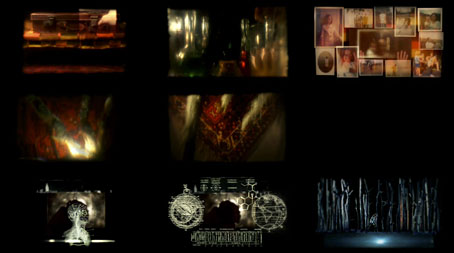
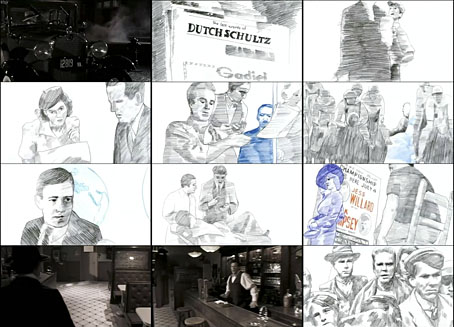
Lily X. Wahrman’s 18-minute video for Prince Rama (Taraka and Nimai Larson) segues songs from the group’s Top Ten Hits Of The End Of The World album into a cosmic mindblast:

One day, they sat us down and asked us, “What is every wildest fantasy you ever wanted to see fulfilled in a movie?” And we were like, “Well, ok, first off we need 12 Abercrombie models lifting marble pyramids that sweat beads of mercury, a jacuzzi of blood that resurrects the lost faces of pop star avatars, two identical motorcycles driven by two blond identical twins with ripped t-shirts that read FOR EVER, live exotic animals, a miniature model of Stonehenge made from red velvet cake and leopard printed fake nails…” (more)

The HD version at YouTube is a treat.

princerama2.jpg

princerama3.jpg

The Book of the Lost

botl.jpg

A recurrent feature of the music landscape of the late 80s and early 90s was the “soundtrack for an imaginary film”, a sub-genre that proved especially popular among the electronica crowd when DJs realised they needed a description to justify their collections of downtempo instrumentals. Two of my favourite examples were produced away from the dance world: John Zorn’s Spillane (1987), and Barry Adamson’s solo debut Moss Side Story (1989), both of which took their thematic cues from crime novels and film noir. The artists on the Ghost Box label haven’t gone down the imaginary film route but many of the tracks on the Belbury Poly and Advisory Circle albums are reminiscent of TV theme tunes from the 1970s. The closest you get to an imaginary film in the Belbury sphere is the unseen giallo horror in Peter Strickland’s Berberian Sound Studio with its score by Ghost Box allies Broadcast, and a title sequence by Julian House.

Given all of this, The Book of the Lost, a collaboration between Emily Jones and The Rowan Amber Mill, is a logical next step: a CD collection offering a theme from a forgotten TV series “shown on Sunday nights in the late ’70s and early ’80s” which broadcast four of the equally forgotten horror films upon which the accompanying songs are based. Between each song you hear a brief snatch of dialogue, just enough to whet the appetite without getting too involved. One of the films referred to, The Villagers, belongs to that current of British folk-horror that runs through Witchfinder General, and Blood on Satan’s Claw, to Ben Wheatley’s intoxicatingly weird A Field in England. Pastiching aside, all projects of this kind depend upon the quality of the music, and the folk-inflected songs here are very good, as is the Book of the Lost theme itself which is as spookily evocative as Jon Brooks’ Music for Thomas Carnaki.

botl2.jpg

If that wasn’t enough, there’s a special numbered edition of the CD which comes packaged in a die-cut slipcase (above) containing cards giving details of each of the films. In addition to promotional artwork there’s also a synopsis, a production history and even a cast list. Other films are mentioned in passing—The House that Cried Wolf, Ghosts on Mopeds—that imply there was a lot more happening in Wardour Street in the 1970s than we previously suspected.

The Book of the Lost isn’t officially released until January but it’s available for purchase now at the project website.

Previously on { feuilleton }
The Outer Church
The Ghost Box Study Series
A playlist for Halloween: Hauntology
The Séance at Hobs Lane
Ghost Box

The poster art of Akiko Stehrenberger

stehrenberger1.jpg

W.E. (2011).

Being someone who enjoys adopting and pastiching different art and design styles for different projects I naturally like to see other people doing the same. American illustrator and designer Akiko Stehrenberger is very adept at using this approach for her film posters. Without knowing the identity of the person responsible you wouldn’t guess that they were all the work of the same person.

The Madonna and Polanski posters are the two most overt pastiches, being based respectively on the paintings of Tamara de Lempicka, and the posters by Jan Lenica for Polanski’s Repulsion and Cul-de-Sac. Good as the poster for W.E. is, it seems the studio preferred a more cliched “romantic” treatment for their international sales. Stehrenberger’s Mac desktop design for Burn After Reading was dropped in favour of yet another Saul Bass pastiche. (As a sidenote I’d suggest a moratorium on imitating Saul Bass for the time being; it’s getting boring.) The Lost Highway design isn’t a poster but I added it here since it’s a surprising take on David Lynch’s noir piece. I like the way the dotted line can be taken either as road markings or a line signifying the division in the film between the separate storylines and the separated characters.

Akiko Stehrenberger talked to Adrian Curry earlier this year about her favourite film posters.

stehrenberger2.jpg

Burn After Reading (2008).

stehrenberger3.jpg

Roman Polanski: Wanted and Desired (2008).

stehrenberger4.jpg

Lost Highway (Spanish Blu-ray cover).

Previously on { feuilleton }
La Belle et la Bête posters
Dr Mabuse posters
The poster art of Frank McCarthy
Repulsion posters
The poster art of Vic Fair
Petulia film posters
Lucifer Rising posters
Wild Salomés
Druillet’s vampires
Bob Peak revisited
Alice in Acidland
Salomé posters
Polish posters: Freedom on the Fence
Kaleidoscope: the switched-on thriller
The Robing of The Birds
Franciszek Starowieyski, 1930–2009
Dallamano’s Dorian Gray
Czech film posters
The poster art of Richard Amsel
Bollywood posters
Lussuria, Invidia, Superbia
The poster art of Bob Peak
A premonition of Premonition
Metropolis posters
Film noir posters

Weekend links 184

lefler.jpg

Gevatter Tod (Godfather Death, 1905) by Heinrich Lefler. Via Beautiful Century.

An inevitable hangover from Halloween this week. At 50 Watts: A Modern Dance of Death (c. 1894) by Joseph Sattler, Harry Clarke Revisited, and more Ex Libris Mr Reaper | At Design Observer: Keith Eggener on When Buildings Kill: Sentient Houses in Fiction and Film | At Dangerous Minds: An interview with horror soundtrack composer Fabio Frizzi | Clive Hicks-Jenkins on illustrating the ghost stories of MR James.

Punk 45: The Singles Cover Art of Punk 1976–80, a book by Jon Savage & Stuart Baker with an accompanying compilation album on Soul Jazz Records. Savage & Baker selected a handful of favourite covers here.

De humani corporis fabrica by Vesalius is back in print as a beautiful two-volume hardback edition. See sample pages here.

…the business of the writer is to find something out for yourself and to stick by it. To forge a new mythology out of materials pertinent to the moment. Otherwise you’re at the mercy of their mythology, which is a destruction of language, above everything else. This non-language, this bureaucratic-speak of the global corporate entities, is a horror in the world. So that strange language we started with – that piece of Kerouac – I think is more valuable than ever.

Iain Sinclair (yes, him again) talking to James Campbell about his new book, American Smoke.

Bob Mizer & Tom of Finland, an exhibition at the Museum of Contemporary Art, Los Angeles.

• From 2010: The Bridget Riley Look, The Bridget Riley Sound, Bridget Riley’s Rolling Papers.

The Strange and Mysterious History of the Ouija Board. Related: Ouija Boards at Pinterest.

Highway 62 posted some close-ups of my adaptation of The Call of Cthulhu.

• “This is not a coincidence”: Max Dax talks to Andrey A. Tarkovsky.

Anthony Lane‘s Foreword to The Big New Yorker Book of Cats.

• At AnOther: Nicolas Roeg on Mirrors and Memory.

Toys and Techniques: a blog.

Death And The Lady (1970) by Shirley & Dolly Collins | Clang Of The Yankee Reaper (1975) Van Dyke Parks | All And Everyone (2011) by PJ Harvey

A mix for Halloween: Ectoplasm Forming

Ectoplasm Forming by Feuilleton on Mixcloud

Presenting the eighth Halloween playlist, and this year I decided it was time to finally make a proper mix of my own. Reluctance in years past has been mainly a result of the time it takes me to put things like this together, hours spent pondering the order of the tracks, and fine-tuning transitions.

This year’s mix is rather heavy on the drones and eldritch atmospherics with little in the way of songs. There are some rhythms, however. I’ve also taken the opportunity to highlight the ongoing excellence of Emptyset, some of whose recordings I’ve been helping design recently. Their Medium album involved installing a quantity of electronic equipment in an allegedly haunted building, a process similar to that undertaken by the unfortunate doctor in The Legend of Hell House, albeit with better results.

The tracklist is on the Mixcloud page but I’m repeating it here with dates added for each recording. One likes to be thorough.

The Legend of Hell House – Dialogue (1973)
Emptyset – Demiurge: Of Blackest Grain To Missive Ruin (Paul Jebanasam Variation) (2012)
Arne Nordheim – Solitaire (1969)
David Lynch – The Air Is On Fire Pt. 7 (2007)
Ben Frost – The Carpathians (2009)
The Wyrding Module – Subtemple Session II (edit) (2013)
:Zoviet*France: – On The Edge Of A Grain Of Sand (1996)
John Zorn – Lucifer Rising (2002)
Jarboe – A Sea Of Blood And Hollow Screaming… (2009)
The Haxan Cloak – Excavation (Part 1) (2013)
Emptyset – Medium (2012)
Jon Brooks – Experiments With A Medium (2011)
Wendy Carlos – Visitors (2005)
The Advisory Circle – Eyes Which Are Swelling (2007)
Bernard Szajner – Chant Funèbre (1981)
Emptyset – Function: Vulgar Display Of Power (Roly Porter Variation) (2012)

Previously on { feuilleton }
A playlist for Halloween: Hauntology
A playlist for Halloween: Orchestral and electro-acoustic
A playlist for Halloween: Drones and atmospheres
A playlist for Halloween: Voodoo!
Dead on the Dancefloor
Another playlist for Halloween
A playlist for Halloween