Of Mice and Minestrone

lansdale.jpg

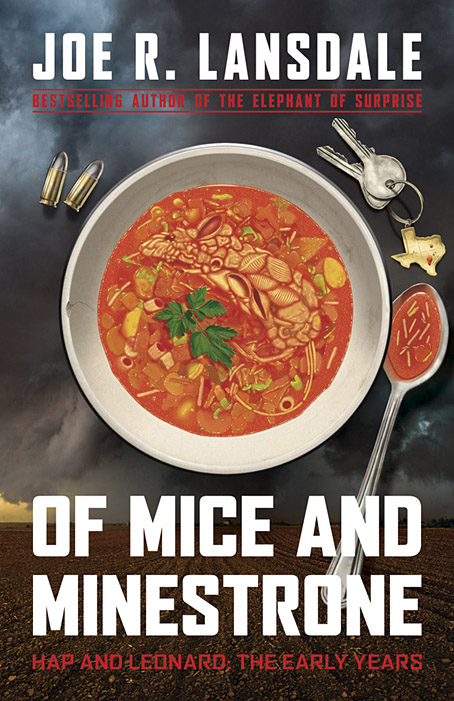
I’ve done a lot of cover work this year, and there are still more designs waiting to be announced. Of Mice and Minestrone isn’t my usual line of work but it’s actually the third cover I’ve done for a Joe R. Lansdale book, although the previous titles were horror and steampunk respectively. The latest volume is a collection of crime stories, and an addition to Lansdale’s Hap and Leonard books, a series about a pair of Texan detectives whose popularity now extends to a TV show.

Crime presents many of the same challenges you find in other genres, all of which come with their own set of clichés which you can either choose to engage with or avoid. In the case of crime there’s a tendency for degraded typefaces to proliferate, along with variations on a red/black/white colour scheme. One of the early drafts of this design did use a red/black/white arrangement but I was told that Joe Lansdale was (unsurprisingly) tired of seeing this scheme applied to his own books. The title of the collection comes from the opening story which concerns the young Hap’s involvement with an older woman and her abusive husband; the marital abuse is resolved via a bowl of soup which has been poisoned with a dead rat, hence the title and the cover image. I like using pareidolia when I can, and the slightly unusual imagery pushed the appearance away from generic clichés (if you discount the bullets) towards the marvellously surreal covers that Tom Adams painted for Agatha Christie’s novels.

The background photo is a rare example of my using a stock image. The soup bowl looked fine from the outset but the background lacked a suitably ominous quality, and was at risk of looking too much like a recipe book. (As it happens there are some recipes by Kasey Lansdale following the fiction although I don’t think any require the use of dead rats.) After trying a number of different table surfaces I decided on a lateral approach so went searching for pictures of Texan storm clouds. The image we eventually used—a tornado over farmland near Patricia, Texas by John Finney at Getty Images—was the second one I tried and it worked so well we decided to keep it.

Of Mice and Minestrone will be published by Tachyon in March 2020 but is available for pre-order now.

Previously on { feuilleton }
The Gods of HP Lovecraft
Lovecraft’s Monsters
Ten titles and a cover
Steampunk overloaded!
New things for April

Weekend links 487

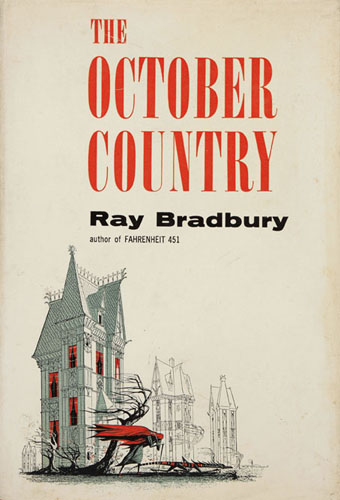
october.jpg

Art by Joe Mugnaini (1955).

• Mixes of the week: The Ivy-Strangled Path Vol. XIX by David Colohan, and The Ephemeral Man’s Teapot 2—Atmosphere insomniac by The Ephemeral Man.

• Patrick Clarke talks to Morton Subotnick and Lillevan about Subotnick’s pioneering synthesizer composition, Silver Apples Of The Moon (1967).

• A second volume of London’s Lost Rivers, a walker’s guide by Tom Bolton with photography by SF Said, is published by Strange Attractor next month.

“That country where it is always turning late in the year. That country where the hills are fog and the rivers are mist; where noons go quickly, dusks and twilights linger, and midnights stay. That country composed in the main of cellars, sub-cellars, coal-bins, closets, attics, and pantries faced away from the sun. That country whose people are autumn people, thinking only autumn thoughts. Whose people passing at night on the empty walks sound like rain.”

Ray Bradbury quoted by Sam Weller in an examination of Bradbury’s dark tales and autumnal horror stories

Lumberjacks In Heat is 11 minutes of music from Mechanical Fantasy Box by Patrick Cowley, the latest Cowley collection from Dark Entries.

They Poured Out Their Light Until Only Darkness Remained: new eldritch vibrations from The Wyrding Module.

• Carmen Villain on the magic of Jon Hassell’s Aka / Darbari / Java: Magic Realism.

• An Evil Medium: Elizabeth Horkley on the films of Kenneth Anger.

• Cosmic gardens and boulder boulevards by Charles Jencks.

• At Dennis Cooper’s: Murray Melvin Day.

Richard Dawson‘s favourite music.

• RIP John Giorno.

My Girlfriend Is A Witch (1968) by October Country | The October Man (1982) by Bill Nelson | Late October (1984) by Harold Budd

Progressive American Architecture

progressive5.jpg

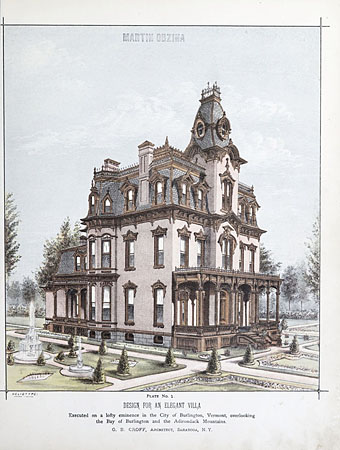
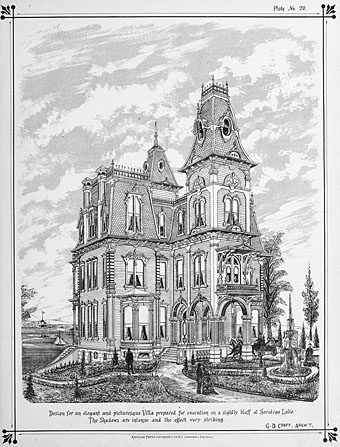
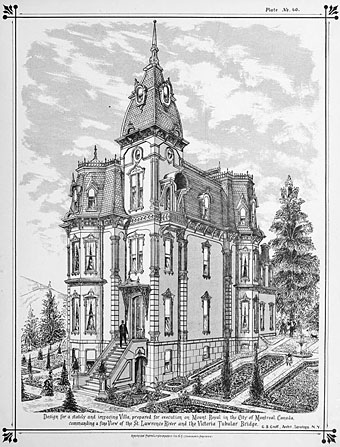
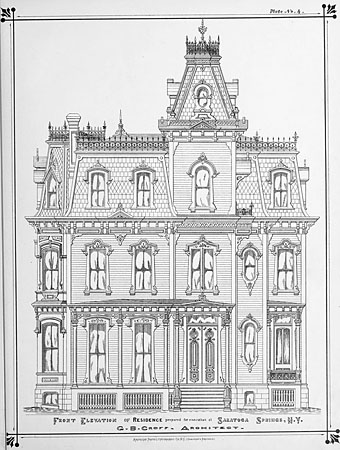
The architecture in Gilbert Bostwick Croff’s book of building designs may have been considered “progressive” in 1875 but seen today most of these buildings scream “haunted house”, or at least, that peculiar American variety of the same as popularised by Psycho, The Addams Family and countless other films and cartoons. Whether old or new, to European eyes these houses have always looked strange, being an exaggerated 19th-century variation of certain forms of Continental architecture that you wouldn’t find anywhere in Europe. Croff’s examples are more exaggerated than usual with their elongated verticals and barbed ornamentation. Seventy years later, with the ravages of time and neglect afflicting their splendour, those that remained standing would look distinctly sinister amid the neat suburbs that grew around them, hence their transmutation into the archetype of the haunted house. Croff even predicts the future status of the style in a note on one of his designs: “The Shadows are intense and the effect very striking.” His book contains almost 100 different plans and architectural details. Browse or download it here.

progressive1.jpg

progressive2.jpg

progressive3.jpg

progressive4.jpg

Weekend links 486

magma.jpg

Magma concert poster, 2017. Art by Jofre Conjota.

The Dream Foundry is a new venture with a mission “to bolster and sustain the nascent careers of professionals working in the field of speculative literature.” This includes artists as well as writers, and to this end I was asked to answer a few questions about my work as a creator of book covers. I also offer some advice about visibility as an artist which I tried not to hedge with too many caveats. Related: my cover for The Resurrectionist of Caligo by Wendy Trimboli & Alicia Zaloga was one of the covers of the month at Muddy Colors.

• “…for a band that were so compositionally advanced, they were adept at producing primordially insistent and hypnotic rhythms.” John Doran on Magma (again), appraising the band’s music and history before presenting Christian and Stella Vander with questions from appreciative musicians.

• Mixes of the week: FACT mix 731 by Meemo Comma, mr.K’s Soundstripe vol 2 by radioShirley, The Ivy-Strangled Path Vol. XIX by David Colohan, and The Pumpkin Tide by Haunted Air.

• At Dangerous Minds: Roddy McDowall reads HP Lovecraft’s The Outsider and The Hound. Related: David McCallum reads HP Lovecraft’s The Dunwich Horror and The Haunter of the Dark.

• “Mathematics is not unique in drawing out charlatans and kooks, of course…” David S. Richeson on cranks, past and present.

• “I plan to take psychedelics again…” Helen Joyce, the finance editor of The Economist, takes a trip.

• The City of Light and its shadows: Brassaï’s Paris.

• At Dennis Cooper’s: Dennis Hopper Day.

Paris (1958) by Perez Prado And His Orchestra | Paris 1919 (1973) by John Cale | Paris 1971 (1971) by Suzanne Ciani

Something from Below

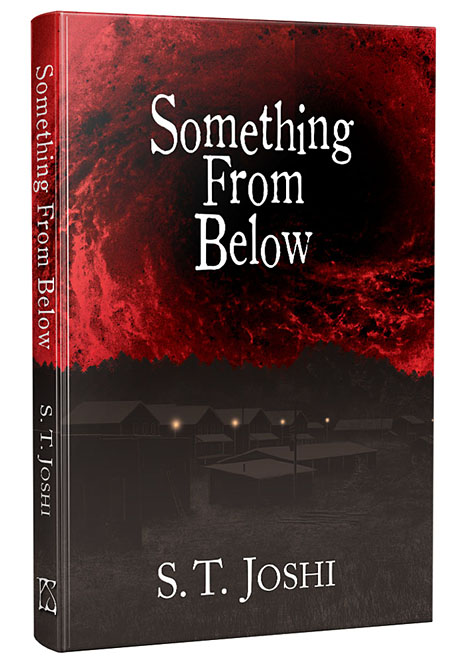
My first encounter with author, editor and Lovecraft biographer ST Joshi was in the form of an artwork request that arrived out of the blue in the late 1980s. My comic-strip adaptation of The Haunter of the Dark had just been published in a large-format edition by Caermaen Press, a small imprint run by Roger Dobson and Mark Valentine, and this prompted a flurry of interest among weird-fiction enthusiasts in Britain and the USA. Joshi was editing Lovecraft Studies for Necronomicon Press at the time, and asked if I’d be willing to contribute illustrations, something I ended up not doing for a variety of reasons. I always felt bad about this, and admitted as much when we eventually met at the Providence NecronomiCon in 2015, so my cover art for his new cosmic-horror novella may be regarded as a kind of recompense.

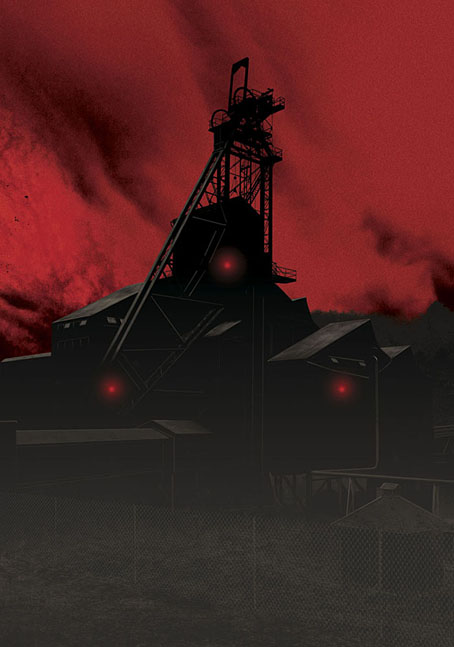
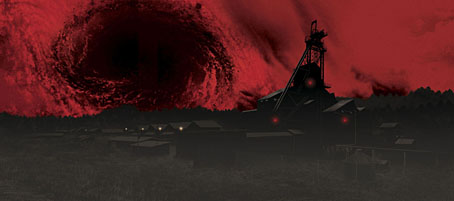
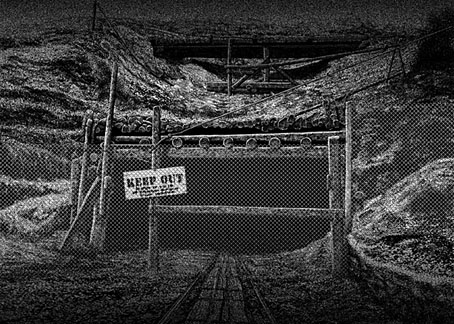
Something from Below is horror with an industrial setting and a Lovecraftian slant, hence the sinister coal mine dominating the artwork:

When 22-year-old Alison Mannering returns to her home in northeastern Pennsylvania after college, she finds a troubling situation. Her father, Guy Mannering, a longtime coal miner, has died recently under suspicious circumstances, and her mother refuses to provide any details of his passing. Alison feels she has no option but to investigate the matter herself, enlisting her high school sweetheart, Randy Kroeber, as well as Randy’s twin sister, Andrea called Andy, to assist her… (more)

The brief for this one was to create a wraparound cover without showing anything overtly monstrous, something I was happy to do since I dislike horror covers that reveal too much. In addition to the wrap I also produced a black-and-white piece for the inner boards. As is evident from the pictures above, the artwork was flipped around in the design but that’s okay, it works both ways. The coal mine is the central location, however.

Something from Below is published this month by PS Publishing in signed and unsigned hardcovers.

Elsewhere on { feuilleton }
The Lovecraft archive