Weekend links 494

church.jpg

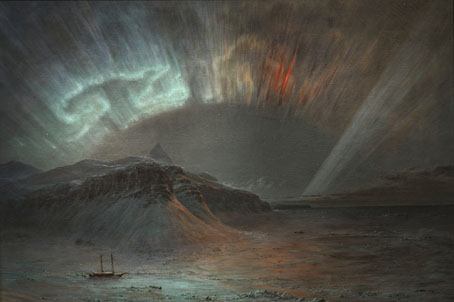
Aurora Borealis (1865) by Frederic Edwin Church.

• December is over-stuffed with enervating cultural lists, most of them reminding you of things which received enough attention earlier in the year. Better value than these—and always unpredictable—is John Waters‘ choice of favourite films; unpredictable and enlightening are the Secret Satan selections at Strange Flowers which come in two flavours: books originally published in English and books translated from other languages.

Flash Of The Spirit (1988), a collaboration between Jon Hassell and African group Farafina (with production by Hassell plus Brian Eno & Daniel Lanois), receives its first ever reissue on double-vinyl and CD next year. The last piece on the album is the 11-minute Masque (Strength).

• “In 1968, Federico Fellini decided he was going make the greatest homosexual movie ever made. What he meant by a homosexual movie, no one was quite sure, but it was going to be great.” Paul Gallagher on Federico Fellini’s delirious (and distinctly homosexual) Satyricon.

• “Here’s the typography of the next decade; the age of font minimalism is coming to a close,” says Rachel Hawley. I’ve been using Didones for the past decade so I’ll carry on happily ignoring the trends.

• More obituaries for comic artist Howard Cruse: Justin Hall at The Comics Journal; Trudy Ring at The Advocate; and Richard Sandomir at the New York Times.

• “Cowley records a kind of utopian sleaze that’s breathtaking.” Brett Josef Grubisic reviews Patrick Cowley’s sex journal of the 1970s, Mechanical Fantasy Box.

• At the BFI: Carmen Gray on where to begin with Sergei Parajanov, and Matthew Thrift on 10 essential Fritz Lang films.

A promo video by Julian House for Paul Weller’s In Another Room EP which is released in January by Ghost Box.

• At Aquarium Drunkard: San Francisco Radical Laboratory and the Mysterious Moogist of Altamont.

• Mix of the week: Through A Landscape Of Mirrors Vol. V – France III by David Colohan.

Aurora Australis (2005) by Émilie Simon | Iceblink (Aurora Borealis Mix) (2011) by Netherworld | Aurora Liminalis (2013) by William Basinski & Richard Chartier

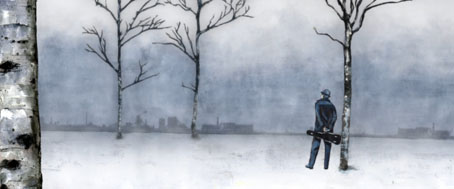
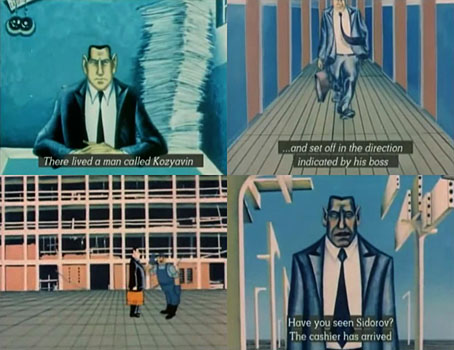
There Lived Kozyavin

khrzhanovsky1.jpg

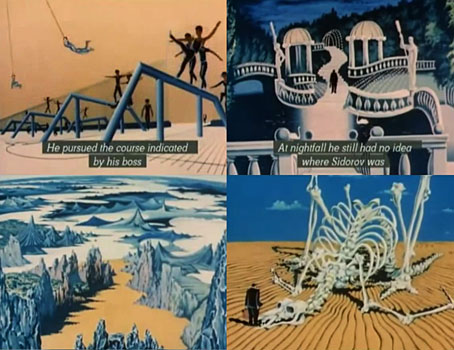
The aesthetics of Surrealism are largely absent in the art of Soviet Russia but they can be found in some of the early animated films of Andrei Khrzhanovsky. One of these, The Glass Harmonica (1968), shows the influence of Magritte and De Chirico, among others, and is also distinguished by being the only animation to be officially banned by the Soviet authorities. The film is rather confused but its message about the liberating power of art and music was clear enough to pose an ideological threat.

More straightforward is There Lived Kozyavin (1966), a shorter film with a jazzy score about a bureaucrat mindlessly following his supervisor’s order to an extreme degree. As with The Glass Harmonica, the film borrows the limitless plains and unusual landscapes of Surrealism for its setting. The message may be the same as those posters exhorting Soviet citizens to be better workers but it does so in a more entertaining manner.

khrzhanovsky2.jpg

Weekend links 493

gaycomix.jpg

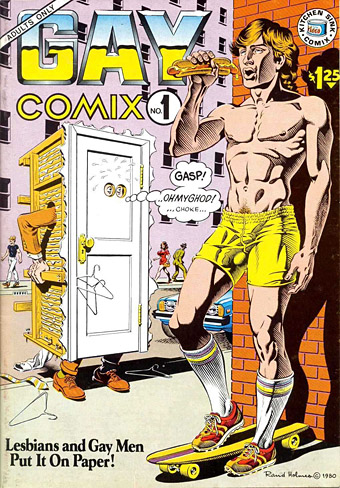
Art by Rand Holmes for Gay Comix No. 1, September 1980.

• In the universe next door, Los Angeles in November, 2019 looks like the drawings in the Blade Runner Sketchbook (1982). The book has been out of print for many years but available online for a while, although seldom in a downloadable form. A recent upload at the Internet Archive remedies this. In addition to the familiar Syd Mead designs for flying cars and street furniture there are some Moebius-like doodles by Ridley Scott, and Mead’s design for Tyrell’s cryogenic crypt, a detail that would have formed part of an unfilmed sub-plot.

• RIP Howard Cruse, comic artist and pioneering editor of the first few issues of Gay Comix in the 1980s. Cruse produced work outside the gay sphere (I first encountered his strips in Heavy Metal) but the stories that he and other artists created for Gay Comix (later Gay Comics) were some of the first by lesbians and gay men chronicling their own lives, as opposed to porn fantasies or the more recent trend of bolting a token sexuality to a superhero. John Seven talked to Cruse about his career in 2007.

• “On the eve of the First World War Stefan George had started recruiting his own twink army…” Well, if you really must have an army… Strange Flowers presents part one of a guide to the city of Vienna.

In Wild Air, 2016–2018: all 72 of Heath Killen’s requests for a list of six interesting things from artists, writers, scientists, ecologists, musicians, historians and others. My answers are at number 55.

• “Satan is a friend of mine”: Sander Bink on a forgotten occult novel, Goetia (1893) by Frits Lapidoth.

• Picturing a voice: Rob Mullender-Ross on Margaret Watts-Hughes and the Eidophone.

• “They broke the rules”: Killian Fox on the film posters of the French New Wave.

• At Dennis Cooper’s: Jan Švankmajer Day.

Ogi No Mato (1976) by Ensemble Nipponia | Rêve (1979) by Vangelis | Blade Runner Esper “Retirement” Edition, Part III (1982)

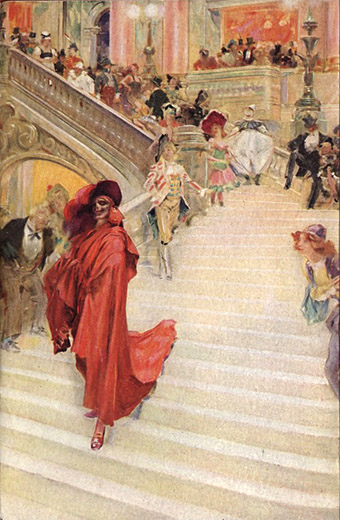
André Castaigne’s Phantom of the Opera

castaigne1.jpg

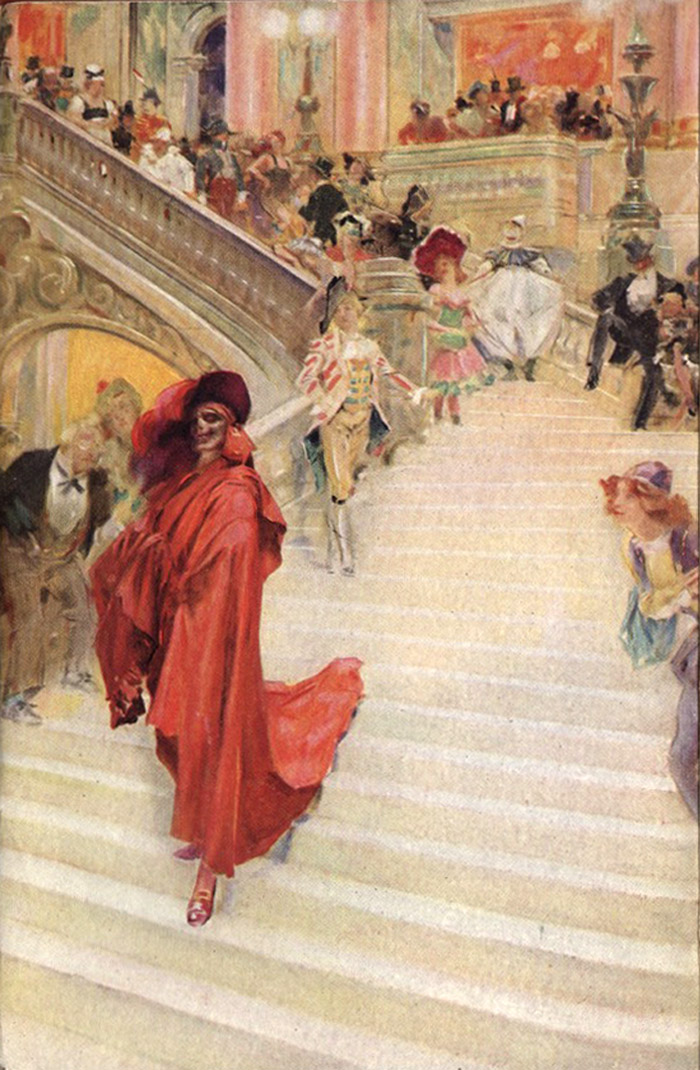
Frontispiece.

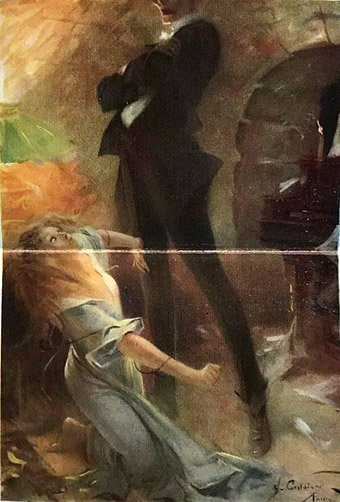
My recent film viewing has included two early adaptations of The Phantom of the Opera, the superb Lon Chaney version from 1925, directed by Rupert Julian, and the not-so-superb 1943 version with Claude Rains as the Phantom. I’d not seen the latter before but it was included in a blu-ray collection of Universal horror films; Rains is wasted in the title role but in its favour the film has Technicolor photography and huge sets, some of which were being reused from the 1925 film. The Chaney version is one of my favourite silent films so it was good to see again after a lengthy absence. It also sent me to Gaston Leroux’s novel at long last, and this in turn led me to the illustrations by André Castaigne for the first edition.
castaigne2.jpg

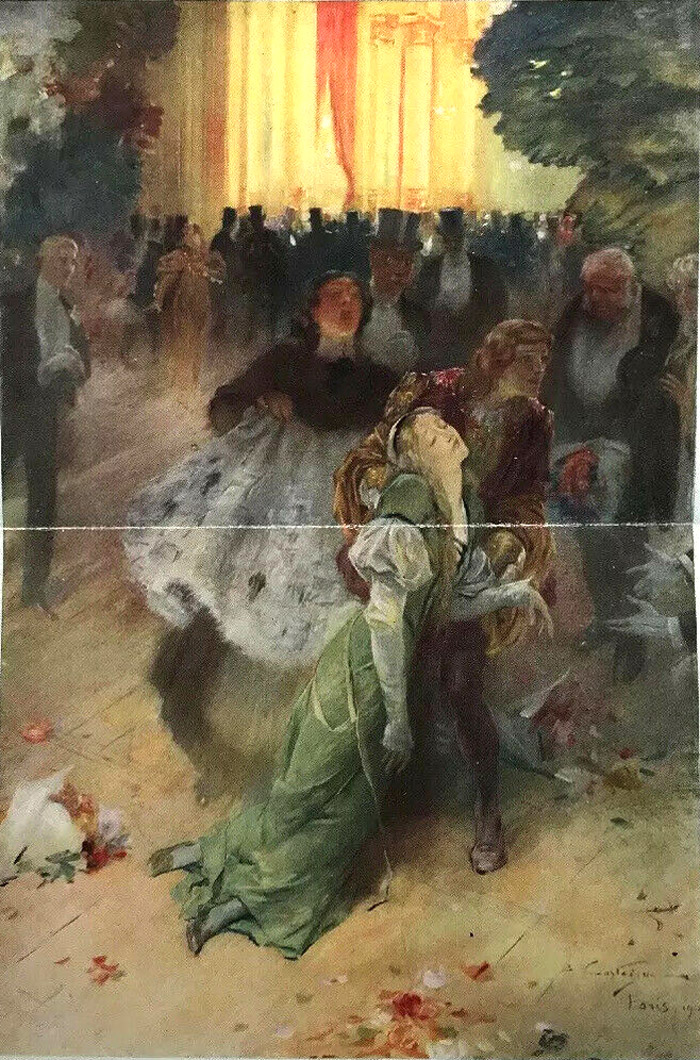
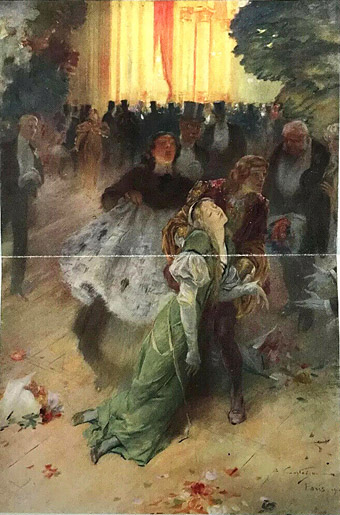
“She staggered swooning.”

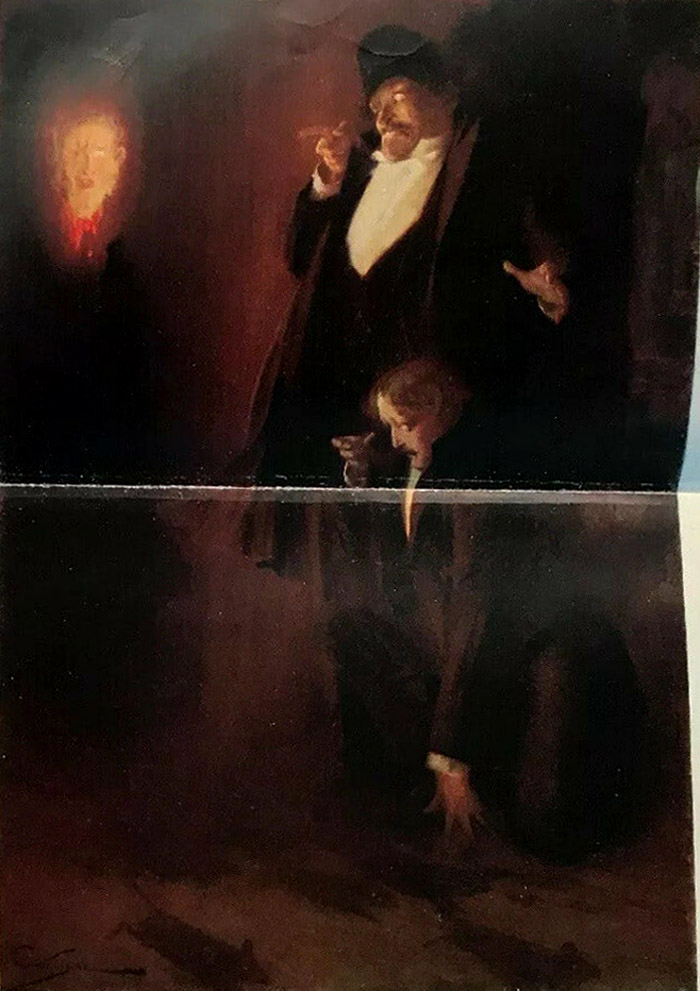
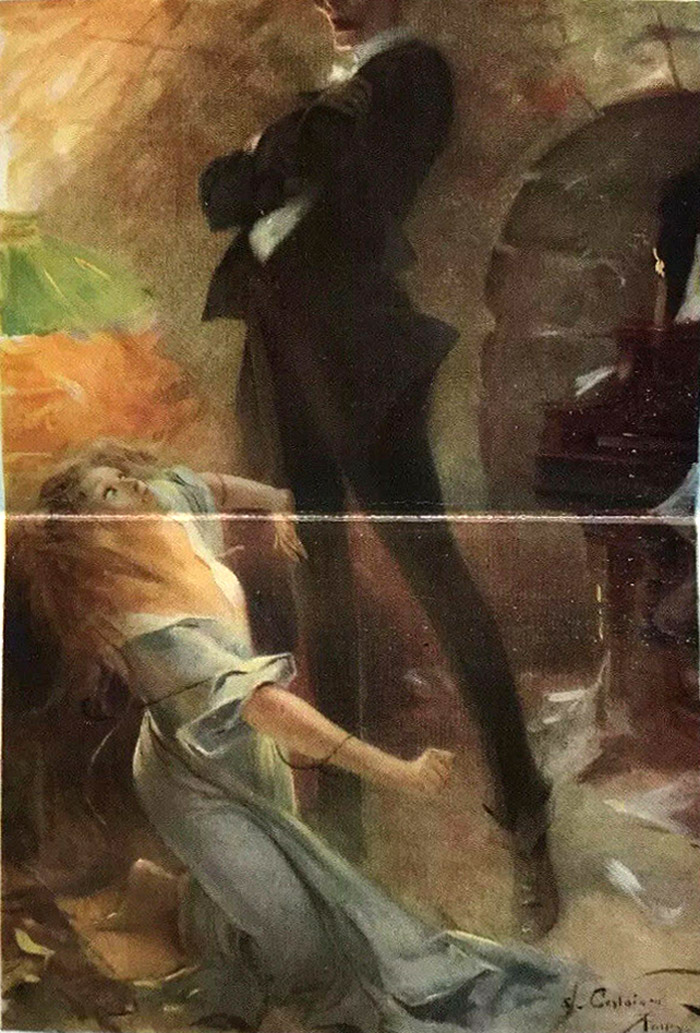
The Phantom of the Opera was published in 1911, and while it hasn’t been subjected to the overexposure sustained by Dracula and Frankenstein it’s still one of those stories where the adaptations now dominate the popular imagination. I’d not seen Castaigne’s illustrations before so I was surprised by how closely the 1925 film followed their details, especially the depiction of the Phantom’s appearance as the Red Death at the bal masque. The same goes for the ghostly head of fire which Raoul and the Persian encounter in the cellars beneath the opera. In the film this is an inexplicable moment but one which would no doubt have been familiar to the novel’s readers. Finally, there’s Lon Chaney’s incredible makeup which turns out to be very close to the glimpses of the Phantom’s skull-like face in these pictures. I often used to wonder about this, how much of Chaney’s appearance was merely an attempt to look as horrifying as possible. (In the 1943 film, and the 1962 Hammer adaptation with Herbert Lom, both Phantoms have been disfigured by acid scarring.)
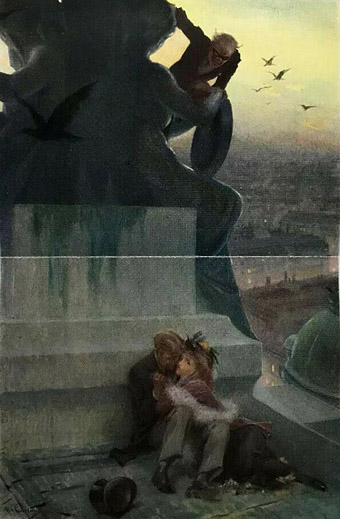
castaigne3.jpg

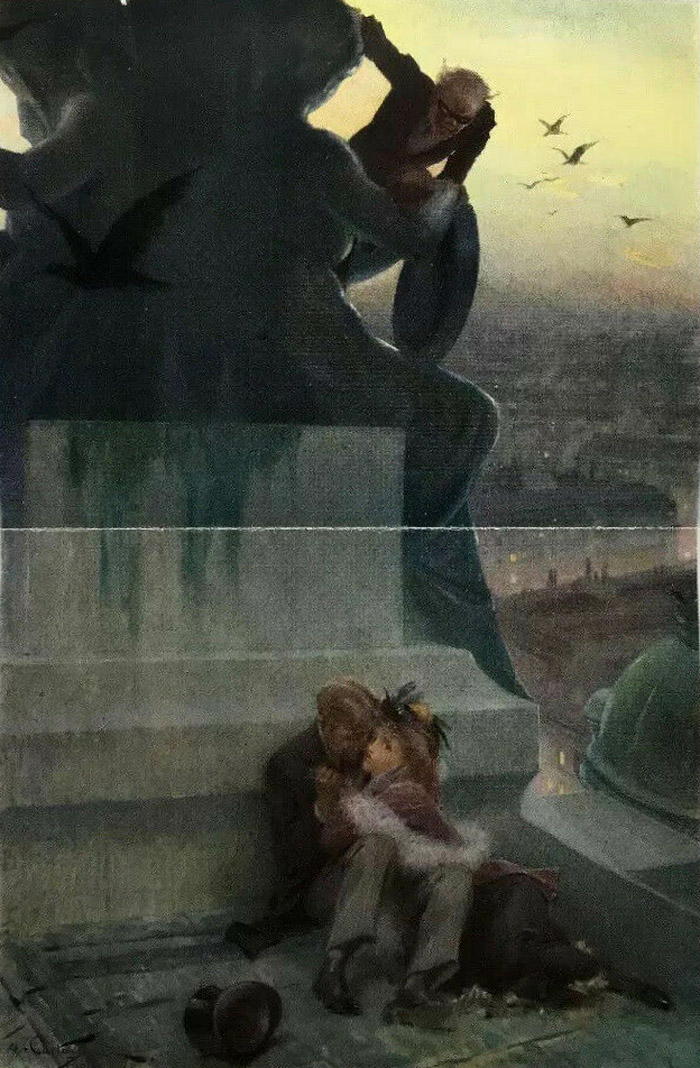
“They sat like that for a moment in silence.”

By coincidence, a new illustrated edition of The Phantom of the Opera was published this month by the Folio Society, with a splendid set of illustrations by Taylor Dolan. As for the Lon Chaney film, the restored blu-ray print is the one to look for, with tinted scenes, the bal masque in two-strip Technicolor, and an excellent orchestral score by Carl Davis.

(Note: With the exception of the frontispiece, all the illustrations here were printed over two pages, hence the fold across each picture.)
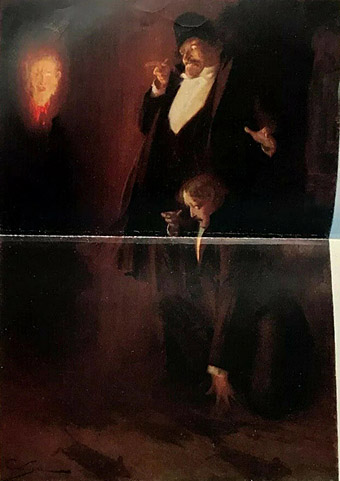
castaigne4.jpg

“A head of fire came toward them.”

castaigne5.jpg

“Talking of death, I must sing.”

Elsewhere on { feuilleton }
The illustrators archive

Previously on { feuilleton }
A Pictorial History of Horror Movies by Denis Gifford