Weekend links 509

occult.jpg

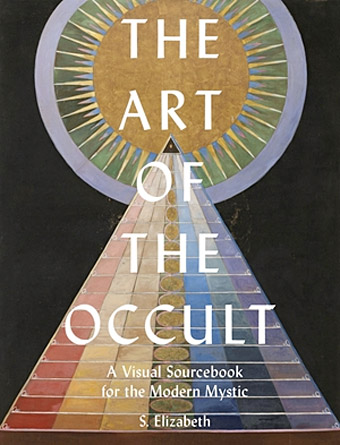
The Art of the Occult: A Visual Sourcebook for the Modern Mystic by S. Elizabeth. The book will be published in September by White Lion Publishing, and includes some work of mine.

• “The structure of the film as a memory palace consists of scenes intercutting different movies, depicting similar situations lived by the same actors in similar locations and, yes, similar sexual positions building over the course of its run-time.” Memory Palace: on Ask Any Buddy and the Golden Age of Gay Porn. Caden Mark Gardner writes on a kaleidoscopic, experimental archive piece of gay pornography. • Related: Paul P., the artist making dreamy paintings from vintage gay erotica.

• At Dennis Cooper’s: Spotlight on…Terry Southern The Magic Christian (1959), and Bill Hsu presents…High Anxiety: tense, dark films from 2010-2019 (for fans of Robert Aickman and Brian Evenson).

Green (1986) by Hiroshi Yoshimura, a welcome reissue of an album of minimal electronica. More green: The Green Fog by Guy Maddin has been on Vimeo for a while.

• Mixes of the week: Time is on our hands by Beautify Junkyards, and Textural Hominini Cognition by The Ephemeral Man.

• How John Waters and Mink Stole made Pink Flamingos, and Mink Stole on the inside story of John Waters’ greatest films.

Viktor Wynd: “I was offered a mummified arm—but I didn’t have €2,000 on me”.

• At Dangerous Minds: the solitary Surrealism of Gertrude Abercrombie.

Cats and Domino

Webcam in Italia

The Green Chinese Table (1988) by Seigen Ono | Green Water (1996) by Coil | Green Evil (1997) by Paul Schütze

Picturing On Land

allsaints.jpg

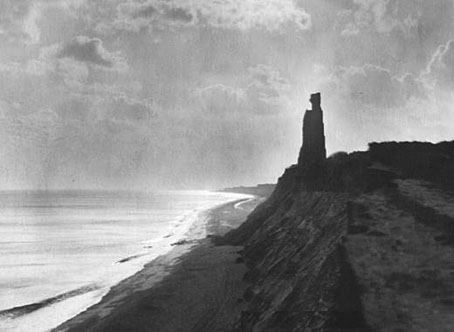
The ruined tower of All Saints Church, Dunwich, 1919.

I became interested in inventing places for sounds. I often listen to music and get a picture of a certain time of day, a certain type of light. I did that with On Land: for each piece I had an image of a time of day. On Land is specifically dedicated to the idea of creating places in music. — Brian Eno

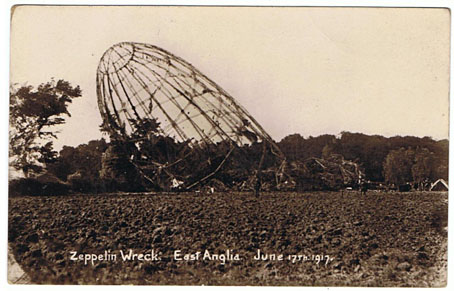
My recent reading has included a couple of novels by the Strugatsky Brothers, and The Rings of Saturn (1995) by WG Sebald, a book I’d been intending to read for many years. The Sebald is a semi-fictionalised account of the author’s walking tour through Suffolk in the early 1990s, an account interleaved with extended detours into personal memory, history and literature, with the text being augmented by grainy and often indistinct pictures or photographs. The book has acquired something of a cult reputation in recent years, and its digressions touch on a couple of cult areas of my own, notably Jorge Luis Borges (via his story, Tlön, Uqbar, Orbis Tertius) and, less directly, the music group Coil, whose Batwings (A Limnal Hymn) is evoked via a description of Thomas Browne’s catalogue of imagined objects, the Musaeum Clausum. Coincidentally, Thomas Browne is mentioned in the Borges story although Sebald cleverly leaves this as something for the curious reader to discover.
zeppelin.jpg

Suffolk is itself a curious county, in the sense of being strange, verging on the weird. The place is rich in British history—its situation on England’s eastern shore made it a site of various invasions—and weird enough to almost be considered Weird in the literary sense, even without fictional resonances from MR James (“Oh, Whistle, and I’ll Come to You, My Lad”, A Warning to the Curious), Robert Aickman (Ringing the Changes) and, tangentially, HP Lovecraft, who took the name of the sea-devoured town of Dunwich for one of his Massachusetts settings.

Sebald doesn’t mention weird fiction and he also doesn’t mention (and quite possibly never heard of) Brian Eno, but Eno’s fourth album in his Ambient series, On Land, was continually in my mind while reading, owing to the intersection of the places that Sebald visits with the titles of several of Eno’s pieces. The most obvious of these is the last track on the album, Dunwich Beach, Autumn, 1960, but equally Suffolkian are Lantern Marsh, and Unfamiliar Wind (Leeks Hills), the latter being a wood situated between Woodbridge and Melton, two of the places that Sebald passes through. Eno was born in Woodbridge, and On Land is as much concerned with unreliable (or semi-fictional) memories as The Rings of Saturn, something that Eno compares in his notes to Fellini’s semi-fictional film about his own childhood, Amarcord. Sebald’s descriptions sent me searching for pictures of Eno’s localities, especially the less familiar ones like Lantern Marsh and Leeks Hill. (Suffolk’s Dunwich is much more familiar to Britons owing to its long history of being eaten away by coastal erosion.) This in turn gave me the idea of trying to find a collection of suitably Sebaldian pictures for each track on the album, pictures that would be generally accurate but might equally be vague enough to suggest something more than the place or (in the case of painter Pierre Tal-Coat) the person in question.

Continue reading “Picturing On Land”
Weekend links 508

lee-nova.jpg

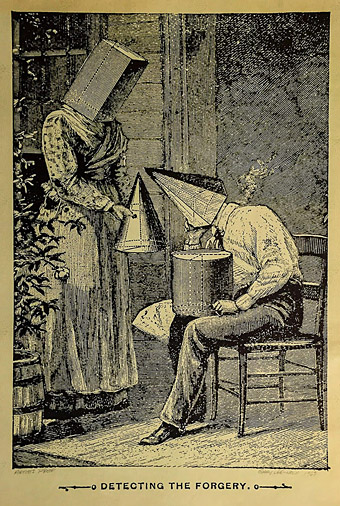
Detecting the Forgery (1967), a collage print by Gary Lee-Nova.

• Nigel Kneale’s adaptation of Susan Hill’s The Woman in Black was given a UK TV screening in 1989, followed by a brief video release after which it was buried for years, and subsequently overshadowed by the later (inferior) big-budget feature film. Network will be releasing the Kneale version on blu-ray in May. I wrote about the TV film a while ago.

• At the BFI: David Parkinson on 10 essential films featuring the late Max von Sydow, a welcome riposte to obituaries that headlined the often mediocre Hollywood fare that Von Sydow elevated with his minor roles. And at the same site, John Berra on where to begin with the martial arts films of King Hu.

• “Enthusiasts Archive, an artistic project by Neil Cummings and Marysia Lewandowska, is the result of extensive research amongst the remnants of amateur film clubs in Poland under socialism. It is a critical archive of amateur films found, restored and made available online.”

Stephen Calloway, co-curator of the Tate Britain Aubrey Beardsley exhibition, and drag performer Holly James Johnston sit down to tea to discuss the “dos and don’ts” of dandyism according to the artist.

• Mutinous Jester: The Collage Novels of Akbar Del Piombo by Gregory Stephenson. Related: Fuzz Against Junk: The Saga of the Narcotics Brigade (1959) by Akbar Del Piombo.

• Michael Richey on chindogu, the useless inventions of Kenji Kawakami.

• From farting to fornication: John Boardley on early print censorship.

Douglas A. Anderson on a case of plagiarism in Weird Tales.

• Mix of the week: mr.K’s Soundstripe vol 3 by radioShirley.

How To Get To Spring is a new album by Jon Brooks.

Rufus Wainwright‘s favourite music.

• At Dennis Cooper’s: Occultists.

Spring Rounds From The Rite Of Spring (1975) by Alice Coltrane | Springlight Rite (1981) by Irmin Schmidt & Bruno Spoerri | Spring Returns (1999) by Isao Tomita

Double weird

weird1.jpg

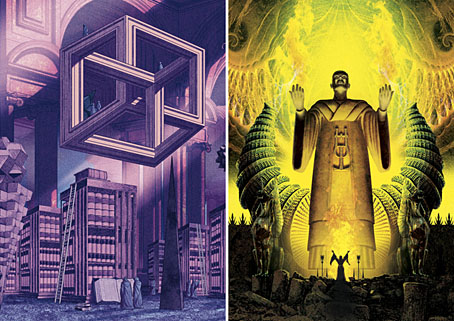
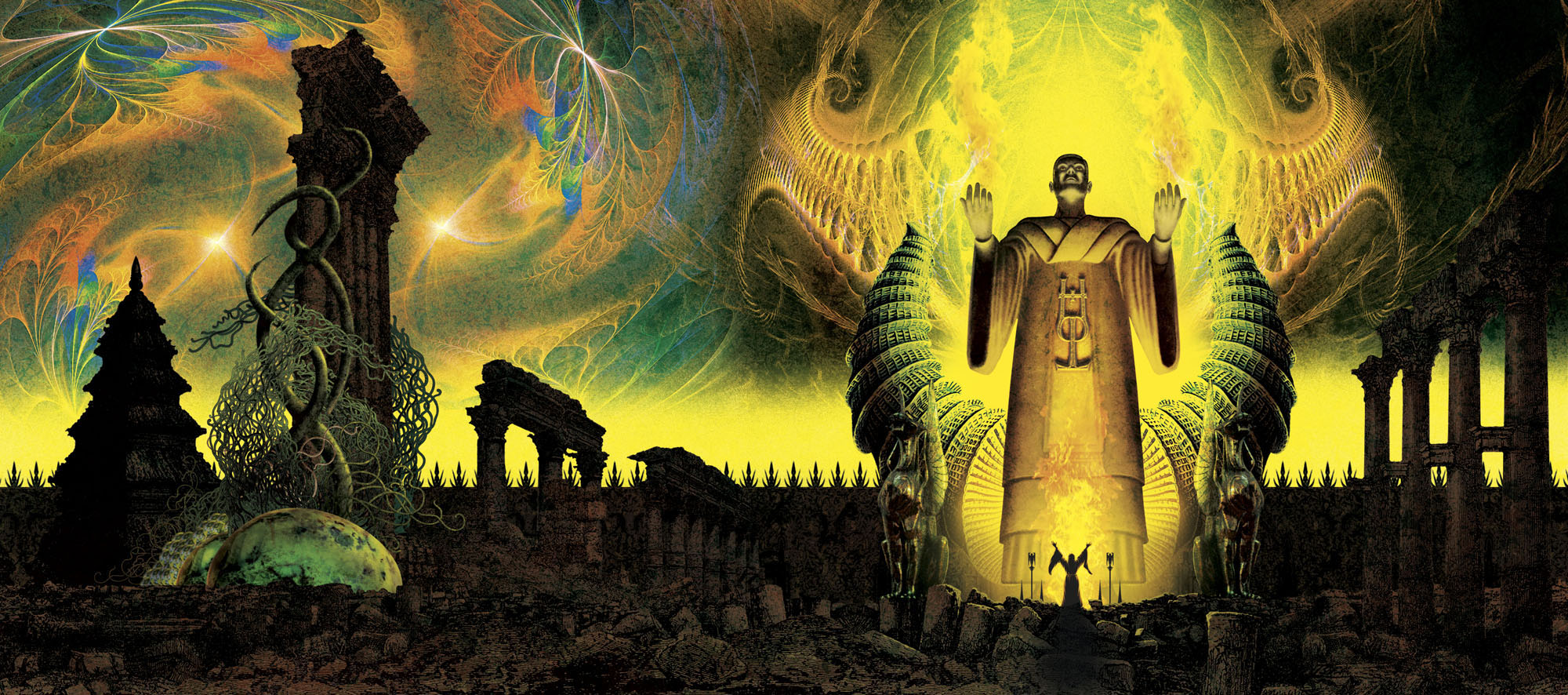
Two of the books whose covers I was working on late last year have been announced so here they are. This is more work for PS Publishing where wraparound covers are the standard, so once again I was able to work in a pictorial, landscape format. (PS also do their design in-house so I only did the art this time. Click on the pictures below for larger views.)

weird2.jpg

Apostles of the Weird is a collection of contemporary weird fiction edited by ST Joshi:

Weird fiction is an incredibly rich and varied genre, running the gamut from supernatural horror to imaginary-world fantasy to psychological terror. This anthology seeks to exhibit the wide range of themes, motifs, and imagery that weird fiction allows, as embodied in the work of some of the leading contemporary writers in the field. (more)

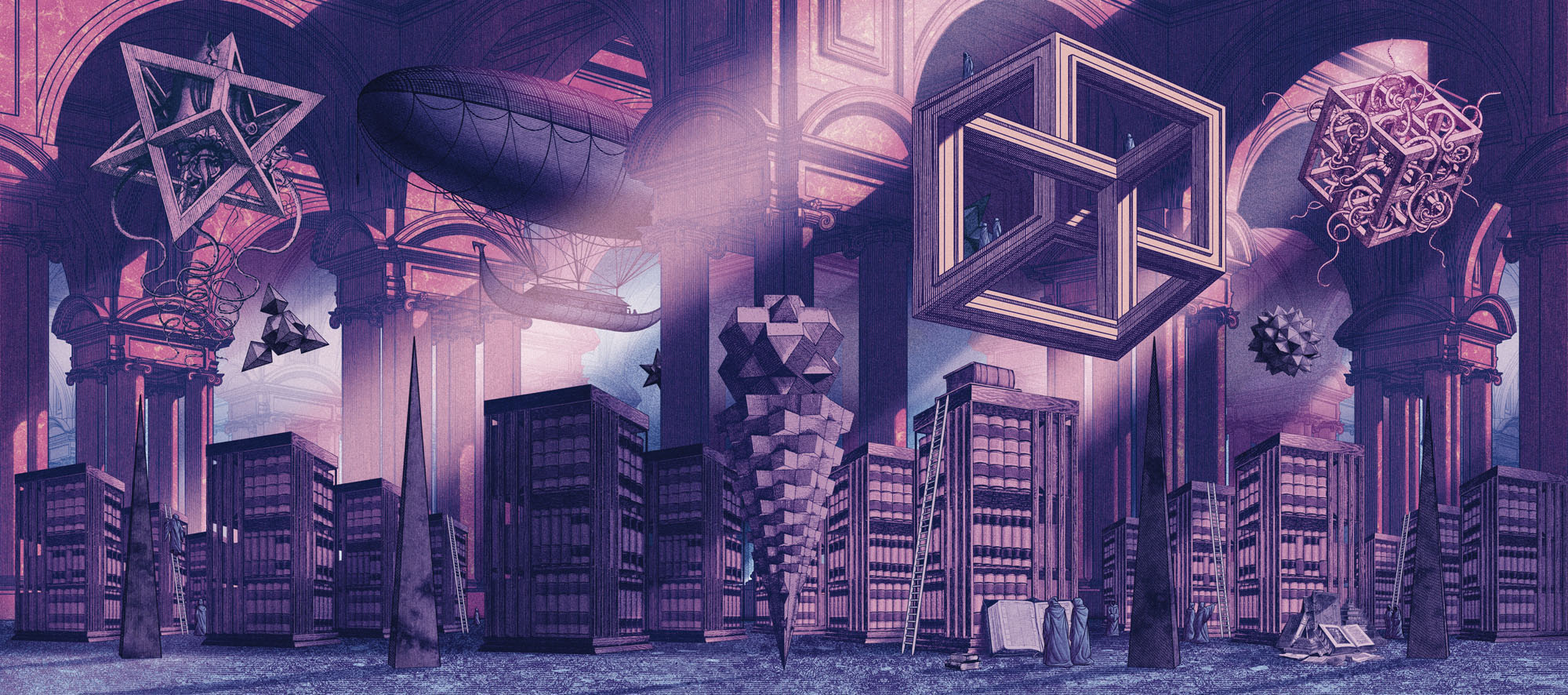
“Weird” is indeed a very broad category so rather than try and create something that represented a single genre I opted for a weird view instead. The idea was to do something like Borges’s Library of Babel in a space that was a hybrid of Piranesi and MC Escher. I was hoping originally to make this more Escher-like, with a number of gravity-defying staircases, but the underlying drawing took so long that I didn’t have time.

weird3.jpg

His Own Most Fantastic Creation: Stories About HP Lovecraft is also edited by ST Joshi:

HP Lovecraft (1890–1937), the pioneering writer of weird fiction, has himself become an icon in popular culture. Stories, novels, and other works featuring the gaunt, lantern-jawed gentleman from Providence, Rhode Island, have proliferated. These works have been triggered by the incredible amount of knowledge we have on the writer—his family, his friends, his idiosyncrasies and eccentricities—as found in his thousands of surviving letters. (more)

This was much easier to achieve since HP Lovecraft is familiar territory. The idea here was to do a portrait of Lovecraft situated in a Lovecraftian zone, a colossal idol of a type that might be found in some of his Cyclopean ruins. Lovecraft and his Weird Tales colleagues had a habit of referring to each other in their stories and letters as though they were ancient priests or sorcerers so portraying Lovecraft in this manner is fitting. The combination of perspective and lighting worked against creating an accurate likeness, however—it doesn’t help that Lovecraft’s features are weird in themselves—so the “HPL” icon is there to affirm the identity.

Both books will be published next month if Great Cthulhu hasn’t risen from the depths by then.

Elsewhere on { feuilleton }
The Lovecraft archive

Previously on { feuilleton }
Something from Below

Weekend links 507

plone.jpg

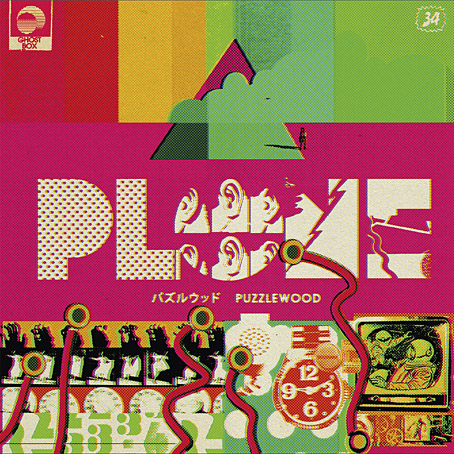
The next release on the Ghost Box label will be Puzzlewood by Plone, “unironically joyful and melodic electronica; informed by library music, music for children’s TV and a deep passion for the history of music technology”. The album will be available in April. Design, as always, is by Julian House.

• “With his panting breath and dripping sweat infused in each page of his memoir, Patrick Cowley describes himself on his knees, bending over and ‘worshipping Phallus.'” Maxwell Shand on Dark Entries‘ “holy trinity” of Patrick Cowley’s Mechanical Fantasy Box, Hot Rod To Hell by Roy Garrett & Man Parrish, and Maxx Mann’s gay synth-pop.

• “We’re gonna do economic activity—without money!”: Inside the criminal glamour of the San Francisco Diggers with Kent Minault. The third installment of a verbal history of the hippie anarchists by Jay Babcock.

• “Susanna Hoffs and friends remember David Roback, who stayed creative, and enigmatic, to the end.” By Randall Roberts.

My connection with [raga] was not to be able to duplicate or emulate it but to learn from it. I combined it with the electronics and the harmonizer and things like that. But I would have a line that was being drawn. You’re thinking about it like a shape that’s being drawn on a canvas. It’s a line that’s being drawn and another. You’re holding three pencils at once while you’re drawing on the wall. So, you’re able to get the shapes. This was my thing with it, because I was into the harmony that it would make. So, it was an easy and natural thing to do, was to go and move into the electronics. Then we had equipment that was doing transposition and all that kind of thing. So that’s one little part of it.

Jon Hassell talking to Aquarium Drunkard about his first album, Vernal Equinox, which is reissued later this month

• Published next month by Strange Attractor Press: Rated SavX: The Savage Pencil Skratchbook.

• They came from outer Finland: the town where everyone saw UFOs, as photographed by Maria Lax.

• Mix of the week: Through A Landscape Of Mirrors Vol. VI – Sweden II by David Colohan.

Moonstrips Empire News (1967) by Eduardo Paolozzi.

• At Dennis Cooper’s: Shelley Duvall Day.

Graham Massey‘s favourite albums.

Phallus Dei (1969) by Amon Düül II | Wrong Eye (1990) by Coil | Red Scratch (1994) by ELpH