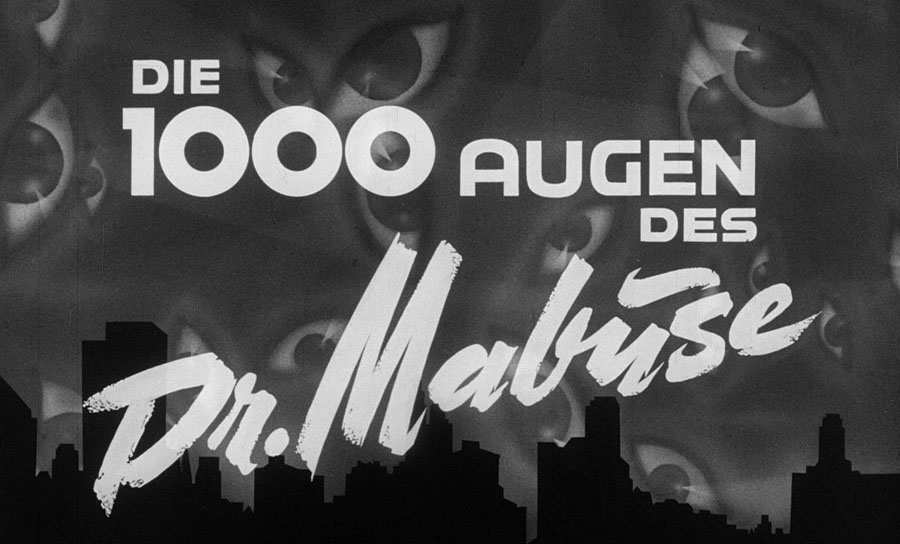
The Thousand Eyes of Dr Mabuse

mabuse1.jpg

Among the weekend’s viewing was the third and final film in Fritz Lang’s Mabuse cycle, The Thousand Eyes of Dr Mabuse (1960). This was also Lang’s final feature, made after his return to Germany in the late 1950s, and another film of his that for many years I knew only as an impossible-to-find title. I’d read about the Mabuse series in Lotte Eisner’s study of Lang’s career even before the name and character was co-opted by Propaganda for their first single in 1984, but the only films of Lang’s that ever used to appear on TV were the Hollywood features or, if you were lucky, a poor print of Metropolis. Mabuse was a source of fascination for the way the character connected the beginning and ends of the director’s career, as well as being a German take on the Moriarty-like super-criminal. The first film in the series, Dr Mabuse, the Gambler (1922), condenses the corruption of Weimar Germany into a potent physical icon, while the sequel, The Testament of Dr Mabuse (1933), reflects the fevered moment when real super-criminals were taking control of the nation. The Nazis were sufficiently discomforted by Testament to ban it shortly after its release.
mabuse2.jpg

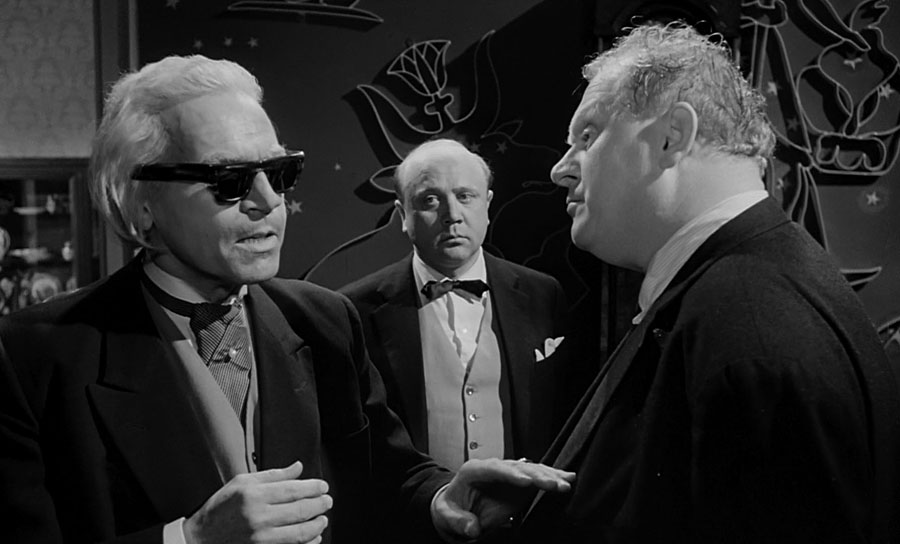
Cornelius the psychic with insurance salesman Hieronymus B. Mistelzweig and police inspector Kras.

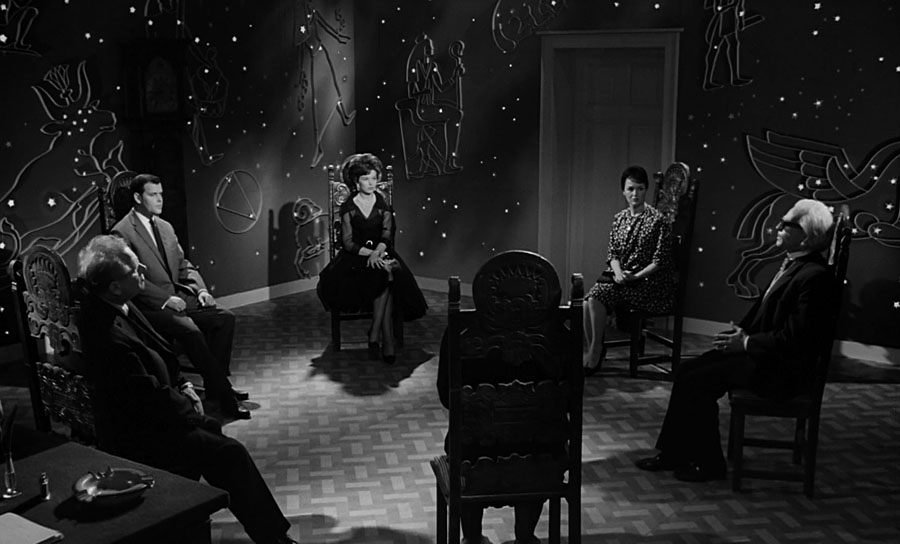
The Thousand Eyes of Dr Mabuse appeared just as new super-villains were emerging to oppose James Bond and his imitators. One of Bond’s early adversaries, Auric Goldfinger, was portrayed on screen by Gert Fröbe who appears here on the opposite side of the law as homicide inspector Kras. Fröbe’s tenacious policeman is one of the few fixed points in a plot filled with twists and deceptive identities. Assassinations and double-crosses are a staple of this type of thriller but Lang also gives us an early example of electronic surveillance in a contemporary setting, together with a séance that harks back to a similar scene in the first Mabuse film. The séance is an unusual touch in a story otherwise devoid of similar moments, prompted by the film’s most mysterious character, Cornelius the blind psychic. With an appearance reminiscent of the late Karl Lagerfeld, Cornelius is an overt throwback to Lang’s pre-war films, many of which hinted at the mystical or supernatural even when such hints seemed unnecessary; Rotwang, the robot-builder in Metropolis (played by the original screen Mabuse, Rudolph Klein-Rogge) is a mechanical genius who just happens to live in a house more suited to an alchemist, with a huge inverted pentagram on one of its walls. The sinister motives of Cornelius aren’t so baldly stated but his consulting room is lavishly decorated with astrological diagrams. The psychic, together with the criminals and the police inspector, create a problem common to films of this kind in which the more colourful characters generate greater interest for the viewer than do the romantic leads. After a succession of breathless opening scenes, Thousand Eyes sags a little while wealthy industrialist Henry Travers (Peter Van Eyck) is getting to know Marion Menil (Dawn Addams), a woman he rescues from a suicide attempt. The film also lacks the subtext of the earlier episodes, although Mabuse’s scheme turns out to be diabolical enough for any of James Bond’s Cold War enemies.
mabuse3.jpg

The séance.

Continue reading “The Thousand Eyes of Dr Mabuse”

Weekend links 534

hasui.jpg

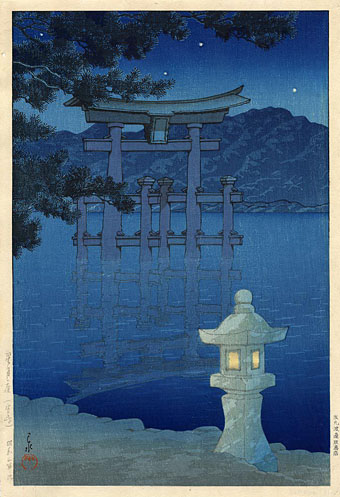
Beautiful night – moon and stars, Miyajima Shrine (1928) by Hasui Kawase.

• One announcement I’d been hoping for since last summer was the news of a second box of Tangerine Dream albums to follow the excellent In Search Of Hades collection. The latter concentrated on the first phase of the group’s Virgin recordings, up to and including Force Majeure. This October will see the release of a new set, Pilots Of Purple Twilight, which explores the rest of the Virgin period when Johannes Schmoelling had joined Froese and Franke. Among the exclusive material will be a proper release of the soundtrack for Michael Mann’s The Keep (previously a scarce limited edition), together with the complete concert from the Dominion Theatre, London. Also out in October, Dark Entries will be releasing a further collection of recordings from the recently discovered tape archive of Patrick Cowley. The new album, Some Funkettes, will comprise unreleased cover versions, one of which, I Feel Love by Donna Summer, is a cult item of mine that Cowley later refashioned into a celebrated megamix.

• “Did you know that Video Killed The Radio Star was inspired by a JG Ballard story?” asks Molly Odintz. No, I didn’t.

Casey Rae on the strange (musical) world of William S. Burroughs. Previously: Seven Souls Resouled.

• “And now we are no longer slaves”: Scott McCulloch on Pierre Guyotat’s Eden Eden Eden at fifty.

• At Dennis Cooper’s: Frank Jaffe presents…Dario Argento and his world of bright coloured blood.

• At Wormwoodiana: The Serpent Calls. Mark Valentine on a mysterious musical instrument.

• At Spoon & Tamago: Long-Exposure Photographs of Torii Shrine Gates by Ronny Behnert.

• Mix of the week: mr.K’s Soundstripe vol 4 by radioShirley & mr.K.

• Rising sons: the radical photography of postwar Japan.

• The illicit 1980s nudes of Christopher Makos.

• RIP Diana Rigg.

Garden Of Eden (1971) by New Riders Of The Purple Sage | Ice Floes In Eden (1986) by Harold Budd | Eden (1988) by Talk Talk

Bergling’s Art Alphabets

bergling02.jpg

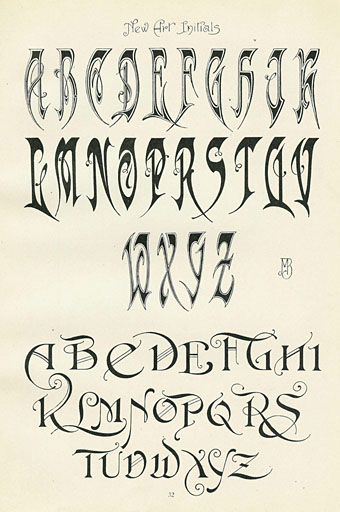
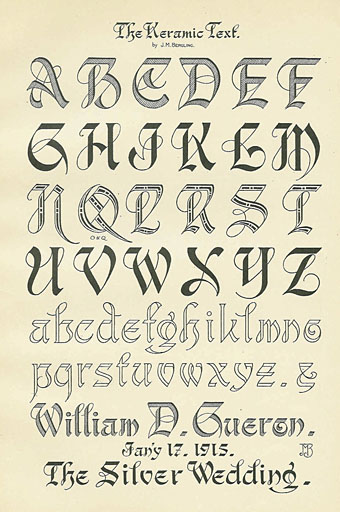
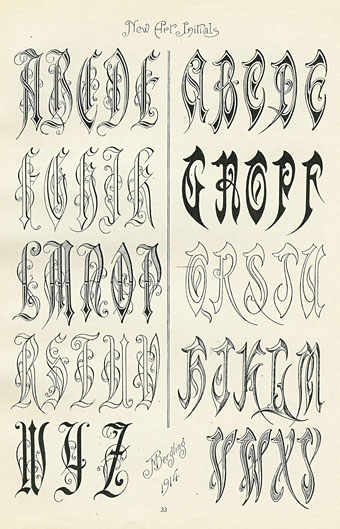
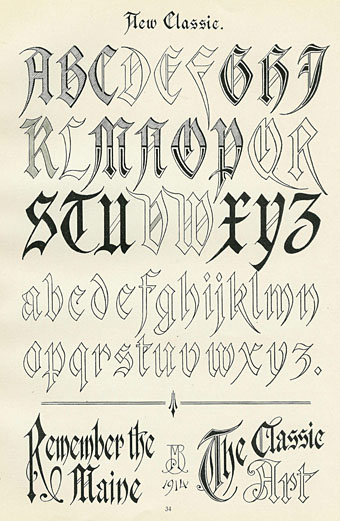
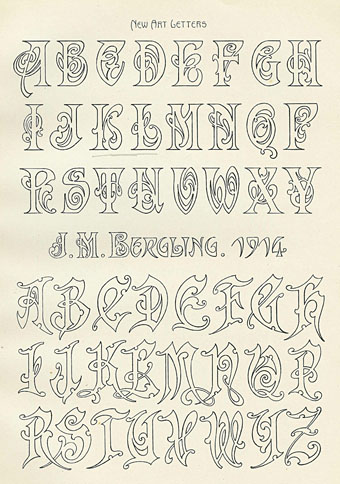
Old type catalogues seldom contain any unusual typefaces so you have to look to craft books for original letterforms. Art Alphabets and Lettering (1914) is an American book for artists and sign painters written and designed by JM Bergling which contains several pages of novel designs among its more familiar typefaces. Bergling evidently had a flair for alphabet design, there are more unique examples here than you’d usually find in a book of this kind, and Bergling’s letterforms are consistently stylish and inventive. In addition to providing a number of spiky variants on the Art Nouveau style (which by 1914 was going out of fashion), he also found time to draw his own version of a 19th-century staple, the Rustic Alphabet. There are two copies of the book at the Internet Archive: a complete one and an incomplete one, the latter volume possibly being a later printing since it contains a number of pages not included in the former.

bergling01.jpg

bergling03.jpg

bergling04.jpg

bergling05.jpg

Continue reading “Bergling’s Art Alphabets”

Phantom Cities by The Sodality of the Shadows

phantom.jpg

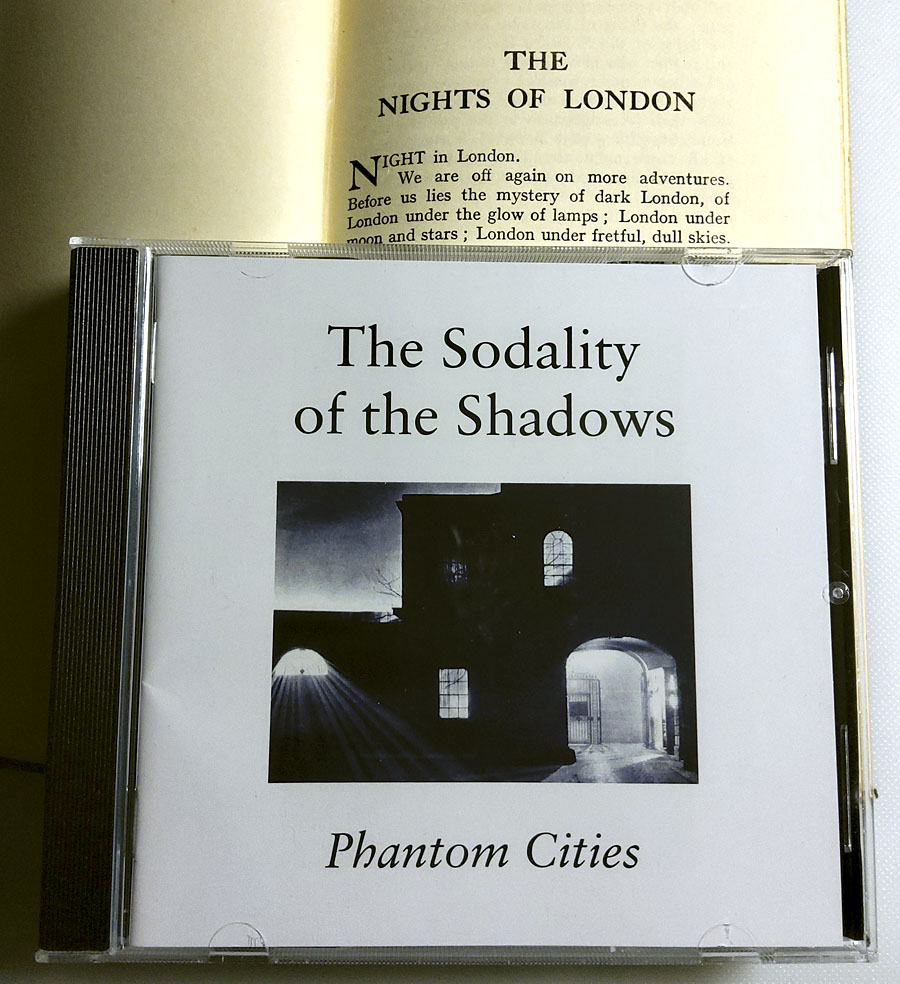
Book by HV Morton (1926) not included.

I like night music, any kind of night music, whether it be the shimmering sonorities of Béla Bartók and George Crumb, Julee Cruise exploring the dark, or the rumbling atmospheres of Thomas Köner. Phantom Cities by The Sodality of the Shadows is night music of another kind, more musically determined than the numerous purveyors of post-Köner dark ambience, with a character defined by weird fiction. The latter quality is perhaps inevitable given the people who comprise the group: Ray Russell and Rosalie Parker have been running Tartarus Press for the past 30 years; Mark Valentine is an author and editor (and occasional publisher) of many story collections, and Jon Mueller’s name has appeared here in the past via the soundtrack CD for the Swan River Press edition of The House on the Borderland that I illustrated. Phantom Cities sidesteps Robbe-Grillet’s Topology of a Phantom City for an older lineage, looking back to Arthur Machen (the group’s name is borrowed from a secret society formed by Machen and AE Waite) and the spectral metropolis of pre-war London photographed by Harold Burdekin in London Night (1934). The music is slow, sombre and reverberant; guitars pluck notes from the embracing dark while Mueller’s drums maintain a funereal pace; sporadic squalls of feedback suggest a deeper darkness, the latent possibilities of unpeopled streets. Mark Valentine had an earlier musical persona as The Mystic Umbrellas but his contribution here is textual accompaniment in the form of 12 fictional pieces, some of which are read by Rosalie Parker over and between the music. This isn’t a collection of readings, however, the album may be taken either as illustration of Burdekin’s photos and the texts or as a work that stands alone. A soundtrack for the longer nights of encroaching autumn.

Phantom Cities
Strange Houses Of Sleep

Previously on { feuilleton }
The Smoke
Two albums
Thomas Köner

Robot Artists and Black Swans

robotartists.jpg

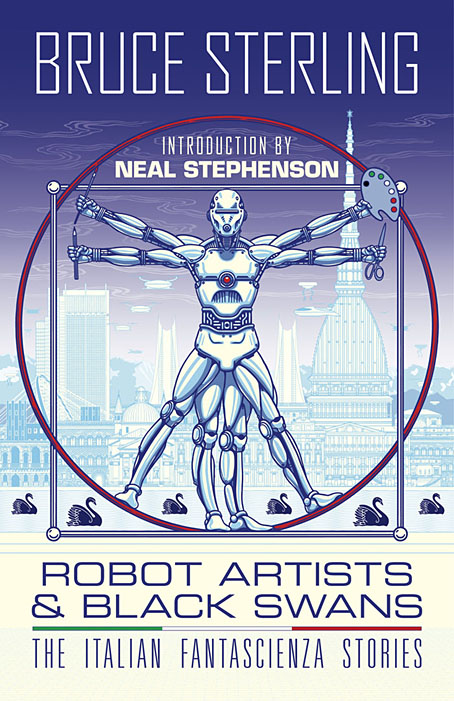
Four years ago I designed and illustrated a book for Tachyon written by Bruce Sterling, Pirate Utopia. Robot Artists and Black Swans is a kind of sequel, being the work of the same author for the same publisher, and with a similar geographical focus on southern Europe. The new book differs from the earlier one by being a collection of stories rather than a single piece, many of which are set in or near the city of Turin where Sterling and his wife, Jasmina Tesanovic, spend much of their time. Sterling has been living in Europe for many years, long enough to have cultivated an alter-ego, Bruno Argento, an Italian science-fiction writer who is offered as the real author of the stories in Robot Artists and Black Swans.

Pirate Utopia was an easy book to design because of the Futurist theme which I illustrated by adapting graphics by artist and designer Fortunato Depero. For the cover of the new volume I considered trying something similar with another Italian artist/designer, Franco Grignani (1980–1999). In addition to having studied in Turin, Grignani was commissioned by David Pelham to create cover art for a handful of Penguin science fiction titles in the late 1960s. Much of Grignani’s artwork is heavily indebted to the Op Art style popularised by Bridget Riley and Victor Vasarely, especially the early Riley formula of dazzling arrangements of parallel lines, a formula he made his own after Riley’s work evolved in other directions. Despite these favourable qualities, Grignani’s art proved too abstract for my purposes, and for Tachyon’s who wanted something more illustrative, so I ended up co-opting a very different Italian artist/designer, Leonardo da Vinci. The figure of Da Vinci’s Vitruvian Man has been parodied and pastiched many times so this isn’t remotely original (I’ve also used the original drawing on a pastiche book cover I designed for the Lambshead Disease Guide), but making the figure a robot was a convenient way of combining the title with Italian history. One of the stories in the collection, Pilgrims of the Round World, concerns the inhabitants of Turin during the Renaissance years, and mentions Leonardo (or “the Vinci boy”) several times, so the figure does have some actual relevance beyond being recognisably Italian. The background is, of course, the city of Turin given a slightly futuristic tweak, although it’s more Turinesque than a match for the place itself.

As usual, I’ll save discussion of the book’s interior until after publication which will be in March, 2021. Watch this spacetime.

Previously on { feuilleton }
Pirate Utopia by Bruce Sterling
Futurismo!