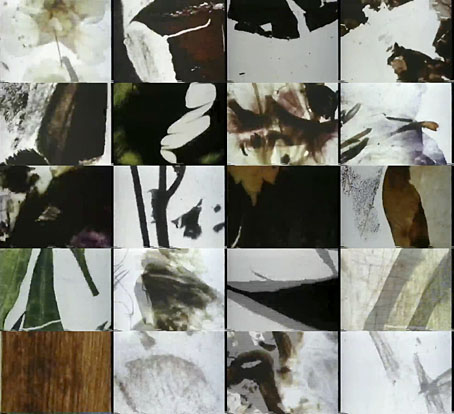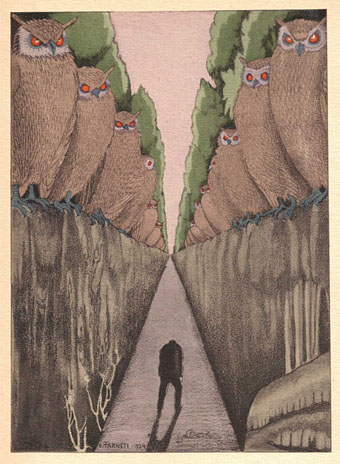
The Invasion of Thunderbolt Pagoda, a film by Ira Cohen

invasion1.jpg

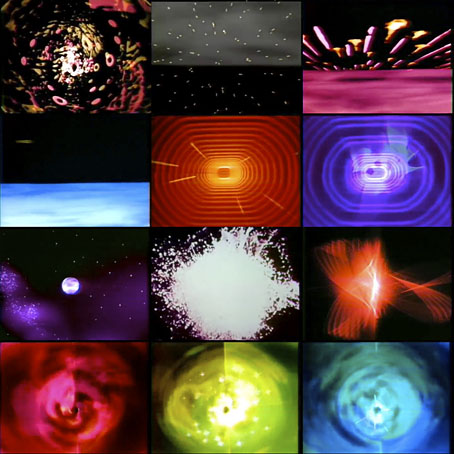
An inevitable follow-up to yesterday’s film, Ira Cohen’s fantasia from 1968 is one of the classics of psychedelic cinema, a Kenneth Anger-like delirium that makes great use of Cohen’s obsession with Mylar distortions. Anger’s Inauguration of the Pleasure Dome is the model here, with a cast of revellers adopting various guises; Cohen himself appears as The Majoon Traveler and Death. The long version of the film at YouTube is the expanded edition that Arthur magazine released in 2006. Unfortunately the original score by Angus MacLise has been replaced by something that’s even more annoying that the jokey music for NY, NY. I’d recommend finding a suitably trippy substitute.

invasion2.jpg

Previously on { feuilleton }
Ira Cohen, 1935–2011
Dreamweapon: The Art and Life of Angus MacLise, 1938–1979
William Burroughs by Ira Cohen, 1967
The Invasion of Thunderbolt Pagoda

NY, NY, a film by Francis Thompson

nyny1.jpg

In Heaven and Hell (1956) Aldous Huxley considers various forms of art that might be said to imitate or resemble the intense visuals generated by psychedelic agents. In past centuries this would include firework displays and the vivid hues of stained glass windows; when discussing the present, mention is made of NY, NY, a short film by Francis Thompson that Huxley had recently seen.

Thompson’s film presents a day in the life of New York City with every shot being subject to some form of distortion or fragmentation via prismatic lenses or reflected surfaces. Nearly sixty years later this seems less psychedelic than it would have done to Huxley, although some of the reflections give the same effects as Ira Cohen’s later Mylar Chamber photographs. Watch NY, NY here, and if you do I’d recommend muting the Mickey Mouse score.

nyny2.jpg

Previously on { feuilleton }
Fog Line, a film by Larry Gottheim
Wavelength
La Région Centrale

Weekend links 242

kroll.jpg

Ghost in the Machine (2012) by Hope Kroll.

Nothing Here Now But The Recordings, an album of William Burroughs’ personal tapes originally released by Industrial Records is reissued on vinyl this month. Andrew Spragg reviews it here. Burroughs’ readings fill several collections but this one was the first I owned, and it’s always been a favourite. The album features recordings of early texts such as The Last Words of Hassan I Sabbah, as well as cut-up tape experiments which fuelled some of the chapters in the Nova Trilogy.

• The Melancholy of Perversion: a study of Caitlín R. Kiernan’s Metamorphosis A by Scott Dwyer. More weird fiction: “Written with real psychological depth, these enigmatic tales rise far beyond straightforward ghost stories.” Chris Power on Robert Aickman.

• At Dangerous Minds: Gay Semiotics, a taxonomy of San Francisco life in the 1970s. Related: The case of One, a gay magazine from Los Angeles prosecuted for obscenity in 1958.

Poe’s mind was by no means commonplace. In the last year of his life he wrote a prose poem, Eureka, which would have established this fact beyond doubt—if it had not been so full of intuitive insight that neither his contemporaries nor subsequent generations, at least until the late twentieth century, could make any sense of it. Its very brilliance made it an object of ridicule, an instance of affectation and delusion, and so it is regarded to this day among readers and critics who are not at all abreast of contemporary physics. Eureka describes the origins of the universe in a single particle, from which “radiated” the atoms of which all matter is made. Minute dissimilarities of size and distribution among these atoms meant that the effects of gravity caused them to accumulate as matter, forming the physical universe.

Marilynne Robinson on Edgar Allan Poe

Vanished City: London’s Lost Neighbourhoods, a book by Tom Bolton with photographs by SF Said.

• Mix of the week: Secret Thirteen Mix 143, a selection of soundtrack music by Las CasiCasiotone.

• “I am in Brussels, numbering the Bruegels.” Toby Ferris conducts a Brueg[h]el Census.

Mothmeister “taxidermy collector & curiosity cabinet”.

Ben Zurawski collects and makes flip books.

Akira Kurosawa’s 100 favourite films

The Trip (1965) by Kim Fowley | The Trip (1966) by Donovan | The Trip (1967) by Park Avenue Playground

Endtrip

endtrip.jpg

A brief journey into a psychedelic afterlife that attempts in 5 minutes what Gaspar Noé’s Enter the Void spends over two hours doing. Endtrip is the work of Koen de Mol, Olivier Ballast and Rick Franssen. Watch it here.

Previously on { feuilleton }
Cosmic Flower Unfolding, a film by Ben Ridgway
The Flow III
The art of Yoshi Sodeoka
Enter the Void
Chris Parks

The edge of coherence: On the Silver Globe

otsg1.jpg

Science-fiction cinema has always suffered in comparison to its written counterparts; sets and special effects have to work hard to create believable worlds or futures, while the need to recoup enormous costs has often meant that film scenarios aren’t much better than those being written in the early days of the pulp magazines. Simplistic adventure stories yield bigger audiences and greater revenues. Computer technology has helped the effects problem but production expenses ensure that inventive or unusual SF films are scarce and invariably low-budget works. Anything too ambitious or challenging is unlikely to be funded.

otsg2.jpg

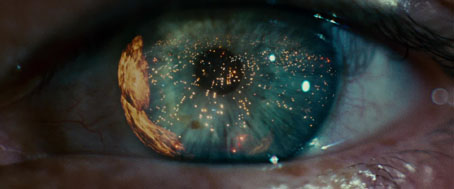
On the Silver Globe is an unfinished science-fiction film by Andrzej Żuławski that even in its incomplete state is that very rare thing: a film with a fantastic premise that doesn’t appear to have been staged for an audience at all. The film is long—over two-and-a-half hours—and much of it so disregards the conventions of commercial cinema that the immediate reaction is amazement that it exists in any form. Żuławski has a cult reputation outside his native Poland for Possession (1981), a unique horror film made when he was living in exile in Paris. On the Silver Globe was one of the reasons for his leaving the country; after two years of work in several countries, and with the film almost finished, the production was shut down in 1977 by a new vice-minister of cultural affairs who perceived a metaphoric subtext directed against the Polish authorities. The existing footage was supposed to have been destroyed but Żuławski and his production team hid the film and costumes hoping one day to shoot the missing scenes. After ten years of waiting it was decided to present the film as it was with the missing scenes filled by shots of Polish streets and countryside. A voiceover by the director describes the missing content.

otsg3.jpg

Continue reading “The edge of coherence: On the Silver Globe”