Ballet Adagio, a film by Norman McLaren

ballet.jpg

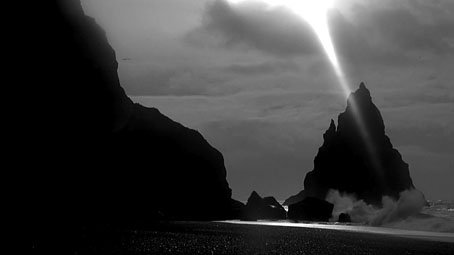
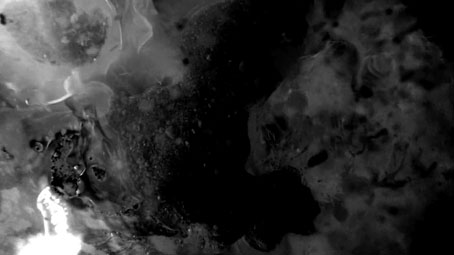
In which Norman McLaren once more brings film technology to the world of dance. McLaren’s earlier Pas de Deux (1968) used optical printing to multiply the movements of the dancers in a manner similar to Marey’s chronophotographs; in Ballet Adagio the entire dance is shown in slow motion, a common enough technique but one you seldom see applied to ballet. The music is Albinoni’s Adagio. The latter technique was employed again in the homoerotic Narcissus (1983) which can be seen in full at the NFB website.

Previously on { feuilleton }
Lodela, a film by Philippe Baylaucq
Pas de Deux by Norman McLaren
Norman McLaren

Weekend links 260

burgher.jpg

Bachelor with “demons” (Sleezy) [sic] (2015) by Elijah Burgher. One of a new series of artworks by Burgher showing at Zieher Smith & Horton, NYC.

• The week in HR Giger: Belinda Sallin on her documentary, Dark Star: HR Giger’s World; Ron Kretsch on the unseen cinema of HR Giger; Matthew Cheney thinks the Gigeresque has become too familiar. I can see his point but originality is always in short supply; asking for something new means setting yourself up for a long wait.

Pwdre ser, or Star jelly, is “a pale, foul-smelling jelly traditionally associated with meteorite falls”. The Rot of the Stars at the ICA, London, is an audio-visual art collaboration between Jo Fisher and Mark Pilkington dealing with the mysterious substance.

• Mixes of the week: A Tri Angle Records birthday DJ set by Björk; OreCast 196 mix by Ilius; Secret Thirteen Mix 153 by M!R!M.

To assume that a given group of people would be similar because of birthdate, Ryder thought, was to risk committing a fallacy. “The burden of proof is on those who insist that the cohort acquires the organised characteristics of some kind of temporal community,” he wrote. “This may be a fruitful hypothesis in the study of small groups of coevals in artistic or political movements but it scarcely applies to more than a small minority of the cohort in a mass society.”

Generational thinking is a bogus way to understand the world says Rebecca Onion

The plan for an airport above the streets of Manhattan. Related: Charles Glover‘s similar plan for London.

Errol Morris on how typography shapes our perception of truth.

Michael Moorcock enjoyed The Vorrh, a novel by Brian Catling.

Clive Barker on almost dying, hustling, and killing Pinhead.

• A new Penguin Books website for Angela Carter.

• Callum James on artist Philip Core.

A Beginner’s Guide to King Tubby

King Tubby Meets Rockers Uptown (1976) by Augustus Pablo | Star Cannibal (1982) by Hawkwind | Sleazy (1983) by Jah Wobble, The Edge, Holger Czukay

Eurydice…She, So Beloved, a film by the Brothers Quay

eurydice.jpg

Another recent short from the Quays that’s yet to be given a wider release, Eurydice…She, So Beloved (2007) is an opera/dance piece subtitled “Film ballet in homage to the 100th anniversary of Claudio Monteverdi’s Orfeo“. Orfeo (Simon Keenlyside) sings an aria while Hermes (Kenneth Tharp) rouses Eurydice (Zenaida Yanowsky) from her sleep in a suitably Stygian and rather industrial Underworld. Watch it here.

Elsewhere on { feuilleton }
The Quay Brothers archive

Inventorium of Traces, a film by the Brothers Quay

inventorium.jpg

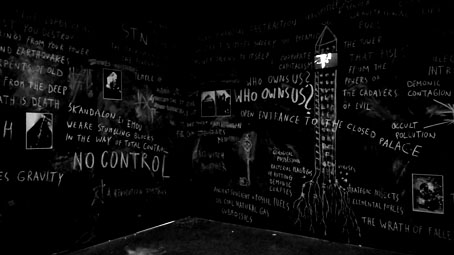
Inventorium of Traces was made in 2009 but it’s taken a while to make its way out of Poland in any complete form. In this 25-minute video piece the Quays turn their attention to Lancut Castle, a celebrated Polish stately home, and the former residence of the Potocki family. Of the latter, Jan Potocki would have an understandable attractions for the Quays being the author of The Saragossa Manuscript, a book that’s briefly alluded to when the Saragossa region is glimpsed on a map. The first half of the film shows visitors to the Castle being observed by statues and paintings, one of which is a portrait of Jan Potocki; in the second half, night falls, the building is locked, and some typical Quay business begins with flickering light and spectral animation. The music is by Krzysztof Penderecki, a composer the Quays used a year later for their superb animation, Maska, and also the composer of the soundtrack to the Wojciech Has adaptation of Potocki’s novel. The quality of the uploaded video could be better (the frame seems to be cropped) but it’s good enough for Quay obsessives. Watch it here.

Elsewhere on { feuilleton }
The Quay Brothers archive

Weekend links 259

bennett.jpg

The Endlessness (2012) by Emma Bennett.

• “Clearly if you’re familiar with The Arcades Project by Walter Benjamin you’ve got a leg up on what Rivette and company are up to. […] Like all Rivette works, it’s obsessed with the interrelationship between theater and life—reality and fantasy.” David Ehrenstein makes Jacques Rivette’s Out 1 sound even more intriguing. The 729-minute film is being reissued later this year.

• “It’s all your artistic friends. They frighten me…they seem evil, somehow—somehow unhealthy. And when you’re with them, dear, you change…” Steven Cordova reviews To the Dark Tower (1946), the debut novel by gay writer Francis King.

• “Sex isn’t a subtext in The Bloody Chamber, but the text itself. (Carter would explain that she was only making explicit a ‘latent content’ that is ‘violently sexual.’)” Laura Miller on Angela Carter’s re-told fairy tales.

Yet, as a citizen, and especially as an artist, [Chimamanda Ngozi] Adichie refuses to censor herself. “There is already enough silencing in public discourse,” says Adichie, and this is certainly true when the topic is race, and especially when the conversation is in America. It is our addiction to comfort that demands our silence regarding certain truths. Too often in America, Adichie claimed, “the goal of public discourse is comfort, not truth.” Comfort, Adichie said, also demands “international digestibility,” a reduction of complicated stories to a simple narrative. In the lecture, Adichie also warned of the silencing that is sometimes a product of social media outrage.

Kay Iguh on Chimamanda Ngozi Adichie’s Arthur Miller Freedom to Write Lecture at the PEN World Voices Festival

• New books: The Strangers and Other Writings by Robert Aickman, and Murderous Passions: The Delirious Cinema of Jesús Franco by Stephen Thrower & Julian Grainger.

• The world is rediscovering Mad Max and George Miller’s prowess for action cinema so Anne Billson posted a transcript of her 1985 interview with the director.

• Mixes of the week: Dmytro Fedorenko presents artists from Ukrainian record label Kvitnu, and The Ivy-Strangled Path Vol. VII by David Colohan.

Assault on Precinct 13 goes disco: The End (John Anthony’s New Scratch Mix) (1983) by “John Carpenter” (The Splash Band).

John Coltrane talked to Frank Kofsky for an hour in November 1966.

• Sleazy Cinema: A guide to Peter Christopherson‘s music videos.

Six hours of women in electronic music.

The weird world of Alfred Kubin.

Giallo Magic Orchestra

Blood (1972) by Annette Peacock | Blood On The Moon (1981) by Chrome | Blood From The Air (1986) by Coil