Weekend links 729

demorgan.jpg

Phosphorus and Hesperus (1881) by Evelyn De Morgan.

• Mix of the week, or possibly the entire year: The Deep Ark, 167 tracks (over 8 hours of music), most of which are from the electronic deluge of the early 1990s. The download link may not work for all browsers—it didn’t for one of mine—but it is active. Via Simon Reynolds who has more about the Deep Ark project.

• At Nautilus: Betsy Mason on the use of stage magic to investigate animal behaviour. “By performing tricks for birds, monkeys, and other creatures, researchers hope to learn how they perceive and think about their world.”

• At The Daily Heller: Mad and the Usual Gang of Idiots. Meanwhile, Mr Heller’s font of the month may prove useful for this election season, a Jonathan Barnbrook design named Moron.

Looking back, you can see a pattern in those eras in which interest in telepathy boomed. Coined by Myers and his fellow psychical researchers in the 1880s, telepathy gained traction because it was formulated inside a moment of scientific and technological revolution, where uncanny transmissions proliferated across the visible and invisible spectrum, seeming to collapse the natural and the supernatural together. In the 1970s, telepathy returned, if under different names, as part of another moment of crisis. The Cold War arms race was an essential part of this, feeding a strange supplemental world of fantasy technologies, from mind control to brainwashing, and playing on an all-too-widespread psychological paranoia around being seen, infiltrated and manipulated by invisible agents.

Roger Luckhurst looks back at a century of psychic research

• New music: Portable Reality Generator by Field Lines Cartographer, and Sublime Eternal Love by Chrystabell and David Lynch.

• Coffee and Chocolates for Two Guitars: Robert Fripp interviewing John McLaughlin in July, 1982.

• Paintings by Ithell Colquhoun currently showing at the Ben Hunter gallery, London.

• At Public Domain Review: Eye Miniatures (ca. 1790–1810).

ESP (1965) by Miles Davis | ESP (1990) by Deee-lite | ESP (2002) by Comets On Fire

The art of Vojtech Preissig, 1873–1944

preissig19.jpg

Self-portrait.

There are times when one of my searches for work by an unfamiliar artist turns up results that are much more varied than I anticipated. Vojtech Preissig is one such artist, a Czech graphic designer, printmaker and typographer whose name I’d only registered in the past via digital revivals of his type designs. Preissig’s career follows a similar trajectory to that of his contemporary František Kupka: both artists started out working their own variations on fin-de-siècle art—Symbolism in Kupka’s case, Art Nouveau design in Preissig’s—before finding their way to abstraction in the 1930s. Both artists also worked for a time with Alphonse Mucha in Paris, until Preissig moved to the USA where he spent a number of years teaching.

preissig03.jpg

When reading about European artists of this generation there’s always the question of how they fared during the Second World War. Preissig was among the less fortunate. After his return to Prague he spent his last few years putting his print skills to the service of the Czech Resistance. He ended his days in the concentration camp at Dachau.

A monograph, Vojtech Preissig by Lucie Vlckova, was published in 2012.

preissig05.jpg

Day (1899).

preissig04.jpg

Night (1899).

preissig01.jpg

Dreaming (1899).

Continue reading “The art of Vojtech Preissig, 1873–1944”

Weekend links 728

wadsworth.jpg

Composition: Cones and Spirals (1929) by Edward Alexander Wadsworth.

• “Repeating items over and over, called maintenance rehearsal, is not the most effective strategy for remembering. Instead, actors engage in elaborative rehearsal, focusing their attention on the meaning of the material and associating it with information they already know.” John Seamon on the vicissitudes of memory, and how actors remember their lines.

• “Mary McCarthy described it as ‘Fabergé gem, a clockwork toy, a chess problem, an infernal machine, a trap to catch reviewers, a cat-and-mouse game, and do-it-yourself novel’, among other things.” Mary Gaitskill on the pleasures and difficulties of Nabokov’s greatest novel, Pale Fire. Also a reminder that I ought to read it again.

• New music: Movement, Before All Flowers by Max Richter; A Thread, Silvered And Trembling by Drew McDowall; Unspeakable Visions by Michel Banabila.

• Among the new titles at Standard Ebooks, the home of free, high-quality, public-domain texts: Ulysses by James Joyce.

• The latest cartographical design from Herb Lester Associates is Facts Concerning HP Lovecraft and His Environs.

• At the Daily Heller: A look back at the craze for poster stamps.

• Mix of the week: A tuning mix for The Wire by Tashi Wada.

• At Dennis Cooper’s: Michael Lonsdale Day.

Annie Hogan’s favourite music.

Clockworks (1975) by Laurie Spiegel | Tin Toy Clockwork Train (1985) by The Dukes Of Stratosphear | Clockwork Horoscope (2008) by Belbury Poly

Weekend links 725

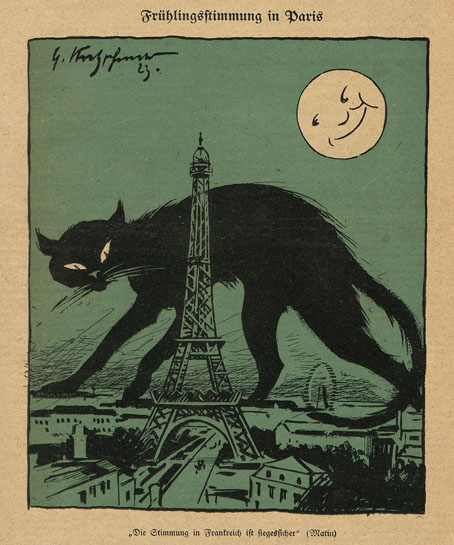
Springtime in Paris (1923) by Georg Kretzschmar.

• I’ve been asked to mention that the tribute book put together for Alan Moore’s 70th birthday, Alan Moore: Portraits of an Extraordinary Gentleman, is still available. As before, the book features contributions from many well-known comic artists, a foreword by Iain Sinclair, and this piece of my own.

• “I never posted any lecture of mine on Tumblr, even though Tumblr would seem to have plenty of elbow-room for hour-long, learned, European public lectures (with many lecture slides).” Utopian Realism, a speech by Bruce Sterling.

• Reading the Signs: John Kenny in conversation with Mark Valentine about Mark’s new collection Lost Estates.

There remains something suspect about blotter, a stain that is both a blessing and a curse. As the blotter producer Matthew Rick, who started selling sheets as non-dipped ‘art’ collectables at festivals in 1998, puts it: ‘[B]lotter is the last underground art form that’s going to stay underground, simply because you’re creating something that looks like and functions like a felony.’ In other words, blotter is ontologically illicit; it is, as Rick says, ‘drug paraphernalia by its very existence’.

Erik Davis (again) on LSD and the cultural history of the printed blotter

• At Colossal: Uncanny phenomena derail domestic bliss in Marisa Adesman’s luminous paintings.

• Standing stones, urban hellscapes and male nudes: Andrew Pulver on Derek Jarman’s Super-8 films.

• “ [breaking news] An anomaly on earth has brought the cats to over 150 meters. Please be patient.”

• At We Are The Mutants: Alien Renaissance: An interview with illustrator Bob Fowke.

• At Dennis Cooper’s: Spotlight on…René Crevel My Body and I (1926).

• At Public Domain Review: The Little Journal of Rejects (1896).

• Steven Heller’s font of the month is Sandhouse.

• RIP Steve Albini.

Sandoz In The Rain (1970) by Amon Düül II | Bon Voyage Au LSD (2001) by Acid Mothers Temple & The Melting Paraiso U.F.O. | Careful With That Sheet Of Acid, Eugene (2019) by Jenzeits

Weekend links 724

ravilious.jpg

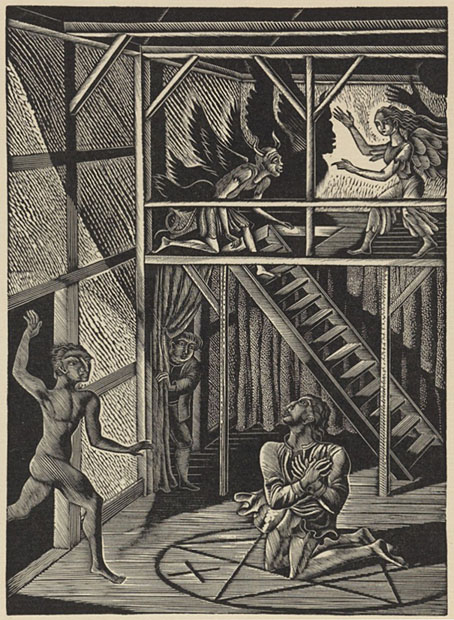
Dr Faustus Conjuring Mephistopheles (1928) by Eric Ravilious.

• Materialising in July from a cloud of sulphurous smoke: The Devil Rides In – Spellbinding Satanic Magick & The Rockult 1967–1974. Cherry Red Records, home of the well-sourced, well-researched multi-disc compilation, might have been channelling my inner desires with this one, a Sabbath-esque soundtrack to the Occult Revival. I ordered it faster than you can say “Hail Satan!”

A Series of Headaches: Shakespeare’s First Folio meets the London Review of Books. “In this film, letterpress printer Nick Hand pulls apart the whole process, from making ink from crushed oak galls to heaving the levers of a replica Jacobean press, and shows how we produced our own (almost) authentic version of the LRB circa 1623.”

• Alan Moore will be subject to greater attention than usual in October. In addition to the forthcoming Moon and Serpent Bumper Book of Magic, the month will also see the publication of The Great When, the first novel in his Long London series. Bloomsbury now has cover art to go with their description of the novel.

Mad Dogs & Englishmen: Faust On Virgin Records: An extract from Neu Klang: The Definitive Story of Krautrock by Cristoph Dallach, “the first comprehensive oral history of the diverse and radical movement in German music during the late 60s and 1970s.”

• Alien life is no joke: Adam Frank on combating “the giggle factor” in the search for extraterrestrial life.

• At Colossal: Lauren Fensterstock’s Cosmic Mosaics Map Out the Unknown in Crystal and Gems.

• New music: Ritual (evocation) by Jon Hopkins; Time Is Glass by Six Organs Of Admittance.

• At Unquiet Things: The Gentle, Jubilant Visual Poetry of Tino Rodriguez.

• At Retro-Forteana: Colin Wilson, Philosopher of the Paranormal.

• DJ Food on Jeff Keen’s Amazing Rayday Comic collages.

At Dennis Cooper’s: Alan Clarke Day.

Krautrock (1973) by Faust | Krautrock (1973) by Conrad Schnitzler | The Kraut (2007) by Stars Of The Lid