The art of Carel Willink, 1900–1983

willink1.jpg

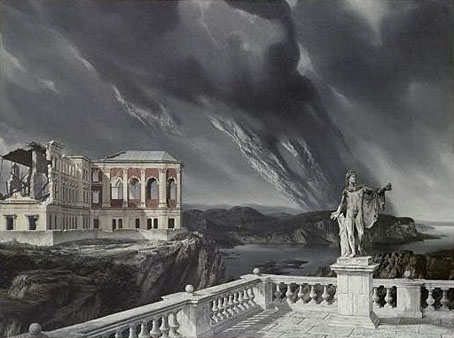
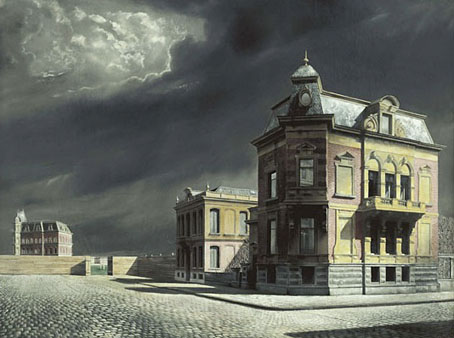
Townscape (1934).

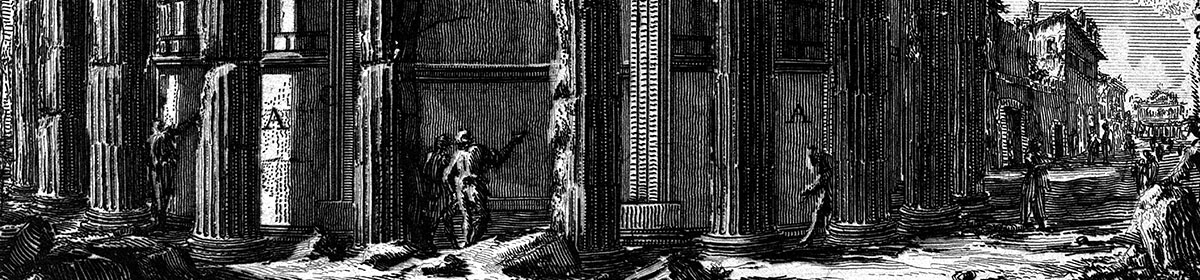
Carel Willink was a Dutch painter whose self-described brand of “imaginary realism” conjured in its early years a collection of views of desolate plazas, empty lanes and abandoned ruins over which smoke or cloud hangs like an ominous portent. The works of Giorgio de Chirico and Paul Delvaux come to mind when looking at these pictures although Willink’s work has enough unique qualities to stand apart from his more famous contemporaries. I’m also reminded a little of Spanish artist Arnau Alemany who has a similar predilection for isolated architecture.

willink2.jpg

Chateau in Spain (1939).

There’s an official Willink website here, while further paintings can be seen at this Flickr set and also at Ten Dreams.

Elsewhere on { feuilleton }
The fantastic art archive

Previously on { feuilleton }
Bruges-la-Morte
Taxandria, or Raoul Servais meets Paul Delvaux
The art of Arnau Alemany

Weekend links 42

martin.jpg

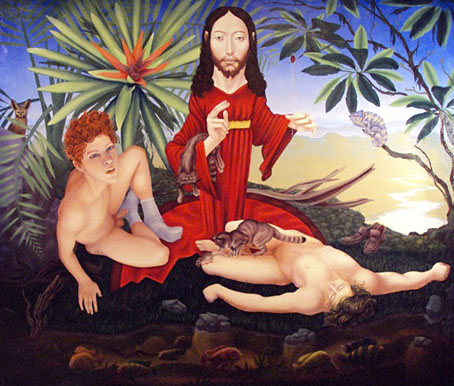
Blasphemous Rumours (2009/2010) by Ryan Martin. The artist now has a dedicated site for his paintings.

The Museum of Censored Art, a mobile gallery, will be showing the withdrawn David Wojnarowicz film outside the National Portrait Gallery, Washington DC, until their contentious gay art exhibition closes next month. Related: Bishop of Mallorca criticises calendar—which shows Catholic youths posing naked—for ‘not respecting Christian symbols’.

• Didier Lestrade published French gay zine Magazine in the 1980s, and later co-founded Têtu. He’s interviewed at BUTT and has started uploading the entire run of Magazine about which he says: “I don’t want to stamp some kind of logo on this material. It’s gay. It’s gay history. It belongs to everybody. If you want to take a piece of it, please try to mention the origins of it, a simple code word “Magazine” will be enough. If you wanna be more specific, be my guest.”

HMV, Britain’s last big music chain, is closing 60 branches. Yet a new wave of CD stores is thriving. Oh, HMV, how I’ll miss your £17 CDs (and double-CDs at £34)… On second thoughts, no I won’t, your wretched retail barns always exemplified the greed endemic in the music business.
kasner.jpg

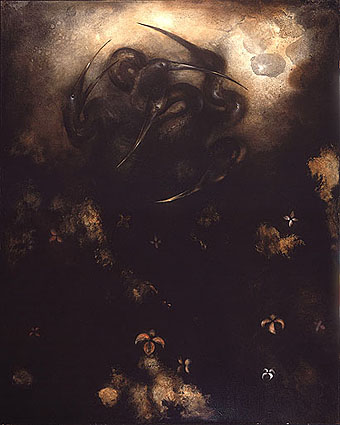
Love Comes/Destroyer by Stephen Kasner.

• Artist Stephen Kasner‘s work has adorned music releases by Sunn O))), Isis and others. He’s currently another American creator in need of assistance with medical expenses. Details here.

The Ghosts of Old London: the gloomy Victorian metropolis in all its deteriorated splendour. See also: In Search of Relics of Old London.

• “It’s time to recognise [Sandy] Denny as not simply a folksinger but one of Britain’s great poets of song,” says Rob Young.

Louis Pattison talks to Locrian about JG Ballard, old VHS tapes and their new album The Crystal World.

The Dreams That Stuff Is Made Of: Lebbeus Woods’ big drawings.

Hannes Bok portfolios at Golden Age Comic Book Stories.

An Iranian rapper named Salome. Also here and here.

A Moment of (Alan) Moore.

RIP Mick Karn.

Book Worship.

Sons of Pioneers (1981) by Japan; Tao-Tao (1982) by Masami Tsuchiya; Glow World (1983) by Bill Nelson.
Gervase and Patrick

gervaise-patrick.jpg

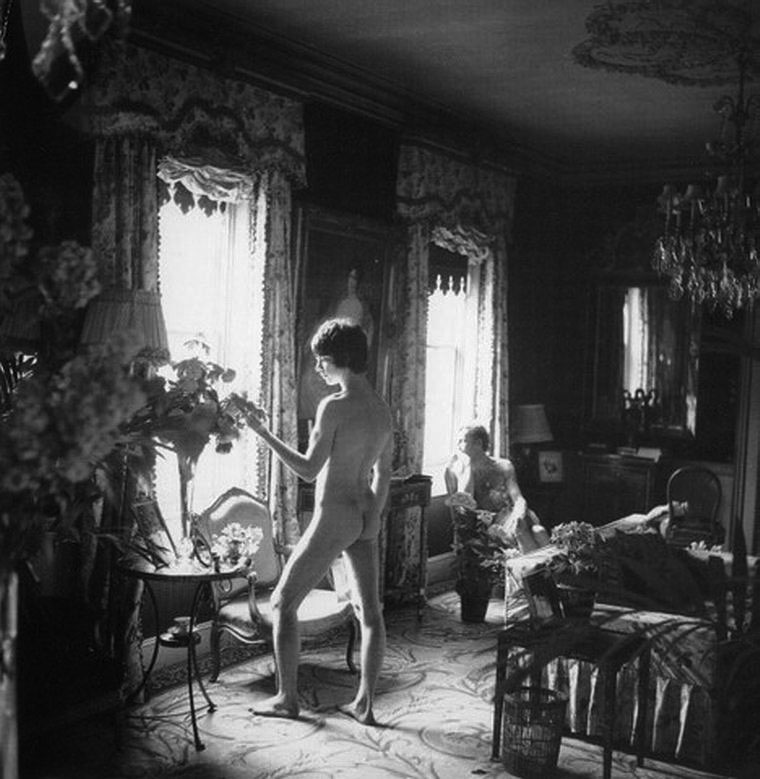
Gervase (left) & Patrick Procktor (right).

Once upon a time in the 1960s: painter Patrick Procktor and friend photographed by Cecil Beaton at Beaton’s home; no wonder David Hockney used to come and visit. Procktor made Gervase Griffiths the subject of his work on more than one occasion, see here and here. Thanks to Little Augury for the picture details.

Update: For more about Procktor, see Patrick Procktor: Art and Life (2010) by Ian Massey.

Previously on { feuilleton }
Further back and faster

Deutsche Kunst und Dekoration #1

dkd01-01.jpg

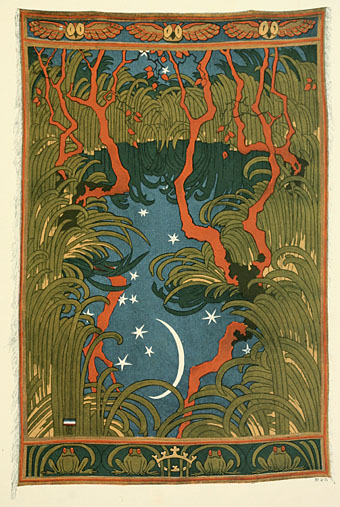
Last year saw an exploration here of the fecund pages of Jugend magazine so in the same spirit I’m embarking on a serial delve into Jugend‘s more serious contemporary Deutsche Kunst und Dekoration. I’ve made a couple of posts in this direction already but these were done before I’d had a chance to look properly through the editions at the Internet Archive, the first thirty of which form a collection which comprises some 7500 pages. Since few people would want to download and sort through that mountain these posts can serve as a select guide to the contents.

dkd01-02.jpg

Deutsche Kunst und Dekoration was published by Alexander Koch in Darmstadt and the first volume is dated October 1897–March 1898. Jugend was a humour magazine so the contents tend to be frivolous and lighthearted, Koch’s title by contrast was a guide to the best of German contemporary art and design and has the advantage of featuring furniture and architectural designs as well as graphic material. The content of this first edition is relatively sedate compared to some of the later numbers when the Art Nouveau style builds up a head of steam. There’s some astonishing design work in subsequent issues, as well as further illustration discoveries like Marcus Behmer. Watch this space.

Continue reading “Deutsche Kunst und Dekoration #1”

Le Baiser de Narcisse

brisset1.jpg

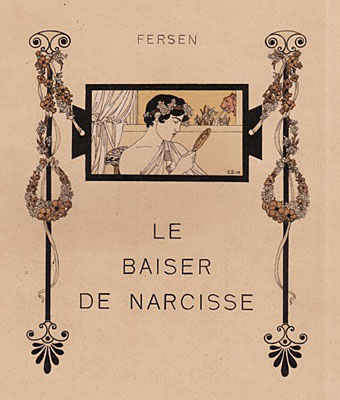
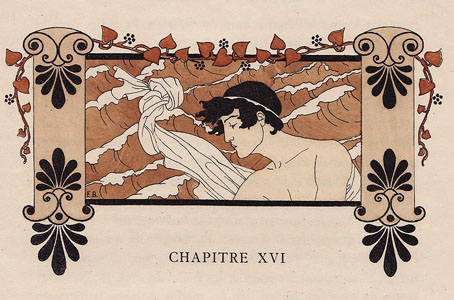
We have the French gay culture site Bibliothèque Gay to thank for posting illustrations by Ernest Brisset from Jacques d’Adelswärd-Fersen’s rare volume of homoerotic fiction, Le baiser de Narcisse (The Kiss of Narcissus). The book was originally published in 1907 but it was a new edition in 1912 which came embellished with Brisset’s Classical drawings and decorations. If these lack a degree of eros it should be noted that the text would have been condemned as outright pornography in the Britain of 1912, a paean to youthful male beauty which lingers over details of a boy’s “polished hips” and his “round and firm sex like a fruit”. As is usual with homoerotics of this period, the Classical setting and allusion to Greek myth provides the vaguest excuse for the subtext even though prudes of the time weren’t remotely fooled by this, as Oscar Wilde discovered.

brisset2.jpg

Among other works by Fersen there’s a decadent roman à clef, Lord Lyllian: Black Masses (1905), which I’ve been intent on reading since it was translated into English a couple of years ago. Here Fersen provides us with yet another fictional extrapolation of Oscar Wilde who the author gifts with some of his own scandalous history. Fersen had been driven from France following a public outrage involving the “Black Masses” of the novel’s title, and the alleged debauching of Parisian schoolboys.

hocker.jpg

Nino Cesarini by Paul Höcker (1904).

Fersen settled in Capri with his partner Nino Cesarini where they spent some years reinforcing the reputation of that island (not for nothing is Noël Coward’s camp and catty character in Boom! named “the Witch of Capri”), and proselytising for the Uranian cause with a literary journal, Akademos, modelled on Adolf Brand’s Der Eigene. Fersen’s later life is reminiscent of that of Elisar von Kupffer, a wealthy contemporary who created a secluded homoerotic paradise of his own, the Sanctuarium Artis Elisarion. Unlike Kupffer, however, Fersen ended his days prematurely in a haze of opium and cocaine. As for Ernest Brisset, if anyone finds other work of his online, please leave a comment.

Elsewhere on { feuilleton }
The gay artists archive

Previously on { feuilleton }
Reflections of Narcissus
Narcissus