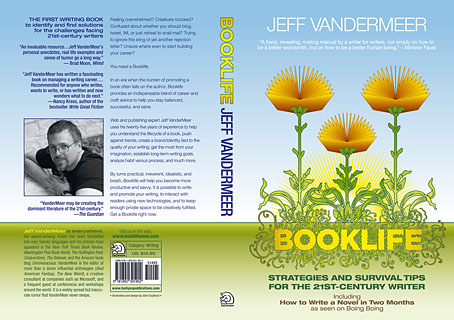
Booklife by Jeff VanderMeer

booklife.jpg

Yet another of the titles I’ve been working on this year—yes, it’s been a very busy time—Booklife took several months of back and forth on the part of author, editor and designer before we had something that everyone was happy with.

Offering timely advice in an era when the burden of production and publicity frequently falls on authors, this essential reference reflects on methods for being focused, productive, and savvy in the craft of writing. Discussing a wide range of essential topics for self-promoting authors, this important guide explores questions such as How can authors use social media and the internet? How does the new online paradigm affect authors, readers, and the book industry? How can authors find the time to both create and promote their work? and What should never be done? Through good-humored encouragement, practical tips of the trade culled from 25 years of experience as a writer, reviewer, editor, publisher, agent, and blogger are shared. Including topics such as personal space versus public space, deadlines, and networking, the benefits of interacting with readers through new technologies is revealed.

After all the work it’s been good to see the book receiving such a positive reception this week, with a feature spot on Boing Boing and a high placing in Amazon’s book listing. Back in February I wrote a lengthy post about the evolution of the cover design, and that post has been reproduced at the Booklifenow site which serves as an online extension of the book itself. Web designer Luís Rodrigues did a great job of matching the site design to the cover.

Update: The cover at unaccountably large size on Wired.com

Previously on { feuilleton }
Designing Booklife

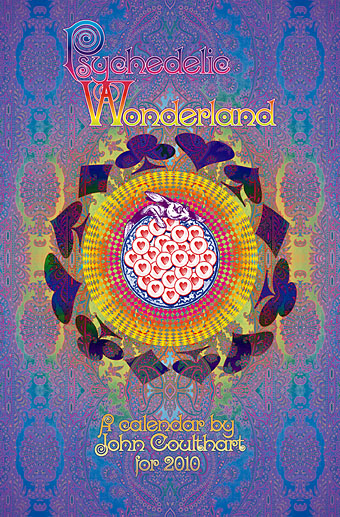
Psychedelic Wonderland: the 2010 calendar

pw00.jpg

So I had a bright idea at the end of September… Instead of rehashing old work for a CafePress calendar design, I thought I’d try something new. I hadn’t done any artwork for myself all year, everything I’d been working on was a commission of some sort. In addition to that, I’d spent a large portion of the year delving deeper into the psychedelic music of the late Sixties, especially the wealth of obscure British bands to be found on the seemingly endless series of compilations which have trickled out over the past two decades. Everyone is familiar with Jefferson Airplane’s White Rabbit but, as I’ve noted before, themes from, and allusions to, the Alice books run through British psychedelia to an even greater degree. The Beatles put Lewis Carroll in their pantheon of influences on the cover of Sgt. Pepper, and Wonderland’s atmosphere of Victorian surrealism chimed perfectly with a resurgence of interest in Victorian art and design.

So at the end of September, mulling over ideas, I picked up one of my Lewis Carroll volumes and looked at the chapter list: 12 chapters…12 months…I could do a psychedelic Alice in Wonderland! The only drawback was being weighed down by ongoing work which meant that anything I did would have to be created quickly and easily. I reckoned it was manageable if I put a few rules in place first: try and rough out a chapter a day; make copious use of clip art decoration and scanned engravings; keep things bold and florid without worrying too much about fidelity to minor story points. In theory I could do the whole thing in about two weeks if I kept on schedule. As it turns out the whole thing took me three weeks as I got increasingly involved with illustrating the story. You can see the results below and larger copies of the pictures here. Two years ago I was saying I probably wouldn’t ever illustrate Lewis Carroll. That was true at the time since I couldn’t find an approach to the stories that would sustain my interest and (possibly) bring something new to the books. Seeing Alice’s adventures through the psychotropic prism of the late Sixties showed me the way into Wonderland. What’s needed now is to do the same next year for Looking-Glass Land. Watch this space.

Some notes on the pictures follow below.

Update: By popular demand, this calendar is now available again.

Continue reading “Psychedelic Wonderland: the 2010 calendar”

Coming Out Day

gay1.jpg

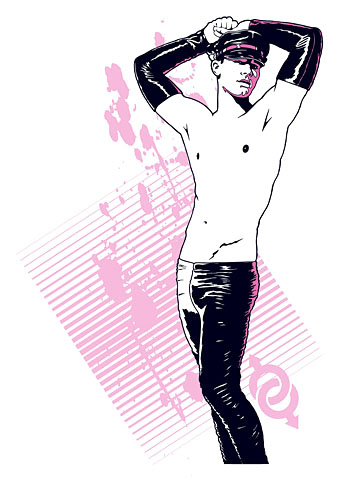
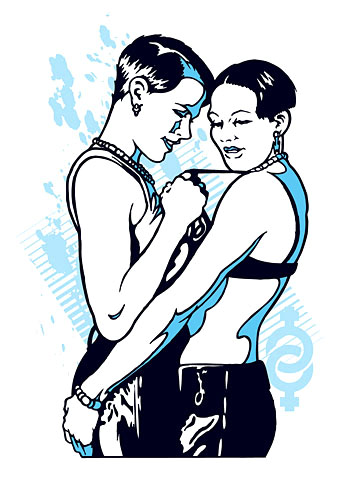
National Coming Out Day is a gay awareness day which has been observed in America since 1988, and is now something of an international event if “the world” can mean the USA and a handful of European countries. With typical contrariness, the UK’s Coming Out Day is a day later on October 12th. The Outer Alliance suggested its members make a post for today so here’s a couple of art pieces I’ve been working on for some poster and flyer designs. Regular readers may notice that the sexy creature above is swiped from this photo. In mitigation, I did actually spend some time drawing the figure; my laziness has a limit. I’ll post these on my artwork pages when the layouts are finished.

gay2.jpg

Previously on { feuilleton }
Outer Alliance Pride Day

Humpty Dumpty variations

thurstan.jpg

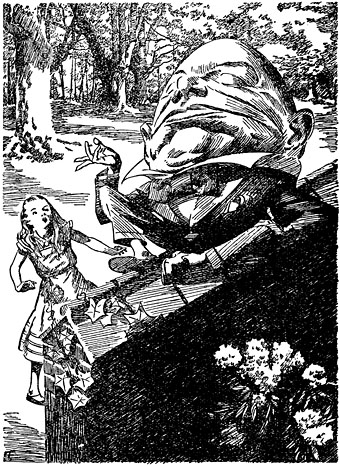
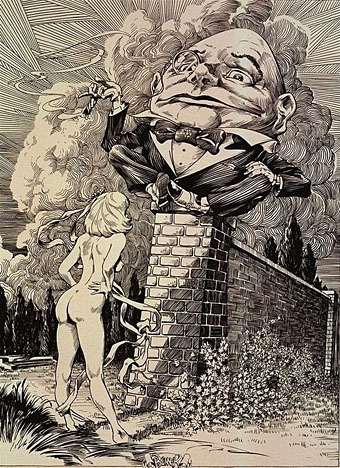
Humpty Dumpty by EB Thurstan (1930).

A preoccupation of the past couple of weeks has been Lewis Carroll’s Alice books as I’ve been working on an Alice in Wonderland project which I’ll unveil shortly. Looking around at some of the numerous visual interpretations of the stories I came across two portfolios I hadn’t seen before by comic artist Frank Brunner. These are from the late Seventies, and typically for that decade they work an erotic twist on the books by adding ten years to Alice’s age whilst depriving her of clothes. Nudity aside, Brunner’s drawings don’t depart from tradition very much—or add much, for that matter—but I did notice that he’d based his Humpty Dumpty figure on an earlier version by illustrator EB Thurstan.

brunner.jpg

Humpty Dumpty by Frank Brunner (1978?).

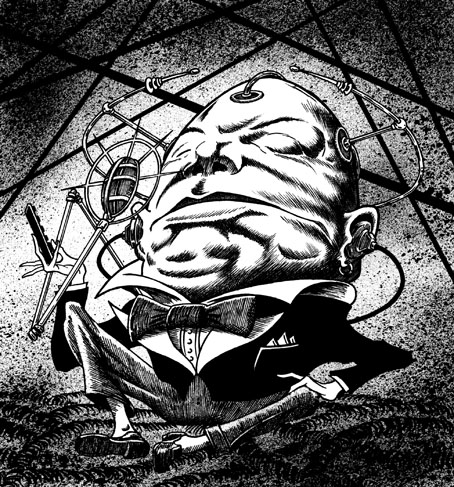
The reason Thurstan’s Humpty is so familiar is that I’d borrowed it myself for one of the many appearances by the character in the Lord Horror comic series, Reverbstorm. Humpty’s presence there would involve too much explanation so you’ll have to be satisfied with the character who explains Jabberwocky remaining inexplicable. As for Brunner’s drawings, you can see coloured versions on his website.

reverbstorm.jpg

Humpty Dumpty from Reverbstorm #3 (1994).

Previously on { feuilleton }
Alice in Wonderland by Jonathan Miller
The Illustrators of Alice

Design as virus 11: Burne Hogarth

mighty_baby.jpg

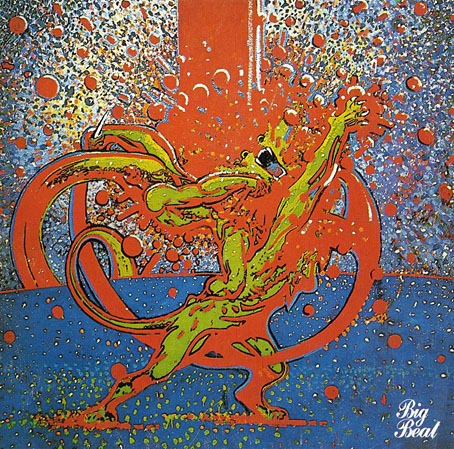
Mighty Baby (1969). Illustration by Martin Sharp.

Yet another album cover prompts this post, part of an occasional series. Mighty Baby were a British rock band who formed out of psychedelic group The Action in the late Sixties, and their music is fairly typical of the period, being “heavy” without any of the psych trappings which—for me—often make everything from that time a lot more interesting. This was a journey undertaken by many groups at the end of that lurid decade, a junking of the playful and evocative side of what was now called rock music in favour of a denim-clad earnestness. This album isn’t one I like very much—I’d rather listen to their earlier incarnation—but the cover painting by psych artist Martin Sharp is certainly a startling piece, being a violent mutation of one of the most famous Tarzan drawings by comic artist Burne Hogarth.

hogarth.jpg

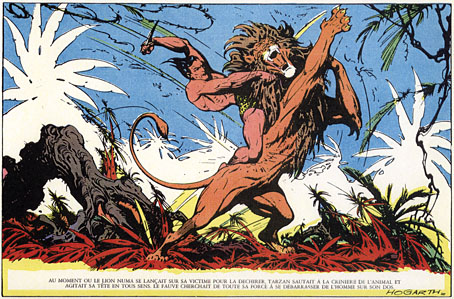
Tarzan by Burne Hogarth (194?).

Hogarth was drawing Tarzan for much of the 1940s and this particular panel showing the Ape-Man attacking Numa the lion dates from the latter part of his run on the series. I wish I could pin this to an actual year but I don’t have a complete set of the comics and that detail eluded me. If anyone knows the date, please leave a comment.

Continue reading “Design as virus 11: Burne Hogarth”