Weekend links 539

earle.jpg

Fire, Red and Gold (1990) by Eyvind Earle.

Roger Penrose won a Nobel Prize recently for his work in physics. I read one of his books a few years ago, and was intimidated by the “simple” equations, but I always like to hear his ideas. This 2017 article by Philip Ball is an illuminating overview of Penrose’s life and work.

• At Dangerous Minds: Joe Banks on the incidents that led to Lemmy’s dismissal from Hawkwind in 1975, an extract from Hawkwind: Days of the Underground. The book is available from Strange Attractor in Europe and via MIT Press in the USA.

• “Not married but willing to be!”: men in love (with each other) from the 1850s on. It’s always advisable to take photos like these with a pinch of salt but several of the examples are unavoidably what they appear to be.

Most of all, this resolutely collaborative production stood against the vanity and careerism of individual authorship; Breton called it the first attempt to “adapt a moral attitude, and the only one possible, to a writing process.” The text itself is peppered with readymade phrases, advertising slogans, twisted proverbs, and pastiches of such admired predecessors as Rimbaud, Apollinaire, and Lautréamont, whose pluralistic credo, “Poetry must be made by all. Not by one,” anticipates the sampling aesthetic by a century. But the intensity was draining, and as the book moves toward its final pages and the writing becomes increasingly frenetic, you can almost feel the burnout taking hold. After eight days, fearing for his and Soupault’s sanity, Breton terminated the experiment.

Mark Polizzotti reviews a new translation by Charlotte Mandell of The Magnetic Fields by André Breton and Philippe Soupault

• The hide that binds: Mike Jay reviews Dark Archives: A Librarian’s Investigation into the Science and History of Books Bound in Human Skin by Megan Rosenbloom.

• “A photographer ventures deeper into Chernobyl than any before him.” Pictures from Chernobyl: A Stalker’s Guide by Darmon Richter.

John Van Stan’s reading of Frankenstein by Mary Shelley uses my illustrations (with my permission) for each of its chapters.

Susan Jamison, one of the artists in The Art of the Occult by S. Elizabeth, talks to the latter about her work.

William Hope Hodgson: The Secret Index. A collection of Hodgson-related posts at Greydogtales.

Gee Vaucher talks to Savage Pencil about her cover art for anarchist punk band, Crass.

Weird, wacky and utterly wonderful: the world’s greatest unsung museums.

Tom Cardamone chooses the best books about Oscar Wilde.

• At Dennis Cooper’s: Jean-Pierre Melville Day.

You by The Bug ft. Dis Fig.

Magnetic Dwarf Reptile (1978) by Chrome | Magnetic Fields, Part 1 (1981) by Jean-Michel Jarre | Magnetic North (1998) by Skyray

Posterized

cramps.jpg

Band portraits by Kris Guidio from his original fanzine illustrations. Cramps DVD shown for scale.

I was asked recently if it was possible to have a poster made of one of the insert pages from the Cramps DVD I designed for Savoy a few years ago. This is the result, a 50.8 cm x 76.2 cm (20 x 30 inches) C-type Fuji print on heavy paper with a gloss finish. I’ve done this in part as a tentative move towards making signed prints available of my other artwork, something I mentioned when writing earlier about the website redesign. I’ve found print-on-demand services like CafePress to be increasingly unsatisfactory, and they were never very useful for poster art since their sizes are limited and they lack the options that a dedicated printer can offer.

This poster is exactly the kind of quality I was hoping for, so the next step will be to add a page to my site so that prints may be ordered via the site itself rather than emailing me with a query. In the meantime, if anyone does want a quality print made from one of my pictures or designs, get in touch.

Previously on { feuilleton }
The Cramps at the Haçienda

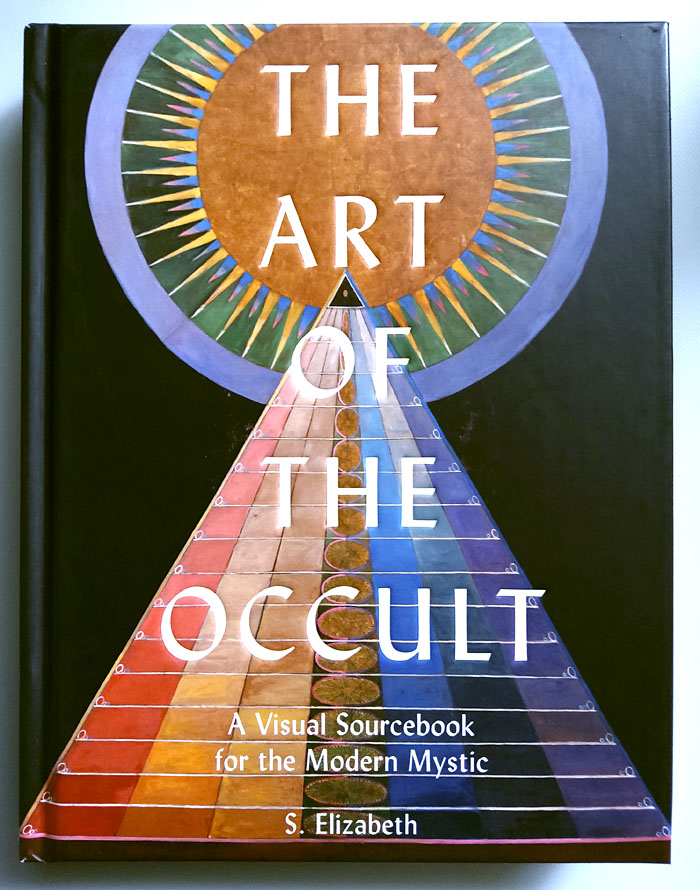
The Art of the Occult

occult1.jpg

Cover art: Group X, No. 1, Altarpiece (1915) by Hilma af Klint. Design by Paileen Currie.

A surprise arrival in today’s post, the occult art compendium by S. Elizabeth which I would have wanted to read even if it didn’t contain one of my pictures:

From theosophy and kabbalah, to the zodiac and alchemy; spiritualism and ceremonial magic, to the elements and sacred geometry – The Art of the Occult introduces major occult themes and showcases the artists who have been influenced and led by them. Discover the symbolic and mythical images of the Pre-Raphaelites; the automatic drawing of Hilma af Klint and Madge Gill; Leonora Carrington’s surrealist interpretation of myth, alchemy and kabbalah; and much more.

Most of the books I’ve seen on this subject have either been very general and in need of an update (Thames and Hudson’s venerable Magic: The Western Tradition) or exhibition catalogues which are never comprehensive and become increasingly hard to find since they don’t get reprinted. The Art of the Occult is an ideal introduction to the subject for the curious reader, as well as being a useful overview for the aficionado (or initiate) which spans several hundred years of art and illustration, from the earliest occult manuscripts to contemporary works. Occult art is a house with many mansions, a form which can encompass photo-realism, Symbolism, Surrealism or total abstraction without the definition breaking down. The Art of the Occult contains a satisfyingly wide range of examples, 200 in all, and includes many artists whose work I hadn’t seen before. It also reinforces the origin of abstract art in occult concerns, a lineage that went unmentioned for many years by critics who couldn’t accept that their beloved “pure” idiom was tainted by mysticism.

occult2.jpg

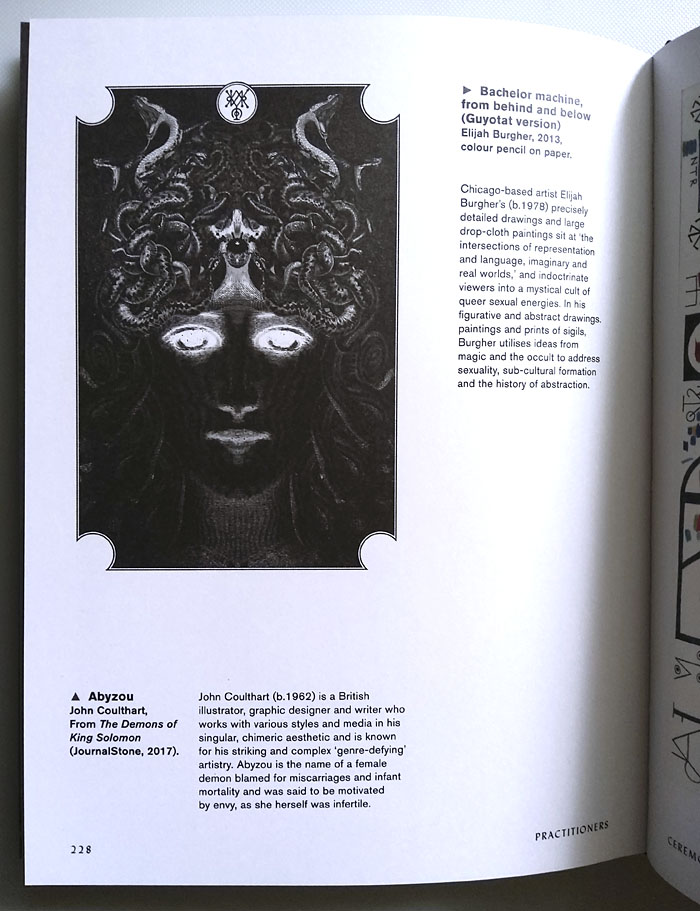
My piece is a portrait of the serpent-haired Abyzou, one of the Solomonic demons I depicted for The Demons of King Solomon in 2017. The picture was one of the better representations in a series I would have preferred to have more time to work on. I was pleased to see my contribution facing one of Elijah Burgher’s sigil drawings; I like Burgher’s art so he makes a good companion. This is the first and maybe the only book where my name is listed in an index between Pamela Colman Smith and Aleister Crowley.

The Art of the Occult will be published by White Lion Publishing on 13th of October, just in time for the annual spook-fest.

Update: Haute Macabre has a new post by S. Elizabeth showing more pages from the book’s interior plus the opportunity to win a copy.

Previously on { feuilleton }
Calendrier Magique
The Demons of King Solomon
Typefaces of the occult revival
The art of Frieda Harris, 1877–1962
The art of Fay Pomerance, 1912–2001
Songs for the Witch Woman
Wilfried Sätty: Artist of the occult
The art of Scott Treleaven

Litany of Dreams

litany.jpg

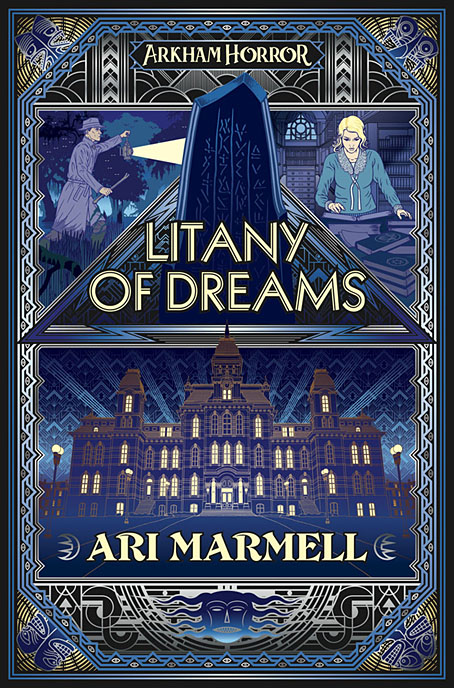
One of the covers I was working on during the summer months was revealed this week so here it is. Litany of Dreams by Ari Marmell is another title from games-related imprint Aconyte, and a further addition to their Lovecraft-related Arkham Horror series of games and novels:

The mysterious disappearance of a gifted student at Miskatonic University spurs his troubled roommate, Elliott Raslo, into an investigation of his own. But Elliott already struggles against the maddening allure of a ceaseless chant that only he can hear… When Elliott’s search converges with that of a Greenland Inuk’s hunt for a stolen relic, they are left with yet more questions. Could there be a connection between Elliott’s litany and the broken stone stele covered in antediluvian writings that had obsessed his friend? Learning the answers will draw them into the heart of a devilish plot to rebirth an ancient horror.

The new cover follows the form of The Last Ritual with an Art Deco style and a similar arrangement of triangular panels with an architectural focus. The building is Lovecraft’s Miskatonic University, and this is the first time I’ve attempted a proper depiction of the place. A couple of the panels in my unfinished adaptation of The Dunwich Horror showed Wilbur Whateley entering the university but the buildings there owed more to Manchester University’s Gothic facades with a pair of gateposts borrowed from Brown University in Providence. The building here is a better match, a typical Ivy League structure with added spikes. The latter are an unusual feature given the generally conservative appearance of these places but still a long way from the eccentricities of Gavin Stamp’s depictions in the George Hay Necronomicon. The faces in the corners of the cover design are based on tupilak figures carved from antlers or whale teeth by the Inuit of Greenland, figures which feature in the story.

Litany of Dreams will be published on April 6, 2021.

Elsewhere on { feuilleton }
The Lovecraft archive

Previously on { feuilleton }
The Last Ritual

The hundred-year Voyage

arcturus1.jpg

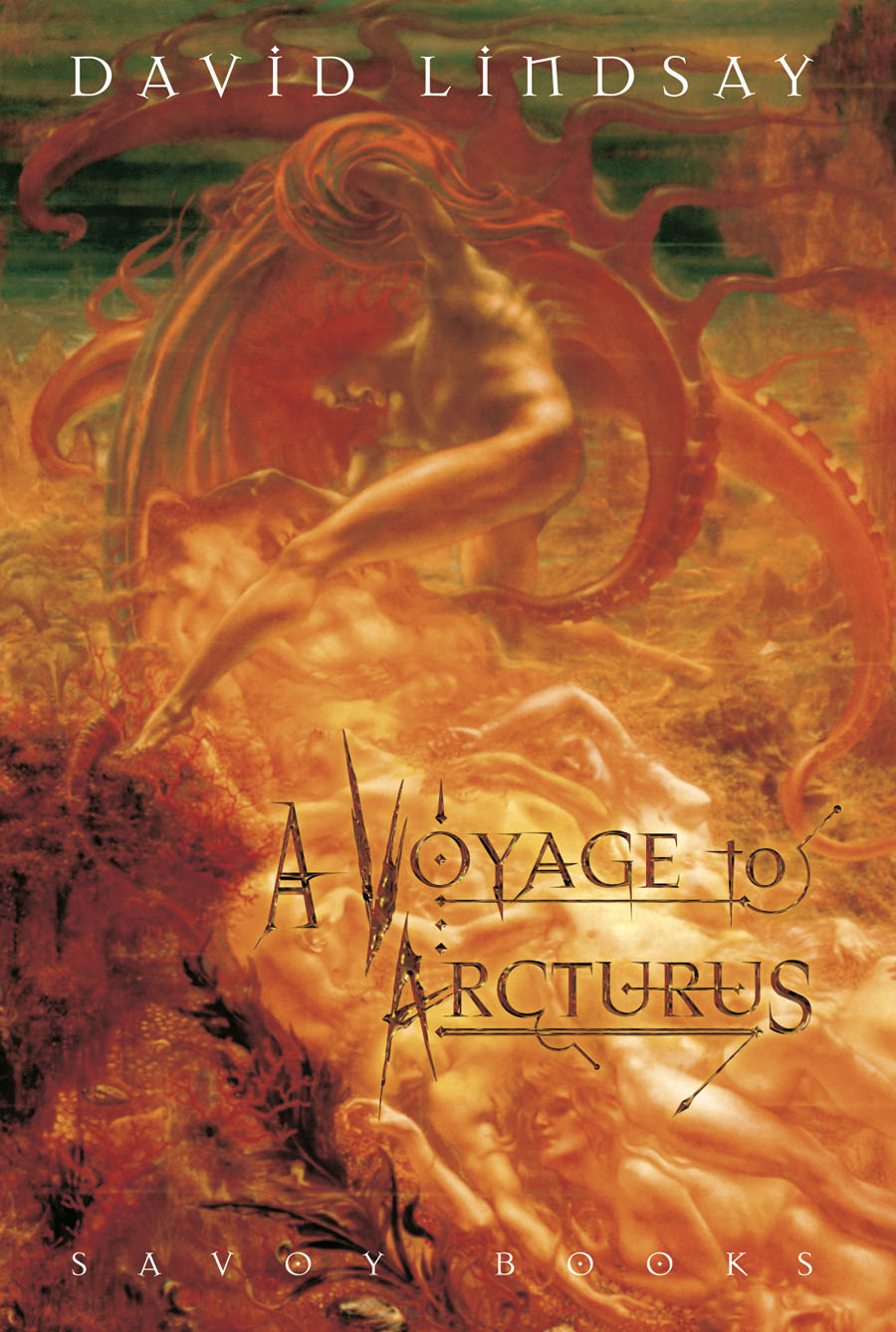
Today’s post at Wormwoodiana reminds me that David Lindsay’s unique novel of philosophical fantasy, A Voyage to Arcturus, was published a hundred years ago today. I designed a lavish reprint for Savoy Books in 2002, an edition which unfortunately used the re-edited text from earlier reprints instead of going to the original publication. This wasn’t done for lack of a first edition, it was more out of ignorance—nobody bothered to look into the history of the text—as well as convenience; Savoy’s earlier reprinting of Anthony Skene’s Monsieur Zenith the Albino had involved many weeks of text preparation, scanning pages from a photocopy of Skene’s very scarce novel, then running the copy through rudimentary OCR software and proofing the result. In Savoy’s slight defence, the reprint of Arcturus did correct a couple of typos that everyone else had missed.

arcturus2.jpg

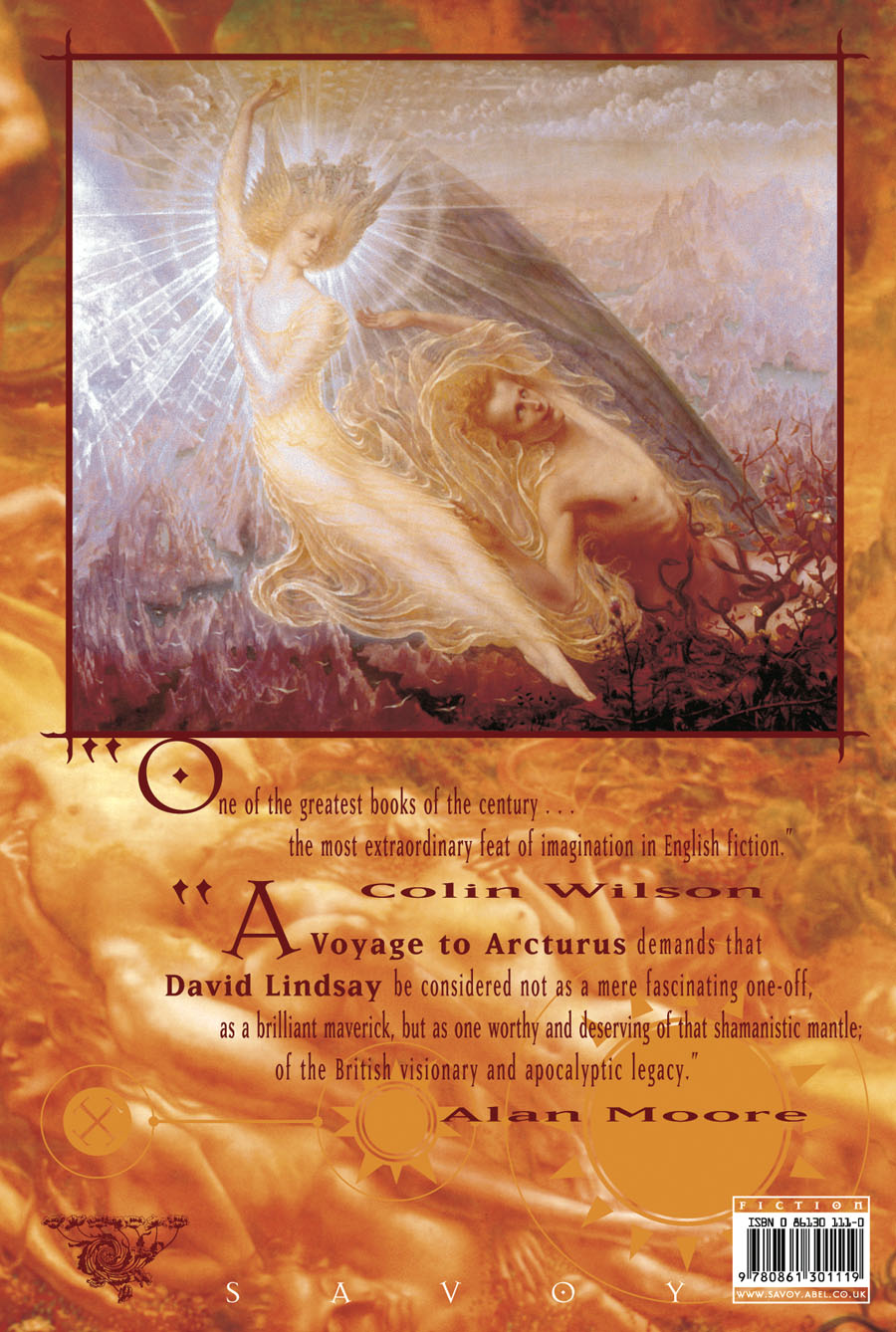
I still think the best feature of my design was the selection of Jean Delville’s remarkable Symbolist painting, The Treasures of Satan (1895), a picture used with the permission of the Brussels Museum of Fine Art. (They supplied us with a print of the painting together with a photo of Delville’s Angel of Splendour (1894) for the back cover.) With the exception of Bob Pepper’s artwork for the 1968 Ballantine paperback, previous reprints of the novel seldom reflected the contents on their covers. I’m no longer happy with the type layout on the rest of the dust-jacket, however, although the front cover looks okay. The Savoy edition included an introduction by Alan Moore, an afterword by Colin Wilson, a collection of philosophical aphorisms by David Lindsay, plus a couple of photos of the author which I don’t think had been published before. Despite its flaws, the book was well-received. The paper was heavier stock than is generally used for hardback fiction which made for a heavy and expensive volume but the edition still sold out.

Penguin are reprinting the novel next year in an edition which continues the tradition of unsuitable cover art. According to Lindsay site The Violet Apple the figure on the cover is from an illustration for a Dostoevsky novella, so what is it doing on Lindsay’s book? Cover art aside, the novel is in a class of its own, and very highly recommended.

Previously on { feuilleton}
The art of Bob Pepper
Masonic fonts and the designer’s dark materials