Harry Willock book covers

moreau.jpg

This time last year I happened to be re-reading my way through the collected short stories of HG Wells; this year I’ve been reading The Island of Doctor Moreau, not to continue the seasonal trend, I simply felt the urge. More about Moreau tomorrow.

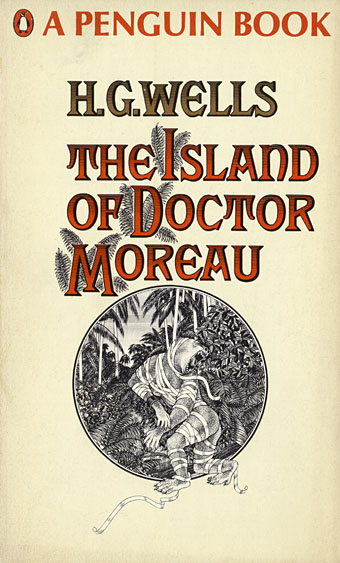
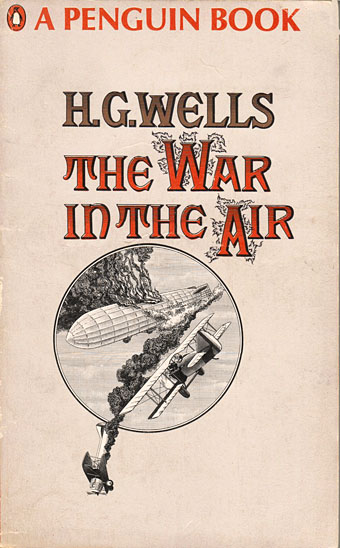
These covers are from a series of Penguin reprints which first appeared in 1967 and went through several editions. Harry Willock was the cover artist, and may also have been the designer of the Wells and Verne titles, other text-only Penguin covers from around this time being credited to Willock. The Penguin Science Fiction site describes the obtrusive “A Penguin Book” legend as the “panic top”, a heavy-handed attempt by Penguin’s management to reinforce their brand. Later reprints dropped this but it’s stamped across most of these editions.
war.jpg

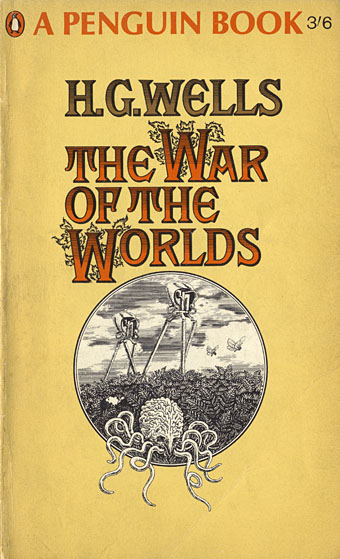
This edition of The War of the Worlds was my first encounter with the novel so the cover has always been very familiar, a factor which probably prevented me from seeing how effectively all the Willock Wells covers work as a set. The Martian war machines aren’t very menacing—especially when they seem to have done little but arouse a pair of butterflies—but I do like the type layouts and the way the illustrations are concentrated into a circle. Willock’s drawings so closely imitate the style of Victorian engravings it’s easy to take them at first glance for the genuine article.
air.jpg

Continue reading “Harry Willock book covers”

Salomé: the font

salomefont01.jpg

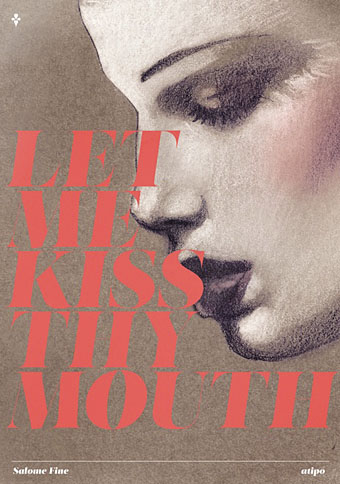
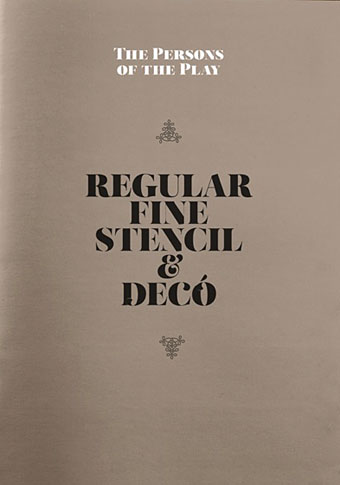
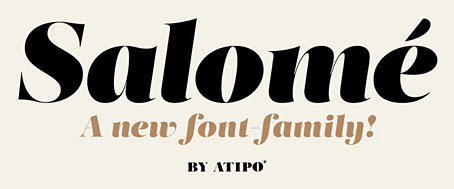
This isn’t the first font that’s been named after Salomé but Salome (without accent) by Rebecca Alaccari and Patrick Griffin was a revival of an earlier design, Cantini, from 1972, whereas Salomé is an original creation by Spanish design studio Atipo. The Atipo design itself owes something to the 1970s being reminiscent of François Boltana’s Stilla (1973), albeit without the eccenticities that make Boltana’s typeface so redolent of the period. Salomé comes in four styles, all of them variations on the extra-bold weights of Didone typefaces.

salomefont02.jpg

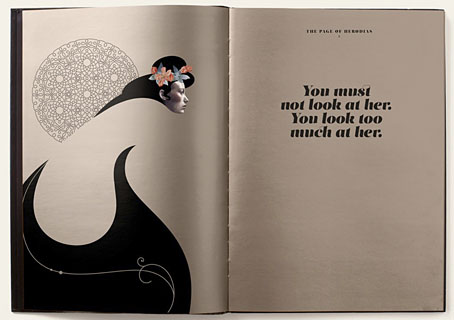
Having a predilection for this look the design appeals to me even without its associations. Atipo add to the attraction by promoting their font family with some gorgeous illustrations juxtaposed against quotes from Oscar Wilde’s play. None of the poster designs or the booklet pages below are credited on the website. The on-screen booklet highlights significant moments from the play with illustrations that manage to be Beardsley-like without going down the pastiche route. This is the way to show off a new font design, it’s just a shame the booklet isn’t available as a pdf. The icing on the cake is that the regular style of Salomé is available for free so long as you help promote it via Twitter or Facebook. The complete family is available for a very reasonable price. Now I have to find something to create that’s worthy of the design.

salomefont03.jpg

salomefont04.jpg

Continue reading “Salomé: the font”

Weekend links 183

doisneau.jpg

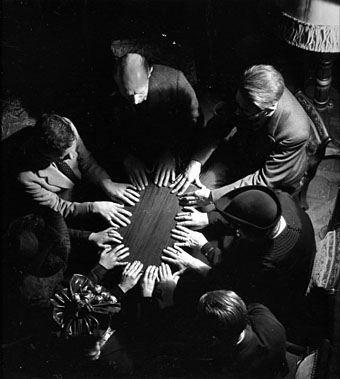
La table qui tourne (1943) by Robert Doisneau.

In [Gödel, Escher, Bach], Hofstadter was calling for an approach to AI concerned less with solving human problems intelligently than with understanding human intelligence—at precisely the moment that such an approach, having borne so little fruit, was being abandoned. His star faded quickly. He would increasingly find himself out of a mainstream that had embraced a new imperative: to make machines perform in any way possible, with little regard for psychological plausibility.

The Man Who Would Teach Machines to Think by James Somers.

Whenever the latest pronouncements about the imminent arrival of artificial intelligence are being trotted out I wonder what Douglas Hofstadter would have to say on the matter. You don’t hear much about Hofstadter despite his having been involved for decades in artificial intelligence research. One reason is that he’s always been concerned with the deep and difficult problems posed by intelligence and consciousness, subjects which don’t make for sensational, Kurzweilian headlines. Hofstadter’s essays on AI (and many other topics) in Metamagical Themas: Questing for the Essence of Mind and Pattern (1985) are essential reading. James Somers’ lengthy profile for The Atlantic is a welcome reappraisal.

• The end of October brings the spooky links: When Edward Gorey illustrated Dracula | Paula Marantz Cohen on Edgar Allan Poe | Yasmeen Khan revisits Werner Herzog’s Nosferatu | Roger Luckhurst on horror from the Gothics to the present day, and Michael Newton on Gothic cinema.

•  Magic Words: The Extraordinary Life of Alan Moore is a biography of the Northampton magus by Lance Parkin. The author talks about his book here, and also here where if you look carefully you can see my Lovecraft book on his shelf.

• A crop of Halloween mixes: Boo, Forever by Jescie | Samhain Seance 2: Hex with a Daemon by The Ephemeral Man | Wizards Tell Lies & The Temple of Doom by The Curiosity Pipe | Radio Belbury’s Programme 11.

The Book of the Lost is an album by Emily Jones & The Rowan Amber Mill presenting music from imaginary British horror films. Release is set for Halloween. More details here.

Laura Allsop on Derek Jarman’s sketchbooks. Jarman’s Black Paintings are currently showing at the Wilkinson Gallery, London.

Magick is Freedom! Existence Is Unhappiness: Barney Bubbles vs. Graham Wood.

• Soho Dives, Soho Divas: Rian Hughes on sketching London’s burlesque artists.

Jenny Diski on the perennial problem of owning too many books.

Equus through the years by Clive Hicks-Jenkins.

Virgin Records: 40 Years of Disruptions

• At BibliOdyssey: Chromatic Wood Type

Witches at Pinterest

The Witch (1964) by The Sonics | My Girlfriend Is A Witch (1968) by October Country | You Must Be A Witch (1968) by The Lollipop Shoppe

Weekend links 174

ikuma.jpg

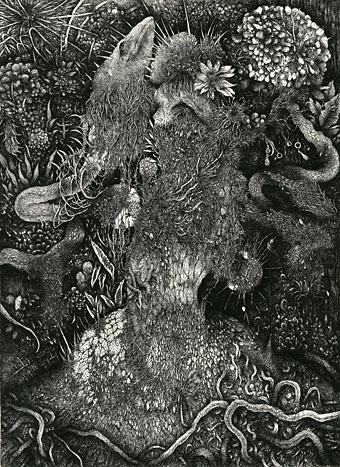
Dress (2012) by Nao Ikuma.

• Two of my Cthulhu artworks can currently be seen in the Ars Necronomica exhibition at the Cohen Gallery, Brown University, Providence, RI. The exhibition is part of NecronomiCon, and runs to September 13th. In related news, my steampunk illustration has been nominated in the Visual category of this year’s Airship Awards. Winners will be announced at Steamcon V in October.

• “…the story of how a small cabal of British jazz obsessives conducting a besotted affair with the style arcana of Europe and America somehow became an army of scooter-borne rock fans…” Ian Penman looks back at the culture of Mod for the LRB.

• “What is it about the writer in the First World that wants the Third World writer to be nakedly political, a blunt instrument bludgeoning his world’s ills?” Gina Apostol on Borges, Politics, and the Postcolonial.

If someone had designed a work regime perfectly suited to maintaining the power of finance capital, it’s hard to see how they could have done a better job. Real, productive workers are relentlessly squeezed and exploited. The remainder are divided between a terrorised stratum of the, universally reviled, unemployed and a larger stratum who are basically paid to do nothing, in positions designed to make them identify with the perspectives and sensibilities of the ruling class (managers, administrators, etc) – and particularly its financial avatars – but, at the same time, foster a simmering resentment against anyone whose work has clear and undeniable social value. Clearly, the system was never consciously designed. It emerged from almost a century of trial and error. But it is the only explanation for why, despite our technological capacities, we are not all working 3–4 hour days.

On the Phenomenon of Bullshit Jobs by David Graeber

Ron Rosenbaum talks to Al Pacino about all the usual stuff, and reveals some detail about the actor’s obsessive interest in Oscar Wilde’s Salomé.

• More queer history: The Brixton Fairies and the South London Gay Community Centre, Brixton 1974–6.

• At Dangerous Minds: Anthony Burgess and the Top Secret Code in A Clockwork Orange

• Every day for 100 days, Jessica Svendsen redesigned a Josef Müller-Brockmann poster.

LondonTypographica: Mapping the typographic landscape of London.

• Mix of the week: Secret Thirteen Mix 083 by Demdike Stare.

• At Strange Flowers: Alfred Kubin the writer.

Derek Jarman’s sketchbooks.

Rick Poynor on Collage Now.

• Thomas Leer: Private Plane (1978) | Tight As A Drum (1981) | Heartbeat (1985)

Weekend links 172

thielker.jpg

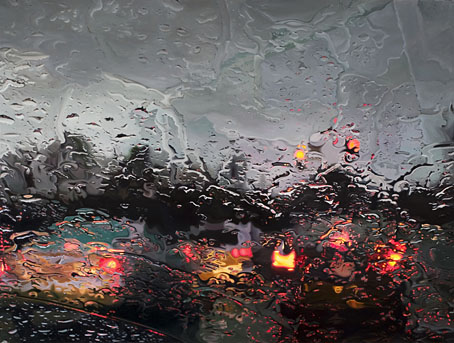
Complete Stop (2008), an oil painting by Gregory Thielker from his Under the Unminding Sky series.

• For Halloween last year I watched a very poor copy of a BBC Play For Today production, Robin Redbreast, a piece of rural horror by John Bowen which received a single screening in 1970. That poor copy—black-and-white, timecoded, multi-generation video—has been circulating for years, so it’s good to know that the BFI will be releasing Robin Redbreast on DVD in time for this year’s Halloween. This might be news enough but the following month the BFI also releases Leslie Megahey’s stunning adaptation of Schalcken the Painter in a dual DVD/Blu-ray edition. I wrote a short review of the latter film last October.

• Mixes of the week: August Sun High from The Advisory Circle, and John Wizards’ Quietus Mix “African music, R&B and chamber pop, filtered through gentle electronic arrangements that cross-pollinate with South African house, Shangaan electro and dub”.

• A trailer has surfaced for The Counselor, a film by Ridley Scott from an original screenplay by Cormac McCarthy. Trailers are too spoilerish so I’m refusing to watch it but for those interested Slate has the details.

Luckhurst makes an admirable attempt to link Lovecraft’s most frustrating writing tic to this theme of the unknown when he claims that Lovecraft’s “catachresis”—deliberate muddling of language through the use of mixed metaphors and the like—is a tool he uses to bolster the atmosphere of futility in the face of “absolute otherness.” The trauma of encountering something so far outside the realms of imagination triggers a collapse of logic in the language itself.

Cate Fricke reviews The Classic Horror Stories of HP Lovecraft, a collection from Oxford University Press edited by Roger Luckhurst.

• “Contemporary audiences found it too weird, too wonky and even borderline distasteful…” Xan Brooks goes looking for the locations from Powell & Pressburger’s 1943 film, A Canterbury Tale.

• Two songs from Julia Holter’s forthcoming album, Loud City Song: World and Maxim’s I. Also unveiled this week: Evangeline, a new track by John Foxx & Jori Hulkkonen.

• Have Ghost, Will Find: Colin Fleming on William Hope Hodgson’s Carnacki, The Ghost Finder.

• At PingMag: Urban Calligraphy: Turning the Streets into Big, Loud Canvases.

• Sex, Spirit, and Porn: Conner Habib talks to Erik Davis.

Serendip-o-matic: Let Your Sources Surprise You

The Pronunciation of European Typefaces

Twilight (2004) by Robin Guthrie & Harold Budd | Luminous (2009) by John Foxx & Robin Guthrie | Cling (2011) by Robin The Fog