Reworking Kraftwerk (again)

kraftwerk00.jpg

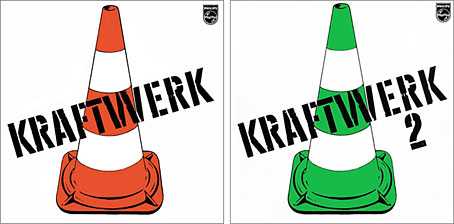
Kraftwerk (1970); Kraftwerk 2 (1972). Design by Ralf Hütter.

Recent posts about Kraftwerk’s design history had me wondering how the group might present the first three albums if these repudiated works were allowed back into the catalogue. Kraftwerk, Kraftwerk 2, and Ralf and Florian haven’t been officially reissued for decades now, and I remain sceptical that Ralf Hütter (or the recently departed Florian Schneider) are willing to taint their carefully cultivated discography with those awkward, experimental albums. This is highly unusual in the music world where everything by a commercially successful group tends to be reissued on a regular basis.
raf.jpg

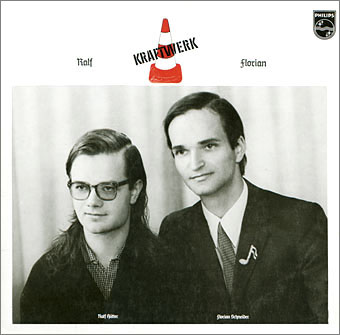
Ralf and Florian (1973). Design by Ralf Hütter & Florian Schneider. Photo by Robert Franck.

Kraftwerk are unique in this, and also in subjecting their approved releases to incremental adjustments. This was mostly strikingly seen in 2009 when the 8 albums were reissued in a box as The Catalogue. Not only had further changes been made to the cover art but two of the albums had amended titles: Electric Café was now Techno Pop (as it would have been titled if released earlier in the 1980s), and Tour De France Soundtracks had become Tour De France. The cover art changes had already been previewed in the version of The Catalogue that briefly appeared as a promo set in 2004 only now it was evident that more human traces were being removed from the albums, notably on the cover of The Man-Machine which swapped the band photo for the El Lissitzky-derived graphics. All of this needed to be taken into account when I had the idea last week of roughing out designs for how the first three albums might be reissued in a box set today.
cover1.jpg

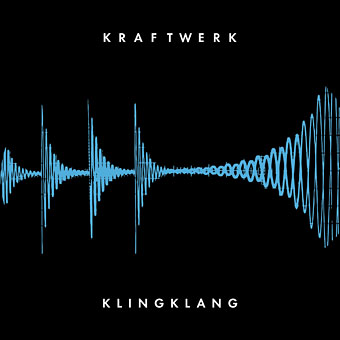
First the title: there’s no way of knowing what Ralf Hütter might call a collected set but mundane choices like Three Albums or Kraftwerk 70–73 seem unlikely. I decided on Klingklang, the name of the first piece of music on the second album, and also the name of Kraftwerk’s studio and publishing company. This would no doubt cause endless (endless) confusion but it still seems apt. The cover design uses Futura, a German typeface that’s been a feature of many Kraftwerk graphics over the years. The oscilloscope wave is taken from the front and back cover of the double-album reissue of Kraftwerk and Kraftwerk 2 on the Vertigo label in 1972. I always liked that cover, and the graphic suits the often raw electronic sound of those albums as well as the minimal nature of the current design.
cover2.jpg

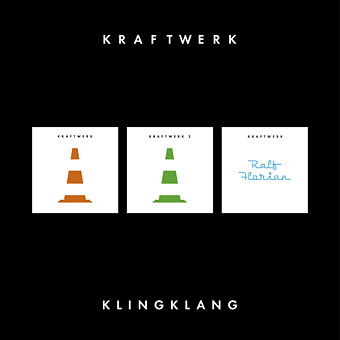
This would be the back of the proposed box, showing the albums within as The Catalogue does.
kw1.jpg

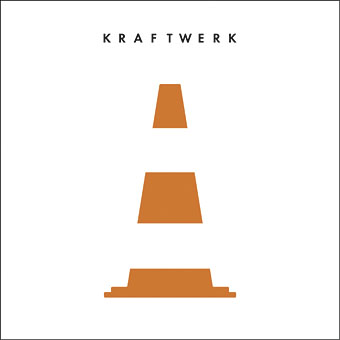
All German traffic cones still follow this standard, apparently, so the design hasn’t dated at all. (See this post for Kraftwerk’s cone obsession.) Using negative space for the white bands works well.
Continue reading “Reworking Kraftwerk (again)”

Weekend links 238

hinrichsen.jpg

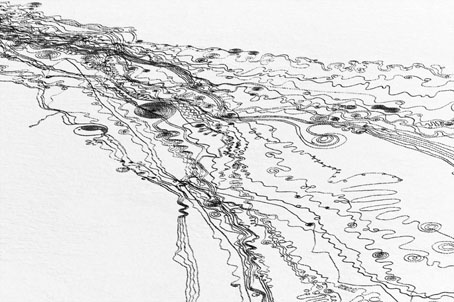
We Are The Water – Snow Drawings Project, Colorado (2014) by Sonja Hinrichsen with 50 volunteers.

• I don’t do end-of-year lists but Dennis Cooper does. My thanks to Dennis once more for including this blog among his selections. Also there is Jonathan Glazer’s film of Under the Skin, an adaptation of Michel Faber’s novel that impressed me as the most insidiously disturbing thing I’ve seen since Mulholland Drive. The Guardian‘s film critics agreed, making it their film of the year. I’d add to Peter Bradshaw’s appraisal by noting the superb score by Mica Levi, the refusal to spoon-feed the audience with explanations, and a refreshing absence of Hollywood gloss. Glazer’s film, like Kill List before it, shows that mundane British streets and interiors can still be a setting for serious horror.

• Related to the above: “I like Caravan, Coil—it’s very sad that they’re both dead now. In fact, Peter Christopherson, who was leader of Coil, contributed a song to a CD which I made for my wife for what we believed would be her last birthday.” Michel Faber talks to Hope Whitmore about Under the Skin and his new novel, The Book of Strange New Things. M. John Harrison recommends the latter on his own end-of-year list. In January Black Mass Rising will release a recording of The Art of Mirrors, Peter Christopherson’s homage to Derek Jarman from 2004.

David Bowie and band live on Musikladen in 1978: 40 minutes with Adrian Belew on squealing lead guitar, some Kurt Weill and an outstanding performance of “Heroes”.

• “Realism is a literary convention – no more, no less – and is therefore as laden with artifice as any other literary convention.” Tom McCarthy on realism and the real.

• Mixes of the week: The Best of the Best of the Best by TheCuriosityPipe, and Secret Thirteen Mix 138, a medley of post punk from Psyche.

• “We spent two weeks making the penises.” Livin’ Thing: An Oral History of Boogie Nights by Alex French and Howie Kahn.

• At Dangerous Minds: Seeing The Man Who Fell to Earth was one of the greatest experiences of Philip K. Dick’s life.

• Giving Voice to Our Pagan Past and Present: Pam Grossman on Witches, Women and Pop Occulture.

• Neglected last week (and linked everywhere but still a good one): The typography of Alien.

William Mortensen, the photographer who Ansel Adams called the Anti-Christ.

• Hear a track from analogue synthesizer virtuoso Kaitlyn Aurelia Smith.

Rick Poynor on illustrations by Bohumil Stepan for Crazy Fairy Tales.

12 excellent features from directors who never made another feature.

Werner Herzog Inspirationals

The Devil in the Hedgerow

New Warm Skin (1980) by Simple Minds | Rapture Of The Skin (1996) by Paul Schütze | Take Me Into Your Skin (2007) by Trentemøller

MCMLXX

data70.jpg

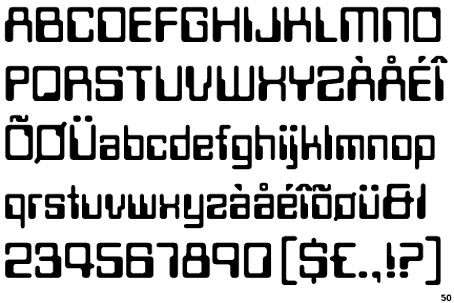
Data 70, a typeface by Bob Newman.

The presence of electronic artists Data 70 in the Spatial mix at the weekend had me thinking about the preponderance of cultural items that were given “70” as a suffix in the 1960s or in the year 1970. The air of futuristic optimism in the 60s drew attention to the birth of a new decade in a manner that hadn’t really happened before, and certainly didn’t happen for 1980 by which time the optimism had been sunk by a decade of political and fuel crises, and the end of the space race.

Data 70 take their name from the “futuristic” computer-like typeface designed by Bob Newman in 1970. Newman’s typeface wasn’t the first of the Space Age designs—Colin Brignall’s Countdown appeared in 1965—but Data 70 was everywhere in the 1970s. Data 70 (the group) dedicated a piece of music to Newman.

A few more 70s follow. These are only the ones I’ve been able to remember or stumble across so I’m sure there are more. And note: to qualify for this micro-category something has to be named “70” only where the suffix signifies modernity or the future, no Expo 70 (the world’s fair in Osaka) or anything annual that happened to be labelled 70 as part of a series.

boccaccio.jpg

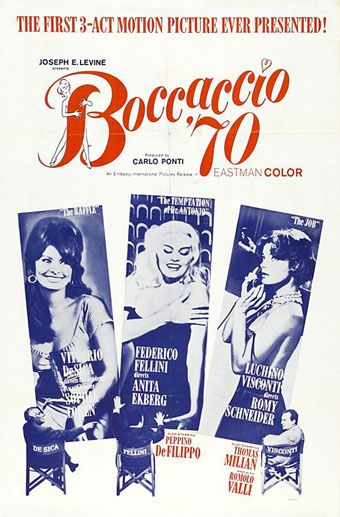
Boccaccio 70 (1962).

The label might imply the future but the predominant tone of these entries is sex. Boccaccio 70 set things in motion by updating the Decameron to modern Italy. Despite the claims of the poster, anthology films are nothing new, and this one has four stories directed by Vittorio De Sica, Federico Fellini, Mario Monicelli and Luchino Visconti. Italo Calvino was one of the writers.

Continue reading “MCMLXX”

Weekend links 233

casas.jpg

Alchemical Stone (2014) by Daniel Lasso Casas. Via full fathom five.

• “I am unsure if this reality is an everyday one. We don’t know if the universe belongs to a realist genre or a fantastic one, because if, as idealists believe, everything is a dream, then what we call reality is essentially oneiric.” Jorge Luis Borges in 1984 in conversation with Argentinian poet and essayist Osvaldo Ferrari.

• “I am transgender, so ‘he’ is not appropriate and ‘she’ is problematic. I’m what I think of as pure transgender.” Antony Hegarty talks to Cian Traynor about Turning, a new DVD and album project.

Unearthing Forgotten Horrors 2014 is a weekend festival of rural weirdness at the Star and Shadow Cinema, Newcastle-upon-Tyne.

Henry Darger, one of the most celebrated examples of an outsider artist (see: Vivian Girls), has been uniformly ignored by the literary firmament. Despite the success of his artwork, none of his fiction manuscripts have seen print. The language of literature is the language of privilege, in which even the stories of the working class are regularly clad in a bourgeois prose. The language of literature cannot be extricated from its white, genteel roots. Those of us without access to education are welcome to practice, but we must come in from the cold, adopt the house language. We must be civilized, scrubbed clean. Naiveté has no place in the colosseum of words.

Ravi Mangla on Coming in from the Cold: Outsider Art in Literature

Carel de Nerée tot Babberich en Henri van Booven, a collection of Beardsley-like drawings by a neglected Dutch artist.

Forever Butt is a new collection of the best of recent issues of BUTT magazine, still the best print mag for gay men.

Anne Billson’s guide to Brussels, another European city I’d like to visit some day.

• At BibliOdyssey: Schönschreibmeister, a calligraphy master’s album.

Third Ear Band live (and in colour!) on French TV in 1970.

• Mix of the week: Secret Thirteen mix 132 by Spatial.

• The Internet Archive now has an Internet Arcade.

Crazy Cat Lady Clothing

The Pattern Library

Stone Circle (1969) by Third Ear Band | Sacred Stones (1992) by Sheila Chandra | Stoned Circular I (1996) by Coil

The beers of Pan

grebhans2.jpg

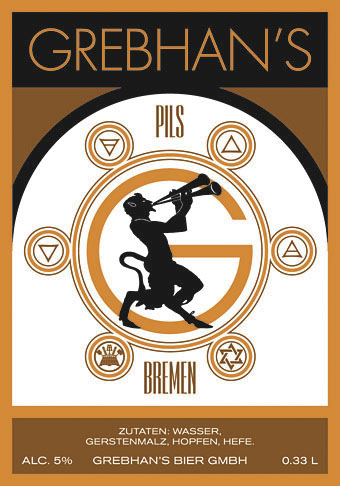
Bacchus has the wine so I suppose Pan can have the beer. Back in May the blog was stalled while I was contending with various computer problems but I did manage to do some work despite the turmoil. One job was a request from Grebhan’s, a small German brewery, who wanted help altering the design of their beer label. The results can be seen above. My contribution mostly involved making a neater arrangement of the Pan piper and symbols, and also changing the fonts. Once we had Futura selected as the main typeface I put a capital G behind the Pan figure. This was subsequently made into the minimal variant you see below, the head being the one from the Pan figure enlarged.

grebhans1.jpg

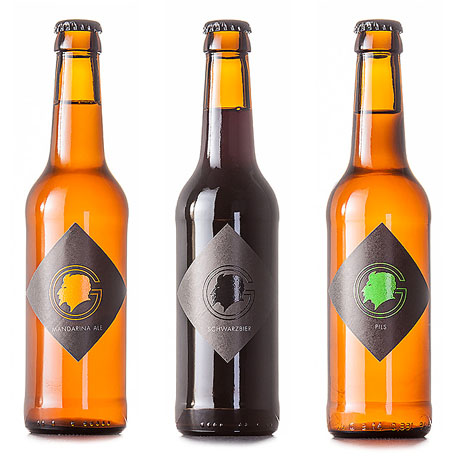
Earlier today Tobbi from Grebhan’s sent me a photo of the new labels. I’m very impressed with the way these have turned out, from the combination of matt and gloss to the diamond shape and the general minimal style. The black-on-black logo for the schwarzbier is a nice touch. I’m not a beer drinker (whisky, please) but if I was I’d want to try some of these.

grebhans3.jpg

Previously on { feuilleton }
Green Pipes: Poems and Pictures
The Piper at the Gates of Dawn
The Great God Pan
Peake’s Pan