The art of Rudolf Hausner, 1914–1995

hausner1.jpg

Die Arche des Odysseus (1948–1956).

hausner2.jpg

Adam Bei Sich (1969).

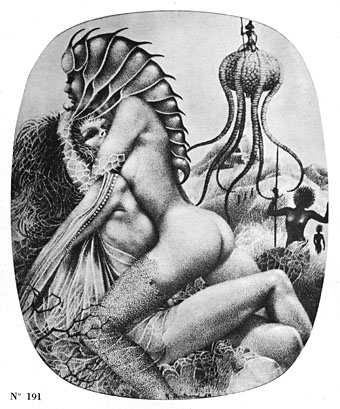
A major Austrian painter and printmaker, Rudolf Hausner studied art at the Academy in Vienna from 1931 to 1936, under Fahringer and Sterrer. Many of his early paintings were confiscated and branded as ‘degenerate’ by the ruling Nazi party in 1938. In 1941 Hausner was drafted by the German army and remained a soldier until the war’s end in 1945. After the war he returned to Vienna and immersed himself in studies dealing with the unconscious and with the art of Surrealists, particularly that of Max Ernst. Along with Wolfgang Hutter and Anton Lehmden, Rudolf Hausner founded the Viennese School of Fantastic Realism in 1947. During the 1950s and 1960s this became one of Austria’s most important movements and Hausner was its most influential artist. During this time he also held principal teaching posts at the academies of Vienna and Hamburg.

Equally gifted as a painter, lithographer and etcher, Hausner’s complex art is based upon potent symbols and imagery. Primary among these is the constantly recurring image of the first man, Adam, who is part autobiographical and part archetype. Another compelling image is that of the man or boy in a sailor’s cap. Hausner claimed that this image symbolized the myth of Odysseus and his epic voyages on the seas. It also, however, is representative of the artist’s own boyhood and the integrated relationships of youth and age within the self.

Elsewhere on { feuilleton }
The fantastic art archive

Taxandria, or Raoul Servais meets Paul Delvaux

delvaux.jpg

La Rue du Tramway (1938) by Paul Delvaux.

Taxandria (1994) is a feature-length fantasy film by Belgian animator Raoul Servais that’s received little attention outside his native country, possibly because it failed in the marketplace and has been deemed too weird or uncommercial to export. You only have to compare the export version of Harry Kümel’s Malpertuis with his original cut to see how inventive Belgian films are treated by US distributors.

taxandria1.jpg

Servais had previously made an acclaimed animated short, Harpya, using a combination of live actors and painted backgrounds. Taxandria elaborates on this process (called Servaisgraphy by its inventor) using settings designed by one of my favourite comic artists François Schuiten, creator (with Benoît Peeters) of Les Cités Obscures. Taxandria intrigues for a third reason, the inspiration of Surrealist master Paul Delvaux whose paintings served as the origin of the project. And it also contains a remarkable detail in the screenplay credit for Alain Robbe-Grillet, a man better known for making Last Year at Marienbad with Alain Resnais, and the kind of fierce intellectual one imagines would usually run a mile from this kind of extravagant whimsy.

taxandria5.jpg

Continue reading “Taxandria, or Raoul Servais meets Paul Delvaux”

The Codex Seraphinianus

codex.jpg

It had to happen…the entirety of Luigi Serafini’s masterpiece (US edition, 1983) scanned and Flickr-ised for your viewing pleasure.

See also
The unofficial Codex site
My 2002 article about the book
Giornale Nuovo

Elsewhere on { feuilleton }
The fantastic art archive

Previously on { feuilleton }
Tressants: the Calvino Hotel
Surrealist cartomancy

The art of Yves Doaré

doare1.jpg

Ange (1981).

doare2.jpg

Le réservoir (1979).

Yves Doaré is well known for his paintings and drawings but better known for his haunting etchings, drypoints and wood engravings. Doaré began exhibiting his art in France in 1966 and since that time his art has been the subject of one man exhibitions at the Gallery Sumers, New York (1975), the Gallery Michele Broutta, Paris (1982), the House of Culture, Orleans (1985), the Gallery Dom Quichotte, Rome (1987), Workshop of Arts, Douarnenez (1993) and the Museum of Contemporary Art, Chamalieres, Belgium (1994). His art is now included in such public collections as the Museum of Annecy, the Museum of Morlaix, the Museum of Fine Arts, San Francisco, and the National Library of Paris.

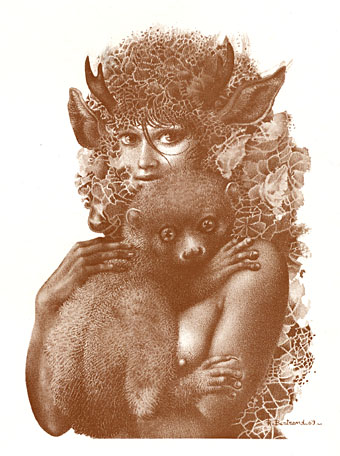
Many of Doaré’s original etchings and engravings explore the theme he has termed, “a kind of geological memory.” Using as his starting point the actual etching plate or engraving block, Doaré explores the surface’s capacity to reveal its own forms and figures. Much like a sculptor, Doaré thus orchestrates the emergence of the random forms which the surface suggests.

More pictures at the Fitch-Febvrel Gallery, Galleria del Leone and the artist’s own site.

Update: more reproductions at Velly.org.

Elsewhere on { feuilleton }
The etching and engraving archive

Surrealist women

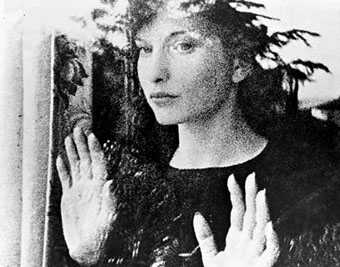
Was the Surrealist movement the first art grouping to give female creators more of an equivalent status to their male counterparts? The recent posting about Leonora Carrington had me considering this question again (yes, this is what taxes my brain while it’s awake). The answer isn’t so easy to find since women artists had been emerging gradually since the late 19th century, from Berthe Morisot onwards. Women certainly played a greater role in the development of Surrealism than they were allowed to do in earlier art movements, and their work is continually featured in histories of the period. The men were still accorded all the glory, of course, and many of the women were only given an opportunity by virtue of being wives or lovers of the male artists, but they still managed to map out their own imaginative territory. The following are some of the more notable examples.

tanning.jpg

Birthday by Dorothea Tanning (b.1910).
My personal favourite, a very accomplished painter who married Max Ernst.

Continue reading “Surrealist women”