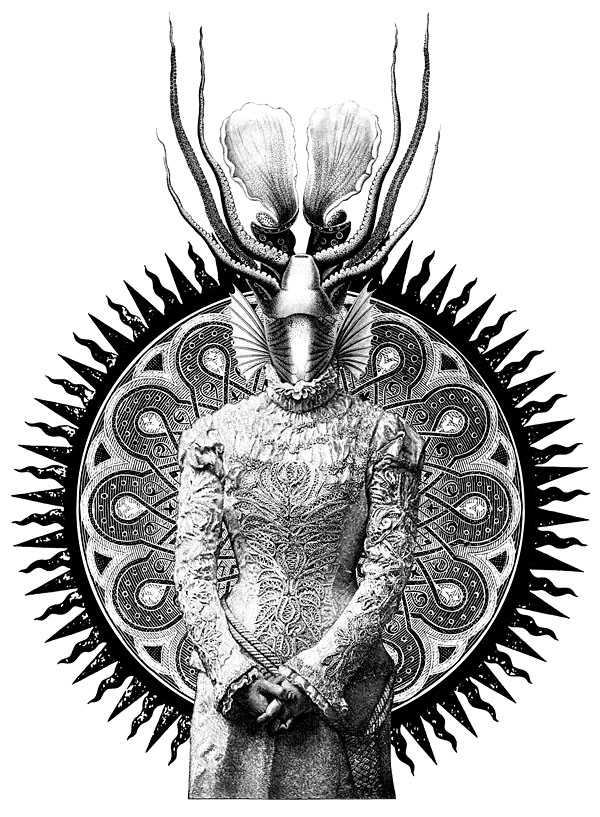
This week’s Photoshop researches lead to interesting encounters.
Previously on { feuilleton }
• Fascinating tentacula
• Jewelled butterflies and cephalopods
• Haeckel fractals
• Octopulps
A journal by artist and designer John Coulthart.

Surrealism
This week’s Photoshop researches lead to interesting encounters.
Previously on { feuilleton }
• Fascinating tentacula
• Jewelled butterflies and cephalopods
• Haeckel fractals
• Octopulps
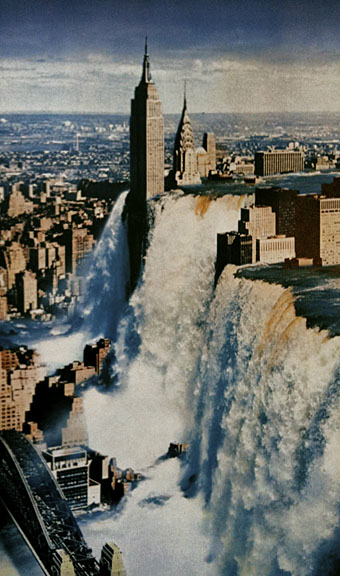
Waterfall by Tsunehisa Kimura.
Continuing an occasional series. Japanese artist Tsunehisa Kimura (1928–2008) was initially inspired by the polemical graphics of John Heartfield to create his own photomontages, a painstaking collage technique now rendered obsolete by Photoshop. Kimura’s work exchanges Heartfield’s satire for an overt and frequently apocalyptic Surrealism, as in his most visible piece, Waterfall. The copy above is one of a number of pictures reproduced by Geoff Manaugh at BLDGBLOG from a 1979 Kimura collection, Visual Scandals by Photomontage.
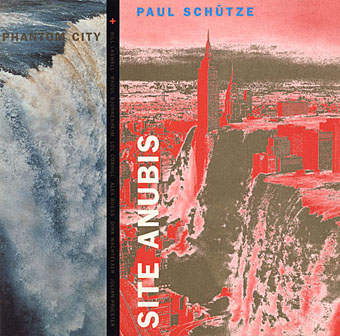
Design by Anne-Louise Falson & Paul Schütze.
I was first startled by Waterfall in 1996 when Paul Schütze released his Site Anubis album, the product of a “virtual group” comprised of musicians recording in different studios around the world:
The musicians comprising Phantom City—the name, incidentally, originating from the book title Topology of a Phantom City by French novelist Alain Robbe-Grillet—never met for the recording of Site Anubis, as each one recorded in a different studio in a different country: guitarist Raoul Björkenheim in Helsinki, bass- and contra-bass clarinetist Alex Buess in a Basel studio, soprano saxophonist Lol Coxhill in London, bassist Bill Laswell at Green Point Studio in Brooklyn, New York, trombonist Julian Priester in Seattle, drummer Dirk Wachtelaer in Brussels, and Schütze himself in London and Basel. Incredibly, Laswell had only Schütze’s electronic backing track to respond to. Wachtelaer had Laswell and Schütze to play against, Björkenheim had drums and bass,—in short, certain players had more information than others.
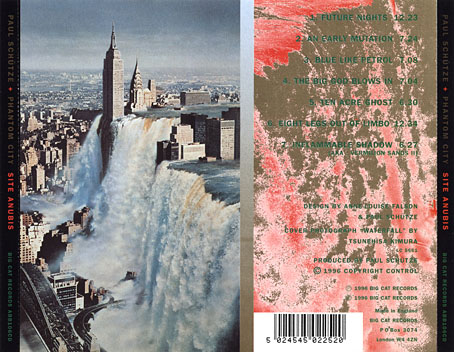
Kimura’s picture is an ideal accompaniment to this excellent album, especially when you note a Ballard reference in the titles (not the first in Schütze’s oevre), and read the scene-setting piece of fiction on the CD insert, an explanation of the album title:
That morning a report came in from an unmarked helicopter somewhere over the city. The waters were subsiding and the smoke from a thousand fires had begun to drift inland revealing an impossible new structure. Towering some eight hundred feet over the gleaming devastation of the streets, its base occupying an entire city block, was a colossal black basalt figure. The body was male and human, – the head, which stared expectantly toward the boiling western horizon, was the head of a jackal. From the air it was clear that the pattern of destruction on the ground was radial and that the massive figure was sited precisely at its centre.
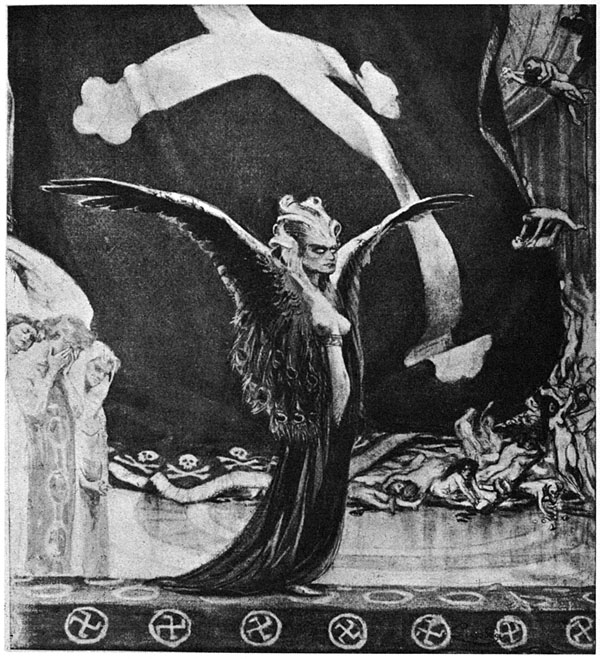
The Conqueror Worm (c. 1900) by František Kupka.
Poe’s illustrators are legion, you could easily devote an entire blog to nothing but depictions of his stories and poems. By way of rounding off this week of posts I thought I’d point to some of the works which have caught my attention over the years, several of them being obscure enough to warrant further investigation.
František Kupka’s drawing is, as far as I can gather, one of a series based on Poe’s poem; this seems to be a related piece. As with many Symbolists artists, you can spend a great deal of time scouring the available resources to find more of their work. We’re told that one of Kupka’s more well-known paintings, The Way of Silence (1903), was inspired by the poem Dream-land.
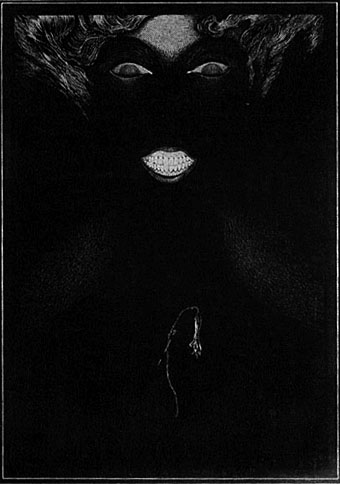
Berenice (1905) by Alberto Martini.
Alberto Martini (1876–1954) is a fascinating artist whose work bridges the decline of Symbolism and the rise of Surrealism. He’s also another talent whose work is woefully underrepresented on the web so let’s hope that changes soon. Wikipedia describes him as having produced 135 Poe illustrations of which only a small handful are visible online, and most of the ones that are go unlabelled. I know this one is for Berenice since I have it in a book but any Poe reader should guess the title from those blazing teeth. A few more of Martini’s drawings can be seen here.
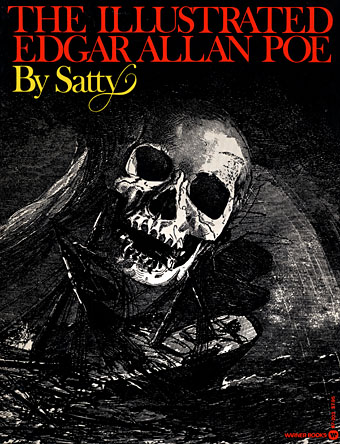
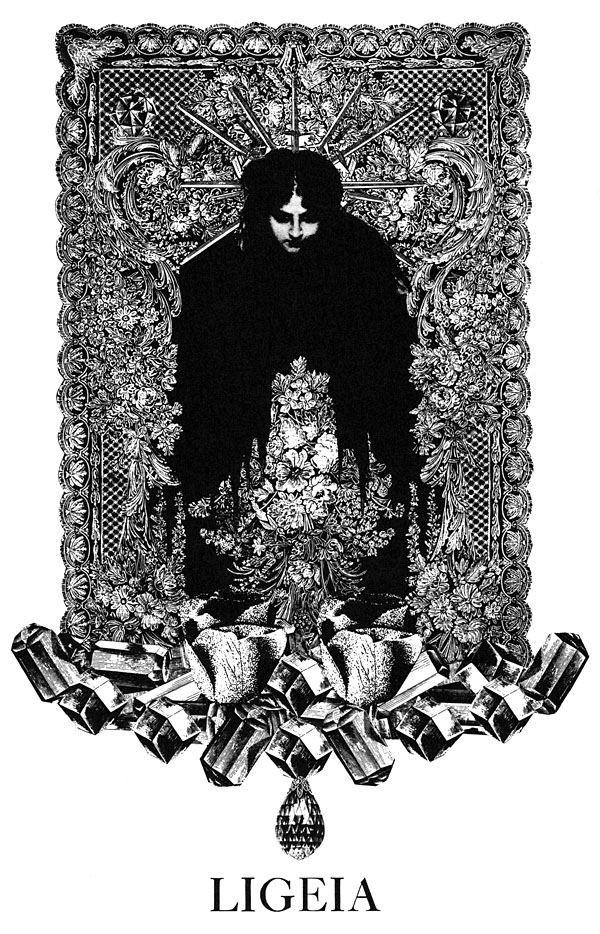
Here it is, the book that began my fascination with the collage art of Wilfried Sätty (1939–1982), a German artist and psychedelic poster designer resident in San Francisco during the 1960s and 1970s. Warner Books published his Poe collection in 1976 and for some reason omit the umlaut from his name even though it’s present in Thomas Albright’s introductory note. I bought my copy in 1979 at a time when I was writing a lot of unsuccessful “experimental” fiction, and the sight of these tremendous collages inspired a surge of writing activity which disregarded Poe’s stories altogether. I’d seen enough of Max Ernst’s engraving collages to know that Sätty was following Ernst’s example but something about Sätty’s work struck me in a manner I couldn’t articulate other than by trying to set down the thoughts they inspired. Personal obsessions aside, I’ve since come to regard this book as the only illustrated Poe which can approach Harry Clarke’s inimitable volume.
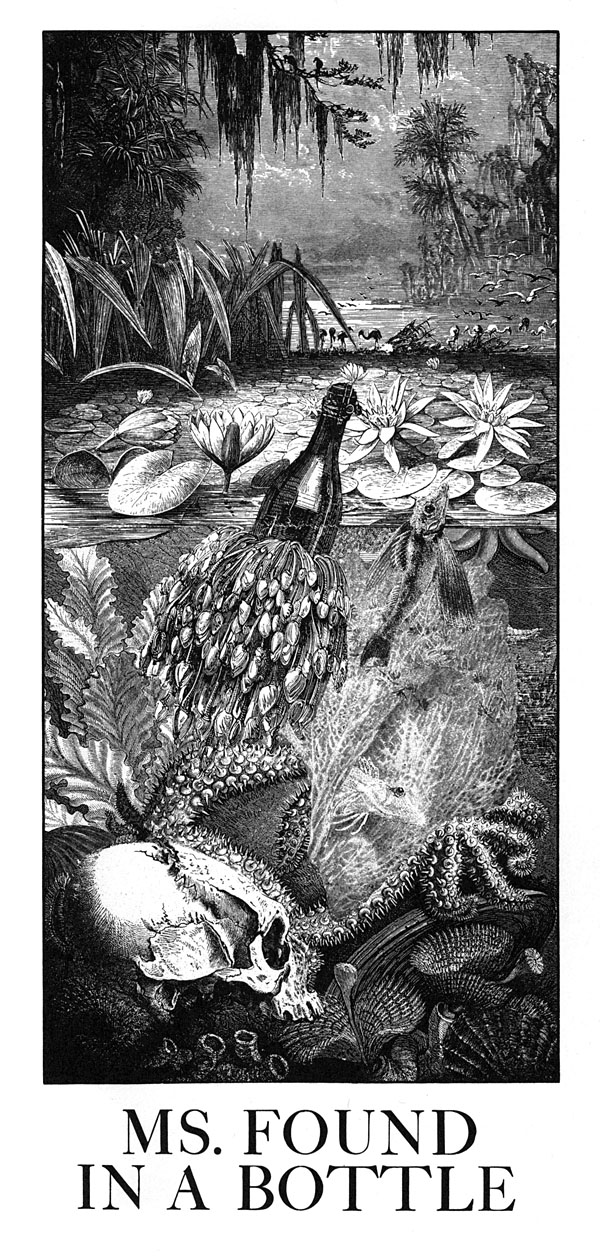
I’m fortunate to own two copies of this edition otherwise I wouldn’t have attempted to scan any pages when doing so involves bending the spine rather badly. The book is profusely illustrated, with many full-page or double-spread illustrations most of which I haven’t tried to reproduce. What you have here are the title pages from nearly all the pieces and a couple of additional illustrations. Sätty’s Poe is still the easiest of his books to find secondhand if you browse the dealer pages at AbeBooks. For more of his incredible work there’s this page at Ephemera Assemblyman, and for details of the artist’s life and career there’s my 2005 essay in Strange Attractor Journal Two.
• Sätty’s illustrations for The Annotated Dracula (1975) at Flickr.
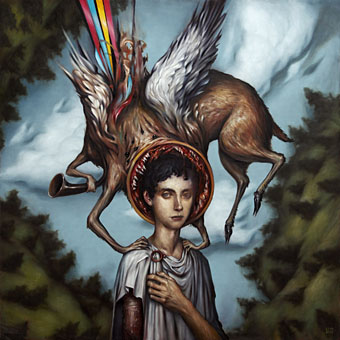
Blue Sky Noise (2010) by Esao Andrews.
• Franz Xaver Messerschmidt is the first exhibition in the United States devoted exclusively to the 18th-century sculptor. Related: an earlier post about the artist’s work.
• How are the team behind War Horse planning to follow up their smash hit? With a gay love story performed by puppets. Related: Achilles (1995) by Barry JC Purves.
• More great posts at A Journey Round My Skull: Czechoslovakian Expose VI and Black Cradle of Bright Life, fifteen works by the Macedonian artist Vangel Naumovski (1924–2006).
• Top 10 Anti-Gay Activists Caught Being Gay. Related: “Fuck your feelings,” in which columnist Dan Savage gets righteously impatient when a correspondent complains. As Savage says, people who use their faith as a stick to beat gay people contribute to an atmosphere of intolerance in which kids are bullied for being gay (or appearing to be), or transgender, or merely different, and kill themselves as a result. Over the past couple of weeks there’s been an upsurge of US media attention to the most recent suicides; Savage inaugurated the It Gets Better project in order to help. Also related: God Loves Poetry.

Meigh (2010) by Esao Andrews.
• Antony Hegarty enthuses about Shoot Yer Load, one of the scurrilous 12″ singles released by my Savoy colleagues in the 1980s. Antony and the Johnsons have a new album out, Swanlights, on Secretly Canadian.
• When the future of music was a rainbow hued parabola: book designer John Gall collects old synthesizer manuals.
• Fantastic Memories (1944) by Maurice Sandoz, illustrated by Salvador Dalí.
• Urban optometry: life as a London crane operator at BLDGBLOG.
• Today is 10/10/10 which means it’s Powers of Ten Day.
• These New Puritans: a band like no other.
• Art Nouveau: a virtual exhibition.
• Diaghilev: Lord of the dance.
• Flaming Telepaths (1974) by Blue Öyster Cult; Flaming Telepaths (2005) by Espers.