Raymond Bertrand paintings

bertrand19.jpg

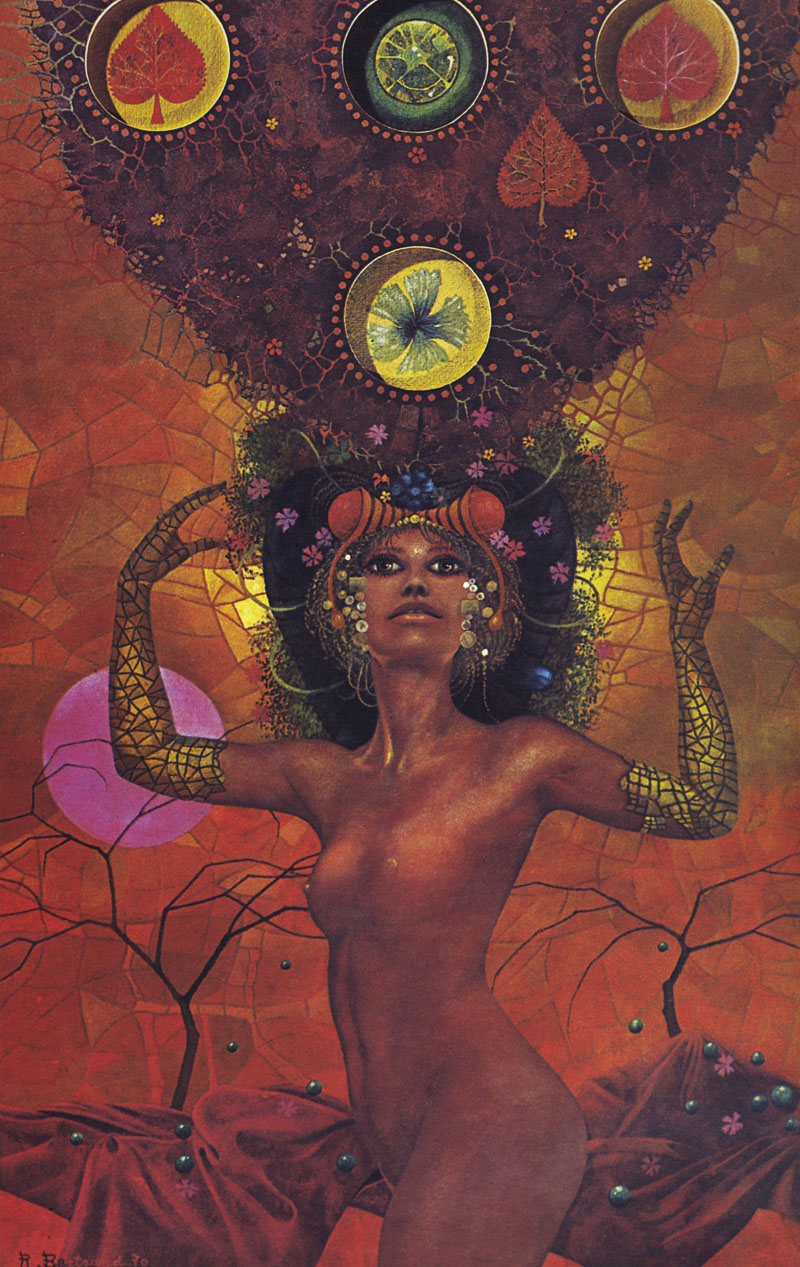
Scanning some of my work today I thought I’d follow yesterday’s post with a few scans of the colour plates in the second Eric Losfeld volume of Bertrand’s work, Dessins Erotiques II (1971). None of the pictures in the book are titled, and there’s little detail either about their production. Among the colour works is the Boschian piece above which for once doesn’t have one of the artist’s strange women as its sole subject. A few more scans from the same book can be seen at this earlier post.

bertrand16.jpg

bertrand17.jpg

Continue reading “Raymond Bertrand paintings”

Weekend links 118

owczarek.jpg

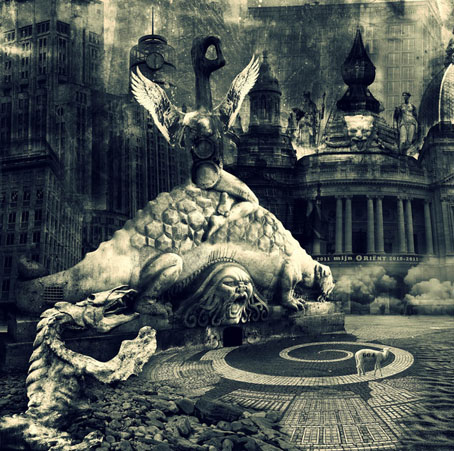
The Garden of Urban Delights (2010) by Marcin Owczarek.

His protagonists are misfits: alienated, implicitly gay, longing for love, frequently hard to be around, always fixated on small pleasures that compensate for an essential feeling of not belonging. […] His patroness Edith Sitwell termed him “that rare being, a born writer.” William Burroughs dedicated The Place of Dead Roads to him, declaring Welch “certainly the writer who most directly influenced my work.” John Waters has called In Youth is Pleasure “so precious, so beyond gay, so deliciously subversive, [it] is enough to make illiteracy a worse social crime than hunger.”

Sadie Stein on Denton Welch, a writer I’m embarrassed about still not having read. Edith Sitwell and William Burroughs had a famously disputatious correspondence in the pages of the TLS over The Naked Lunch. An appreciation of Welch’s work was one of the few things they had in common.

• Don’t mention guitars: Robert Hampson on acousmatic music, the curse of Loop and the rebirth of Main.

• No Straight Lines: A Collection Of Queer Comics part one, part two, part three. A history by Justin Hall.

Pieces Of Gold by The Aikiu: shots from gay porn videos repurposed via some smart editing.

• RIP İlhan Mimaroğlu, electroacoustic composer. Ubuweb has a selection of his recordings.

“A good ground rule for writing in any genre is: start with a form, then undermine its confidence in itself,” he says. “Ask what it’s afraid of, what it’s trying to hide – then write that.” For Harrison, the most satisfying writers are “at odds with their cultural context. They’re trying to fit in and failing, or they’re trying to remove themselves and failing. The attempt to resolve the conflict is an angle – a frame or a context – in itself.”

The Guardian’s A Life in Writing profiles M. John Harrison. His new novel, Empty Space, was published on Thursday. There’s also this recent video interview with Arc magazine.

• Stephen Usery interviews editor Russ Kick about The Graphic Canon: Volume One.

At home with Prince Zaleski, the “most decadent and imperial detective in fiction”.

• A Visit with Magritte: photographs by Duane Michals.

Loitering airships could dispense drones on demand.

• Creating a Forever Object: Ian Schon’s Pen Project.

• A Tumblr for the late, lamented Arthur Magazine.

• “Few cities can boast a railway line for the dead.”

The Lost Tapes by Can: An Oral History.

Space Reflex (1963) by Dick Hyman & Mary Mayo | Space Is Deep (1972) by Hawkwind | Space Is The Place (1973) by Sun Ra | Space Moment (1995) by Stereolab | Space Pong (2006) by T++


Weekend links 115

vandamme.jpg

Untitled painting by Suzanne Van Damme (1901–1986).

Eric Berkowitz, author of Sex and Punishment: 4000 Years of Judging Desire, chooses five books for The Browser.

Venus febriculosa is running another competition: Design a new cover for Brian Eno’s Music For Films.

• Paul Mayersberg and Tony Richmond on making The Man Who Fell to Earth.

When a good idea occurs, it has been prepared by a long time of reflection. But you have to be patient. We all have what I call the invisible worker inside ourselves; we don’t have to feed him or pay him, and he works even when we are sleeping. We must be aware of his presence, and from time to time stop thinking about what we are trying to do, stop being obsessed about answers, and just give him the room, the possibility, to do his work. He is tenacious, you see. He never loses hope.

Screenwriter Jean-Claude Carrière discusses his remarkable career. Related: The Discreet Charm of the Bourgeoisie revisited.

Tragic Time Capsules: Capturing the Decay of Forgotten Olympic Venues.

Louis Menand on “The Puns and Detritus in James Joyce’s Ulysses“.

• Saul Bass’s original ending for Phase IV unearthed in Los Angeles.

Katherine Lanpher uses witchcraft to find a New York apartment.

Italo Calvino’s adolescence – that in-between time.

• The early film posters of Waldemar Swierzy.

Psychedelic nano-art in oils and ferrofluids.

David Toop has a blog.

Callum James Paper.

Bodies of Water (1995) by David Toop

Dalí in New York

dali.jpg

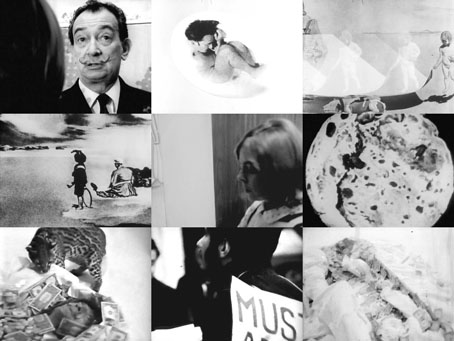
Another Dalínean gem surfaces at Ubuweb. Dalí in New York is a fascinating 50-minute account of the artist’s antics in New York City at the end of 1965. Unlike the reverential documentaries of the 1970s this film isn’t out to flatter its subject: scenes of the usual Dalí happenings are intercut with some combative verbal sparring from the equally remarkable Jane Arden who does her best to try and make sense of the painter’s pronouncements. The director was Arden’s collaborator, Jack Bond, most of whose work was for television although he’s also notable for having directed the Pet Shop Boys’ It Couldn’t Happen Here (1988), a film with some not entirely successful “surrealist” moments of its own.

Previously on { feuilleton }
The Secret Life of Edward James
René Magritte by David Wheatley
Soft Self-Portrait of Salvador Dalí
Mongolian impressions
Hello Dali!
Dirty Dalí
Impressions de la Haute Mongolie revisited

The Fourth Dimension

fourthdimension.jpg

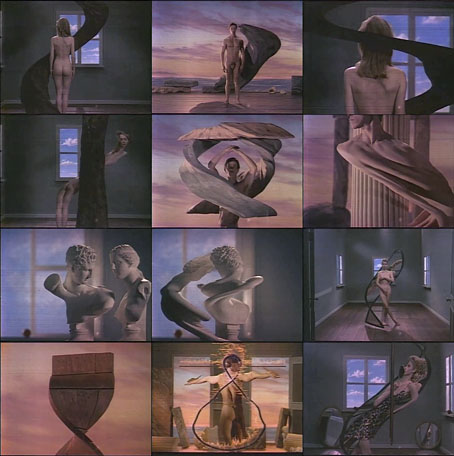
This post ought to have followed the one about Tango since it concerns another experimental film by Zbigniew Rybczynski. The Fourth Dimension was made in 1988 and like many of the director’s films uses a single effect to create striking results. In this case the effect involves photographing people and objects one narrow line at a time. When the lines are combined then shifted slightly the objects seem to bend and twist like melting plastic. This is the kind of semi-analogue technique which has now been made redundant by computer animation but Rybczynski gives his compositions a quasi-Surrealist quality, reinforced by the Magritte-like windows in some of the rooms.

Previously on { feuilleton }
Tango