Weekend links 504

maclean.jpg

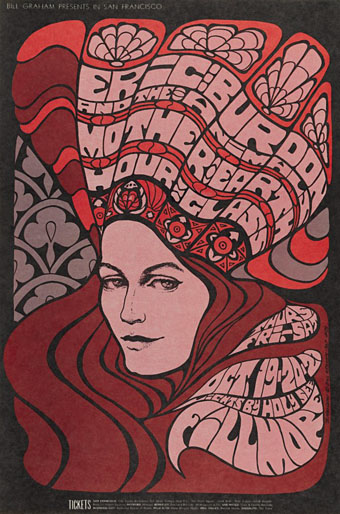
Eric Burdon and the Animals, Mother Earth, Hour Glass; Fillmore Auditorium, October 19-21, 1967 by Bonnie MacLean.

• RIP Bonnie MacLean, another of the original San Francisco poster artists, and the only woman of note in the US psychedelic poster scene. (Not the only woman, however; in Europe we had Marijke Koger.) Related: Bonnie MacLean’s posters at Wolfgang’s. And RIP to illustrator Tom Adams, an artist whose exceptional covers for novels by Agatha Christie are only one part of a long and varied career.

The Litanies Of Satan (1982), the short but uncompromising debut album by Diamanda Galás, is reissued on Galás’s own label later this month. Further albums from her remarkable back catalogue will follow. Related: video of Galás performing The Litanies Of Satan in 1985.

• “Scorsese is amazed that United Artists didn’t touch one frame of Raging Bull, since it’s the first time in his life as a feature director that this has apparently occurred.” In 1981 Derek Malcolm talked to Martin Scorsese about his reasons for making a boxing picture.

“…in a post-AIDS world, its scenes of mass male-on-male decadence evoke a sense of the spiritual: Not to put so blunt a phrase on it, but the majority of the men we see in Cruising‘s bars would likely die within the next decade, victims of a very heterosexual genocide of neglect. These are blurred, melancholic memories locked forever within Cruising‘s celluloid; a phantasmagoria of men whose liberation was not legislatively delivered, but recovered in the privacy of leather bars and cruising joints. The film’s overt sexuality makes it hard to escape a sense of catastrophic loss.”

Jack King on William Friedkin’s Cruising

• The Pet Shop Boys’ eccentric feature film, It Couldn’t Happen Here (1988), is released on blu-ray and DVD in June. The video for You Were Always On My Mind gives an idea of the contents.

• “Orion being one of the brightest constellations makes it a lot of people’s favourites, and he was my favourite as a kid.” Ben Chasny on his history of stargazing.

• “You think the Holy Grail is lost? No. I have it on my piano.” John Boorman talks to Xan Brooks.

• Laura Cumming on the dark and haunting paintings of Belgian Symbolist Léon Spilliaert.

• Mix of the week: XLR8R Podcast 631 by Ondness.

Alistair Ryder chooses 10 great killer plant films.

Howl by John Foxx And The Maths.

• At Dennis Cooper’s: Gleam.

The Litanies Of Satan (1969) by Ruth White | Grail (1971) by Grail | Plants’ Music (1981) by Ippu-Do

Haeckel’s Radiolaria

haeckel01.jpg

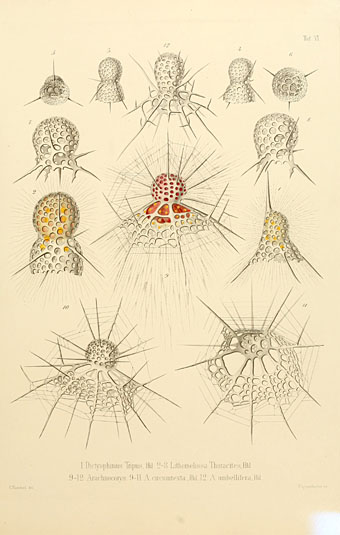
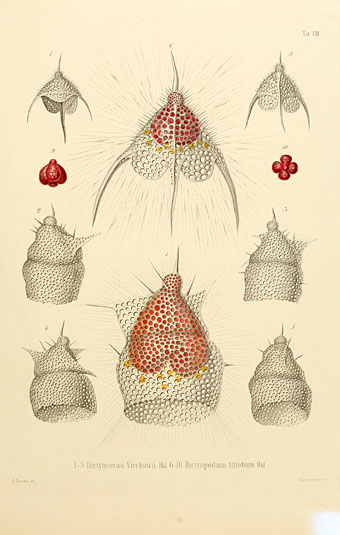
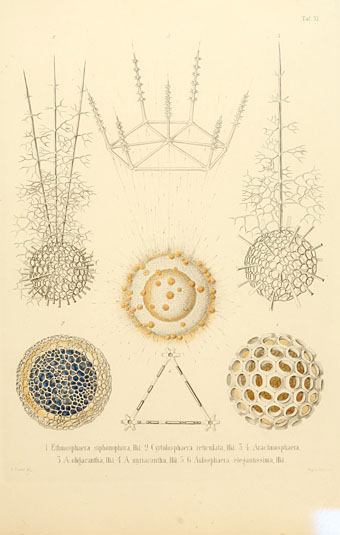
I’ve been admiring (and plundering) Ernst Haeckel’s Kunstformen der Natur (Artforms in Nature, 1904) for many years, but until this week I hadn’t thought to look for other books by the German biologist. The plates in Haeckel’s Kunstformen fascinate for the way their drawings emphasise the aesthetic qualities of the animals being studied, without taking the wild liberties one finds in early zoological books or being photographically faithful to the specimens.

haeckel02.jpg

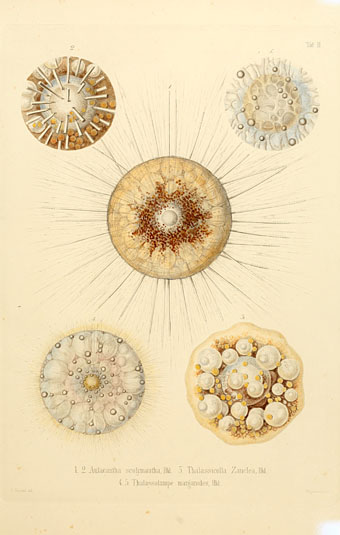
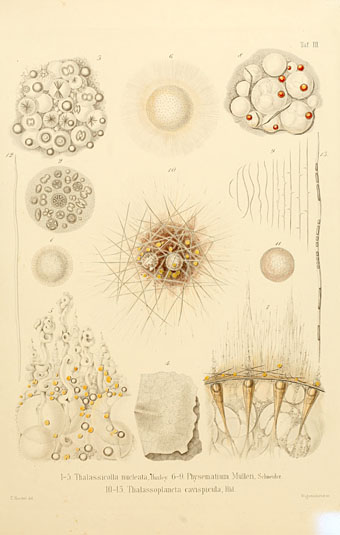
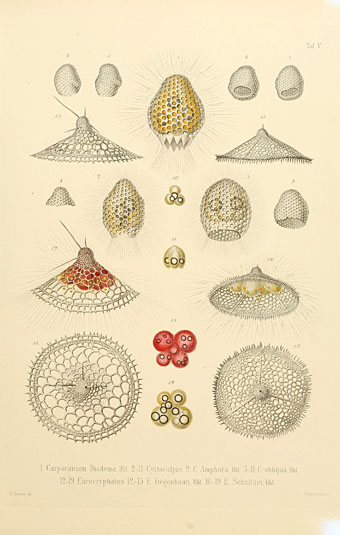
Of particular fascination are the many plates devoted to Radiolaria, tiny marine protozoa whose mineral skeletons look less like the product of living creatures than abstract decorations, crystalline growths or even pieces of alien architecture. These unusual forms were the ones that captured the imagination of René Binet, a French designer and architect who collaborated with Gustave Geffroy on a whole book of architectural and household designs derived from Haeckel’s plates. So too with Salvador Dalí who wasn’t above borrowing (or “quoting”) from Haeckel’s Radiolaria.

haeckel03.jpg

Haeckel was evidently just as fascinated with the protozoa, enough to write and illustrate a substantial monograph. Die Radiolarien (Rhizopoda radiaria): Eine Monographie (1862) is available at the Biodiversity Heritage Library and the Internet Archive in a mammoth four-volume set, a large portion of which is explanatory text. There’s also a separate volume with a selection of the plates alone which is easier to browse. These drawings show much more variety than the Kunstformen plates which represent the examples that Haeckel considered most visually appealing; they also show us how much Haeckel tailored his renderings for Kunstformen, favouring symmetry and harmony over natural imperfections. Oscar Wilde would have approved of Haeckel’s adjustments, as he writes in The Decay of Lying: “My own experience is that the more we study Art, the less we care for Nature. What Art really reveals to us is Nature’s lack of design, her curious crudities, her extraordinary monotony, her absolutely unfinished condition. Nature has good intentions, of course, but, as Aristotle once said, she cannot carry them out.”

haeckel04.jpg

haeckel05.jpg

haeckel06.jpg

Continue reading “Haeckel’s Radiolaria”

Weekend links 498

mead.jpg

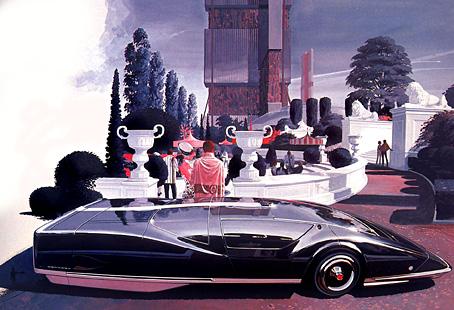
The Sentinel 280, a car design by Syd Mead from 1964.

• “Boris Dolgov did not exist. The man who bore that name may have existed, but there never was a man in the United States with that name until 1956, too late for Weird Tales.” Teller of Weird Tales on the mysterious identity of a magazine artist.

• Saying goodbye to 2019 also meant saying farewell to Vaughan Oliver, Neil Innes and Syd Mead. Related: Vaughan Oliver at Discogs; I’m The Urban Spaceman; a look back at Syd Mead’s vehicle designs.

Lanre Bakare on how ambient music became cool. (Again. This begs the question of when it became uncool, especially when a ten-year-old Brian Eno piece about “the death of uncool” is being quoted.)

Westerners interpreted the peyote experience very differently from the practitioners of the peyote religion, where the focus was “ritual, song and prayer, and to dissect one’s private sensations was to miss the point”. Writers such as Havelock Ellis, who published an essay on his peyote experiences in the Lancet in 1897 (it’s likely that he also administered the substance to his friends W.B. Yeats and Arthur Symons), instead tended to focus on its visual effects. Ellis described “the brilliance, delicacy and variety of the colours” and “their lovely and various textures”. Peyote reached Europe in tandem with the X-ray, cinema and electric lights, Jay notes, and “nothing delighted the eye of the mescal eater so much as the new electrical sublime”.

Emily Witt reviewing Mescaline: A Global History of the First Psychedelic by Mike Jay

Peter Bradshaw takes on the thankless task of ranking Federico Fellini’s feature films.

Geoff Manaugh on when Russia and America coöperated to avert a Y2K apocalypse.

• “Music is an ideal medium for interstellar communication,” says Daniel Oberhaus.

Keith Allison on Karel Zeman, a creator of remarkable cinematic fantasies.

•  Japanese Designer New Year’s Cards of 2020.

• At Dennis Cooper’s: Vera Chytilová Day.

2020 in public domain.

Sentinel (1992) by Mike Oldfield | Sentinels (2001) by Cyclobe | Sentinel (2004) by Transglobal Underground

Weekend links 495

klee.jpg

Angelus Novus (1920) by Paul Klee.

• “Compared to [László] Krasznahorkai’s earlier fiction, Baron Wenckheim’s Homecoming is funnier and more stylistically accessible—despite its length and seemingly endless sentences—but it is also his most unremittingly ruthless work,” says Holly Case. Elsewhere: “Baron Wenckheim’s Homecoming may not bring joy or consolation, but reading it is a mesmerisingly strange experience: a slab of late modernist grindcore and a fiercely committed exercise in blacker-than-black absurdity,” says Sukhdev Sandhu.

Zeitraffer (“Time-lapse“) is an exhibition devoted to Tangerine Dream which opens at the Barbican, London, in January. Also coming in January is a new album, Recurring Dreams, by the current iteration of the group which will be available on CD and double vinyl. I was impressed by the last TD release, Quantum Gate, so I’m looking forward to this even if it is only a reworking of popular pieces from the Virgin years.

• RIP Gershon Kingsley, an electronic music pioneer best known for the silly but fun albums he made with Jean-Jacques Perrey, and for being the composer of that evergreen synthesizer novelty, Popcorn.

The first major study in English of ancient Greek sexuality—especially the way relationships between men were both common and celebrated as a perfect embodiment of love—A Problem in Greek Ethics helped set the stage for the modern-day gay rights movement. But it did so surreptitiously, behind closed doors, as required by the times. Symonds printed it privately in 1883; a print run of just 10 copies reduced the risk that it would fall into the wrong hands. The typesetter complained about the content. Symonds circulated it cautiously, to people he trusted or had reason to think would be discreet. Until now, researchers believed that only five copies survived.

Rachel Wallach on the discovery of a sixth copy of John Addington Symonds’ landmark study

Contagious Magick of the Super Abundance is a book of art by the late Ian Johnstone, former partner of John Balance and cover artist for some of the last releases by Coil.

Dennis Cooper‘s favourite fiction, poetry, non-fiction, film, art, and internet of 2019. Thanks again for the link here!

• At the BFI: Hannah McGill on the umbrellas of cinema, and Jasper Sharp on 10 essential films by Yasujiro Ozu.

• Bobby Krlic, aka The Haxan Cloak, talks to Claire Lobenfield about creating the soundtrack for Midsommar.

Joker and Chernobyl composer Hildur Guðnadóttir: “I’m treasure hunting”.

Joshua Rothman on how William Gibson keeps his science fiction real.

Samantha Rose Hill on Walter Benjamin’s last work.

Scientific phenomena photographs of the year.

The Dream Before (1989) by Laurie Anderson | Angel Tech (1994) by The Grid feat. Sheila Chandra | Angel Tech (1994) by Pete Namlook & Bill Laswell

Weekend links 494

church.jpg

Aurora Borealis (1865) by Frederic Edwin Church.

• December is over-stuffed with enervating cultural lists, most of them reminding you of things which received enough attention earlier in the year. Better value than these—and always unpredictable—is John Waters‘ choice of favourite films; unpredictable and enlightening are the Secret Satan selections at Strange Flowers which come in two flavours: books originally published in English and books translated from other languages.

Flash Of The Spirit (1988), a collaboration between Jon Hassell and African group Farafina (with production by Hassell plus Brian Eno & Daniel Lanois), receives its first ever reissue on double-vinyl and CD next year. The last piece on the album is the 11-minute Masque (Strength).

• “In 1968, Federico Fellini decided he was going make the greatest homosexual movie ever made. What he meant by a homosexual movie, no one was quite sure, but it was going to be great.” Paul Gallagher on Federico Fellini’s delirious (and distinctly homosexual) Satyricon.

• “Here’s the typography of the next decade; the age of font minimalism is coming to a close,” says Rachel Hawley. I’ve been using Didones for the past decade so I’ll carry on happily ignoring the trends.

• More obituaries for comic artist Howard Cruse: Justin Hall at The Comics Journal; Trudy Ring at The Advocate; and Richard Sandomir at the New York Times.

• “Cowley records a kind of utopian sleaze that’s breathtaking.” Brett Josef Grubisic reviews Patrick Cowley’s sex journal of the 1970s, Mechanical Fantasy Box.

• At the BFI: Carmen Gray on where to begin with Sergei Parajanov, and Matthew Thrift on 10 essential Fritz Lang films.

A promo video by Julian House for Paul Weller’s In Another Room EP which is released in January by Ghost Box.

• At Aquarium Drunkard: San Francisco Radical Laboratory and the Mysterious Moogist of Altamont.

• Mix of the week: Through A Landscape Of Mirrors Vol. V – France III by David Colohan.

Aurora Australis (2005) by Émilie Simon | Iceblink (Aurora Borealis Mix) (2011) by Netherworld | Aurora Liminalis (2013) by William Basinski & Richard Chartier