Weekend links 524

heisler.jpg

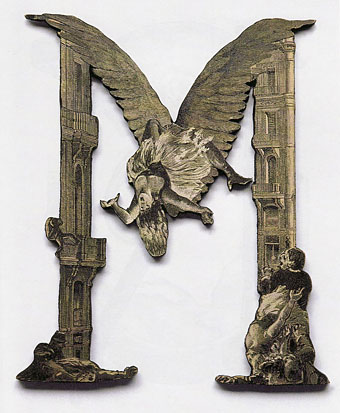
Letter M from Abeceda (1942) by Jindrich Heisler.

• At the BFI: Matthew Thrift chooses 10 essential Ray Harryhausen films. “This is, I can assure the reader, the one and only time that I have eaten the actors. Hitchcock would have approved,” says Harryhausen about eating the crabs whose shells were used for Mysterious Island. Meanwhile, Alfred Hitchcock himself explains the attraction and challenges of directing thrillers.

“Although largely confined to the page, Haeusser’s violent fantasies were even less restrained, his writings littered with deranged, bloodthirsty, scatological scenarios.” Strange Flowers on Ludwig Christian Haeusser and the “Inflation Saints” of Weimar Germany.

• Death, Pestilence, Emptiness: Putting covers on Albert Camus’s The Plague; Dylan Mulvaney on the different design approaches to a classic novel.

• A trailer (more of a teaser) for Last and First Men, a film adaptation of Olaf Stapledon’s novel by the late Jóhann Jóhannsson.

• At Dennis Cooper’s: Spotlight on…James Purdy: The Complete Short Stories of James Purdy.

Al Jaffee at 99: Gary Groth and Jaffee talk comics and humour.

Steven Heller on Command Records’ design distinction.

Czech Surrealism at Flickr.

Sisters with Transistors.

Solitude by Hakobune.

Mysterious Semblance At The Strand Of Nightmares (1974) by Tangerine Dream | Mysterious Traveller (Dust Devils Mix) (1994) by System 7 | The Mysterious Vanishing of Electra (2018) by Anna von Hausswolff

Weekend links 523

miller.jpg

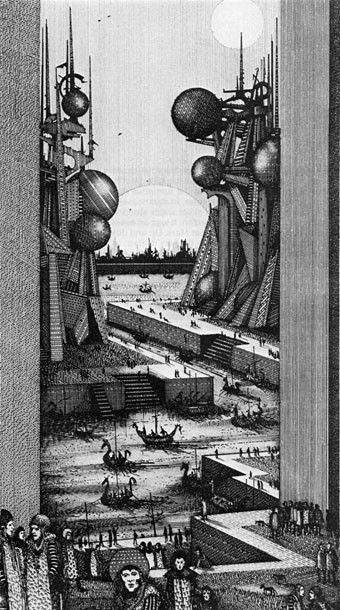
One of Ian Miller‘s drawings from the illustrated edition of Ray Bradbury’s The Martian Chronicles, 1979.

• “I always said we were kind of an electronic punk band, really. We were never New Romantics, I don’t like it when we get lumped in with that.” Dave Ball of Soft Cell and The Grid talking to Duncan Seaman about his autobiography, Electronic Boy: My Life In and Out of Soft Cell. I’ll now be waiting impatiently for the unreleased Robert Fripp/Grid album to appear.

• “[Patricia] Highsmith’s writing—often eviscerating, always uncomfortable—has never been more relevant,” says Sarah Hilary.

• Ron Peck’s debut feature, Nighthawks (1978), is “a nuanced look at gay life in London,” says Melissa Anderson.

And then there are those figures who seem to flit around the edges of movements without ever being fully involved in any of them, who pursue their own eccentric paths no matter what is going on around them. These are the writers who make up the secret history of literature, the hidden history that’s not easily reduced to movements or trends, and who always waver on the verge of invisibility until you stumble by accident onto one of their books and realize how good they actually are, and wonder, Why wasn’t I told to read this before? But of course you already know the answer: You were not told because it doesn’t fit smoothly into the story those in authority made up about what literature is—it disrupts, it can’t be reduced to the literary equivalent of a meme.

That’s the kind of writer Pierre Klossowski (1905–2001) is. He is not a joiner. He has his own particular and often peculiar concerns, and pursues them. He does not particularly welcome you in. The content of his writing, too, has the feel of a gnostic text, as if you are reading something that, if only you were properly initiated, you would understand in a different way. In that sense his work has an esoteric or occult quality to it—and likewise in the sense that it returns again and again to the intersection of religion and pornography, the sacred and the profane.

Brian Evenson on The Suspended Vocation by Pierre Klossowski

• Chad Van Gaalen creates a psychedelic animation for Seductive Fantasy by the Sun Ra Arkestra.

• More sneak peeks from the forthcoming The Art Of The Occult by S. Elizabeth.

• More Robert Fripp: Richard Metzger on Fripp’s sui generis solo album, Exposure.

Pamela Hutchinson on the pleasures of David Lynch’s YouTube channel.

• Mix of the week: a second Jon Hassell tribute mix by Dave Maier.

• At Dennis Cooper’s: Ferdinand presents…Dark Entries Day.

15 fascinating art documentaries to watch now.

Soft Power by Patten.

• RIP Milton Glaser.

hauntología

Aquarium (1992) by The Grid (with Robert Fripp) | Soft Power (2005) by Ladytron | The Martian Chronicles (2007) by Dimension X

Scarabus, a film by Gérald Frydman

scarabus1.jpg

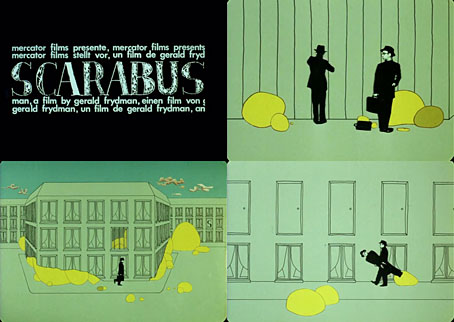
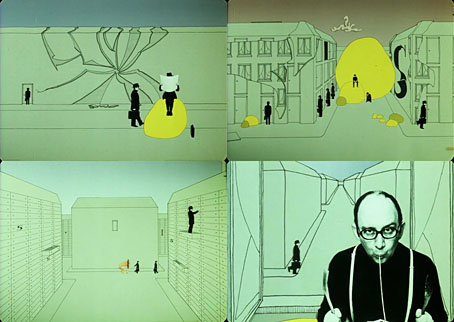
Another tip from Philip Strick’s Science Fiction Movies (1976) (previously) that’s also another short animated film I hadn’t seen before. Gérald Frydman is a Belgian director, and Scarabus (1971) was his debut film. As with a number of the selections in Strick’s book, Scarabus tends more towards Surrealism than science fiction, although this always depends how broadly you define SF: identical men in black clothes populate a crumbling urban environment where much of the architecture is inside out and upside down, and unidentified yellow blobs clutter the place. Airships drift overhead while the men interact with each other, sometimes in a violent manner. The meaning may be elusive but it’s all very well done, and the film was later chosen to accompany the French theatrical screenings of Alain Resnais’s Providence. That’s what I call a good night out.

scarabus2.jpg

Previously on { feuilleton }
Labirynt by Jan Lenica

Interview with the vampire illustrator

illustration1.jpg

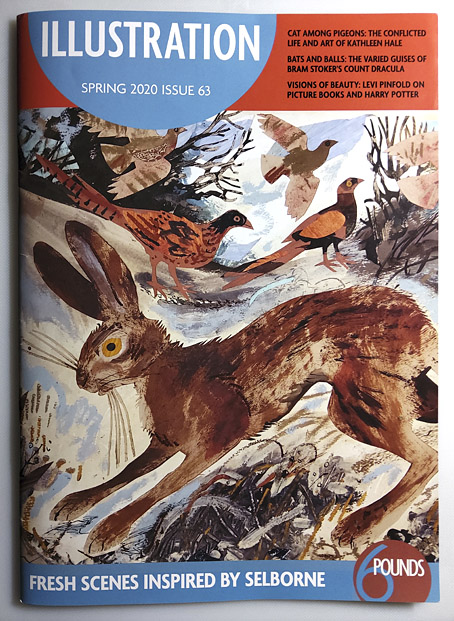
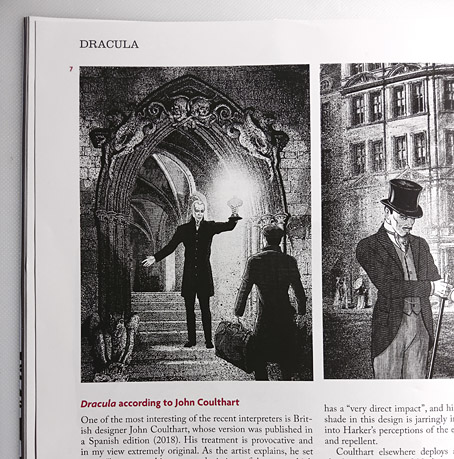
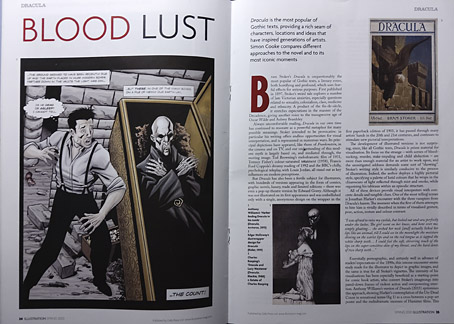
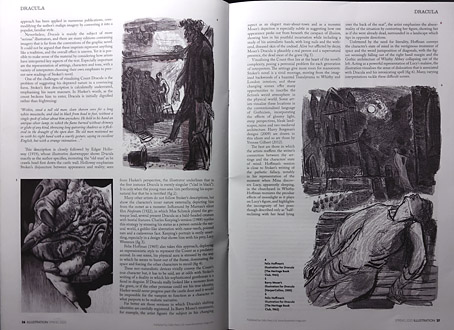
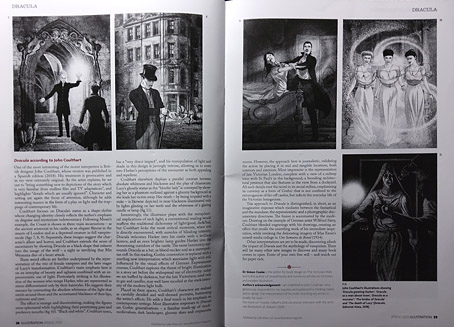
Some of the many illustrators of Bram Stoker’s Dracula are the subject of a six-page feature in the latest issue of Illustration magazine. The writer of the piece, Simon Cooke, asked me a few questions about the edition I worked on for Editorial Alma in 2018 (previously), and he devotes two pages to analysing my illustrations. I was a little unnerved by this since Alma asked me to produce 27 full-page pictures—one for each chapter—in five weeks, which isn’t the kind of deadline I prefer for work that requires so much historical research. Consequently, I still feel the book is compromised but people evidently like the end results so I should stop complaining. Illustration magazine is available from Cello Press.

illustration2.jpg

As for my work of the moment, the Joe Banks Hawkwind book will be published by Strange Attractor in the next few weeks, so everyone will finally get to see my Frank R. Paul-derived wraparound cover. And there’s more science fiction on the way with a new cover design featuring a robot as its centrepiece. Watch this space.

illustration3.jpg

illustration4.jpg

illustration5.jpg

Previously on { feuilleton }
Hawkwind: Days of the Underground
Illustrating Dracula

The Heat of a Thousand Suns by Pierre Kast

kast1.jpg

In an earlier post I mentioned how invaluable I’d found Philip Strick’s Science Fiction Movies, a large-format study published in 1976. Like Denis Gifford’s Pictorial History of Horror Movies (1973), the book was intended as a cheap introduction to a popular genre but Strick wasn’t content to limit himself to familiar titles, offering instead a remarkably eclectic list of films, many of which are barely science fictional at all: Last Year at Marienbad, The Saragossa Manuscript, The Hour of the Wolf, Teorema, The Discreet Charm of the Bourgeoisie, and so on. For my teenage self, and no doubt many other readers, this was my first encounter with these and other titles, and it was Strick’s descriptions that kept me on the lookout for them for many years (over 20 in the case of Saragossa). Strick’s equanimity treated cinema as a global medium, not one where Hollywood dominates the marketplace and all the conversation. Other films under discussion were definitely SF but unviewable to those of us who without access to an arts cinema, and little hope of ever seeing them on TV, European obscurities such as La Jetée, Fantastic Planet, Je t’aime, je t’aime and The End of August at the Hotel Ozone. Despite the book’s age, and the relative ease with which anyone can now see films such as these, a few scarcities remain, one of which I watched for the first time last week.
kast2.jpg

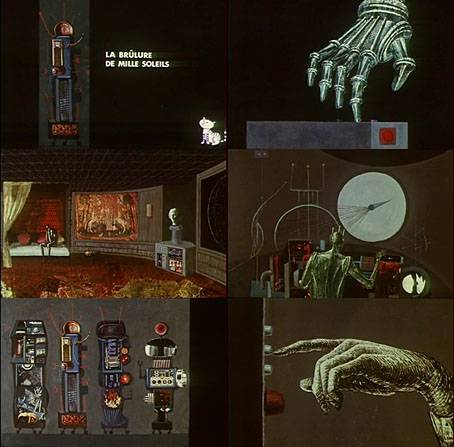
The Heat of a Thousand Suns/La Brûlure de Mille Soleils (1965) is a 25-minute animated film written and directed by Pierre Kast that Strick not only describes but further tantalises the reader with a pair of stills, which may account for its title having lodged in my memory all this time. Strick discusses the film between two other animations that are now very familiar: The Green Planet, an early work by Piotr Kamler, and Les Jeux des Anges by Walerian Borowczyk. (If all this sounds like wilful obscurantism on Strick’s part, on the previous page he discusses a pair of classic Hollywood features, This Island Earth and Forbidden Planet.) Kamler’s film is a humorous one, while Borowczyk’s is strange and disturbing; Kast’s film is pitched somewhere between the two:

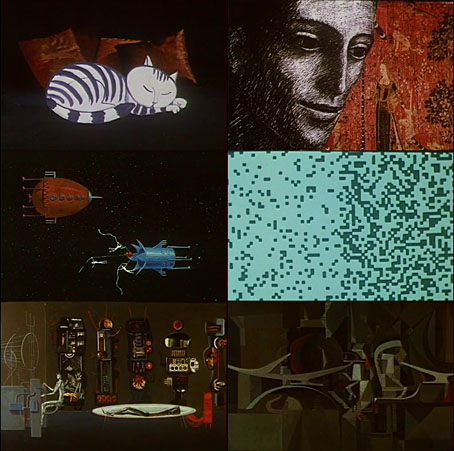
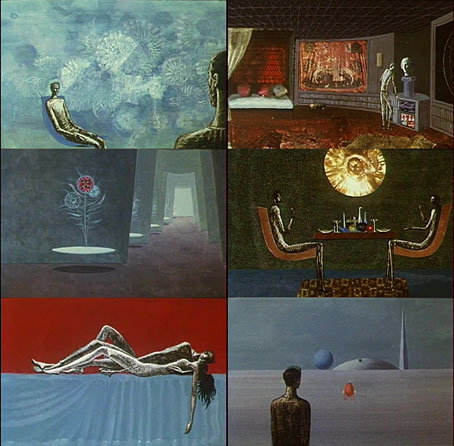
A young man in the far future becomes bored with the solar system he knows too well and goes for an unrepeatable trip to the stars, in the company of his robots and his cat. On a remote planet he encounters a tranquil civilization where something has only to be wished for, and it happens; he meets a girl, they fall in love, and their romance is frustrated by his complete inability to recognize the different standards of her society where sexual groups of eight comprise a family. Put together from paintings by a Spanish surrealist artist, Eduardo Luiz, whose suffused landscapes and delicate tapering figures provide the perfect balance to the gentle melancholy of the hero’s monologue, the film has the same touch of scorn at its centre as was evident in Kast’s other science-fiction works, Amour de Poche (1957) and Les Soleils de l’Ile de Pâques (1971), although its twinkling conclusion is more in keeping with his romantic comedy Vacances Portugaises (1961). It’s one of the most effective screen versions so far of science fiction’s crusade not so much for a better world as for better people on it.

Strick also mentions a detail about the production that I’d forgotten, namely the editing being the work of La Jetée director, Chris Marker. The latter’s credit makes the inclusion of a space-faring cat both funny and fitting although the animal is unconcerned by interstellar travel, and spends most of its time asleep. Another notable name is electronic composer Bernard Parmegiani who provided the score for this and other films by Kast; he also scored several shorts by Piotr Kamler and Borowczyk’s Jeux des Anges.
kast3.jpg

Now that I’ve finally seen Kast’s film I wouldn’t say it was worth the wait but it was definitely worth watching. The animation is very minimal, with most of the shots being still images that the camera wanders over. The SF scenario is very conventional, as are the trappings: a pointed rocket, bleeping robots, aliens that look and behave like Earth people even if they do have eight sexes. The film distinguishes itself much more with its design, the Giacometti-like figures, and the interior of the spacecraft which pre-empts Barbarella with its lavish chambers filled with period decor and artwork. Despite Strick’s praise, Kast’s conventionality seems a missed opportunity when animation can do so much more than ape live-action cinema. Piotr Kamler’s films, in particular Labyrinth (1969) and Chronopolis (1983), offer science-fiction scenarios that are remote from our own lives and preoccupations; so too with Borowczyk’s Jeux des Anges, a film whose industrial nightmare is closer to David Lynch than Barbarella. Kast does have a late surprise, however, although this may only mean anything to those familiar with Chris Marker’s photography.

The Heat of a Thousand Suns is on YouTube but with no subtitles for its French narration. The copy I watched was from this page which includes a subtitle file. I suspect this may be a DVD rip, and therefore immoral, but the same probably applies to the YouTube version as well. The choice is yours.

Previously on { feuilleton }
A Pictorial History of Horror Movies by Denis Gifford
Saragossa Manuscript posters
Marienbad hauntings
Chronopolis by Piotr Kamler
Les Jeux des Anges by Walerian Borowczyk