
Secular Europe’s Merits
| Get thee behind me, God.
Category: {religion}
Religion
The art of Stella Langdale, 1880–1976
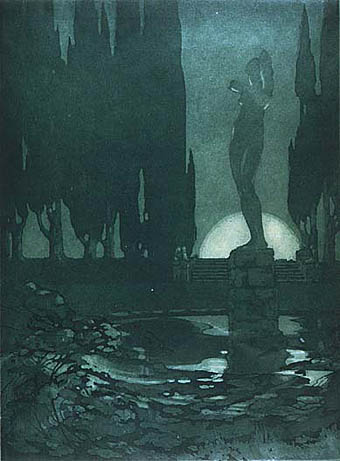
Nocturne (aquatint; no date).
One of Callum‘s recent book postings alerted me to the work of Stella Langdale, an artist and illustrator I hadn’t come across before. Judging from online listings her obscurity would seem to be a result of not having being as productive as some of her contemporaries, and her drawings are a deal more gloomier than the delicate pen-and-ink style that was common in book illustration at the time. But it’s her brooding charcoal masses which I find appealing. As with the better Gustave Doré illustrations, they adumbrate more than they depict by the use of careful composition. Some of her other works are aquatints, a form of etching which allows for similar effects to the graded atmospheres of charcoal.
Cain’s son: the incarnations of Grendel
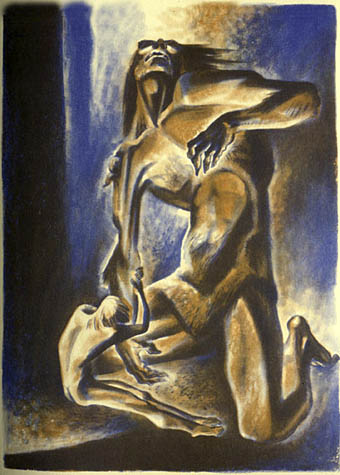
Beowulf wrestles with Grendel, Lynd Ward (1939).
There’s nothing new in pointing out Hollywood’s crimes against literature, the film business has been screwing up book adaptation since the earliest days of silent cinema. But sometimes the wound is so grievous you can’t help but speak out, in this case against Roger Avary’s Beowulf which is released next month. This is another CGI-heavy confection along the lines Polar Express, with the actors being given digital bodies via motion-capture, and it’s something I’d probably have ignored until I saw this picture of Grendel, the story’s principal monster. Beowulf is one of the earliest surviving Anglo-Saxon poems and Grendel, the bloodthirsty creature which Beowulf battles, is one of the ur-fiends of English literature, along with his equally monstrous, lake-dwelling mother and the dragon which fatally wounds the hero. The trio give us a peek back into the dark imagination from a time before recorded history and Grendel especially has always had something raw and primal about its character. So when you see a beast with such a history portrayed as little more than a diseased muppet you wonder what’s going on. Are the creators inept? Ignorant? Were studio restrictions at work? How does an industry with the talent to give splendid life to the trolls and Balrog of Lord of the Rings, or Davy Jones and crew in Pirates of the Caribbean, screw up so badly?
Last Suppers and last straws

Hardly a week passes without the religious right in America getting their knickers in a twist over some new iniquity, a condition so commonplace that new outbreaks are barely worth acknowledging. However, this week’s storm in a teacup caught my attention for being art-related.
If there’s one thing certain American Christians have in common with Muslim fundamentalists, it’s the habit of reacting to anything remotely gay with all the composure of caged baboons being prodded with sharp sticks. The pointed implement on this occasion has been the poster for the Folsom Street Fair, an annual Leather Pride/BDSM event held in San Francisco. The photograph by FredAlert (site NSFW) continues what’s become a minor tradition in artistic parody by working a variation on Leonardo da Vinci’s The Last Supper (1498), with leather girls and guys for the disciples and a black man in the place of Leonardo’s Jesus. The flag on the table is a Leather Pride flag. The intent behind the poster was explained by Andy Cooper, one of the event’s organisers:
There is no intention to be particularly pro-religion or anti-religion with this poster; the image is intended only to be reminiscent of the Last Supper painting. It is a distinctive representation of diversity with women and men, people of all colors and sexual orientations.
(…)
We hope that people will enjoy the artistry for what it is—nothing more or less. Many people choose to speculate on deeper meanings. This is one artist’s imagining of the Last Supper, and we have made it our own. The irony is that da Vinci was widely considered to be homosexual. In truth, we are going to produce a series of inspired poster images over the next few years. Next year’s poster ad may take inspiration from American Gothic by Grant Wood or Edvard Munch’s The Scream or even The Sound of Music! I guess it wouldn’t be Folsom Street Fair without offending some extreme members of the global community, though.
To judge by the splenetic frothing of groups such as the Concerned Women for America, it seems they managed a double helping of offence this year. The CWA see a deliberate attack on their religion, something I can’t see at all. While the reaction may seem to be harmless bluster, it should be noted that groups such as CWA and the more substantial American Family Association receive a lot of money via donations from supporters. Moral panics and perennial threats to civilisation have become a means to drum up additional support (ie: cash) to safeguard what they claim are Christian values. And gay people/rights/events have become a convenient whipping boy (so to speak) for fund-raising. As Joe Murray, ex-staff attorney for the American Family Association writes, this is now a multi-million dollar business:
It is not coincidental that the road to Hell is paved with the best of intentions, thus while one hopes that conservative leaders, such as Don Wildmon, began their crusade motivated by morality, it appears that a number of them have been hypnotized by the siren song of the almighty dollar.
Christian activism has become a lucrative business. According to its 990 form, the AFA took in millions. Arguably, such revenue was made possible by sending out “Action Alerts” warning homosexuals will throw Christians in jail under the hate crimes bill. Such rhetoric is misleading at best, dishonest at worse.
How does one protect Christianity? Send money. Call it cash-back Christianity…
Public complaints about blasphemy or other slights are always double-edged. Without the outrage I probably wouldn’t have noticed the Folsom poster, despite reading gay news blogs every day. But thanks to the CWA this isn’t the only blog now replicating the picture or showing similar examples of alleged Leonardo abuse. It hardly needs pointing out that the two other paintings mentioned in the Folsom Street Fair statement are also very popular as parody subjects and parody doesn’t work at all if the original reference isn’t well-known. Leonardo’s two most famous works are the Mona Lisa and The Last Supper and the latter proves attractive for parodists by being a group scene presented in tableaux form. The Last Supper, American Gothic and Michelangelo’s Creation of Adam must be the three most-parodied paintings in art history; many of the Last Supper variations?including versions by Salvador Dalí and Andy Warhol?are very well-known and have been around for years.
Strange cargo: things found in books

The Secret Oral Teachings in Tibetan Buddhist Sects by Alexandra David-Neel & Lama Yongden, City Lights Books (1972).
One of the additional pleasures of buying old books besides finding something out-of-print (or, it has to be said, something cheap) occurs when those books still possess traces of their previous owners. A recent posting on The Other Andrew’s page concerned book inscriptions, something any book collector will be used to seeing. Less common are the objects which slip from the pages when you’ve returned home. There are several categories of these.
1: Bookmarks
I have a substantial collection of bookmarks proper, from embossed strips of leather to the more mundane pieces of card of the type that bookshops frequently give away. But I also make a habit of using odd inserts to mark a place as did the previous owners of these volumes. The City Lights book (above) came with a very fragile leaf inside it which may well be as old as the book. Another City Lights book I own, the Artaud Anthology from 1965, included a newspaper article about Artaud. Newspaper clipping inserts are discussed below.