The Hound of Heaven by RH Ives Gammell

gammell.jpg

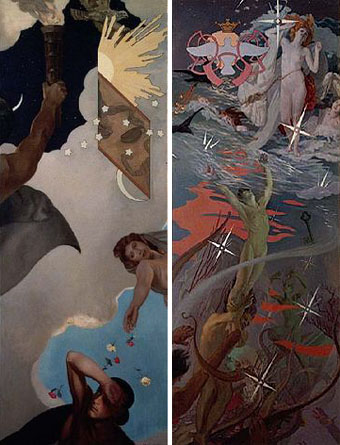
A Pictorial Sequence by RH Ives Gammell Based on
The Hound of Heaven (1956):
left: Panel II—I Fled Him, Down The Nights and Down The Days.
right: Panel XI—Would Clash It To.

I mentioned Francis Thompson’s poem The Hound of Heaven in the Stella Langdale post a couple of days ago. There don’t appear to be any examples of those pictures online but there are a few samples of RH Ives Gammell‘s remarkable paintings based on the same work which Claire alerted me to last month. Gammell (1893–1981) was an American realist with a forthright attitude that set him against Modernist and later art trends yet he was still able to incorporate a more contemporary approach to composition in these unique works. Too often pitching yourself against the present results in the kind of reactionary posturing one sees at the Art Renewal Center where they wish they could turn the clock back to a time before Picasso. Gammell was smarter than that and his Thompson paintings are a striking series of Tarot-like depictions of Christian mysticism.

Once again I have to make the complaint that there aren’t many good reproductions of these works online at the moment; a complete set of the pictures would be a start. The paintings themselves can be seen at the Maryhill Museum of Art, Goldendale, Washington, USA.

RH Ives Gammell by Elizabeth Ives Hunter
Transcending Vision; details of a 2001 exhibition

Elsewhere on { feuilleton }
The fantastic art archive

Previously on { feuilleton }
The art of Stella Langdale, 1880–1976

The art of Stella Langdale, 1880–1976

langdale1.jpg

Nocturne (aquatint; no date).

One of Callum‘s recent book postings alerted me to the work of Stella Langdale, an artist and illustrator I hadn’t come across before. Judging from online listings her obscurity would seem to be a result of not having being as productive as some of her contemporaries, and her drawings are a deal more gloomier than the delicate pen-and-ink style that was common in book illustration at the time. But it’s her brooding charcoal masses which I find appealing. As with the better Gustave Doré illustrations, they adumbrate more than they depict by the use of careful composition. Some of her other works are aquatints, a form of etching which allows for similar effects to the graded atmospheres of charcoal.

Continue reading “The art of Stella Langdale, 1880–1976”

Cain’s son: the incarnations of Grendel

beowulf1.jpg

Beowulf wrestles with Grendel, Lynd Ward (1939).

There’s nothing new in pointing out Hollywood’s crimes against literature, the film business has been screwing up book adaptation since the earliest days of silent cinema. But sometimes the wound is so grievous you can’t help but speak out, in this case against Roger Avary’s Beowulf which is released next month. This is another CGI-heavy confection along the lines Polar Express, with the actors being given digital bodies via motion-capture, and it’s something I’d probably have ignored until I saw this picture of Grendel, the story’s principal monster. Beowulf is one of the earliest surviving Anglo-Saxon poems and Grendel, the bloodthirsty creature which Beowulf battles, is one of the ur-fiends of English literature, along with his equally monstrous, lake-dwelling mother and the dragon which fatally wounds the hero. The trio give us a peek back into the dark imagination from a time before recorded history and Grendel especially has always had something raw and primal about its character. So when you see a beast with such a history portrayed as little more than a diseased muppet you wonder what’s going on. Are the creators inept? Ignorant? Were studio restrictions at work? How does an industry with the talent to give splendid life to the trolls and Balrog of Lord of the Rings, or Davy Jones and crew in Pirates of the Caribbean, screw up so badly?

Continue reading “Cain’s son: the incarnations of Grendel”