Spare things

spare-cthulhu.jpg

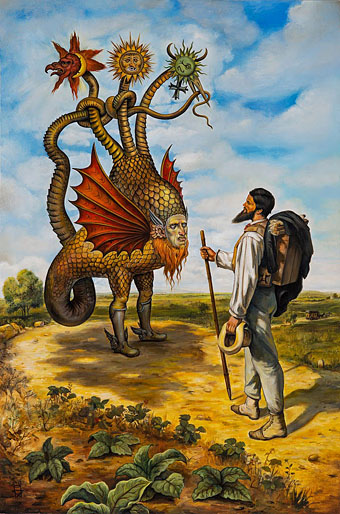
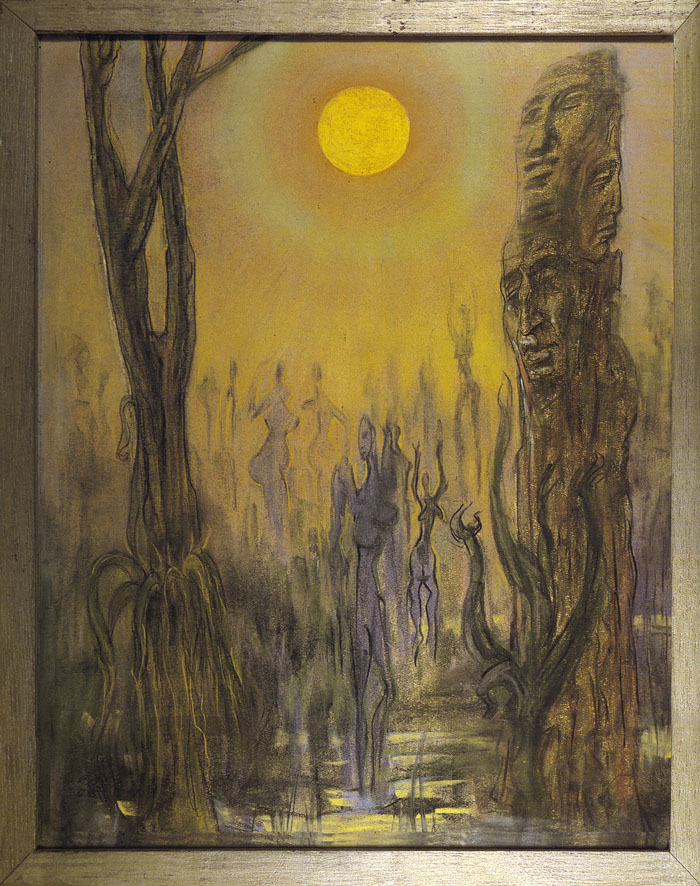
Cthulhu Cultus: The Sun is Sick (no date) by Austin Osman Spare.

I’ve been telling people about this drawing for years but I’ve not posted it here before. Spare produced this piece after Kenneth Grant gave him some of HP Lovecraft’s stories to read. I’ve never seen it dated but it’s probably from the mid-50s when Kenneth and Steffi Grant were corresponding with Spare and commissioning new artworks. What’s notable for me is that this is probably the first Lovecraft-derived drawing that wasn’t either a magazine or book illustration, or something done for one of the horror fanzines.
coc.jpg

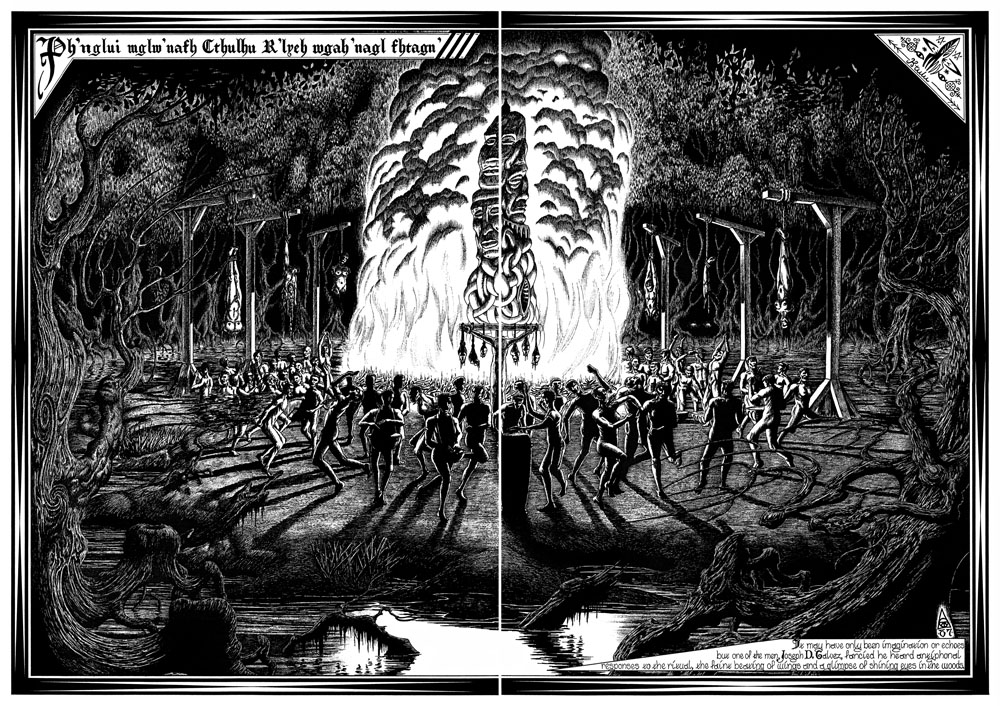
The Call of Cthulhu (1987) by John Coulthart.

Lovecraft aficionados have never seemed aware of Spare’s drawing since Lovecraft studies tended until very recently to remain fixed on popular media and the often parochial world of genre fandom. When I came to draw the swamp scene for The Call of Cthulhu in 1987 I borrowed the faces from Spare’s pillar for the column in the centre of the picture.
bulldogbreed.jpg

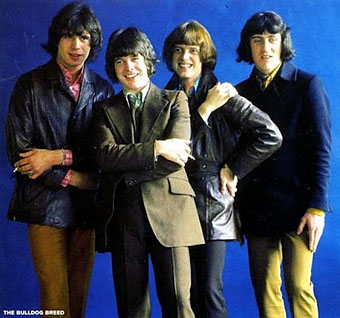
Bulldog Breed.

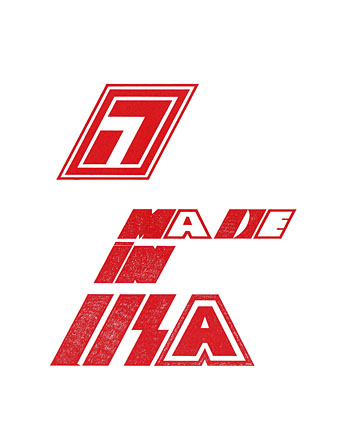
While we’re on the subject, and in the spirit of showing how all the obsessions here connect in one way or another, Phil Baker’s excellent biography of Austin Spare notes a surprising reference to the artist that predates Man, Myth and Magic via the psychedelic music scene. Bulldog Breed were a short-lived London group, one of many being promoted by the Deram label in the late 1960s. The group’s one-and-only album, Made In England, was released in 1969. The cover art is dreadful but the final song is a number entitled Austin Osmanspare [sic], a paean to the artist that turns AOS into a typical character from British psychedelia: an eccentric, oddly named, Victorian type with a sinister and mysterious glamour. According to Baker one of the band members had an aunt who knew Spare. It’s not a bad song, and the choice of magus gave them an edge over the Beatles who went for the more obvious Aleister Crowley. “They said he was before his time…”

Previously on { feuilleton }
Dreaming Out of Space: Kenneth Grant on HP Lovecraft
MMM in IT
Intertextuality
Abrahadabra
The Occult Explosion
Murmur Become Ceaseless and Myriad
Kenneth Grant, 1924–2011
New Austin Spare grimoires
Austin Spare absinthe
Austin Spare’s Behind the Veil
Austin Osman Spare

Weekend links 249

ulrich.jpg

The Philosophers (Homage to Courbet) by Christopher Ulrich. Another great tip from Full Fathom Five.

• “Mushrooms are the only psychedelic drugs that I take, and I don’t take them very often. But I would trust them. Once you’ve done them a few times it’s very easy to feel a sense of entity. You can feel that there is a characteristic in this level of consciousness which almost seems…playful? Or aware, or sometimes a bit spooky.” Alan Moore discussing art and psychedelics in Mustard magazine. Related: “Psychedelics not linked to mental health problems or suicidal behavior: A population study.”

• “Leonora Carrington transcended her stolid background to become an avant-garde star,” says Boyd Tonkin. At the BBC Chris Long looks at Leonora Carrington’s journey from Lancashire to Mexico. The Carrington exhibition at Tate Liverpool opened on Friday.

A Savoyard’s First Brush with Censorship, Clara Casian’s proposed documentary film about Savoy Books, is looking for Kickstarter funding.

Warner suggests that there are four characteristics that define a veritable fairy tale: first, it should be short; second, it should be (or seem) familiar; third, it should suggest ‘the necessary presence of the past’ through well-known plots and characters; fourth, since fairy tales are told in what Warner aptly calls ‘a symbolic Esperanto’, it should allow horrid deeds and truculent events to be read as matter-of-fact. If, as Warner says, ‘the scope of a fairy tale is made by language’, it is through language that our unconscious world, with its dreams and half-grasped intuitions, comes into being and its phantoms are transformed into comprehensible figures like cannibal giants, wicked parents or friendly beasts.

Alberto Manguel reviewing Once Upon a Time: A Short History of Fairy Tale by Marina Warner

De Natura Sonorum (1976) by Bernard Parmegiani: a free download at AGP of the original vinyl recording, something I overlooked several years ago.

• At Dangerous Minds: Real Horrorshow!: Malcolm McDowell and Anthony Burgess discuss Kubrick and A Clockwork Orange.

Meeting Bernard Szajner, a short film about the French electronic musician by Tom Colvile, Nathan Gibson & Abdullah Al-wali.

• Dismembrance of the Thing’s Past: Dave Tompkins on John Carpenter’s The Thing.

That Battle Is Over, a new song by Jenny Hval.

Mushroom (1971) by Can | The Mushroom Family (2010) by The Time And Space Machine | Growing Mushrooms Of Potency (2012) by Expo ’70

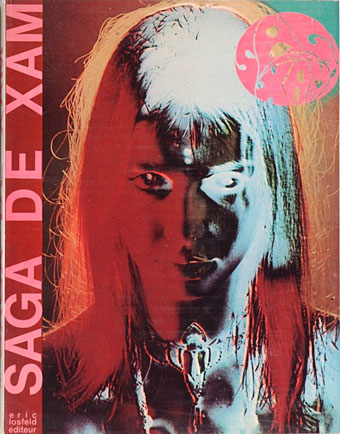
Saga de Xam revisited

saga01.jpg

Back in December I was thrilled to discover that Nicolas Devil’s large-format psychedelic/erotic comic book, Saga de Xam, had been scanned and uploaded to Scribd. The book was published by Éric Losfeld in 1967 in an edition of 5000 which quickly sold out, and has remained out of print ever since. Losfeld died in 1979 but it was always his intention that the book would remain scarce (although a second edition did appear after his death) with the result that copies today command high prices.

saga01.jpg

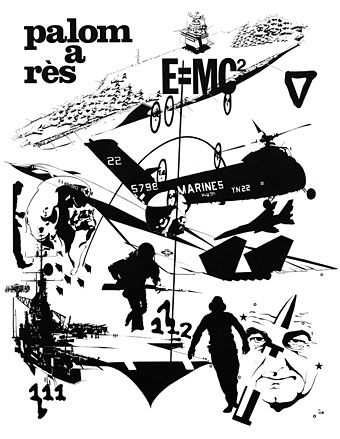
Six of the seven chapters had been uploaded to Scribd in December but the seventh and final episode of the time-travelling Saga’s adventures was frustratingly absent. So I’m pleased to report that the final chapter is now available for reading or downloading, prompted in part by the interest my earlier post generated. The seventh chapter sees Saga arrive in the present day (ie: 1967) where she encounters more human conflict in the form of the US military and marauding Hells Angels. The chapter ends with several Exquisite Corpse pages which had Philippe Druillet among their contributors; it was the appearance of three of these pages in the Musée d’Orsay’s Art Nouveau Revival catalogue in 2010 that first brought the book to my attention. The very end of the book has a key to the alphabets used on some of the pages. I’d love to see Fantagraphics reprint this volume in a translated edition but those alphabets would create some difficulties. For the moment the PDFs at Scribd are the only place you can read this unique publication.

saga02.jpg

saga03.jpg

Continue reading “Saga de Xam revisited”

Falk-Ulrich Rogner album covers

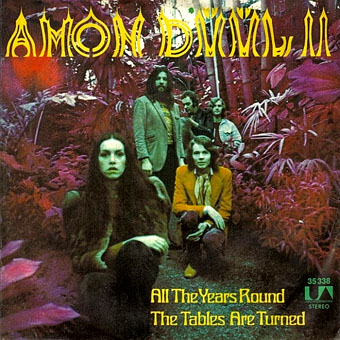
duul00.jpg

All The Years Round (7-inch single, 1972).

I mentioned earlier that Falk-Ulrich Rogner’s cover art for Amon Düül II was worthy of a post so here you are. Amon Düül II were slightly ahead of the pack in the German music scene of the 1970s, starting earlier and (arguably) finishing their prime period earlier. They were also closer in musical style and group ethos to the psychedelic/early prog groups in Britain and America, especially Hawkwind with whom they shared a record label and a bass player. Other German groups were often psychedelic to some degree but Amon Düül II went all-out for a German take on psych rock, with extended guitar-heavy jams played against oil-on-water projections.

Falk-Ulrich Rogner was one of the longer lasting members of the group’s shifting personnel, playing organ and electronics, writing lyrics and creating artwork that’s a perfect match for what I always think of as Amon Düül II’s Gothic Surrealism: a blend of lyrics and themes running through songs titled like Max Ernst paintings: Flesh-Coloured Anti-Aircraft Alarm, Archangel’s Thunderbird, Stumbling Over Melted Moonlight, Green Bubble Raincoated Man. The cover art is generally a collage of photographs, old paintings and other graphics, a familiar technique for psychedelic album covers. What gives Rogner’s work an edge is the way he blends multiple collages together by either photographic exposure or the photographing of projected transparencies. This has the effect of softening hard edges and transitions, and makes the resulting images all the more hallucinatory and dream-like. Effects like this are easy to achieve today with Photoshop but in the early 1970s they required a considerable effort.

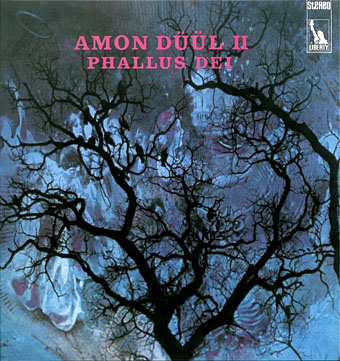
duul01.jpg

Phallus Dei (1969).

At first glance the cover of the gloriously titled debut album looks like a painting but it’s a photograph of a tree silhouette juxtaposed against some vague collage business. This doesn’t really communicate the lysergic intensity of the music within which may explain why the cover was changed to something more typically psychedelic for its UK release.

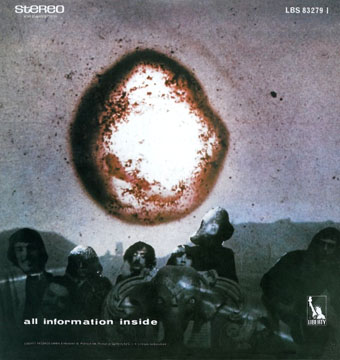
duul02.jpg

The back cover inaugurates a pattern of placing the band on the back of the album, a reversal of the usual state of affairs even today.

duul03.jpg

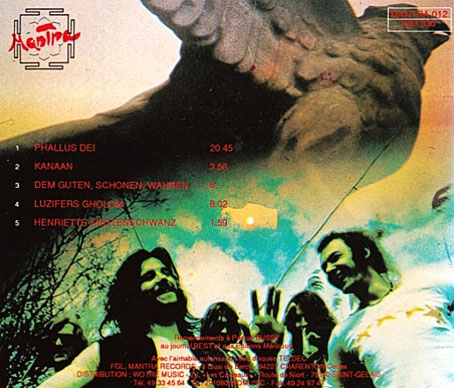
The first CD release of Phallus Dei on the Mantra label featured what may be another Rogner photomontage, one that I’ve not seen anywhere else.

Continue reading “Falk-Ulrich Rogner album covers”

The Kosmische Tarot

geitner-tarot-box.jpg

Revelation of the weekend has been the discovery that there are two sets of (for want of a better term) Krautrock Tarot cards. The first, Walter Wegmüller’s Zigeuner Tarot, is familiar for being included in the Tarot concept album released on the Kosmischen Kuriere label in 1973. The album was credited to Wegmüller but he only advised on the symbolism and acts as MC/narrator. Wegmüller’s cards are detailed and somewhat original, but their drawing is from the enthusiasm-over-technique school which goes against the grain of the rest of the album design and the accomplishment of the musicians.

mythos.jpg

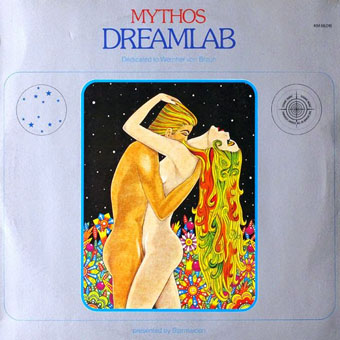
Dreamlab (1975) by Mythos. Design by Peter Geitner.

As noted a few days ago, the designer of the Tarot album was Peter Geitner working under the direction of a pair of very hands-on label bosses, Rolf-Ulrich Kaiser and Gille Lettmann. The story of Kaiser’s rise and fall has been recounted in some detail over the years (see here and here). Given the colourful saga, and the cast of notable musicians, writers and artists, I’m surprised to have seen no mention of the second Tarot set that Peter Geitner designed and illustrated in 1975 while the Kosmische Musik empire was imploding. One illustration (The Lovers) was even used as cover art for the Dreamlab album by Mythos.

geitner-tarot-back.jpg

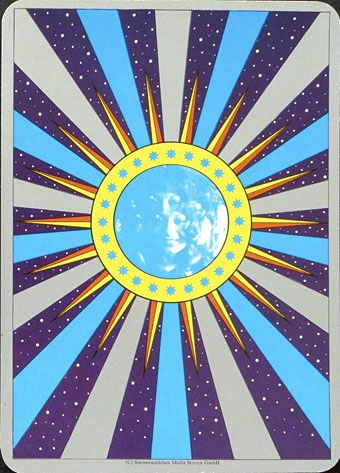
Card back for the Sternenmädchen’s Wahrsagespiel.

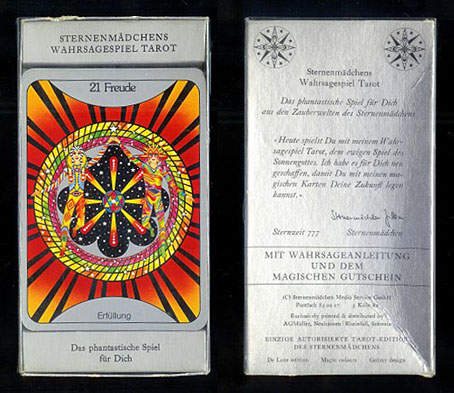
Sternenmädchen’s Wahrsagespiel (Star Girl’s Fortune Telling Game) is a specialised set of the Major Arcana presented as a spin-off from Gille Lettmann’s Sternenmädchen persona as featured on the Gilles Zeitschiff album; the back of the 22 cards features the photo of Gille from the album cover. I’ve said that Geitner illustrated the cards but some of the drawings may have originated as sketches by Gille Lettmann; information is scant but I’ve seen mention of her having been a textile or fashion designer. What’s most striking to me about these designs is how psychedelic they all are, more so than any of the Kosmische Musik album covers even though they maintain the cosmic themes of the record label. Many of those involved with the Kosmische empire were taking LSD at the time so this isn’t very surprising but psychedelia of this intensity was an outmoded thing by the mid-70s. Also of interest is the renaming of the cards which push the attributions away from medieval tradition and into the cosmos. I’ve not been able to find examples of all 22 designs but a list of the cards follows, together with examples of variable quality. The set was printed by AGM Müller but has never been reissued so it now commands high prices. (Many thanks to Jeff for drawing my attention to these!)

Continue reading “The Kosmische Tarot”